wayground logo

Free Printable Worksheets

NEW

Font size

S
M
L
XL
Worksheets

CIRCUIT THEORY

Total questions: 72

Worksheet time: 2hrs 31mins

Name
Class
Date
1.

What is the flow of electrical charge through a circuit called?

a)

Current

b)

Voltage

c)

Resistance

d)

Power

2.

What is the measure of opposition to current flow in a circuit called?

a)

Current

b)

Voltage

c)

Resistance

d)

Power

3.

What is the electrical force that causes current to flow in a circuit called?

a)

Current

b)

Voltage

c)

Resistance

d)

Power

4.

____________ __________ assumes that current flows out of the positive side of the battery, through the circuit, and back to the negative side of the battery.

a)

Conventional Current

b)

Ohms Law

c)

Electron Flow

d)

Kirchoff's Current Law

5.

____________ __________ is what actually happens. The electrons flow out of the negative side of the battery, through the circuit, and back to the positive side of the battery.

a)

Conventional Current

b)

Ohm's Law

c)

Electron Flow

d)

Kirchhoff's Current Law

6.

Both Conventional Current and Electron Flow are used. In general, the science disciplines use Electron Flow, whereas the engineering disciplines use Conventional Current.

a)

True

b)

False

7.

What Law defines the relationship between voltage, current, and resistance in an electric circuit

a)

Kirchhoff's Voltage Law

b)

Kirchhoff's Current law

c)

Ohm's Law

d)

Mom's Law

8.

Components in a circuit can be connected in one of two ways: Series or parallel.

a)

True

b)

False

9.

In a series circuit, there are multiple paths for current to flow.

a)

True

b)

False

10.

In a parallel circuit, both ends of the components are connected together.

a)

True

b)

False

11.

The current flowing through every series component is equal.

a)

True

b)

False

12.

The total resistance (RT) is equal to the sum of all of the resistances (i.e., R1 + R2 + R3) in a series circuit.

a)

True

b)

False

13.

The sum of all of the voltage drops (VR1 + VR2 + VR2) is equal to the total applied voltage (VT) in a series circuit.

a)

True

b)

False

14.

The voltage across every parallel component is not equal.

a)

True

b)

False

15.

The total resistance (RT) is equal to the reciprocal of the sum of the reciprocal in a series circuit.

a)

True

b)

False

16.

In a parallel circuit, the sum of all of the currents in each branch (IR1 + IR2 + IR3) is equal to the total current (IT).

a)

True

b)

False

17.

Which law states, the sum of all of the voltage drops in a series circuit equals the total applied voltage.

a)

Kirchhoff's Voltage Law

b)

Kirchhoff's Current Law

c)

Ohm's Law

d)

Parallel Law

18.

Which law states, the total current in a parallel circuit equals the sum of the individual branch currents.

a)

Kirchhoff's Voltage law

b)

Kirchhoff's Current Law

c)

Ohm's Law

d)

Parallels Law

19.
The voltage drop across the parallel resistors shown in the figure is?
a)
17.3 volts
b)
20.7 volts
c)
62.1 volts
d)
100 volts
20.
What is the total resistance of the circuit in the figure?
a)
15.32 ohms
b)
24.17 ohms
c)
70.41 ohms
d)
120.12 ohms
21.
How many amps of current would flow through the circuit in the figure?
a)
2
b)
3.24
c)
4.14
d)
5.21
22.
What is the total resistance of the three resistors in parallel with values of 2 ohms, 8 ohms, and 14 ohms?
a)
1.44 ohms
b)
2.24 ohms
c)
2.32 ohms
d)
2.65 ohms
23.
What is the resistance of a light bulb that uses 15 watts of power when placed across a 15-volt battery?
a)
1.5 ohms
b)
15 ohms
c)
50 ohms
d)
150 ohms
24.
What is the total resistance of three resistors in parallel with values of 4 ohms, 10 ohms, and 25 ohms?
a)
1.50 ohms
b)
2.25 ohms
c)
2.56 ohms
d)
3.43 ohms
25.
If R3 was removed from the circuit in the figure, how many amps of current would flow through the circuit?
a)
4
b)
5
c)
12
d)
15
26.
What is the total resistance of the circuit in the figure?
a)
19 ohms
b)
29 ohms
c)
30 ohms
d)
50 ohms
27.
If a circuit with a source of 200 volts is connected across four parallel 50-ohm resistors, the current through each resistor is?
a)
1 amps
b)
2 amps
c)
3 amps
d)
4 amps
28.
According to Kirchhoff's current law, the current in a parallel circuit is equal to?
a)
the sum of the currents in each branch
b)
zero
c)
the total voltage drop
d)
the applied voltage
29.
The statement that total current entering a point must equal total current leaving that point best describes?
a)
Ohm's law
b)
Coulomb's total current law
c)
The Theroy of Relativity
d)
Kirchhoff's current law
30.
Two resistances of 30 and 25 ohms are connected in parallel. In series with this combination is a 40-ohm resistance, and in parallel with this total combination is a 28-ohm resistance. Given a voltage of 1.28 volts, the total current flowing through the circuit is?
a)
55 milliamps
b)
60 milliamps
c)
70 milliamps
d)
95 milliamps
31.
Given: A circuit has a voltage of 100 volts across five resistors in parallel (5,14,21,25, and 100 ohms). The total current is?
a)
12.71 amps
b)
20.2 amps
c)
25.3 amps
d)
36.9 amps
32.
The total resistance of four resistors in parallel with values of 3, 10, 25, and 50 ohms is?
a)
1.66 ohms
b)
2.03 ohms
c)
2.75 ohms
d)
3.33 ohms
33.
Which of the following is considered a voltage rise?
a)
A resistor
b)
A diode
c)
A motor
d)
The source
34.
According to Kirchhoff's voltage law, the total voltage drop in a circuit is equal to the? 
a)
voltage of the power source
b)
total resistance in the circuit
c)
current divided by resistance
d)
total current in the circuit
35.
A circuit in which two or more components are connected equally across the same voltage source is a?
a)
series circuit
b)
parallel circuit
c)
series-parallel circuit
d)
resistive circuit
36.
The total voltage in a circuit with voltage drops of 15V, 25V, and 20V is?
a)
20V
b)
60V
c)
120V
d)
180V
37.
There are four resistors in a circuit with an applied voltage of 120V. The voltage drops across three resistors is 15V each. What is the voltage drop across the fourth resistor?
a)
15V
b)
45V
c)
75V
d)
120V
38.
In a parallel circuit, the total line current must equal?
a)
the branch current divided by the number of resistors
b)
the branch current divided by the total resistance
c)
the sum of the branch currents
d)
zero
39.
In a parallel circuit, the total line current must equal?
a)
the branch current divided by the number of resistors
b)
the branch current divided by the total resistance
c)
the sum of the branch currents
d)
zero
40.
What is a series circuit?
a)
The transfer of electrons from one object to another
b)
A circuit with a single path the current follows
c)
A circuit that goes in multiple directions
d)
A circuit that takes place in a series of events
41.
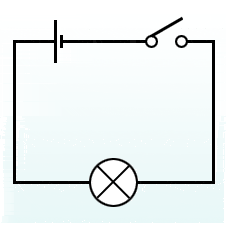
this circuit is .....?
a)
open
b)
parallel
c)
closed
d)
The cutest little circuit evah!
42.
When all parts of the circuit are connected it is a ______ circuit. 
a)
open
b)
closed
43.
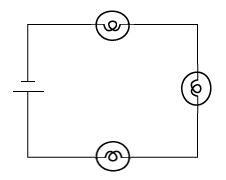
The picture shows an electrical circuit. This circuit is a series circuit because: 
a)
It has 3 light bulbs.
b)
The same current flows through all three light bulbs.
c)
It uses a single battery.
d)
The electrical current has more than one path to flow through
44.
Which of these best completes the circuit?
a)
rubber band
b)
metal nail
c)
leather shoelace
d)
wooden toothpick
45.
Would would best complete this circuit?
a)
A wire
b)
A switch
c)
A battery
d)
A light bulb
46.
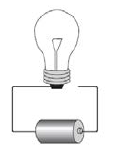
Pick the correct sentence.
a)
This circuit will work because it is a closed circuit.
b)
Energy will freely flow in this circuit.
c)
This circuit will not work because there is no energy source.
d)
This circuit will not work because there is no switch.
47.
Which statement is true?
a)
The light bulb will light up because the  circuit is complete.
b)
The light bulb will light up because the  circuit is broken.
c)
The light bulb will not light up because the  circuit is complete.
d)
The light bulb will not light up because the  circuit is broken.
48.
If you replace the paper clip with a plastic spoon, what happens?
a)
The bulb doesn't light
b)
The bulb is dimmer
c)
The wires get hot
d)
There is no change
49.
This type of circuit only has one path for current to flow. 
a)
series
b)
parallel
c)
combination
d)
split
50.
A material in which electrons are not able to move easily 
a)
Circuit 
b)
Insulator 
c)
Resistance 
d)
Conductor
51.
A material in which electrons are able to move easily
a)
Circuit
b)
Insulator 
c)
Resistance 
d)
Conductor 
52.

What Law defines the relationship between voltage, current, and resistance in an electric circuit

a)

Kirchhoff's Voltage Law

b)

Kirchhoff's Current law

c)

Ohm's Law

d)

Mom's Law

53.

The SI unit for power is

a)

Volts

b)

Amperes

c)

Watts

d)

Resistance

54.

The SI unit for electromotive force is

a)

Volts

b)

Watts

c)

Amperes

d)

Resistance

55.

The type of electricity derived from a battery is

a)

Alternating Wattage

b)

Alternating Current

c)

Direct Wattage

d)

Direct Current

56.

The relationship between current, resistance and voltage is stated in

a)

Boyle's law

b)

Ohm's law

c)

Current's law

d)

Charge's law

57.

The symbol shown would indicate

a)

Voltage Alternating Current

b)

Voltage Direct Current

c)

Reduced Voltage Alternating Current

d)

3 Phase Alternating Current
58.
this is the symbol for a _____?
a)
switch
b)
light 
c)
battery
d)
wires
59.
what is this symbol for?
a)
light bulb
b)
cell
c)
battery
d)
resistor
60.
This is the symbol for a ...
a)
Bulb
b)
Battery
c)
Horn
d)
Fuse
61.
This is the symbol for a ...
a)
Wire
b)
Battery
c)
Buzzer
d)
Fuse
62.
This is the circuit symbol for ...
a)
an AC current source
b)
a DC current source
c)
an ammeter
d)
a voltmeter
63.
This is the circuit symbol for ...
a)
an AC current source
b)
a DC current source
c)
an ammeter
d)
a voltmeter
64.
This is the circuit symbol for ...
a)
an AC current source
b)
a DC current source
c)
a battery
d)
a single cell
65.
This is the symbol for 
a)
An Ammeter
b)
A Voltmeter
c)
A Meter
d)
A Motor
66.
This is the symbol for a _____?
a)
Lamp
b)
Water wheel
c)
Loudspeaker
d)
Motor
67.
a)
Closed switch
b)
Push switch
c)
Trap door
d)
AC Power supply
68.
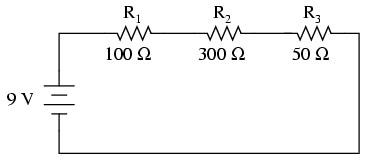
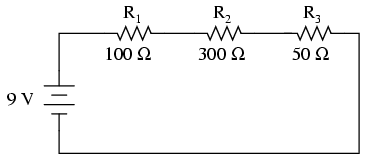
What type of circuit is show in the image?
a)
Series Circuit
b)
Parallel Circuit
69.
The total resistance in this circuit is 
a)
100 ohms
b)
450 ohms
c)
400 ohms
d)
30 ohms
70.
The total current through this circuit is
a)
0.02 amps
b)
0.09 amps
c)
50 amps
d)
9 amps
71.
As resistors are added in series to a circuit, the total resistance will...
a)
increase
b)
decrease
c)
stay the same
72.
In a parallel circuit which of the following is the same value throughout the circuit?
a)
Voltage
b)
Current
c)
Resistance
d)
Charge