
 Worksheets
Practice Quiz Engphys 3
Total questions: 70
Worksheet time: 4hrs 30mins


Definition of SHM:
A body is in simple harmonic motion
if its acceleration, a is inversely
proportional to its displacement, x
from a fixed point and is always
directed towards that fixed point.
False
True

A good example of SHM is an object with mass m attached to a spring on a frictionless surface.
False
True
The maximum displacement from equilibrium of a particle is 1 m and its maximum acceleration is
1.57 m s-2. The period of the particle will be
1.25 s
0.63 s
0.20 s
5.03 s
If a simple harmonic oscillator has a displacement of 0.02 m and acceleration equal to 2.00 m s-2, the angular frequency is equal to:
10.0 rad s-1
0.10 rad s-1
100 rad s-1
1.00 rad s-1
Given equation of SHM, x=0.34 cos 3000t where x in mm and t in second. The frequency is:
3000 Hz
3000/2π Hz
0.74/2π Hz
3000/π Hz
The acceleration of a particle in SHM is:
always zero
always constant
maximum at amplitude
maximum at the equilibrium position
The amplitude and period in a SHM is 0.5 m and 0.4 s respectively. The equation of SHM will be:
x=0.5 sin 5πt
x=0.5 sin 4πt
x=0.5 sin 2.5πt
x=0.5 sin 0.8πt
Which of the following equation represent the displacement of SHM:
x= A tan ωt
x= A sin ωt
x= A sin ωt cos kx
x= A sin (ωt ± kx)
A particle undergoes simple harmonic motion with angular velocity of 5 rad/s and amplitude of 50 cm. Find the displacement, x at time t = 10 s.
0.500 m
0.383 m
-0.131 m
0.131 m
The variation of the acceleration, a of a particle executing SHM with displacement, x is as shown in figure:


The graph in FIGURE 1 shows the relationship between the acceleration, a and its displacement, x for an object of mass 2 kg which is in simple harmonic motion. Determine the frequency of oscillation.
1.6 Hz
1.26 Hz
0.20 Hz
5.00 Hz
The displacement x, for a particle at time t in simple harmonic motion is given by the equation, x = 10 sin 20t where x is in meters and t is in seconds. Determine the displacement at t=10 s
91.3 m
8.73 m
-91.3 m
-8.73 m
A particle oscillates with undamped simple harmonic motion. Which one of the following statements about the acceleration of the oscillating particle is true?
It is least when the speed is greatest.
It is always in the opposite direction to its velocity.
It is proportional to the frequency.
It decreases as the potential energy increases.
The frequency of a body moving with simple harmonic motion is doubled. If the amplitude remains the same, which one of the following is also doubled?
the time period
the total energy
the maximum velocity
the maximum acceleration
When the length of a simple pendulum is decreased by 600 mm, the period of oscillation is halved. What was the original length of the pendulum?
800 mm
1000 mm
1200 mm
1400 mm

A body executes simple harmonic motion. Which one of the graphs, A to D, best shows the relationship between the kinetic energy, Ek, of the body and its distance from the centre of oscillation?
A
B
C
D

The displacement (in mm) of the vibrating cone of a large loudspeaker can be represented by the equation x = 10 cos (150t), where t is the time in s. Which line, A to D, in the table gives the amplitude and frequency of the vibrations.
A
B
C
D
A mechanical system is oscillating at resonance with a constant amplitude. Which one of the following statements is not correct?
The applied force prevents the amplitude from becoming too large.
The frequency of the applied force is the same as the natural frequency of oscillation of the system.
The total energy of the system is constant.
The amplitude of oscillations depends on the amount of damping.
A particle of mass 0.20 kg moves with simple harmonic motion of amplitude 2.0 × 10⁻²m.
If the total energy of the particle is 4.0 × 10⁻⁵J, what is the time period of the motion?
0.79 s
1.57 s
3.14 s
6.28 s

The graph shows the variation in displacement with time for an object moving with simple harmonic motion. What is the maximum acceleration of the object?
0.025 m s–2
0.99 m s–2
2.5 m s–2
9.8 m s–2
Two pendulums, P and Q, are set up alongside each other. The period of P is 1.90 s and the period of Q is 1.95 s.
How many oscillations are made by pendulum Q between two consecutive instants when P and Q move in phase with each other?
19
38
39
78
A particle of mass m oscillates in a straight line with simple harmonic motion of constant amplitude. The total energy of the particle is E.
What is the total energy of another particle of mass 2m, oscillating with simple harmonic motion of the same amplitude but double the frequency?
2E
4E
6E
8E
The bob of the pendulum moves faster at the lowest position for a larger amplitude.
TRUE
FALSE
A body executes simple harmonic motion. The potential energy, the kinetic energy and total energy are measured as a function of displacement x. Which of the following statements is true?
Kinetic energy is maximum when x = 0
Total energy is zero, when x = 0
Kinetic energy is maximum when x is maximum
Potential energy is maximum when x = 0
The ratio of frequencies of two pendulums is 2:3 then their lengths are in ratio
32
23
94
49
If a spring of mass 30kg has a spring constant of 15N/m, then its time period is
6.3 s
8.9 s
5.0 s
2.8 s
A simple pendulum with a length of 1 m oscillates on the surface of a hypothetical planet X. What is the
surface gravity on the planet if the period of oscillations is 4 s?
1.6 ms-2
3.7 ms-2
2.5 ms-2
11.2 ms-2

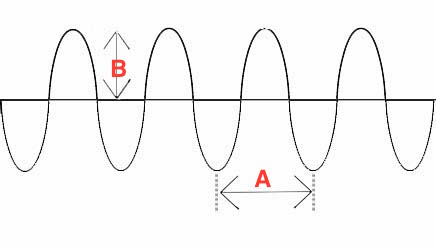
Six waves go past a fixed point in two seconds. What is the frequency of the wave?
3
6 Hz
3 Hz
2
20 waves go past a fixed point in 10 seconds. What is the frequency of the wave?
20 seconds
20 Hz
2 Hz
2

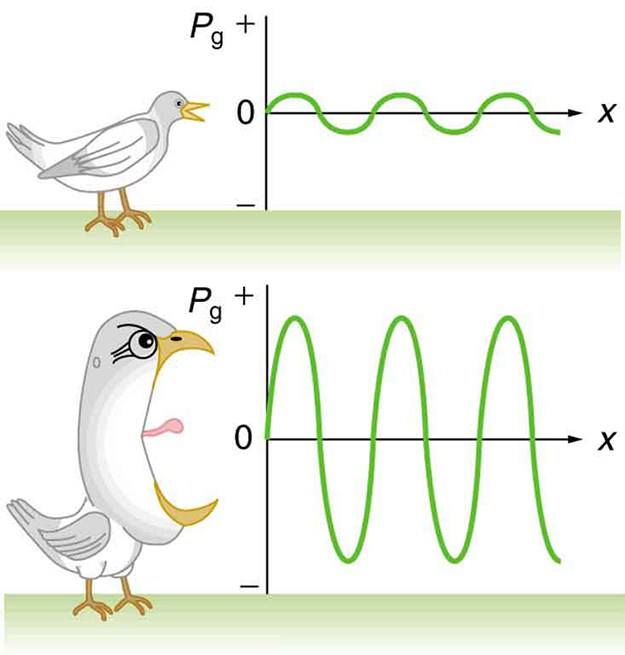
The material through which a wave travels is?
a rope
water wave
snaves
medium
Waves that require a medium are known as
Medium waves
Mechanical waves
Air waves
Heat waves
What is a longitudinal wave?
the matter through which a mechanical wave travels
two lines that will never touch
the particles of a medium that travel parallel to a wave
two lines that meet at a right angle
What is a transverse wave?
the particles of a medium that travel perpendicular to a wave
the particles of a medium that are fast
the particles of a medium that travel parallel to a wave
the particles of a medium that you can touch

What type of wave is this?
Transverse
Longitudinal
Surface
Hair wave

What type of wave is this?
Transverse
Longitudinal
Surface
Hair wave
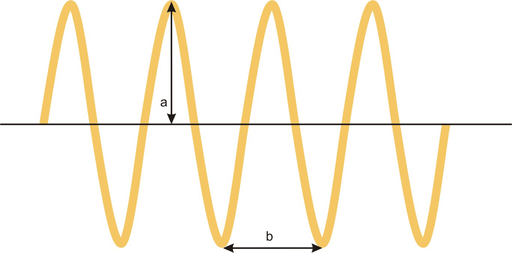

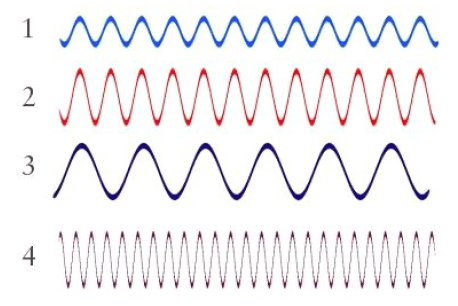
If this wave chain represents 1 second, What is the frequency of the waves?
1 Hz
9 Hz
3 Hz
6 Hz
∎ Progressive waves are travelling along the string in both directions.
∎ The standing wave is an example of superposition.
∎ The wavelength of the standing wave is d.


Standing waves are created by
Two identical waves reflecting off each other
Two identical waves being diffracted together
Two identical waves move through each other in opposite directions
Two identical waves are diffracted from two identical sources

A violin string of length 0.54 m and wave speed of 565 m/s along it. Calculate the frequency of the 5th harmonic.
1046.3 HZ
282.5 Hz
3138.89 Hz
1546 Hz
The first harmonic has
1 antinode
1 node
2 antinodes
no nodes
The second harmonic on a string fixed at both ends shows
A wavelength
Half a wavelength
Two wavelengths
The third harmonic on a string fixed at both ends shows
A wavelength and a half
Half a wavelength
Two wavelengths
A wavelength
It is the inducing of vibrations of a natural rate by a vibrating source having the same frequency.
Refraction of sound
Diffraction of sound
Interference
Resonance
What is a general definition of wave interference?
When a wave bounces off an object
When more than on wave meet and interact in the same medium
When a wave bends around a corner
When a wave creates static
Sound waves are also known as ----- waves.
Compression
Longitudinal
Neither
Both longitudinal and compression
happens when a wave bounces back after hitting a barrier
reflection
refraction
diffraction
interference
when a wave passes through a substance
transmitted
dispersed
echo
interference
the bending of a wave as the wave passes from one medium to another at an angle
refraction
transmitted
reflection
echo

