wayground logo

Free Printable Worksheets

Font size

S
M
L
XL
Worksheets

General Astronomy Quiz

Total questions: 65

Worksheet time: 23mins

Name
Class
Date
1.
Which astronomer of antiquity first applied a telescope to astronomical observation?
a)
Ptolemy
b)
Galileo Galilei
c)
Tycho Brahe
d)
Copernicus
2.
What did Galileo NOT see?
a)
Mountains on the earth's moon.
b)
Uranus's moons Titania and Oberon.
c)
Jupiter's 4 largest moons.
d)
The phases of Venus.
3.
Which astronomer of antiquity measured the size of the earth?
a)
Aristarchus
b)
Ptolemy
c)
Copernicus
d)
Eratosthenes
4.
Which astronomer of antiquity made elaborate models of an earth-centered universe?
a)
Copernicus
b)
Aristarchus
c)
Ptolemy
d)
Tycho Brahe
5.
Who first suggested that earth rotated on its axis?
a)
Tycho Brahe
b)
Aristarchus
c)
Aristotle
d)
Copernicus
6.
Astronomer Johannes Kepler...
a)
Published Almagest
b)
Invented the first Radio Telescope
c)
Suggested elliptical orbits for the planets
d)
Was made head astronomer for the Church
7.

Earth's rate of revolution around the sun is approximately

a)

1 degree per day

b)

360 degrees per day

c)

15 degrees per hour

d)

23.5 degrees per hour

8.

The passage of the moon into the Earth's shadow is known as

a)

Lunar Eclipse

b)

Solar Eclipse

c)

New Moon

d)

Full Moon

9.

The path of a Foucault Pendulum shows that the Earth

a)

is tilted on its axis

b)

Revolve on its orbit

c)

rotates on its axis

d)

has an elliptical orbit

10.

At which phase does the moon have the LOWEST ALTITUDE from the horizon?

a)

New Moon

b)

Full Moon

c)

First Quarter

d)

Third Quarter

11.

Which is the appropriate term to use if the Earth is aligned in between the Sun and another planet?

a)

Conjunction

b)

Opposition

c)

Elongation

d)

Quadrature

12.

Which are the inferior planets. There are more than one answer

a)

Mercury

b)

Venus

c)

Mars

d)

Jupiter

13.

Which particular constellation is used as the "reference" for measuring time?

a)

Orion

b)

Draco

c)

Big Dipper

d)

Ursa Minor

14.

How many fingers will be stacked if there is an approximate of 1 hour and 45 minutes before sunset? (Just the number ONLY)

(a)  

15.

Which of the following explains the reason why the stars move across the night sky?

a)

The moon revolves around the earth

b)

The earth rotates around its axis

c)

The earth revolves around the sun

d)

The stars orbit around the earth.

16.

How many minutes is the discrepancy between the sidereal and solar day?

(a)  

17.
What is the name of the star closest to the Celestial North Pole?
a)
Rigel
b)
Vega
c)
Polaris
d)
Orion
18.

Which sun's path best represents the summer solstice?

a)

A

b)

B

c)

C

19.
Which direction do all of the planets go around the sun?
a)
clockwise
b)
counter-clockwise
c)
verticle
d)
horizontal
20.
Put the planets in order, smallest to largest.
a)
Neptune, Jupiter, Uranus, Mars, Mercury, Saturn, Earth, Venus
b)
Jupiter, Saturn, Uranus, Neptune, Earth, Venus, Mars Mercury
c)
Mars, Mercury, Earth, Venus, Uranus, Neptune, Saturn, Jupiter
d)
Mercury, Mars, Venus, Earth, Neptune, Uranus, Saturn, Jupiter
21.

Which planet is considered as the LEAST dense?

(a)  

22.

____________are areas of gas on the sun that are cooler than the gas around them.

a)

Solar Wind

b)

Solar Flares

c)

Sunspots

d)

Core

23.
When we look at the sun, what layer are we viewing?
a)
photosphere
b)
chromosphere
c)
corona
d)
convection zone
24.

What protects life on Earth from gamma rays, X rays, and particles emitted by the Sun?

(a)  

25.
Name the moon phase
a)
Waning Crescent
b)
Waxing Crescent
c)
Waning Gibbous
d)
Waxing Gibbous
26.

A large, flat land area composed of dark lava flows on the surface of the moon is _______

a)

Highlands

b)

Maria

c)

Rille

d)

Craters

27.

What is the main difference between asteroids and meteoroids?

a)

Asteroids are pieces of comets, whereas meteoroids are pieces of space debris

b)

Asteroids are only found in the “belt” between Mars and Jupiter

c)

Meteoroids are generally bigger than asteroids

d)

Asteroids are generally bigger than meteoroids

28.

Where do most comets come from?

a)

In the Kuiper Belt & Oort Cloud beyond Neptune's orbit

b)

In the Asteroid Belt between Mars and Jupiter

c)

Near the Sun

d)

Earth's atmosphere

29.

Select three known Kuiper Belt Objects?

a)

Makemake

b)

Pluto

c)

Neptune

d)

Eris

e)

Titan

30.

The Cosmic Background Radiation is:

a)

the remaining energy from the big bang.

b)

incredibly hot.

c)

visible to the human eye.

d)

only located in certain places in the universe.

31.
If a star is being observed from Earth and it's light has shifted towards the blue side of the electromagnetic spectrum it would be...
a)
Moving towards the Earth
b)
Moving away from the Earth
c)
This is a trick question that cannot be answered
d)
It isn't a star, it is a very large blueberry.
32.

Who observed that most galaxies are moving away from us?

a)

Edwin Hubble

b)

Arno Penziaas

c)

Robert Wilson

d)

Albert Einstein

33.

When an ______ core is reached in a high-mass star, gravity takes over.

a)

iron

b)

carbon

c)

oxygen

d)

helium

34.
Which of the following list the correct order of the life cycle of massive stars?
a)
Nebula --> protostar --> main sequence --> red supergiant --> supernova --> blackhole
b)
Nebula --> protostar --> main sequence --> red giant --> planetary nebula --> white dwarf --> black dwarf
c)
Nebula --> protostar --> main sequence --> supernova --> red giant --> blackhole
d)
Nebula --> protostar --> blackhole --> red supergiant --> supernova --> main sequence
35.
The life cycles of stars are determined by their:
a)
mass (size)
b)
color
c)
distance from Earth
d)
luminosity
36.

All elements heavier than carbon were formed in supernova explosions.

a)

True

b)

False

37.
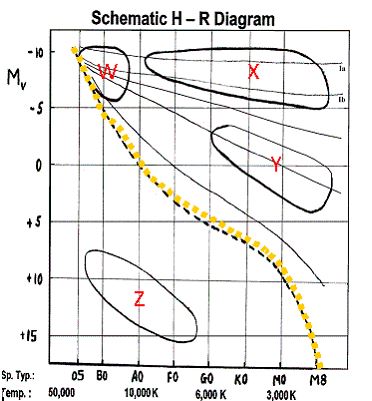
In which region of the H-R Diagram would you be likely to find the oldest stars?
a)
W
b)
X
c)
Y
d)
Z
38.
In which region of the H-R Diagram would you be likely to find stars fusing hydrogen to make helium in their cores?
a)
W
b)
X
c)
Y
d)
The orange dashed line
39.
Stars that are closer appear to move more than distant stars due to the phenomenon called... 
a)
periphelion
b)
parallel
c)
prism
d)
parallax
40.

This HR Diagram overlays data from many star clusters. According to this diagram, which cluster is youngest?

a)

M67

b)

The Pleiades

c)

NGC 2362

d)

The Hyades

41.

Low mass red giant stars participate in a fusion chain resulting in which products?

a)

Carbon, Nitrogen, Oxygen

b)

Helium, Carbon, Beryllium

c)

Oxygen, Neon, Iron

d)

Hydrogen, Helium, Carbon

42.
Which one is the correct order from hottest to coolest stars?
a)
blue, yellow,orange, red
b)
red, orange, yellow, blue
c)
blue, red, yellow, orange
d)
yellow, blue, orange, red
43.

Brightness determined by DISTANCE from the earth

a)

Amazing magnitude

b)

Absolute magnitude

c)

Apparent magnitude

d)

Awesome magnitude

44.
The sky is divided into ____ constellations.
a)
11
b)
22
c)
44
d)
88
45.
Ursa Major (Larger Bear) has this asterism in its pattern 
a)
the Little Dipper
b)
the Big Dipper
c)
Orion
d)
The Crux
46.

The zodiac constellations are those that lie within the (a)   .

47.

A star like object with a very large redshift is a_______

a)

neutron star.

b)

nova

c)

quasar

d)

supernova.

48.

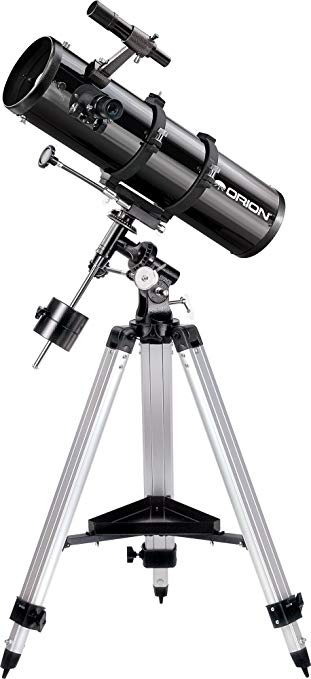
Reflecting telescopes use _______ to focus light.

a)

Lenses

b)

Flat mirrors

c)

Curved Mirrors

d)

A lens and lasers

49.
What is the MAJOR problem with trying to see stars in or near a city?
a)
Not as many people with telescopes
b)
Light pollution
c)
Clouds
d)
The stars are too far away.
50.

Which bands of electromagnetic radiation are blocked from reaching Earth's surface by our atmosphere?

a)

visible light

b)

radio waves

c)

x-ray

d)

gamma rays

51.

The amount a telescope can enlarge an object is its rate of

a)

aperture

b)

magnification

c)

objective

d)

illumination

52.

It is a one-dimensional point which contains a huge mass in an infinitely small space.

a)

Dilation

b)

Nucleosynthesis

c)

R-process

d)

Singularity

53.
Three elements made in the fusion of helium are ________________.
a)
hydrogen, helium, and lithium
b)
carbon, nitrogen, and oxygen
c)
helium, nitrogen, and oxygen
d)
carbon, nitrogen, and iron
54.
People in the Northern Hemisphere do see the same constellations as the people in the Southern Hemisphere.
a)
True
b)
False
55.
3 helium nuclei fuse to make _________.
a)
carbon
b)
lithium
c)
hydrogen
d)
phosphorous 
56.

Which doomsday hypothesis could be described as a reverse big bang, resulting in a hot dense end to our Universe?

a)

The big crunch.

b)

The big bang.

c)

The big chill.

d)

The big bounce.

57.

The Hubble constant (Ho) is...

a)

70 km/s/Mpc

b)

1240 eVnm

c)

6.67x10⁻¹¹ m3/kgs2

d)

9.8 m/s2

58.
The bulge of water on the side of the Earth closest to the moon produces ___________.
a)
high tide
b)
low tide
c)
neap tide
d)
spring tide
59.
patterns that appears to circle every night around Polaris (the North Star). They appear in the sky of the northern hemisphere close to Polaris all year.
a)
North Star
b)
Circumpolar Stars
c)
Circumpolar Constellations
d)
Auroras
60.
is the point in the sky that is directly overhead.
a)
Roof
b)
North Star
c)
Zenith
d)
Nebula
61.
Which vehicle’s engine is filled with chemical propellants?
a)
rocket
b)
rover
c)
satellite
d)
space shuttle
62.
The International Space Station began in
a)
1988
b)
1998
c)
2000
d)
1968
63.
Which piece of equipment explores the outer planets?
a)
Space Shuttle
b)
Rover
c)
Space Probe
d)
Satellite
64.
Country that sent the first man into space
a)
China
b)
Soviet Union (Russia)
c)
USA
d)
Antarctica
65.
Country that landed the first man on the Moon
a)
Soviet Union (Russia)
b)
Iceland
c)
China
d)
USA