wayground logo

Free Printable Worksheets

NEW

Font size

S
M
L
XL
Worksheets

15-19

Total questions: 80

Worksheet time: 47mins

Name
Class
Date
1.
When World War I began, the official United States policy was
a)
to enter on the side of the Allied Powers
b)
the enter on the side of the Central Powers
c)
to remain militarily and politically neutral
d)
to support the Central Powers by providing war materials
2.
Which of Woodrow Wilson's proposals was included in the Treaty of Versailles?
a)
the League of Nations
b)
reparations from Germany
c)
removal of all trade barriers
d)
restoration of the Russian monarchy
3.
On May 7, 1915, a German submarine torpedoed and sank
a)
the Maine
b)
The Titanic
c)
The Lusitania
d)
The Queen Mary
4.
Who was the President of the United States during WWI?
a)
Woodrow Wilson
b)
Grover Cleveland
c)
Teddy Roosevelt
d)
Franklin D. Roosevelt
5.
World War started in _______ in 1914.
a)
Australia
b)
Europe
c)
South America 
d)
Antarctica
6.

What event led to the US entry into WWI?

a)

Germany bombed Paris

b)

Germany's unrestricted submarine warfare

c)

Assassination of Archduke Franz Ferdinand

7.

What was the Zimmerman note?

a)

A note from Wilson to Zimmerman

b)

A note from Germany to Mexico promising US territory if Mexico enters the war

c)

A note from the United States to the United Kingdom promising war supplies

d)

A note from the French asking the US for help on the Western Front

8.

Which groups of people had increased social mobility because of World War I

a)

Young men and men over 60

b)

Children and immigrants

c)

African Americans and women

d)

Farmers and union members

9.

Were tensions of Imperialism a cause of WWI?

a)

Yes

b)

No

10.

Which of the following was NOT a reason that the US entered WWI?

a)

Germany announced unrestricted submarine warfare

b)

The Zimmerman note

c)

Britain refused to buy war supplies

11.
Which of Woodrow Wilson's proposals was included in the Treaty of Versailles?
a)
the League of Nations
b)
reparations from Germany
c)
removal of all trade barriers
d)
restoration of the Russian monarchy
12.
According to Woodrow Wilson, the purpose of the League of Nations was
a)
to remove threat of future wars.
b)
to prevent nuclear proliferation.
c)
to help the US gain more territories.
d)
to help promote prohibition in other countries.
13.
A series of proposals in which U.S. President Woodrow Wilson outlined a plan for achieving a lasting peace after WWI
a)
League of Nations
b)
Fourteen Points
c)
Militarism
d)
Propaganda
14.
Expressing pride in one's country
a)
Treaty of Versailles
b)
Nationalism
c)
Imperialism
d)
Alliance
15.
Banned people from making, drinking or selling alcohol
a)
17th Amendment
b)
18th Amendment
c)
19th Amendment
d)
21st Amendment
16.

Name given to the movement of many African Americas from the south to the north and west.

a)

Great Movement

b)

Racial Migration

c)

Great Migration

d)

Job Movement

17.

Was the build up of military power in Europe a cause of WWI?

a)

yes

b)

no

18.

What were American citizen buying to help finance the war effort?

a)

Savings Bonds

b)

Military Supplies

c)

Liberty Boards

d)

Liberty Bonds

19.

Why did President Wilson sever diplomatic ties with Germany?

a)

Unrestricted Submarine Warfare

b)

Zimmerman Telegram

c)

Total Warfare

d)

Breech of Contract

20.
What case held that expressions that resulted in a "clear & present danger" could be punished?
a)
Schenck v. U.S.
b)
Mendez v. Westminster
c)
White v. Regester
d)
Edgewood v. Kirby
21.

Jazz was

a)

a musical style created by southern plantation owners.

b)

a style of art created by African American activists.

c)

a fashion style that came and went quickly.

d)

an American hybrid of African American and European music forms.

22.

Which BEST defines the Harlem Renaissance?

a)

a time of great racial tension exemplified by race riots in New York.

b)

a time of high interest in southern African American culture

c)

a concentrated time of African American achievement in literature and music

d)

the renovation of turn of the century buildings in Harlem

23.

The Red Scare was prompted by

a)

westward expansion due to the increased immigration

b)

the rise of communism and socialism in the United States

c)

the annexation of Hawaii following military action by the U.S. Navy

d)

U.S. involvement in Latin America

24.

Langston Hughes, Zora Neale Hurston, Claude McKay, and other African American poets gained prominence during a 1920s literary movement called

a)

the Jazz Age

b)

the Harlem Renaissance

c)

the New Deal

d)

Civilian Conservation Corps

25.

Who made automobiles more affordable with new mass-production techniques during the early 1900s?

a)

Henry Ford

b)

Upton Sinclair

c)

Samuel Gompers

d)

Langston Hughes

26.

This is the 19th Amendment.

a)

Prohibition

b)

Suffrage of Women

c)

Presidential inauguration moved to January

d)

Repeals Prohibition

27.

Which groups of people had increased social mobility because of World War I

a)

Young men and men over 60

b)

Children and immigrants

c)

African Americans and women

d)

Farmers and union members

28.

Which BEST defines the Harlem Renaissance?

a)

The renovation of the turn of the century buildings in Harlem, New York.

b)

Citizens fears concerning the social changes of the 1920s.

c)

A time period of African American achievement in literature and music.

d)

A time period of interest in southern African American culture.

29.

Which BEST defines the Harlem Renaissance?

a)

The renovation of the turn of the century buildings in Harlem, New York.

b)

Citizens fears concerning the social changes of the 1920s.

c)

A time period of African American achievement in literature and music.

d)

A time period of interest in southern African American culture.

30.

What was Henry Ford’s impact on the automobile industry?

a)

He was the first person to invent the automobile

b)

He sold automobiles at extremely high prices so only the wealthy could afford them

c)

He was the first to perfect and successfully market the automobile through mass production using an assembly line

d)

He hired craftsmen to intricately design and build each individual automobile by themselves, thus increasing the value

31.

The invention of the radio and movies (talkies)

a)

Increased cultural awareness

b)

Increased knowledge of world and national events

c)

Increased the popularity of music and sports

d)

All of the above

32.

Tin Pan Alley was named for

a)

The creative process of banging tin pans together to keep time during composition of songs

b)

The sounds of cheap pianos tinkling throughout the area as composers banged out their songs

c)

The rust coloring of the buildings near Harlem

d)

The use of ten pans to mix paint colors for landscape pictures such as “God Bless America”

33.
What is the 'dream deferred' that Langston Hughes refers to in his poem?
a)
His day dream which was just interrupted
b)
His dream of fame and fortune
c)
The 'American Dream' being denied to African Americans
d)
A dream he had last night about running
34.
The political cartoon is demonstrating: 
a)
The checkpoint process immigrants at Ellis Island endured. 
b)
The fear of immigrants entering the US, killing Americans and blowing up the Statue of Liberty. 
c)
The Eastern European immigrants bringing their way of life to America. 
d)
The Red Scare and the fear of allowing revolutionaries into America from Eastern Europe. 
35.

An African American who moved from rural Georgia to New York City in 1919 would have been part of ...

a)

an anti-imperialism movement

b)

an isolationist movement

c)

the Great Migration

d)

the NAACP

36.
Many African American Artists had opportunities to flourish and express their creativity during ________?
a)
Harlem Renaissance 
b)
Great Awakening 
c)
Harlem Resurgence 
d)
The Great Migration
37.
Henry Ford's mass-production process allowed for all of the following except?  
a)
Higher Wages 
b)
Shorter Work Hours
c)
Lower prices 
d)
Less Competition for jobs 
38.
Ford's system was efficient because it?  
a)
He personally made each car
b)
He divided the process into simple parts. 
c)
Had teams of workers compete to built a car quickest. 
d)
Used immigrant labor 
39.

Why were the 1920s called the Roaring Twenties?

a)

American wanted to intervene in European politics

b)

Many immigrants entered the United States eager to find jobs.

c)

Congress passed many pro-immigration bills.

d)

There was much lifestyle change.

40.

Why was the National Origin Act of 1924 passed?

a)

to provide a database for immigrants

b)

to promote immigration for all parts of the world

c)

to create a means of tracking immigrants from Europe

d)

to limit immigration from southern and eastern Europe

41.

Jazz music was born in New Orleans and was spread to the North by such musicians as

a)

Louis Armstrong

b)

Zora Neale Hurston

c)

Paul Roberson

d)

Langston Hughes

42.
October 29th, 1929
a)
Black Monday
b)
Black Tuesday
c)
Black Wednesday
d)
Black Friday
43.
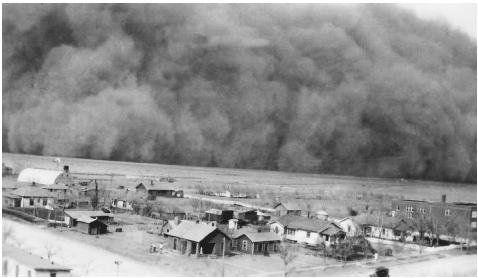
The Dust Bowl devastated what part of the U.S. during the Great Depression?
a)
West Coast
b)
New England
c)
Deep South
d)
Great Plains
44.
Buying stock without knowing the risks, assuming it will just go up is known as ________.
a)
speculation
b)
buying on margin
c)
market capitalization
d)
hammering the market
45.
Who are these people?
a)
hoboes
b)
immigrants
c)
tourists
d)
carpet baggers
46.
This natural disaster served to worsen the effects of the Great Depression on Farmers in the Midwest 
a)
Tornados
b)
Dust Bowl
c)
Black Tuesday 
d)
Hurricanes
47.
When people went to the bank to withdraw their money and the banks had no money was known as the 
a)
Bank Crisis 
b)
Black Tuesday
c)
Stock Market Crash
d)
New Deal 
48.
What effect did the Dust Bowl storms have on the Great Depression?
a)
Many farmers were forced to leave the Great Plains.
b)
Unemployment decreased gradually.
c)
Many homes long the Mississippi River were flooded.
d)
Hoover was re-elected as president.
49.
The Bonus Army incident in 1932 best illustrates the idea that
a)
F.D.R.'
s relief programs were unsuccessful.
b)
many felt that Herbert Hoover was not handling the Depression well.
c)
protests by veterans during the Depression were effective.
d)
the U.S. Army had increased in size and power during the Depression.
50.
Which was NOT a LONG-TERM cause of the Great Depression?
a)
Buying stock on margin
b)
Stock market crash (Black Tuesday)
c)
too much production and consumer spending
d)
Laisezz-faire economic policies
51.

What was a TURNING point in the Great Depression? What gave people hope?

a)

Hoovervilles were built

b)

Roosevelt was elected.

c)

The Nineteenth Amendment was ratified

d)

the beginning of jazz music

52.

Why was Herbert Hoover an unpopular president?

a)

Hoover only helped wealthy people.

b)

Hoover spent too much money trying to help.

c)

Hoover didn't help trade

d)

Hoover didn't do enough to help people who struggled.

53.

Which best explains the reason behind the Crash of '29

a)

Consumers were working too hard in the factories

b)

Americans lost their savings and could not pay their bills

c)

Factories closed when demand for products decreased

d)

Europeans started to import more American wheat

54.

Unemployment is the number of people without.....

a)

money

b)

children

c)

jobs

d)

food

55.
What was created to end the Great Depression?
a)
The New Deal
b)
American Purchase
c)
Stock Market
d)
Economic control
56.
These places helped to feed people in Hooverville.
a)
Kicthens
b)
Shelters
c)
Micro Kitchens
d)
Soup Kitchens
57.
What happened during the "run on banks" after the stock market crash in 1929?
a)
People rushed to withdraw their money and caused banks to close
b)
People went and rushed to deposit money in the banks
c)
People went and started to buy stocks in the banks
d)
People went to rob the banks...because you know...crime and such
58.
Which of the following describes when companies make too many durable goods?
a)
Over-Consumption
b)
Under-Production
c)
Under-Consumption
d)
Over-Production
59.
Which of the following describes when consumers do not buy as many durable goods as expected?
a)
Over-Consumption
b)
Under-Consumption
c)
Over-Production
d)
Under-Production
60.

What was a purpose of the Social Security Act of 1935?

a)

to decrease the unemployment level

b)

to lower interest rates on bank loans

c)

to provide economic aid for the elderly

d)

to fund the expansion of the armed forces

61.

Which of President Franklin D. Roosevelt’s political opponents pushed for more progressive policies and used the motto “every man a king” to popularize his positions?

a)

Charles Coughlin

b)

Herbert Hoover

c)

Huey Long

d)

Francis Townsend

62.
Which first lady would be the first to sit in a position appointed by her husband?
a)
Ida Tarbell
b)
Bess Truman
c)
Grace Hoover
d)
Eleanor Roosevelt
63.

What was one result of the work of the Tennessee Valley Authority in the 1930s?

a)

restoration of a natural environment

b)

construction of nuclear power plants

c)

generation of affordable electricity for rural areas

d)

improvement in systems of communication

64.
The relief efforts of the New Deal were to
a)
help the unemployed
b)
provide welfare
c)
jump start the economy
d)
rebuild the country
65.

Which domestic concern did the U.S. Congress address by passing the Social Security Act of 1935?

a)

stabilizing the banking system

b)

assisting the elderly and unemployed

c)

guaranteeing the right of workers to organize labor unions

d)

providing electrical power in an underdeveloped region

66.
Which program insures banks and keeps your money safe?
a)
Social Security
b)
TVA
c)
CCC
d)
FDIC
67.
What was FDR’s plan to add justices to the Supreme Court called?
a)
The Yes Man Trials
b)
Court Packing Scheme
c)
Operation Puppet
d)
Court Repatriation
68.

This program gave federal money to states in order to provide relief for their people.

a)

NRA

b)

Wagner Act

c)

FERA

d)

HOLC

69.
What was the main criticism of the Court-Packing Scheme?
a)
Congress allowed it
b)
Too much of an expansion of executive power
c)
The Court would be too small
d)
Only state governments could pack the court
70.
June 6, 1944 - Led by Eisenhower, over a million troops (the largest invasion force in history) stormed the beaches at Normandy
a)
D-Day
b)
Adolf Hitler and Nazis
c)
Benito Mussolini
d)
A. Philip Randolph
71.
Became president when FDR died; gave the order to drop the atomic bomb
a)
Adolf Hitler and Nazis
b)
Harry S. Truman
c)
Benito Mussolini
d)
A. Philip Randolph
72.
U.S. naval victory over the Japanese fleet in June 1942, in which the Japanese lost four of their best aircraft carriers. It marked a turning point in World War II.
a)
Benito Mussolini
b)
Battle of Midway
c)
Lend-Lease Act
d)
Adolf Hitler and Nazis
73.
In April 1945, surrounded by Allies to southwest & Soviet Red Army to the east, Hitler committed suicide with wife Eva Braun & the Third Reich surrendered
a)
Axis Powers
b)
Allied Powers
c)
Fall of Berlin
d)
Rationing
74.
leader of the Allied forces in Europe then was elected to be Pres. of the USA
a)
Soviet Union
b)
Hiroshima
c)
Dwight D. Eisenhower
d)
Winston Churchill
75.
code name for the secret United States project set up in 1942 to develop atomic bombs for use in World War II
a)
Operation Overlord
b)
Manhattan Project
c)
Japanese-American Internment
d)
Allied Powers
76.
Japanese city that was hit with the first atomic bomb on August 6, 1945
a)
Hiroshima
b)
Dwight D. Eisenhower
c)
Nagasaki
d)
Soviet Union
77.
allowed sales or loans of war materials to any country whose defense the president deems vital to the defense of the U.S
a)
Adolf Hitler and Nazis
b)
Soviet Union
c)
Battle of Midway
d)
Lend-Lease Act
78.
America's leading black labor leader who called for a march on Washington D.C. to protest factories' refusals to hire African Americans, which eventually led to President Roosevelt issuing an order to end all discrimination in the defense industries.
a)
A. Philip Randolph
b)
Adolf Hitler and Nazis
c)
Harry S. Truman
d)
Benito Mussolini
79.
Restricting the amount of food and other goods people may buy during wartime to assure adequate supplies for the military
a)
Rationing
b)
Allied Powers
c)
Normandy
d)
Fall of Berlin
80.

Which statement shows US involvement during WWII before joining war?

a)

Supported allies with supplies while declaring neutrality

b)

Supported Germany with troops while declaring neutrality

c)

Immediately joined war when fighting started

d)

Started secret alliance with Mexico