wayground logo

Free Printable Worksheets

Font size

S
M
L
XL
Worksheets

9th grade global midterm review

Total questions: 81

Worksheet time: 2hrs 30mins

Name
Class
Date
1.
During the Neolithic Revolution
a)
People learned to grow food
b)
People migrated to find food
c)
People were nomadic
2.
Nomadic means to
a)
Sleep in tents
b)
Move around frequently
c)
Stay in one place
3.

If you were to tame or adapt an animal for your own use, you would be doing this:

a)

domesticate

b)

sedentary

c)

divine right

4.

Why did populations explode in the Neolithic Era?

a)

access to more reliable food

b)

good farmers

c)

economic prosperity

d)

not enough hospitals

5.
Humans had to gather plants and wild fruits to survive.
a)
Paleolithic
b)
Neolithic
6.

Which of the following developed after the Paleolithic Age?

a)

language

b)

farming

c)

art

d)

tools

7.

"If a seignior [noble] has knocked out the tooth of a seignior of his own rank, they shall knock out his tooth. But if he has knocked out a commoner's tooth, he shall pay one-third mina of silver" - Code of Hammurabi


What idea does this law reflect?

a)

All men were equal under the law

b)

Fines were preferable to corporal punishment

c)

Divisions existed between social classes

d)

Violence was always punished with violence

8.
Judaisms holy book (scripture)  
a)
Bible
b)
Qur'an
c)
Torah
d)
Gospels
9.
According to Buddhists, all life is.....
a)
Enjoyment
b)
Gratifying
c)
Disasterous
d)
Suffering
10.
The social structure in India that prevents social mobility.  
a)
Caste System
b)
Eightfold path
c)
Hinduism
d)
Vedas
11.
Islamic place of worship
a)
Synagogue
b)
Church
c)
Mosque
d)
Temple
12.
Who is the messiah, according to Christians?
a)
Moses
b)
Muhammad
c)
Jesus
d)
Abraham
13.

Who started the religion of Islam

a)

Buddha

b)

Jesus

c)

Moses

d)

Muhammad

14.
What is a form of government in which all citizens get a vote?
a)
Democracy
b)
Assembly
c)
Oligarchy
d)
Tyranny
15.
A militaristic city-state where boys were trained from an early age to fight.
a)
Athens
b)
Delphi
c)
Corinth
d)
Sparta
16.
A city-state which favored democracy and a well-rounded education. 
(Also, the largest city-state by a wide margin)
a)
Sparta
b)
Athens
c)
Delphi
d)
Corinth
17.
Who was the leader of Athens after the defeat of the Persians and took athens into a "Golden Age" of prosperity and achievement?
a)
Pericles
b)
Leonidas
c)
Themistocles
d)
Socrates
18.
Rome was located near what body of water?
a)
Pacific Ocean
b)
Atlantic Ocean
c)
Red Sea
d)
Mediterranean Sea
19.
A form of government where the supreme power is held by a king or queen.
a)
presidential democracy
b)
parliamentary democracy
c)
oligarchy
d)
monarchy
20.
The Pax Romana was a 200 year period of 
a)
Peace
b)
War
c)
Conflict
d)
Conquests
21.
In addition to their own developments, the Romans borrowed many ideas from the 
a)
Chinese
b)
Greeks
c)
Egyptians
d)
Mesopotamians
22.

Respecting your elders in Confucianism is known as

a)

nirvana

b)

animism

c)

filial piety

d)

hadj

23.
Which belief system would you associate filial piety with?
a)
Judaism
b)
Buddism
c)
Shintoism
d)
Confucianism
24.
What do Judaism, Islam, and Christianity have in common?
a)
papal supremicy
b)
teachings of the Koran
c)
reincarnation
d)
monotheism
25.
What two religions believe in reincarnation?
a)
Christianity and Judaism
b)
Hinduism and Islam
c)
Islam and Buddhism
d)
Hinduism and Buddhism
26.
The Byzantine Empire reached its greatest extent under:
a)
Justinian
b)
Constantine 
c)
Vladimir 
d)
Diocletian 
27.
Where did the first civilizations rise?
a)
On rivers
b)
Near mountains
c)
In North America
d)
Near Seas
28.
Scientists believe that the earliest humans evolved in and migrated from which continent? 
a)
Europe 
b)
North America 
c)
Asia 
d)
Africa 
29.
Which best describes the nomadic lifestyle of the Paleolithic people? 
a)
They lived in large villages, where they raised crops and livestock.
b)
They migrated, or moved, from place to place
c)
They stayed in one place, living in caves and beneath rock shelters.
d)
They lived in small villages and farmed the land. 
30.
Which statement best describes the Neolithic people? 
a)
They lived in caves or built simple shelters.
b)
They migrated from place to place to hunt animals for food.
c)
They could settle in one place because they had a reliable food supply. 
d)
They used simple tools made from stone.
31.
Which statement best explains the greatest effect the emergence of agriculture had on early societies?
a)
The population steadily decreased.
b)
People were not able to specialize in just one trade. 
c)
Agriculture made it harder to find food. 
d)
The population steadily increased. 
32.
What civilization is associated with the Tigris-Euphrates rivers?
a)
China
b)
Egypt
c)
India
d)
Mesopotamia
33.
A golden age is
a)
rise of cities
b)
when a society conquers others
c)
an age of invention
d)
when a civilization is at its highest in culture
34.
Animism and Shinto  share a belief that
a)
There is only one god
b)
Fasting is important
c)
There are spirits in nature
d)
Statues should be made to honor the gods
35.
Hammurabi's code was important because
a)
Lots of people went to jail
b)
People stopped committing crime
c)
Laws were written down
d)
Ended slavery
36.
A strong seasonal wind is ____
a)
Typhoon
b)
Hurricane
c)
Monsoon
d)
Tornado
37.
In what sea was Rome a peninsula, which allowed it to prosper in trade and interact with and conquer other lands? 
a)
Red
b)
Black
c)
Mediterranean
d)
Arabian
38.
What is a form of government called in which the leader is put into office by citizens with the right to vote?
a)
Republic
b)
Monarchy
c)
Empire
d)
Theocracy
39.
What does the term “Hellenistic” mean?
a)
It means the spreading of Greek animals following the death of Alexander the Great.
b)
It means the spreading of Greek culture following the death of Alexander the Great.
c)
It means the spreading of Greek culture following the death of Pericles.
40.
Greek has many _________that are like mini countries.
a)
counties
b)
city-states
c)
provinces
d)
parishes
41.
What word best describes the land of the Greek peninsula?
a)
rocky and mountainous
b)
flat
c)
desert
d)
rolling plains
42.
The caste system is part of which religion?
a)
Buddhism
b)
Hinduism
c)
Confucianism
d)
Islam
43.
The Five pillars of Faith are a basic belief in what religion?
a)
Buddhism
b)
Hinduism
c)
Shintoism
d)
Islam
44.
What was the purpose of the Great Wall of China?
a)
It became a tourist attraction for modern man.
b)
It was built to protect the Chinese from the nomadic tribes of northern and central Asia.
c)
It acted as an aqueduct and was not truly a wall.
d)
The building of the wall helped decimate the Chinese population.
45.
What is a dynasty?
a)
a series of rulers from the same family
b)
A reality TV show
c)
Monarchy
d)
a family business
46.
The aim of the civil service examination system was to ______.
a)
limit government appointments to the aristocracy
b)
open government service to all talented and able people 
c)
make it possible for women to serve in the government
d)
make it difficult for anyone to work in the government
47.
Trade from China to Europe was possible along this route?
a)
made China poor
b)
Silk Road
c)
passed along the Grand Canal
d)
came across the East China Sea
48.
What is associated with polytheism?
a)
praying in a synagogue
b)
accepting the eightfold path
c)
Worshipping many gods
d)
reading the Koran
49.
The Golden Age of India's Gupta Empire is known for its
a)
development of gunpowder
b)
sea trade routes to Europe
c)
acceptance of Christianity as an official religion
d)
advancements in mathematics and medicine
50.
Buddhism spread from India on which famous trade route?
a)
The Trans-Saharan Trade Route.
b)
The Indian Ocean trade routes.
c)
The Black Sea trade routes.
d)
The Silk Road.
51.

The exchange of beliefs, customs, traditions, languages, technologies, etc. between different cultures

a)

cultural sharing

b)

cultural diffusion

c)

cultural dissemination

d)

cultural confusion

52.

Which word means related to cities?

a)

urban

b)

suburban

c)

rural

53.

Which word means related to farms or "the country?"

a)

urban

b)

suburban

c)

rural

54.
What is urbanization?
a)
When people move from urban to rural areas
b)
When people move from the lake to the forest
c)
When people move from rural areas to urban areas
d)
When people work in factories more than farming
55.
The point at which a very significant change occurs
a)
Turning Point
b)
sedentary
c)
nomads
56.
What change marked the beginning of the Neolithic Revolution? 
a)
beginning of hunting and gathering
b)
man learned to write
c)
man began farming
d)
man built towns and cities
57.

Which of the following is NOT associated with the rule of Shi Huangdi during the Qin Dynasty in China?

a)

consolidating and adding to the Great Wall

b)

legalism - harsh laws & punishments

c)

the terra cotta warriors in a massive tomb

d)

the Mediterranean Sea Complex trade route

58.
Which statement is best supported by the information on this map?
a)
The Roman Empire extended over three continents.
b)
Rivers kept invaders out of the Roman Empire.
c)
Alexandria served as the eastern capital of the Roman Empire.
d)
Carthage was eventually destroyed by the Romans.
59.
Which title best completes the partial outline below?
I. ______________________
A. City-states depended on goods exchanged directly with Mediterranean peoples
B. Political loyalty centered on the city-state
C. A common enemy, Persia, threatened city-states' autonomy
a)
Features of Gupta Empire
b)
Attributes of Indus Valley Civilizations
c)
Characteristics of Ancient Greece
d)
Traits of Ancient China
60.
The creation of independent city-states in ancient Greece can be most directly attributed to the
a)
diverse ethnic groups in the region
b)
large number of different languages
c)
rugged mountainous terrain
d)
 practice of oligarchy
61.
The Code of Hammurabi and Chinese legalism both rely on the idea that
a)
governments must provide their people with rights
b)
 harsh laws are needed to control society
c)
all subjects are equal under the law
d)
 religion and government must be brought closer together
62.

Both the Han and the Roman empires declined as a result of

a)

undisciplined armies and limited access to trade

b)

overexpansion and foreign invasions by nomadic peoples

c)

inefficient theocratic rulers and few government regulations

d)

harsh climates and high taxes

63.
the Ten Commandments, Confucian teachings, and the Eightfold Path in Buddhism were all similar because they-
a)
Promoted polytheism
b)
Established equality between men and women
c)
Provided codes for moral behavior
d)
Affirmed belief in one God
64.
Legalism emphasized that humans were naturally:
a)
Good
b)
Peaceful
c)
Powerful
d)
Evil
65.

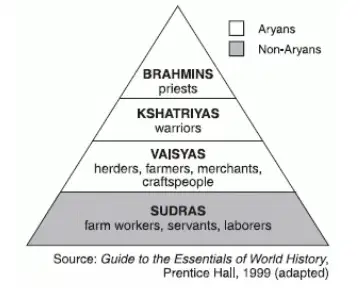
Which concept is illustrated in the diagram?

a)

manorialism

b)

caste

c)

apartheid

d)

Ecomienda

66.

Which claim is best supported by the information in the diagram?

a)
  1. The Gupta Emperors did not support the caste system.

b)
  1. Buddhists followed the caste system to provide order in their community

c)
  1. The caste system enabled Hindus to choose where they lived. 

d)
  1. The caste system determined what occupations one could have. 
67.

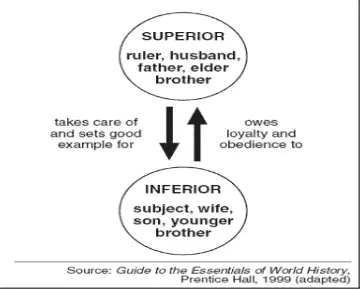
Based on this illustration, we can infer that

a)
  1. everyone has duties and responsibilities depending on his/her position in a relationship.  

b)
  1. that a ruler owes loyalty and obedience to his/her subjects. 

c)
  1. a younger brother must set a good example.

d)
  1. women had no social duties or responsibilities.

68.

The most straightforward theory for Western Rome’s collapse pins the fall on a string of military losses sustained against outside forces. Rome had tangled with Germanic tribes for centuries, but by the 300s “barbarian” groups like the Goths had encroached beyond the Empire’s borders. The Romans weathered a Germanic uprising in the late fourth century, but in 410 the Visigoth King Alaric successfully sacked the city of Rome.


Based on the text above, the author's point of view best supports the claim that:

a)

Rome tangled with Germanic forces while being able to keep the Germanic tribes away from Rome's borders

b)

The most immediate cause for the fall of Rome were the invasions of Germanic forces

c)

In 410, the Romans weathered a Germanic uprising

d)

Barbarian groups like the Goths attacked beyond Rome's borders, while causing minimal damage

69.

Which mountain range acts like a natural barrier to the north of India?

a)

Alps

b)

Andes

c)

Rocky Mountains

d)

Himalaya Mountains

70.

Which social scientists are best known for studying the ARTIFACTS of a culture?

a)

Geographer

b)

Archeologist

c)

Economist

d)

Sociologist

71.

Which practice is closely associated with most ancient RIVER valley civilizations

a)

recording events in cave paintings

b)

using irrigation systems

c)

developing democratic traditions

d)

spreading monotheistic religious customs

72.

In the traditional Hindu caste system, the status of a person was usually determined by

a)

Birth

b)

Education

c)

Wealth

d)

Power

73.

How did the geography of the Italian peninsula influence the development of the Roman Empire

a)

unnavigable rivers protected Romans from their neighbors

b)

harsh climate prevented agricultural production on the Italian peninsula

c)

long seacoast encouraged frequent invasions of the Italian peninsula

d)

location of the peninsula contributed to the Roman control of the Mediterranean sea

74.

One way in which the Code of Hammurabi, and the Twelve Tables are similar is that each

a)

legalized monotheistic beliefs

b)

established legal standards

c)

provided records of economic activity

d)

provided a method to count the population each year

75.

Which of the following claims is supported by the quotes above?

a)

Speaker A believes in reincarnation

b)

Speaker B believes in reincarnation

c)

Speaker C believes in reincarnation

d)

Speaker D believes in reincarnation

76.

Which generalization about the Maurya and Gupta Empires is supported by the map?

a)

Expansion was limited by geographic factors

b)

Trade contributed to stable societies

c)

Extensive road systems unified India

d)

Southern India was isolated from northern India

77.

Which innovation most contributed to the development of civilizations along rivers?

a)

Paper

b)

Irrigation

c)

The compass

d)

Gunpowder

78.

Which belief system provided the basis for government in the Han Dynasty?

a)

Confucianism

b)

Hinduism

c)

Buddhism

d)

Christianity

79.

Why did the Romans make roads?

a)

to get around faster

b)

for military use

c)

just for decoration

80.

Which statement best explains the importance of ancient Rome’s large systems of roads?

a)

The Roman population was nomadic and did not develop a civilization

b)

The quick transportation of goods and messages was an economic and military necessity in the Roman empire.

c)

The Roman roads prevented unemployment by funding poor people to build public-works projects.

81.

The Nile was seen as effective for all of the purposes except

a)

Traveling up and down the river

b)

Using the water for irrigation

c)

Transporting large objects up and down the river

d)

Using the water to conquer the Mongols