
 Worksheets
Africa Unit Review
Total questions: 50
Worksheet time: 21mins
Africa is the _______ largest continent.
1st
2nd
3rd
4th

True or False: Africa is a country made up of 54 districts
True: Like the U.S, Africa is very diverse but everyone is apart of the same country
False: Africa is not a country, it is a continent
What African river is the longest in the world?
Amazon
Nile
Mississippi
Yangtze
The largest desert in the world is ______
Savanna
Mojave
Sahara
Antarctica
Which mountain in Tanzania is Africa’s highest peak?
Mount Kenya
B Mount Everest
C Mount McKinley
Mount Kilimanjaro
What is a savanna?
Large areas of sand
Grassy plains with few trees
Elevated flat lands
Which are common misconceptions of Africa or Africans?
African countries were once some of the most powerful nations in world history.
Africans were uncivilized and needed the influence of Europeans to improve their lives.
The continent of Africa has some of the richest natural resources in the world.
African folktales reflect traditional Sub-Saharan Africa culture because they have been
carved in stone monuments for all to see
recreated by movie makers and playwrights
preserved in African libraries for centuries
passed on orally from generation to generation
Creating masks is an art form that is popular in Sub-Saharan Africa because —
religious leaders use these artifacts in ceremonies
Europeans and Africans made large amounts of money from the masks
European settlers taught the techniques to Africans
many art schools were built in the region by colonists

The 3 kingdoms that were a part of the gold-salt trade?
Ghana, Mali, and Songhai
Ghana, Songhai, and Persia
Ghana, Mali, and Timbuktu
Ghana, Songhai, and Rome
North Africans crossed the dangerous Sahara Desert and traded TO GET what natural resource?
gold
diamonds
oil
cotton
The camel was the animal that allowed traders to cross the...
Kalahari Desert
Arabian Desert
Mojave Desert
Sahara Desert
Not only was salt valuable, it was also a...
protein
preservative
carbohydrate
fat

This man was very rich, spreading Islam throughout Africa.
Justinian
Abraham
Hammurabi
Mansa Musa
What is the African diaspora?
A system of passing the throne through the mother's family.
The spread of Africans outside and away from their homeland.
The name of the trip across the Pacific Ocean that the slaves were forced to take.
The war campaign led by Sundiata over royal inheritance.
What was the route of the Triangle Trade Route?
England to Africa, Africa to the Americas, the Americas back to England.
China to North America, North America to India, India back to China.
England to South America, South America to China, China back to England.
South America to England, England to India, India back to South America.


How were the conditions of the slave boats during the Middle Passage?
The lodgings were clean and sanitary for the slaves
The slaves were well fed and clothed
The conditions were dirty and unsanitary for the slaves
All of the above
Why did so many people die on the Middle Passage?
Slave traders usually purchased unhealthy individuals
Disease and malnutrition
Overloaded ships often sank
Successful rebellions on board ships took many lives
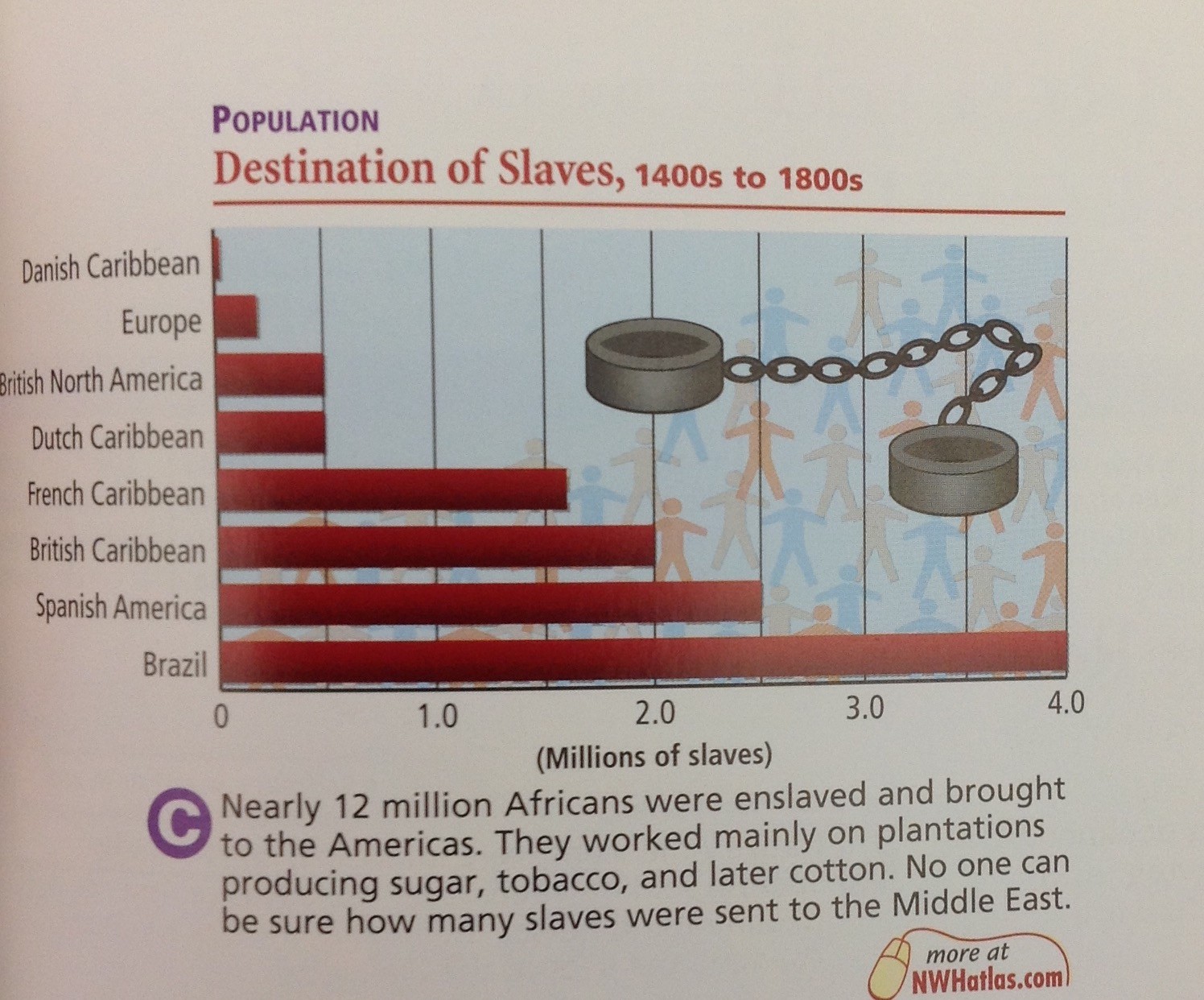
According to the graph, where were most African slaves brought to in the New World?
Danish Caribbean
Brazil
Europe
North America
How did the slave trade affect Africa’s population?
Economic opportunities led to a massive migration to the cities
New foods led to better health and nutrition
Reduced population and frequent warfare destroyed communities .
Increased trade raised the standard of living for most Africans
Define Colonization
Creating a home for refugees
Trading with another country
Forced take over by one nation over another
Where did the European powers split up African territories?
New Mexico Conference
Versailles
Berlin Conference
Nuremberg Trials

King Leopold II ruled what European country?
Belgium
Bosnia
Great Britain
Spain

Where in Africa did King Leopold conquer?
Congo
Sudan
Libya
Nigeria
Which natural resource did Leopold II want the most?
Rubber
Diamonds
Tin
Orangutans
Who is the proponent or founder of the NEGRITUDE movement?
Nelson Mandela
Leopold Senghor
Jean Joseph Rabearivelo
Ferdinand Oyono
What was Apartheid
A part of an animal hide
System of government in South Africa that separated people based on their race and skin color
A communication system, built by Europeans to trade more easily with other countries in Africa

What year did Apartheid end?
1932
1948
1994
2013
How long did Nelson Madela spend in prison while sentenced to life?
27 days
27 months
27 yaks
27 years
Who was the first black president of South Africa?
Eliud Kipchoge
Nelson Mandela
Joseph Kony
Robert Mugabe
How has the history of Sub-Saharan Africa contributed to political instability in some nations of the region?
The devastation of the Second World War has left some nations struggling to recover.
The end of foreign aid to the region is leaving many without
proper food and medicine.
The end of European colonization left some nations struggling
to form effective governments.
The migration of the Bantu-speaking people across national boundaries has caused a clash of cultures.
Many conflicts in Sub-Saharan Africa resulted from the way the European
colonists -
mined the region for resources
educated different ethnic groups
distributed farm land among the settlers
established boundary lines between nations
The two major ethnic groups in Rwanda are:
Hera and Tari
Hutu and Tari
Hutu and Tulsi
Hutu and Tutsi
President Habyarimana (a Hutu) was assissinated during his presidency. How?
Car crash
Plane crash
Shooting
Poisioning
Which group carried out the genocide of the Tutsis in Rwanda?
Janjaweed
Interhamwe
Rwandan Army
Rwandan Patriotic Front
The Rwandan genocide took place in:
1991
1998
1992
1994
Which economic indicator is the best evidence that South Africa's economic development is not at a level that is considered "more developed"?
GDP
Literacy rates
Urban population
Population below poverty line
Conflict minerals are...
Expensive and valuable natural resources which military groups use to make money and enslave people
Natural resources that different countries negotiate and trade for
Food items at my Thanksgiving table
The long-term result of drought and desertification in Sub-Saharan Africa is most likely...
disease.
famine.
flooding.
wild fires.
Article 4: "No one shall be held in slavery or servitude; slavery and the slave trade shall be prohibited in all their forms." –Universal Declaration of Human Rights, United Nations, 1948
"...My best estimate of the number of slaves in the world today is 27 million...." –Kevin Bales, Disposable People, University of California Press, 1999
Based on an analysis of these statements, which conclusion is accurate?
All governments have taken active steps to end slavery
The United Nations has solved the problem of slavery.
The number of enslaved persons has increased dramatically since 1948
Slavery remains a problem in the modern era
Since 1980 Africa is the continent that has had the most Civil Conflicts in the World (20).
True
False

