
 Worksheets
Physical Science EOC 2021
Total questions: 97
Worksheet time: 2hrs 29mins
What subatomic particle is responsible for atoms bonding to form compounds?
protons
neutrons
electrons
quarks
What state of matter has no definite shape or volume?
solid
liquid
gas
All matter has a definite shape and volume.
Which is an example of a physical change?
Iron rusting
Silver tarnishing
Mixing baking soda and vinegar
Melting ice
What is sublimation?
Change from solid to liquid.
Change from liquid to gas.
Change from liquid to solid.
Change from solid to gas.
1. An object with a mass of 35.6 grams occupies 5.0cm3 of space. If density = mass / volume, then the object’s density is
35.6 g/mL
6.4 g/mL
7.12 g/mL
0.14 g/mL
Identify the type of reaction: A + B-----> AB
combustion
synthesis
decomposition
single-displacement
Identify the type of this reaction: AX + B ---->BX + A
combustion
decomposition
double displacement
single displacement
Which object has the greatest inertia ?
a tennis ball
a bowling ball
a beach ball
a volleyball
The law that states for every action force there is an equal and opposite reaction force is
Newton's first law of motion
Newton's second law of motion
Newton's third law of motion
the law of converation of momentum
Freshly brewed black coffee
Heterogeneous
Homogeneous
Dirt
Heterogeneous
Homogeneous
Brass (an alloy of copper and zinc)
Heterogeneous
Homogeneous
Identify the reaction type for the following equation:
K + F2 --> KF
Double replacement
Single Replacement
Synthesis
Decomposition
Identify the type of reaction:
ZnCl2 + Mg --> Zn + MgCl2
Precipitate
Single Replacement
Double Replacement
Decomposition
Identify the reaction type:
NaCl + KOH --> KCl + NaOH
Double replacement
Combustion
Synthesis
Decomposition
Identify the reaction type:
H2O2 --> H2O + O2
Decomposition
Synthesis
Combustion
Acid Base
3Cr(MnO4)6
Al + O2 --> 2Al2O3
2C2H2 + 5O2 --> 4CO2 + 2H2O
4Fe + 3O2 --> 2Fe2O3
All atoms are most stable with (or would "prefer") how many electrons in their valence shell?
1
2
8
18
Ionic bonds are formed between...
Non - metals
A metal and a non-metal
Metals
How is an ionic bond formed?
Sharing of electrons
Delocalised electrons
Transfer of electrons
What is the name of the electrons involved in bonding?
Reaction electrons
Dipoles
Electrostatic
Valence electrons
Which of the following actions will NOT
increase the rate of dissolution
(dissolving) for solids?
Stirring the solution
Decreasing the temperature
Increasing the surface area of the
solute
Increasing the temperature
What combination would dissolve a solid solute the fastest?
high temperature, no stirring
no heat, no stirring
sugar cube, no heat
high temperature, stirring
A substance that is more basic has a _____ pH than a substance that is acidic.

Four substances were tested for pH, lemon juice (pH 2), baking soda (pH 9), bleach (pH 12), and milk (pH 6). Which of the following correctly lists the substances from most basic to acidic?
lemon juice, milk, baking soda, bleach
bleach, baking soda, milk, lemon juice
milk, lemon juice, baking soda, bleach
baking soda, bleach, lemon juice, milk
lemon juice is a
acid
base
bleach is
an acid
a base
if you add an acid to a base what will happen?
BOOM
it will neutralize
it wont mix


Vinegar, fruit juice, and cola are examples of:
strong acids
strong bases
strong bases
weak acids
NaOH may be found in drain cleaners and as a component of soaps. Is NaOH an acid or a base?
Acid
Base
Neither (Neutral)
When the solution equilibrium point is reached and no more solute will dissolve, the solution is said to be _________.
unsaturated
saturated
supersaturated
What do you call a solution that contains less than the maximum amount of solute that is capable of being dissolved?
unsaturated solution
saturated solution
supersaturated solution
insoluble solution
Which of the following best describes a supersaturated solution?
a solution that contains the maximum amount of solute that is capable of being dissolved
a solution that contains less than the maximum amount of solute that is capable of being dissolved.
a solution that contains more than the maximum amount of solute that is capable of being dissolved.
none of the above

What is happening at E?
Stationary
Accelerating
Fast steady speed; moving away from the starting position
Steady speed; returning to start position


Calculate the average speed of a car that travels 60 km in 2 hours.
12 km/h
30 km/h
25 km/h
35 km/h
A bus travels 20 km in 30 minutes. What is the average speed of the bus?
20 km/h
30 km/h
40 km/h
50 km/h
A car drives with a constant speed of 80 miles per hour. How far can it travel in 180 minutes?
0.44 miles
240 miles
100 miles
80 miles

How will this object move?
It won't move.
It will move to the right.
It will move to the left.
It will move up.

How will this object move?
It won't move.
It will move to the right.
It will move to the left.
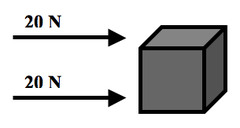
What is the resultant force?
40 N, Left
0 N, Balanced
400 N, Right
40 N, Right
Energy transfer that does not require matter
Conduction
Convection
Radiation
Induction
Which of the following is the correct equation for calculating an object's gravitational potential energy?
PE = mgh
PE = mg / h
PE = mg + h
PE = gh
What is the gravitational potential energy (GPE) of a 1 kilogram book that is 1 meter above the ground?
g = 9.8 m/s2
9.8 Joules
1.0 Joule
0.10 Joule
11.8 m/s2
On Earth, a scale shows that you weigh 490 N. What is your mass?
22 kg
50 kg
100 kg
75 kg

Battery
Lines
Resistor
bulb

resistor
Ammeter
Voltmeter
Switch


Which part of the wave is shown at letter A?
amplitude
crest
trough
wavelength

Which part of the wave is shown at letter B?
amplitude
crest
trough
wavelength

What part of the wave is shown at letter C?
amplitude
crest
trough
wavelength

Which part of the wave is shown in letter D?
amplitude
crest
trough
wavelength

Look at the arrows on the TOP of the image. What part of the wave are they?
compression
crest
rarefaction
trough
Look at the arrows on the BOTTOM of the image. What part of the wave are they?
compression
crest
rarefaction
trough

What type of wave behavior is shown?
diffraction
reflection
refraction
total internal reflection

Which type of wave behavior is shown?
diffraction
reflection
refraction
total internal reflection

What type of wave behavior is shown?
diffraction
reflection
refraction
total internal reflection
Atoms of the same element with a different number of neutrons
Ion
alloy
Isotope
Quarks
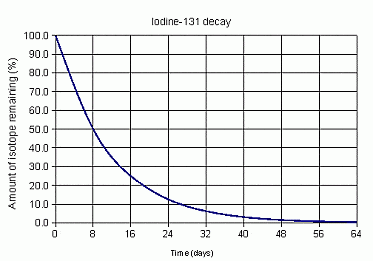
At constant pressure, how are the temperature and volume of a gas related?
The are directly proportional
They are inversely proportional
They are constant
They are indirectly proportional
At constant temperature, when the volume of a gas is decreased, what happens to its pressure?
It increases
It decreases
It will vary
It remains constant
At constant temperature, the pressure and volume of a gas are ______ proportional.
inversely
directly
What happens to a volume of gas under constant temperature if the pressure decreases?
The volume increases
The volume decreases
The volume remains the same
At a constant volume, if the temperature increases the pressure will
Increase
Decrease
Remain the same

