
 Worksheets
CFE Comp Practice 24
Total questions: 70
Worksheet time: 1hrs 29mins

To adjust to a changing environment (a)
The variable that is being measured or observed is called the _______________. Hint: this is the variable that is the result or effect
independent variable
dependent variable
control variable
When you do many trails during an experiment then it is called (a)
Having an experiment repeated by others is called ? (a)
Daniel and Alex are both scientists. Daniel conducts an experiment testing different fuel sources for cars in the future. Daniel conducts each test three times in order to compare his data. After he finishes the trials, Daniel showed Alex his results from each trial. Alex is confused about Daniel’s results, so he decides to conduct the experiment for himself. Which scientific process did each scientist use?
Alex and Daniel used each others data to compare their results.
Alex and Daniel used the same hypothesis to compare their results.
Daniel used repetition in his experiment while Alex replicated Daniel's experiment
Daniel used replication in his experiment while Alex used repetition to conduct Daniel's experiment.
Brittney, an astronomer, measured the spectrum of a star. She took detailed notes about the type of equipment and method she used. She made four observations of that star on different evenings and recorded her results. She shared the information with another astronomer, Peter who followed Brittney's detailed notes and confirmed her results. Which statement below best explains the scientific process Peter used to confirm her results?
Peter replicated Brittney's experiment and got the same results.
Peter made multiple observations of Brittney's experiment and agreed with her results.
Peter and Brittney discussed her experiment at length and Peter confirmed her results.
Peter repeated Brittney's experiment using the same method but a different type of equipment.
SC.7.N.1.2
Scientists frequently repeat the experiments of others scientists. Why is this important in science?
a. Scientists often ask each other for help in performing experiments.
b. Replication of experiments helps to confirm and verify results.
c. Scientists frequently perform other scientists’ experiments in order to practice their technique.
d. Repeating experiments is an effective way to make sure a laboratory is in optimal condition.
a
b
c
d
Theory or Law??? Predicts what will happen in the natural world. (a)
Theory or Law??? Changes with new observations. (a)
Theory or Law??? Is a well-tested EXPLANATION for a wide range of observations and experimental results. (a)
The law of universal gravitation states that both mass and distance of objects affect the gravitational force between them. Gravitational force increases as the mass of the objects increase. Gravitational force decreases as distance between the objects increases. Why are these statements considered scientific law, and not scientific theory?
The statements tells what happens, and not why it happens.
The statements involve mass and distance measurements.
The statements explain the attractive force between two objects.
The statements predict what will happen under certain conditions.
Lilly was trying to explain to her friend the difference between a theory and a law in science. She used the theory of plate tectonics and the law of superposition as examples. Lilli explained the difference by using non-scientific language. Which statement could Lilly use to correctly describe the difference between a theory and a law in science?
A theory describes a natural event, while a law explains it.
A theory explains a natural event, while a law predicts it.
A theory explains a natural event, while a law describes it.
A theory predicts a natural event, while a law explains it.
A rock formed from fragments of other rocks is a(n) (a)
Rocks that form from colling magma inside Earth? (a)
Any rock that forms from another rock as a result of changes in heat or pressure (or both) is a: (a)

According to the diagram, what process is shown by letter A? (a)
According to the diagram, what process is shown by letter B? (a)
Which of the following causes Earth's tectonic plates to move? (a)

What type of event will occur at this boundary? (a)
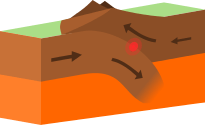
What type of plate boundary is this? (a)
A divergent boundary occurs when plates (a)
What describes the outer core? (a)
What happens to pressure as we move from the crust to the inner core? (a)
Which layer of Earth has the GREATEST density? (a)
Which layer of Earth is made up of tectonic plates? (a)
The Himalayas in Asia are an example of what type of plate boundary? (a)
This landform can occur at a divergent plate boundary. (a)
What is the transfer of heat by movement of liquids or gases? (a)
What are waves that can transfer heat through the vacuum of empty space? (a)
What is the transfer of heat by direct contact? (a)

What are the states of matter? (a)

State of matter with no definite shape or volume. (a)
How is a gas defined? (a)
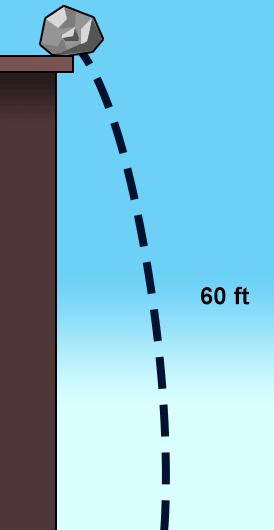
The rock in the picture is pushed over the edge and it begins to fall. Which type of energy conversion is taking place? (a)
As a roller coaster goes downhill
kinetic energy is converted into potential energy.
potential energy is converted into kinetic energy.
electrical energy is converted into potential energy.
potential energy is converted into electrical energy.
When gasoline is burned in a car engine, ________ energy is converted into _________ energy.
(a)

Muscles convert chemical energy into (a)
What form of energy does a compressed spring have? (a)
Energy due to motion is (a) energy.
On a roller coaster, where is maximum potential energy? (a)
Which portion of the electromagnetic spectrum includes the entire range of light that can be detected by the human eye? (a)
Which part of the electromagnetic spectrum has high enough energy to cause damage to eyes and skin, and sometimes even cancer? (a)

Cancer can be treated with (a) waves.

(a) have the longest wavelengths and lowest frequencies of all electromagnetic waves.
A wave with a large wavelength will have a (a) frequency and (b) energy
The distance from one point to the next corresponding point on a wave is called the (a) .

High frequency waves have (a) wavelength.
The number of waves that pass a fixed point in a given amount of time is (a)
Which of these choices is made from the process of mitosis? (a)
What does meiosis create? (a)
Which symbols best describe parasitism? (a)
A relationship between two organisms in which both organisms benefit. (a)
A frog eats a fly. The frog and fly are demonstrating (a) .
Remora are small fish with a sucker-like organ that allows them to attach themselves to larger animals like a shark. By doing this, the remora is able to gain protection from the presence of the shark while helping the shark stay clear from parasites. This relationship shows _? (a)
Gobies are a type of small fish that live in small burrows. Sometimes these burrows are created and maintained by burrowing shrimp. The goby shares the burrow with the shrimp and uses it to protect its eggs. The shrimp has poor eyesight, but monitors the behavior of the goby with its antennae. When it feels the shrimp retreat into the burrow away from danger it quickly follows. This relationship demonstrates which of the following? (a)
In an ecosystem, members of the lizards are observed eating members of the insect population. In this same ecosystem, birds are also observed using insects as a food source. The relationship between lizards and birds would best be described as – (a)
I am the chef for the ecosystem because I am the only organism that can make my own food. (a)
I rely on eating other organisms for the energy I need to function since I can not make my own food. (a)
I am Mother Nature's recycler because I take dead things and turn them back into soil. (a)

