
 Worksheets
Economics Semester Test Study Quiz
Total questions: 122
Worksheet time: 1hrs 22mins
While the wants and needs of consumers are unlimited, productive resources are limited, forcing consumers and producers to make choices. This concept is known as
Borrowing
Surplus
Scarcity
budgeting
In economics, the term “scarcity” is best illustrated by which of the following situations?
Producers lack the productive resources needed to produce all of their goods and services.
Consumers have no money needed to buy goods and services.
Entrepreneurs lack the customers needed to earn a profit.
Laborers lack the skills needed to earn a promotion.
What are the factors of production?
Land, labor, capital, entrepreneurship
Land, needs, wants, capitals
Rent, wages, interest, profit
Land, labor, scarcity, entrepreneurship
In the production of loaves of bread, which best represents the factor of capital?
The flour used in the dough
The retailer who sells the bread
The oven used to bake the bread
The worker who kneaded the dough
George decides to go back to school to earn an advanced degree. Which productive resource is most directly affected by George’s decision?
Entrepreneurship
Human capital
Natural resources
Physical capital
People’s education, skills/abilities, health, and motivation are all part of _________ capital.
Physical
Natural
Financial
Human
Which topic would a macroeconomist most likely study?
Supply and demand
Production costs
Inflation
Labor markets
Microeconomics focuses on
the economic impact of implementing fiscal and monetary policy.
the big picture, looking at the economy as a whole.
international trade and finance.
small economic units, such as individuals, firms, and markets.
Which description below best describes the relationship between opportunity costs and trade-offs?
Trade-offs are the opposite of an opportunity cost.
Trade-offs decrease the opportunity cost of any decision.
Opportunity costs occur when trade-offs are made.
The opportunity costs and the trade-off are constant.
Imagine you have decided to buy a movie ticket for $15. Which of the following best describes the opportunity cost of your decision?
The $5 you pay for popcorn
The time spent watching previews before the movie
The money and time you spend on the movie
The time you spent deciding which movie you should watch
When one choice is made over another, the next best use of time, money, and/or resources is called a/an
rational decision
opportunity cost
favorable outcome
efficient outcome
In order to classify a decision as rational,
the decision is lawful.
the marginal cost outweighs the marginal benefit.
the producer makes a profit.
the marginal benefit outweighs the marginal cost.
Which of the following best describes marginal cost?
The additional expenses or effort you expend when performing one more unit of action
The additional benefit you receive from performing one more unit of action
The amount you pay for a good or service
When consumers wants and needs exceed scarce productive resources
Which of the following best describes marginal benefit?
The benefit you get when you sell a good or service
The additional expenses or effort you expend when performing on more unit of action
When scarce productive resources meet the needs of consumers
The additional benefit you receive from performing one more unit of action
Which of the following is the best example of an implicit cost?
The price of a movie ticket.
The homework you could have completed instead of going to see a movie
The cost of fuel to drive to the movie theater
The cost of popcorn and a drink.
Freedom of choice and competition are most commonly associated with which type of economic system?
Command
Market
Traditional
Communist
In a command economy, the role of the government is to
Make major economic decisions
Promote competition
Encourage entrepreneurs
Meet the needs and wants of consumers
Which of the following is a common role of government in a mixed economy?
Guarantee that all incomes are equal
Prevent regulators from interfering with markets
Provide public goods
Set production quotas
Which of the following lists the three basic economic questions?
What to produce, How to produce, Why to produce
When to produce, For whom to produce, How to produce
Where to produce, For whom to produce What to produce
What to Produce, How to produce, For whom to produce
The way in which a society answers the three basic economic questions determines its:
Market Structure
Political system
Marketing system
Economic system
Private ownership and voluntary exchange are characteristics of which type of economic system?
Command
Traditional
Market
Planned
Which term below is a command economy most commonly associated with?
Capitalism
Government regulation
Competition
Private property
The concept of the invisible hand refers to which of the following?
Congress passing a new law
Government regulation
Individuals seeking their own self-interests
The Federal Reserve adjusting interest rates
A mixed economy allocates resources through
demand, but not supply.
by bartering.
government directives only.
supply, demand, and government intervention.
Which of the following is a common role of government in a market economy?
Provide public goods
Own the factors of production
Prevent competition
Encourage central planning
How are public goods and public assistance programs paid for in the United States?
Profits earned by corporations
Tax revenue collected from consumers and producers
Charitable donations
Income earned from the sale of stocks
In a mixed economy, which of the following would most likely be considered a role of the government?
To protect monopolies
To control the use of productive resources
To correct market failures
To ensure the wants and needs of all consumers are met
Congress moved to pass a new antitrust law. This new law is an example of which role of government?
Discouraging negative externalities
Promoting competition in the market
Protecting the environment
Preventing labor unions
Congress passed a new law that taxing car producers based on the amount of pollutants their plants released into the atmosphere. This new law is an example of which role of government?
Discouraging negative externalities
Promoting competition in the market
Protecting consumers
Preventing labor unions
A negative externality results in a ________ for a different person other than the original decision maker, while a positive externality results in a ________ for a different person other than the original decision maker.
loss, cost
cost, benefit
gain, benefit
benefit, cost
Of the choices below, which role would the United States government least likely play?
A central planner determining what products to make
A regulator preserving competition in the market
A consumer of goods and services
A protector from negative externalities

Driving a car on a crowded highway produces
a negative externality.
a positive externality.

Apartment dwellers who buy fire alarms or fire extinguishers generate a
negative externality.
positive externality.
What is the free-rider problem?
scarcity even when you pay for a good
Reaping all the benefits without contributing
Common goods that don't have a price
none of the above
What statement best explains why the government provides goods and services to its citizens?
To provide benefits to small groups of people in certain areas of the country.
To provide goods and services that would not be available if individuals had to provide them.
To compete with businesses in the private sector.
To make a large profit by providing certain goods and services to its citizens.
What is one reason that local law enforcement is considered a public good?
Everyone in the community benefits from it.
Nobody in the community has to pay for it.
Private firms make a profit from producing it.
Individual citizens pay directly for it.
The part of the economy that involves the transactions of the government.
Private sector
Free rider
Public sector
Externality
The part of the economy that involves the transactions of individuals and businesses.
Public sector
Externality
Private sector
Public good
Is a situation in which the market, on its own, does not distribute resources efficiently.
Public good
Private sector
Externality
Market Failure
An example of a public good is...
Firefighters
police officers
parks
all of thee above
What does non-rival mean?
More than one person can use it
Only one person can use it
There are direct competitors for a product
None of the above
Excludable means:
Someone can deny access to a good
Everyone is able to access a good
Multiple people can use something at the same time
Only one person can use something at one time
Public goods are
rival and excludable
non-rival and non-excludable
rival and non-excludable
non-rival and excludable
What kind of statement is this: "Minimum Wage should be $50/hour."
normative
positive
micro
macro
What kind of statement is this: You are taking an economics test.
positive
normative
micro
macro
What kind of statement is this: The rich make too much money
positive
normative
micro
macro
Alex is studying for his math quiz, but his favorite TV show just started. If he studies for the quiz, he will miss out on watching the show. Alex decides not to watch the show and continue studying for the quiz. What is the opportunity cost of his decision?
studying for a quiz
watching TV
eating dinner
taking a nap
Amber was shopping at the mall. She had $80 to spend. She found three items she liked: $75 for a pair of shoes, $70 for a jacket, and $62 for a dress. After shopping for a couple hours, she decided to borrow a pair of shoes from her cousin and to buy the jacket for $70. What was her opportunity cost?
Shoes
Jacket
Dress
Purse
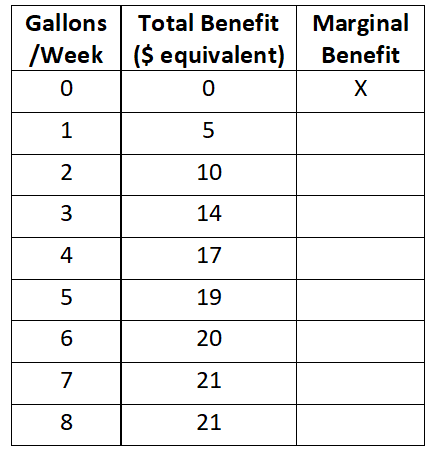
The table shows your total benefits from consuming different quantities of gas each week.
What is the marginal benefit of one more gallon of gas, when you currently have 0 gallons?
(a)
The table shows your total benefits from consuming different quantities of gas each week.
What is the marginal benefit of one more gallon of gas, when you currently have 1 gallon?
(a)
The table shows your total benefits from consuming different quantities of gas each week.
What is the marginal benefit of one more gallon of gas, when you currently have 2 gallons?
(a)
The table shows your total benefits from consuming different quantities of gas each week.
What is the marginal benefit of one more gallon of gas, when you currently have 3 gallons?
(a)
The table shows your total benefits from consuming different quantities of gas each week.
What is the marginal benefit of one more gallon of gas, when you currently have 4 gallons?
(a)
The table shows your total benefits from consuming different quantities of gas each week.
The price of gasoline is $2.50/gallon.
Given this information, what is the optimal number of gallons of gas to consume each week:
(a)
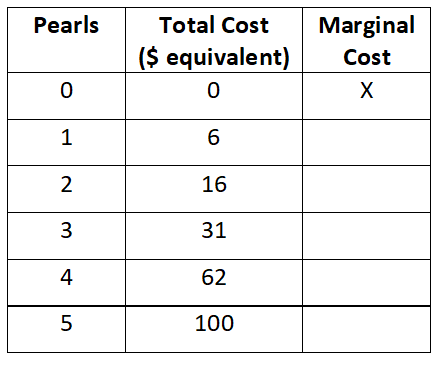
A deep-sea diver can sell each pearl he retrieves for $20 in the seaside market.
However, each time he dives in search of a pearl, it is harder to find than the one he found before. The table below describes the cost (in time and effort) of retrieving each successive pearl.
At what number of pearls harvested should the diver stop diving for more pearls?
(a)
Which law bans monopolies?
Tea Act
Anti-Trust Act
Townsend Act
Monopoly Act
Which of the following is an example of an Involuntary Exchange?
Buying a pizza online
Going to work for a paycheck
A person being robbed
Trading baseball cards
Use Marginal Analysis to explain why you are continuing to answer these questions instead of leaving them all blank?
I'm not using marginal analysis
The benefit of answering the questions is greater than the cost of not answering the questions
The cost of answering the questions is greater than the benefit of not answering the questions
Marginal Analysis is not being used, this is negative externalities
What prevents businesses from charging extremely high prices in the free market system?
Monopolies
Negative Externalities
Competition
Positive Externalities

Is this chart showing an example of income inequality? Explain why or why not.
No, people make different amounts of money, that's life
No, people who don't have money are lazy and uneducated
Yes, the chart shows the lower-class making more than the middle-class. That is wrong
Yes, there are significant differences in income amounts between all of the groups
The law of demand argues that as prices rise
the quantity demanded will fall
the quantity demanded will rise
the demand curve will shift to the right
no change will occur
This part of the market determines DEMAND
buyers
sellers
suppliers
store owners
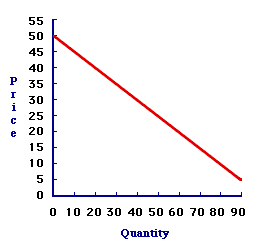
What does this curve represent?
supply
equilibrium
demand
surplus
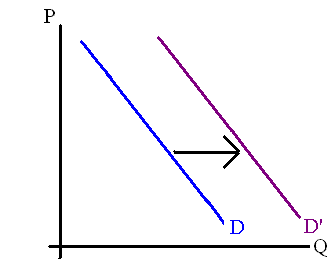
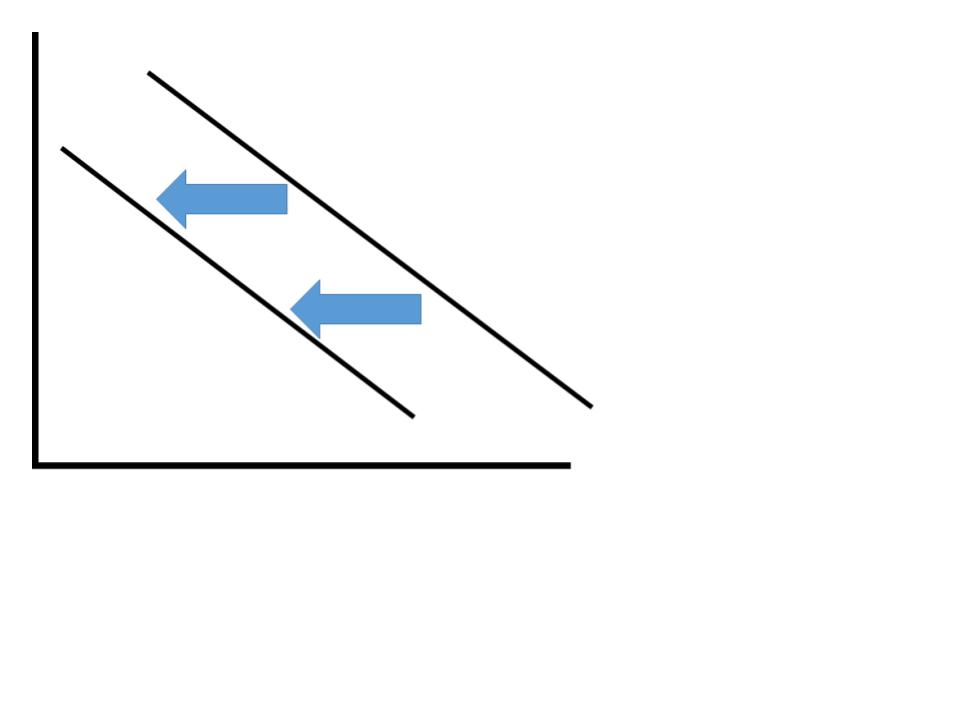
The diagram represents a
increase in demand
decrease in demand
change in quantity demand
none of the above
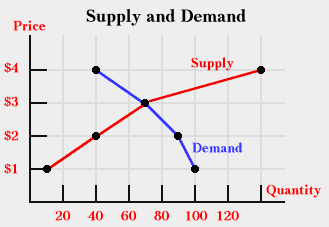
What is the Equilibrium Price?
1
2
3
4

Which of the following will cause an increase in demand for snowboards?
More costly production methods
A decrease in the price of lift tickets at resorts in Colorado
A decrease in consumer income
A decrease in the population
Demand can be best defined as
an individual's need or desire for a good or service at a given price.
how much of a good or service is being produced.
The only thing that causes a movement along a supply or demand curve (Change in Quantity Demanded):
Price
Quantity
Climate
Weather
Goods that are bought and used together are
complementary goods
substitute goods
income goods
unrelated goods
Which of the following is likely to increase the demand for peanut butter?
Fewer children in the population
News that insects have destroyed much of the peanut crop and that there will be less peanut butter on the shelves in three months.
A big increase in the price of jelly.
A report from the Surgeon General of the United States that eating peanut butter makes people nutty.
What is caused when the demand for a product or service is higher than the supply?
shortage
consumer
surplus
equilibrium
What is caused when the demand for a product or service is lower than the supply?
shortage
consumer
surplus
equilibrium

What is the equilibrium price of the graph?
20
40
60
No equilibrium price shown
If the original price was $40 and we raised the price to $60, what would most likely happen?
Demand would decrease and a surplus would be created
Demand would increase and a shortage would be created
Not enough information to make an accurate prediction
No change would occur
If the original price was $40 and we lower the price to $20, which option would be correct?
A surplus of 50 would be created
A shortage of 50 would be created
A shortage of 100 would be created
A surplus of 100 would be created

Which statement is correct about the Law of Supply?
When the price of a good decreases, quantity supplied decreases
When the price of a good decreases, quantity supplied increases

Apple manufactures the iMac G3 with all original technology with very little interest from consumers. What causes Apple to not sell many of these computers?
Quantity Supplied is Greater than Quantity Demanded
Quantity Supplied is Less than Quantity Demanded

According to the supply and demand schedule, what is the equilibrium price?
$1.00
$1.25
$1.50
$1.75

Based on the movement of the supply curve, did the equilibrium price increase or decrease?
Increase
Decrease

Which answer choice does this image represent?
Quantity Supplied is Greater than Quantity Demanded
Quantity Supplied is Less than Quantity Demanded

The newest Jordan's release caused Foot Locker to sell out of their supply in less than one hour. What caused the Jordan's to sell out so quickly?
Quantity Supplied is Greater than Quantity Demanded
Quantity Supplied is Less than Quantity Demanded

Based on the movement of the supply curve, did the equilibrium price increase or decrease?
Increase
Decrease

Which answer choice does this image represent?
Quantity Supplied is Greater than Quantity Demanded
Quantity Supplied is Less than Quantity Demanded

Which graph below shows the SUPPLY CURVE?
A
B
C
D
This part of the market determines SUPPLY
buyers
sellers
consumers
Impossible to determine

The diagram represents a(n)
increase in supply
decrease in supply
change in quantity supplied
none of the above

How many cup holders are producers willing to supply at a price of $2.50?
3,000
4,000
5,000
7,000

When the demand for a product or service is higher than the supply this causes what?
shortage
consumer
surplus
equilibrium
A decrease in the price of a good will
increase supply.
decrease supply.
increase quantity supplied.
decrease quantity supplied.
Which image shows what will happen if the United States government gives U.S. Car producers Subsidies


If we raise the price to $60 what happens to Quantity Supplied?
Quantity supplied will decrease to 100
Quantity supplied will increase to 200
Quantity demanded will decrease to 50
No change
If we lower the price to $20 what will happen to the quantity demanded?
Quantity demanded will increase to 200
Quantity demanded will decrease to 100
Quantity supplied will decrease to 50
No change
Which of these best defines equilibrium in a market?
a situation in which quantity supplied is greater than quantity demanded
a situation in which quantity demanded is greater than quantity supplied
a situation in which quantity supplied and quantity demanded are equal
a situation where a minimum price is set
A situation in which the quantity supplied is greater than the quantity demanded is
a shortage
a surplus
a price floor
a price ceiling
A situation in which quantity demanded is greater than quantity supplied is
a shortage
a surplus
a price floor
a price ceiling
Which of the following demonstrates price equilibrium? (Could be more than one answer)


Which of these demonstrates a surplus of goods?


Which of these demonstrates a shortage of goods?


At $9 the market is experiencing
a surplus
a shortage
equilibrium
a quota

Assuming this is the market for bottled water, this shift could be caused by
Hurricane Irma
A population decrease
An increase in technology
Government Subsidy

Record Peach Harvest—Price Lowest in a Decade How will this information likely affect the supply curve for frozen peach pies?
Panel a
Panel b
Panel c
Panel d

Average Wages Decline for Workers Around the Country How will this information likely affect the demand curve for movie tickets?
Panel a
Panel b
Panel c
Panel d

U.S. Car Company to Close Six Factories How will this information likely affect the supply curve for the company’s minivans?
Panel a
Panel b
Panel c
Panel d

Congress Passes New “Sugar Tax” How will this information likely affect the supply curve for sugar?
Panel a
Panel b
Panel c
Panel d

Hospitals Report Dramatic Decrease in Births How will this information likely affect the demand curve for baby strollers?
Panel a
Panel b
Panel c
Panel d

The President Approves Subsidies for Solar Energy Industry How will this information likely affect the supply curve for solar energy panels?
Panel a
Panel b
Panel c
Panel d

Looking at the graph: to return to equilibrium, price would need to:
Increase
Decrease
Stay the same
Shift demand curve
An effective price floor must be set above equilibrium, resulting in:
a shortage
a surplus
limited choices
None of the above

If the government set the price at $700, would that be a price ceiling or floor?
Price Ceiling
Price Floor
Neither
If an effective rent ceiling is eliminated, which of the following is most likely to occur in the rental housing market?
An increase in the demand for housing, resulting in a decrease in the quantity of housing supplied
An increase in the demand for housing, resulting in an increase in the quantity of housing demanded
An increase in rents, resulting in an increase in the quantity of housing supplied
A decrease in rents, resulting in an increase in the quantity of housing supplied
When a price ceiling is imposed in a market:
A surplus results
Sellers of the product are made better off
A shortage results
Quantity supplied is greater than the quantity demanded
At the price, neither a surplus or a shortage exists
equilibrium
consumer surplus
producer's surplus
dead weight
A _______________ is a maximum price sellers are allowed to charge for a good. It's an upper limit for the price.
equilibrium
shortage
surplus
price ceiling
This is the minimum price buyers are required to pay for a good. It's a lower limit for the price.
equilibrium
shortage
price floor
price ceiling
A price ceiling will result in a
shortage
surplus
equilibrium price
equilibrium quantity
A price floor will result in a
shortage
surplus
equilibrium price
equilibrium quantity

What is the equilibrium quantity in this graph?
$1.50
$1.00
600
800

At the price of $1.00, there is a
shortage of 200
surplus of 200
shortage of 400
surplus of 400
If the government set the price at $300, what would be the result?
Surplus of 4,000
Surplus of 2,000
Shortage of 4,000
Shortage of 2,000

If the government creates a price floor of $80, which one of the following statements is correct?
The quantity demanded = 60
The quantity supplied = 180
There is a shortage of 140
The price floor is ineffective

In a free market, the equilibrium price would be
$10
$8
$6.
$4
If the government institutes a price ceiling of 30$, which of the following statements will be correct?
There is a shortage of 90
There is a surplus of 90
There is a shortage of 140
The price ceiling is ineffective

