
 Worksheets
Am Hist 2 Semester Test (Units 1-8)
Total questions: 122
Worksheet time: 1hrs 1mins
Exploration Matching
Reached Newfoundland in 932 CE.
The Vikings
Christopher Columbus
Amerigo Vespucci
Hernan Cortez
Robert LaSalle
Exploration Matching
Landed in the Caribbean in 1492.
The Vikings
Christopher Columbus
Amerigo Vespucci
Hernan Cortez
Robert LaSalle
Exploration Matching
Italian navigator and writer on a Spanish ship.
The Vikings
Christopher Columbus
Amerigo Vespucci
Hernan Cortez
Robert LaSalle
Exploration Matching
Claimed Mexico for Spain.
The Vikings
Christopher Columbus
Amerigo Vespucci
Hernan Cortez
Robert LaSalle
Exploration Matching
Claimed Louisiana for France.
The Vikings
Christopher Columbus
Amerigo Vespucci
Hernan Cortez
Robert LaSalle
Which of the following is a core belief of transcendentalism?
a. All government funds in the Bank of the United States should be transferred to the public.
b. A belief in the inherent goodness of people and nature.
c. The Christian religion should be made the official religion of the United States.
d. None of the above
What impact/s did the Indian Removal Act have on the indigenous people of the southeastern United States?
a. Hundreds of thousands of indigenous people were forcibly removed from their traditional home lands to reservations west of the Mississippi River.
b. The indigenous groups affected included the Choctaw, Creek, Cherokee, and Seminole.
c. Thousands of indigenous people died on the journey, many of exhaustion due to having to walk for hundreds and hundreds of miles.
d. All of the above
Which of the following was NOT part of Henry Clay's "American System?"
a. A protective tariff to protect and promote American industry.
b. A National Bank.
c. Construction of infrastructure such as roads and canals.
d. Protective laws for indigenous groups, who were often referred to as American Indians.
Which of the following was NOT true of Margaret Fuller?
a. She was an abolitionist.
b. She was an activist for women's rights and education.
c. As First Lady of the United States, she advanced rights for indigenous groups.
d. Her book "Woman in the Nineteenth Century" is considered the first major feminist work in the U.S.
e. All of the above are true.

A good title for the below map would be-
a. The American Colonies, 1845.
b. Consequences of the Indian Removal Act of 1830
c. Battles of the Mexican-American War
d. Democratic-Republican Electoral Votes, 1837 - 1845

A good title for the below map would be-
a. The Election of 1828: Jackson Defeats Adams
b. The Election of 1828: Adams Defeats Jackson
c. Democratic-Republican Electoral Votes, 1837 - 1845
d. None of the above would be a good title.
The expression "corrupt bargain" was-
a. John Adams' term for the Indian Removal Act.
b. Andrew Jackson's term for the creation of the Bank of the United States.
c. How Andrew Jackson referred to the results of the presidential election of 1824.
d. How John Adams referred to the removal of property ownership requirements for voters.
Which of the following is an example of the Spoils System?
a. A newly elected president gives jobs to people who donated to his campaign.
b. A state governor institutes a tariff system for imported fruits and vegetables.
c. A state governor restricts public education access to children of wealthy families.
d. A women's rights activist vandalizes and government building.
The "Jacksonians" withdrew from the Republican party & formed the-
a. Democratic Party
b. Nationalist Party
c. Federalist Party
d. Democratic-Republican Party.
What was the Trail of Tears?
Sectionalism was-
a. The term used by geographers to indicate distinct regions of the U.S.
b. A short-lived third American political party founded by Andrew Jackson.
c. The popular movement in the South which supported Southern states' desire to leave the US, which lead to the American Civil War.
d. The result of different regions of the United States, such as the North and the South, prioritizing their own unique political and social needs over those of other regions, leading to conflict.
Sectionalism can best be defined as … ?
a. The way American geography was divided up by "sections" in the 19th century, including specific areas such the Oregon, New Mexico, and Wyoming Territories.
b. The act of placing the interests of your region ahead of the needs of the nation as a whole.
c. The official government term for the reservation system.
d. The division of the US government into 3 separate branches.
Which of the following was a key characteristic of the West in the 19th century?
a. A constant influx of new settlers.
b. Mining as an important economic activity.
c. Connected to the East by both rail and telegraph.
d. All of the above statements are true.
Which of the following was a characteristic of the South in the 19th century?
a. An extensive railroad network connecting the rural areas to major cities like Atlanta.
b. An economy based heavily on the unpaid labor of enslaved peoples.
c. Sparsely populated territories with very few women.
d. Many large cities with diverse populations.
Which of the following was a characteristic of the North in the 19th century?
a. Big cities with large immigrant populations.
b. An economy based solely on small farming.
c. Strong trade ties with Latin America, especially the Portuguese colony of Brazil.
d. A government-controlled economy with little freedom for people.
The main goal of the Missouri Compromise was to-
a. establish the North as "The Union."
b. form an official agreement on which new states entering the Union would be free states and which would be slave states.
c. Create the borders of the new state of Missouri, which had been engaged in a territorial dispute with Arkansas.
d. end the practice of slavery in America for good.
Which of the following was NOT part of the Compromise of 1850?
a. California entered the Union as a free state.
b. Texas joined the Union as a free state.
c. The slave trade was banned in Washington, D.C.
d. A stronger Fugitive Slave Act.
True/False: The Kansas-Nebraska Act of 1854 -
repealed the Missouri Compromise of 1820.
True
False
True/False: The Kansas-Nebraska Act of 1854 -
left the decision on the legality of slavery to the people.
True
False
True/False: The Kansas-Nebraska Act of 1854 -
established the boundary between the two states.
True
False
True/False: The Kansas-Nebraska Act of 1854 -
was supported by states in the South.
True
False
True/False: The Kansas-Nebraska Act of 1854 -
was supported by states in the North.
True
False
True/False: The Kansas-Nebraska Act of 1854 -
involved the concept of "popular sovereignty."
True
False
True/False: The Kansas-Nebraska Act of 1854 -
resulted in violence.
True
False
True/False: The Kansas-Nebraska Act of 1854 -
was written by President Martin Van Buren.
True
False
What was "Bleeding Kansas" ("Bloody Kansas") ? (In your own words, 2-3 sentences)
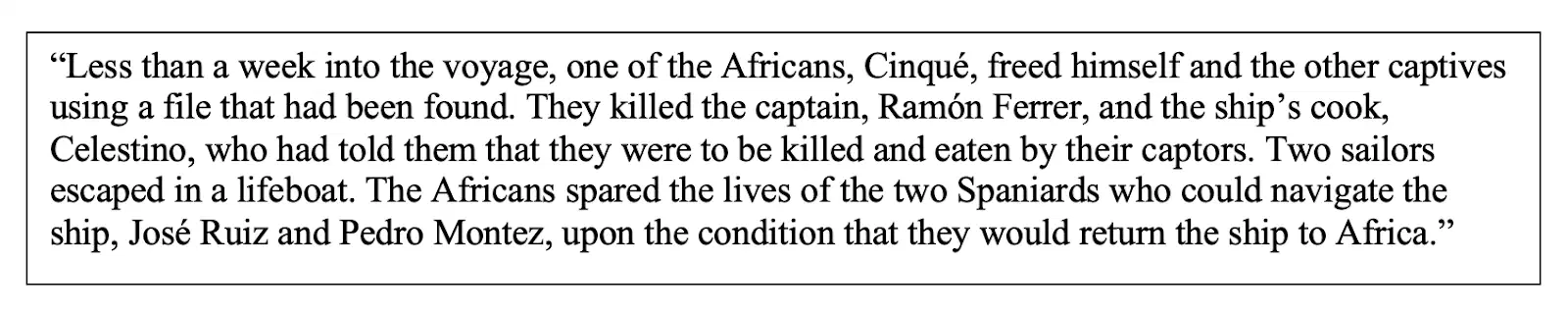
What event is the below excerpt describing?
a. A revolt of captured and enslaved people on board the Amistad.
b. A rebellion of sailors from South Carolina following nullification.
c. A mutiny on a New England whaling ship.
d. None of the above.
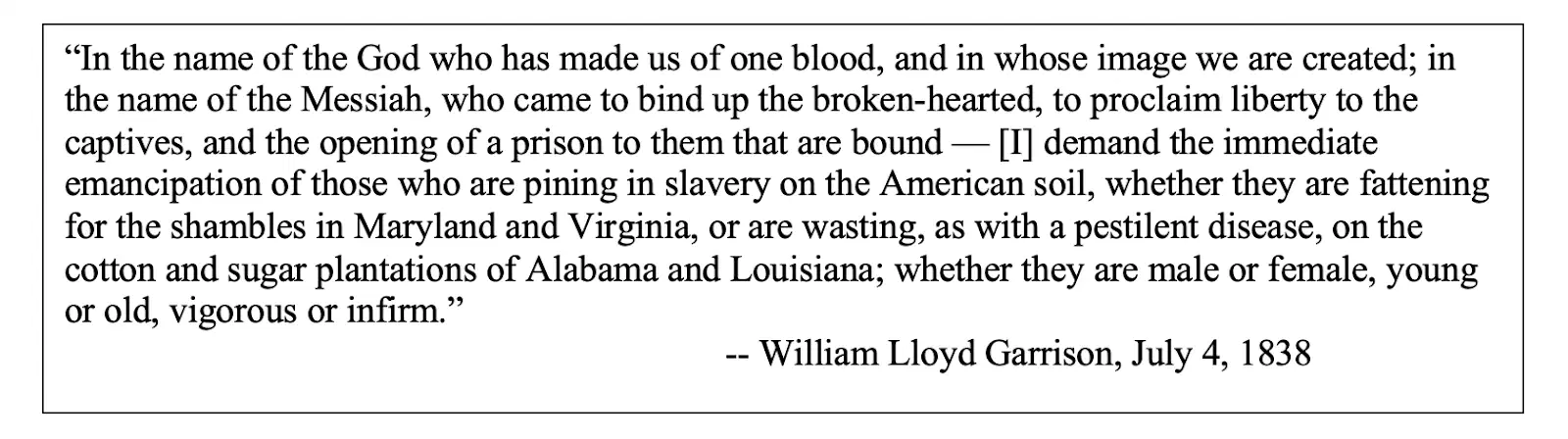
Based on the below excerpt and your knowledge from the unit, William Lloyd Garrison was a(n)-
a. Southern slave owner.
b. Abolitionist and anti-racist advocate.
c. British army officer.
d. Advocate for indigenous rights.
John Brown led a raid on the federal armory at Harper's Ferry because he … -
a. Planned to steal weapons to arm plantation owners against a slave rebellion.
b. Planned to steal weapons to arm slaves against plantation owners.
c. Was a passionate Anti-Federalist and planned to attack Washington, D.C.
d. Was the leader of the military arm of the Democratic-Republican party and planned to attack New York City.
What did Nat Turner and John Brown have in common? -
a. They are both remembered for taking drastic anti-racist actions.
b. Both were escaped slaves from Virginia who reached freedom in Boston via the Underground Railroad.
c. They were both students of Frederick Douglass.
d. None of the above.

Below is a famous painting depicting the concept of Manifest Destiny in the United States in the 19th century. All of the figures are moving to the LEFT in the painting because -
a. There is no meaning; it's just how the artist painted the picture.
b. "Manifest Destiny" referred to free Black individuals moving from the South to the North, and north is usually on the left side of a map.
c. "Manifest Destiny" was the philosophy behind Westward Expansion, and west is usually on the left side of a map.
d. American politics were moving to the left at this time.
What was one major reason that the Republic of Texas declared independence in 1836?
a. Disagreement with Mexico over the legality of slavery.
b. Tension with the United States government over federal taxes; "taxation without representation."
c. The American army's loss to the Spanish at the Battle of the Alamo.
d. Nullification.
The Missouri Compromise was necessary because-
a. Maine wanted to be admitted into the Union as a slave state, but the other New England States were free states.
b. The balance of power between the North and the South was threatened in the Senate.
c. Missouri followed Kansas and South Carolina in the nullification process.
d. The elections of 1824 and 1828 were deemed "unfair" and the new compromise made electoral votes more equitable.
What was the Compromise of 1850? (In your own words 1-2 sentences)
An important result of the Kansas-Nebraska Act was that it - ?
a. Contributed to Bleeding Kansas.
b. Allowed popular sovereignty in Kansas.
c. Stoked national tensions over slavery.
d. All of the above statements are TRUE.
Who were the "Forty-Niners?"
a. Southern veterans of the Mexican-American War of 1849.
b. Texas veterans of the Battle of the Alamo.
c. Gold prospectors in California.
d. U.S. senators who voted to legalize slavery in all territories west of the Mississippi.
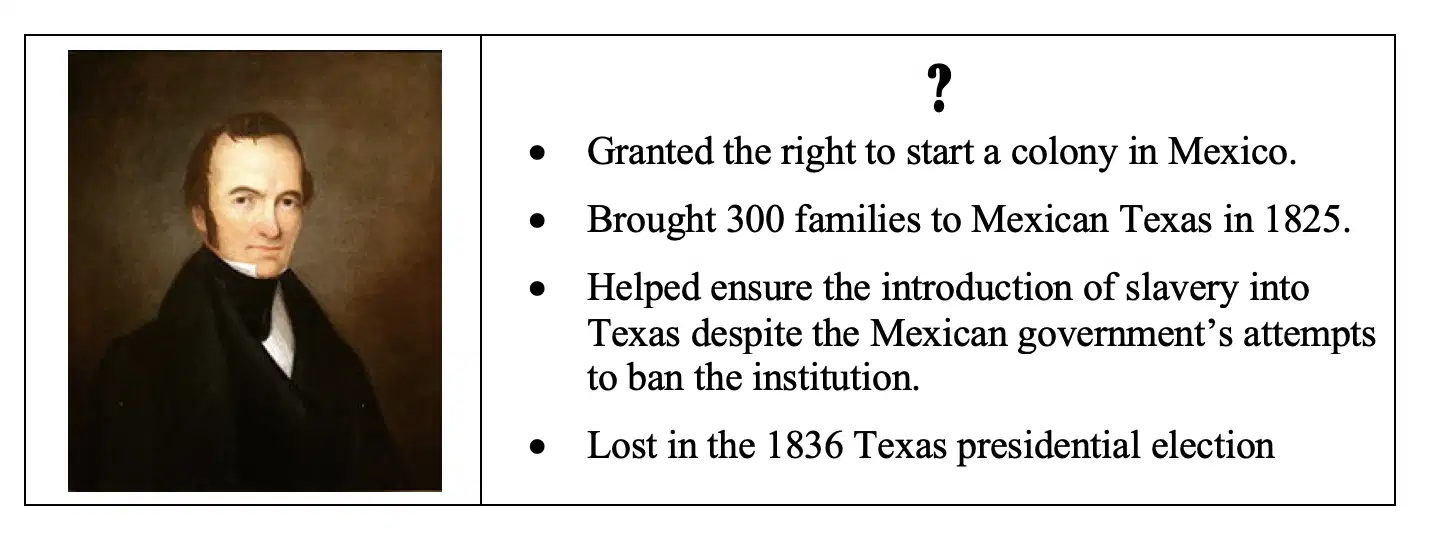
The table below best describes -
a. Andrew Jackson
b. Sam Houston
c. Stephen F. Austin
d. Davy Crockett
Which of the following aspects of living in a Mexican colony upset white American settlers?
a. Dominance and influence of the Mexican Roman Catholic Church.
b. The Spanish language.
c. A Mexican law outlawing slavery in 1829.
d. All of the above upset white settlers.
Who was Antonio López de Santa Anna? (2-3 sentences)
Which of the following was NOT an outcome of the Treaty of Guadalupe Hidalgo?
a. Mexico officially became independent from Spain but gave up all land rights in southern Florida and the Caribbean.
b. Mexico agreed to accept the Rio Grande River as the southern border of Texas.
c. Mexico recognized that Texas was part of the United States.
d. Mexico gave up an area of land stretching from Texas to the Pacific Ocean.
California became a state in 1850. What problem did this cause?
a. It entered the Union as a free state, upsetting the slave state/free state balance in Congress.
b. All gold found in Gold Rush areas was now considered taxable by the U.S. government.
c. Indigenous people in California revolted because they did not want to suffer persecution.
d. Mexico still claimed California as their own territory, which led to the Mexican-American War.
The problem/s facing American farmers in the mid-19th century included-
a. Drought
b. Crop and animal diseases
c. Expensive railroad shipping costs
d. All of the above
Why did American crop prices fall in the mid-19th century?
a. The demand for food crops diminished following the Mexican-American War because the U.S. government was no longer buying up large quantities to feed government troops.
b. New technologies and the use of more productive farming techniques meant that each farmer was producing much larger quantities of crops, leading to surplus crops and low prices.
c. Americans began to demand specialty crops and food products from South America, such as sugar cane, chocolate, and coffee. Interest in American crops dropped, leading to lower profits for American farmers.
d. All of the above.
Which of the following best describes the result of the Battle of Little Big Horn?
a. Colonel Custer achieved fame and glory from the battle resulting in a long political career.
b. It was a great victory for American forces and is remembered today in the U.S. Army's official service song.
c. Lakota Sioux and Cheyenne warriors killed the entire U.S. 7th Cavalry.
d. Chief Crazy Horse achieved a peaceful settlement with Colonel Custer.
What happened at Wounded Knee, South Dakota Territory, in December of 1890?
a. A small settlement of Irish-American homesteaders was massacred by Cheyenne warriors.
b. A mutually-agreed treaty was signed between the Lakota Sioux, the Cheyenne, and the U.S. government, ending the so-called "Indian Wars."
c. A major battle between the Lakota Sioux and the Cheyenne resulted in significant land gains for the Sioux; land that remains under Lakota Nation independent rule to this day.
d. The U.S. Army's 7th Cavalry killed over 150 Lakota Sioux, many of them unarmed women and children.
What was the Dawes Act of 1887? (2-3 sentences)
The original goal of the Populist Party when it was founded in 1892 was to--
a. Establish a population of white Americans in the Wyoming Territory.
b. Fight for women's suffrage (right to vote) in the western states and territories.
c. Help farmers get out of debt and give the common, everyday people a greater voice in American government.
d. Compete with the Republican party, which was dedicated to immigrants' rights and the abolition of slavery.
Which of the following was NOT a part of the Populist Party's political platform?
a. Direct elections of U.S. senators.
b. An eight-hour work day for all Americans.
c. A graduated federal income tax.
d. Redistribution of lands to indigenous groups, with the goal of ending the reservation system.
American farmers who wanted the federal government to produce more silver coins were hoping for-
a. Inflation, which would lead to higher crop prices.
b. More money in circulation, distributed by the federal government for free to farmers and workers, increasing the personal wealth of regular citizens.
c. An increase in production at the silver mines of Colorado and Nevada, which would create badly needed jobs in those two territories.
d. All of the above.

Below is a famous painting produced by the Populist Party in 1875. Based on this picture and your knowledge from the unit, who did the Populists believe were the most important workers in the United States?
a. Railroad executives
b. Lawyers
c. Farmers
d. Soldiers
What was the Underground Railroad? (In your own words 2-3 sentences)
Who was Sojourner Truth? (2-3 sentences)
Who organized the Seneca Falls Convention in 1848?
a. Elizabeth Cady Stanton & Lucretia Mott.
b. Frederick Douglass & Harriet Tubman
c. Robert Purvis & Robert E. Lee
d. Harriet Tubman & Susan B. Anthony
The purpose of the Seneca Falls Convention was to-
a. Organize Northern volunteers for the Underground Railroad.
b. Discuss the desire of Southern states to leave the Union.
c. Establish new laws regarding the treatment of indigenous peoples and immigrants in the United States.
d. Further women's rights, including the right to vote.
Which of the following is NOT true of Horace Mann?
a. He worked for the rights of prisoners in Massachusetts jails.
b. He fought for the same reform movement as Catherine Beecher, the sister of Harriet Beecher Stowe.
c. He believed in higher pay for teachers, better curriculum, and newer school buildings.
d. He was secretary of the Massachusetts Board of Education.
What was "nullification?" (1-2 sentences)
In your own words (2-3 sentences) what was the Columbian Exchange?
The Natives American sided with whom during the French and Indian War?
The British
The colonists
The French
Neither
What statement best describes French relations with American Indian tribes compared to the British?
The French treated them worse by enslaving them and taking their lands.
The French forced the Natives to convert to Christianity
The French continuously fought against the Native Americans in bloody wars
The French treated the Natives with respect and were peaceful
Under the Articles of Confederation, each state's power in Congress was based on:
one vote per state.
the state's size.
the state's total population.
the state's voting population.
Why did our founding fathers originally not want a strong government?
They wanted a government similar to that of Britain
They were all Federalists
They were anarchists
They were afraid of creating another king-like government
What did Shay’s Rebellion show America about its government under the Articles of Confederation?
The US Government is too strong
State’s had too much power
The US Government is too weak
States are too weak
The _____________________ combined both of the plans proposed at the Constitutional Convention, the Virginia Plan and the New Jersey Plan, and created a two house Congress. One with equal representation and one based on population.
⅗ Compromise
Great Compromise
Compromise of 1775
Constitutional Compromise
Checks and balances refer to…
The institutional checks of power between the three branches of government
The money system used for weighing gold
The powers of the President over the states
The inability of certain rich fat cats to balance their bank accounts
Passed by Congress on September 25, 1789, the Bill of Rights are the
Pre-amble
Articles of Confederation
First 10 amendments of the Constitution
Reasons the Constitution was written
The Federalist papers written by John Jay, Alexander Hamilton and James Madison, which appeared in the New York newspapers from 1787 to 1788 were aimed to
Challenge the Constitution
Defend the Constitution
Defend the British government
Challenge the British government
The ________________________ branch has the power to make laws.
Legislative
Executive
Judicial
Senate
The president is elected to a term of:
two years.
four years.
six years.
eight years.
The "supreme law of the land" in America is:
the Constitution.
the Bill of Rights.
the Articles of Confederacy.
the Preamble.
The three main branches of the U.S. government are:
the House of Representatives, Senate, and Supreme Court.
the president, Senate, and Supreme Court.
executive, legislative, and judiciary
state, local, and federal
The _________________________ branch has the power to veto laws.
Legislative
Executive
Judicial
Our country has how many total Senators?
2
50
100
Depends on a state’s population
Which of the following is NOT true of Alexander Hamilton when he was Secretary of the Treasury?
He said: "A national debt, if it is not excessive, will be to us a national blessing."
Argued that all the states fought for freedom, so the federal government should assume all state debts.
Supported the idea of a National Bank.
All of the above are true.
What was the purpose of the Bill of Rights? (In your own words 2-3 sentences)
What debate did the Great Compromise solve? (In your own words 2-3 sentences)
Which of the Amendments is the most important to you personally and why? (In your own words 2-3 sentences)
The War of 1812 was fought between the United States and -
France
Spain
Mexico
Great Britain
The Missouri Compromise
Outlawed Slavery
Admitted Missouri as a slave state and Main as a free state
Was favored by everyone in the U.S.
Prohibited slavery in the rest of the Louisiana Purchase
B and D Only
What was the Monroe Doctrine? (In 2-3 Sentences)
Which treaty ended the War of 1812?
Treat of Ghent
Treaty of Paris
Treaty of Guadalupe-Hidalgo
Treaty of Versailles

Why was the presidency of James Monroe referred to as the “Era of Good Feelings?”
most of the country was enjoying the economic benefits of slavery
there was political unity and prosperity (success) and no fighting
there was excellent relations between the Americans and Natives
the slave trade had been banned in all areas of the United States
America's first two political parties were the -
a. Federalists and Nationalists
b. Federalists and Democratic-Republicans
c. Democrats and Republicans
d. Republicans and Nationalists
The Supreme Court case Marbury v. Madison (1803) is most closely associated with-
a. Interstate commerce
b. Foreign tariffs
c. Judicial review
d. The rights of indentured servants

On the below map, which letter shows the approximate location of the Louisiana Purchase?
a. A
b. B
c. C
d. D
"Judicial review" is the process of--
a. Reviewing the work of federal judges and ambassadors.
b. Determining if a law is constitutional or not.
c. Evaluating the strength of state laws and judiciaries.
d. Establishing a new federal jurisdiction.
What was "impressment?" (In 2-3 Sentences)
Matching: Battles of the War of 1812
Francis Scott Key witnessed the battle and wrote a poem, which became the United States' National Anthem.
Battle of Fort McHenry
Battle of New Orleans
Battle of York
Matching: Battles of the War of 1812
Occurred after the Treaty of Ghent because word of the treaty had not yet reached the battle site.
Battle of Fort McHenry
Battle of New Orleans
Battle of York
Matching: Battles of the War of 1812
Important American victory; the British fort nearest the battle site were burned to the ground.and town
Battle of Fort McHenry
Battle of New Orleans
Battle of York
Henry Clay's "American System" for uniting the country following the War of 1812 included --
a. Ending all tariffs
b. Improvements to American infrastructure such as roads, canals, and railways.
c. The purchase of Hawaii, Guam, and the Virgin Islands from Spain.
d. Ending slavery across the United States.
The new territory brought into the U.S. by the Adams-Onis Treaty with Spain was--
a. New Mexico
b. Florida
c. Arizona
d. California
Alexander Hamilton's reason/s for supporting the idea of a National Bank was/were-
a. He wanted a bank that could print a national currency.
b. He thought it would make repaying the American war debt easier.
c. He felt that it would be a source of expanding capital for the growing U.S. economy.
d. All of the above
What was a result of the Whiskey Rebellion?
Set an example of federal law, authority, and follow-through
Made Whiskey cheaper
The farmers beat the army in a rebellion
Washington has to resign as president
After the XYZ affair when foreign ministers demanded bribes a Quasi-War broke out between the U.S. and WHO?
Great Britian
France
Spain
Barbary Pirates
The Alien & Sedition Acts empowered the President to deport "dangerous" aliens and made it criminal to make false statements critical of the government. How did the Democractic-Republicans see these Acts?
Necessary to keep the peace
Not a good idea by John Adams but what must be done
Bad but because John Adams was one of them, they had to accept it
A measure against freedom of speech
What was the effect of the French and Indian War being very costly?
The British turned to slavery to make money
The British passed new taxes on the colonists
The British began to sell part of its American lands to other countries
The French passed new taxes on the colonists
The policy practiced by England during the 17th & 18th centuries of not enforcing laws and leaving the American colonies relatively free to do as they pleased was known as:
Mercantilism
Great Awakening
Salutary Neglect
Navigation Acts
Which of the following acts limited colonists’ westward movement past the Appalachian Mountains?
Stamp Act
Intolerable Act
Declaration of Boundaries
Proclamation of 1763
Where were the first shots fired in the Revolutionary War?
Lexington and Concord
Saratoga
Yorktown
Breed’s Hill
What was the name of the radical group founded by Samuel Adams in response to higher British taxes?
Ku Klux Klan
Adams’ Raiders
Freedom Fighters
Sons of Liberty
Which event FIRST showed that tensions between the British and colonists would turn violent
Boston Tea Party
Boston Massacre
Lexington and Concord
Second Continental Congress
A former French and Indian War commander, this Virginia planter and politician was appointed commander in chief of the Continental Army during the Revolutionary War.
George Washington
Benedict Arnold
John Adams
Horatio Gates
This group of colonists sided with the views of Franklin, Patrick Henry, Thomas Paine and Thomas Jefferson during the war.
Tories
Loyalists
Separatists
Patriots
At the conclusion of the American Revolution…
The Colonists are forced to continue paying taxes to the British
The British has complete control over the colonies
The British agreed to recognize America as a new and separate country
America was now the strongest country in the world
Common Sense, written by Thomas Paine, was written to
encourage colonists to declare their independence
help fund the Lewis and Clark expedition
tell the colonists they had no sense in America
help the French win the French and Indian war
What was not a purpose of the Declaration of Independence?
Describe all the ways Britain had gone against colonists’ rights
Explain everyone has rights that a government should not ever break
Declare war on Britain
Cut ties with Britain and declare independence
Which group helped the colonists during the American Revolution by training them and increasing naval power?
British
French
Germans
Native Americans
Name 3 Important Battles of the Revolutionary War
On Christmas Night 1776, George Washington led troops across what river?
The Hudson River
The Potomac River
the Delaware River
The Cedar River
What British leader surrendered at the Battle of Yorktown?
Cornwallis
Burgoyne
Howe
Washington
What Document was Signed to officially recognize the independence of the U.S. from Great Britain?
Treaty of Versailles
The Constitution
The Declaration of Independence
The Treaty of Paris
Bacon’s Rebellion exemplified -
the growing power of former indentured servants
the colonial resentment over the Stamp Act
England’s anger over the Puritan control of Massachusetts
the ability of African slaves to rise up and rebel
Who benefited most from the system of mercantilism?
Colonies
Mother Countries
Native Americans
Africans
What was the Great Awakening
A religious revival in all Thirteen Colonies.
The rebellion of Wampanoag peoples in the New England Colonies.
The European decision to force the Iroquois people out of the Middle Colonies.
A Revival of Catholicism in Georgia
List the 13 Colonies
The Middle Passage was the:
a. land route across the isthmus of Panama to the Pacific Ocean.
b. trade route that brought captured and enslaved Africans across the Atlantic.
c. trade route that brought valuable tobacco and other crops to Europe.
d. French route from New Orleans up the Mississippi River.
What was the Triangle of Trade? (Include what parts of the world it was between and what was traded)

