
 Worksheets
Penguin Final
Total questions: 49
Worksheet time: 43mins
Some female peacocks prefer males with large, colorful tales while other female peacocks prefer males with no tail at all. Females are now mating only with the tail they prefer. What type of reproductive barrier is this?
behavioral isolation
hybrid sterility
temporal isolation
mechanical isolation
In the Great Lakes region of North America, gray wolves and coyotes are similar species but do not mate because their breeding periods occur at different times of the year.
Geographic isolation
Behavioral isolation
Temporal isolation


Bees don’t see red, but do see yellow, blue, and ultra-violet light. Thus, bee-pollinated flowers are mostly yellow or blue with UV nectar guides (landing patterns) to guide the bee. They usually have a small, narrow floral tube to fit the tongue-length of that species of bee.
Convergent Evolution
Divergent Evolution
Coevolution
The Galápagos tortoises share a common ancestor, but have necks of different lengths to best reach the food they need in their environment.
Convergent
Divergent
Coevolution

What is shown in diagram as an evidence of evolution?
Homologous structures (structures have similar functions) b/c the bird and bat live in similar environments
Analogous structures (structures have similar functions) b/c the bird and bat live in similar environments
Homologous structures (structures have different functions) b/c the bird and bat live in different environments
Analogous structures (structures have different functions) b/c the bird and bat live in different environments
Which of the following contributes most to promoting sustainability in an ecosystem?
lack of decomposers
a balanced water table
variety of organisms
a narrow temperature range
A greater a habitat's biodiversity, the greater will be that habitat's -
sustainability over time with varying conditions.
consumption of energy in the form of sunlight.
temperature ranges across the seasons.
distance to the nearest water source.
How is the current decline in biodiversity different from the previous mass extinctions that Earth has experienced?
It is happening much more slowly
This time it is not really happening
It is made worse by an asteroid hitting Earth
This is being caused by humans
Which of the following is NOT a way in which humans are destroying habitats?
Gathering rain water to use to water crops
Clearing out prairies to grow a single crop
Cutting trees to use as toilet paper
Building a shopping mall with a large parking lot
Which of the following is NOT a cause for the current decline in the biodiversity of our ecosystem?
over-exploitation of resources
planting new forests to replace trees
pollution of animal's water sources
increasing human population
What is an invasive species?
An organism that is new to an environment that has positive effects on the environment.
An organism that is native to an environment that has negative effects on the environment.
An organism that is new to an environment that has negative effects on the environment.
An organism that is native to an environment that has positive effects on the environment.
The excessive use of species that have economic value is known as
pollution
habitat destruction
over - exploitation
climate change
The threat to biodiversity that occurs when the homes of different species are destroyed
pollution
habitat destruction
over - exploitation
climate change
When human-made chemicals and garbage find their way into nature and harm the air, soil, and water it is called
pollution
habitat destruction
overexploitation
climate change
Which of the following is NOT an example of habitat destruction?
Removing species from a habitat faster than they can reproduce
Bulldozing & burning forests to use as areas for cattle grazing or farming
Carving a road or trail through a forested area
How do invasive species threaten the survival of native organisms?
They outcompete native organisms for resources
They upset the hierarchy of diebacks within an ecosystem
They enhance the genetic diversity within an ecosystem and are therefore quite beneficial to native organisms
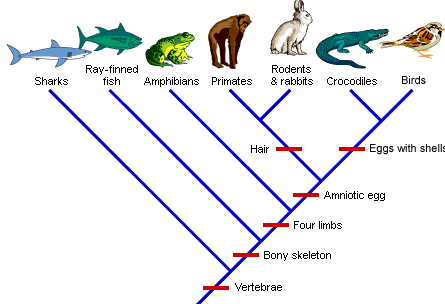
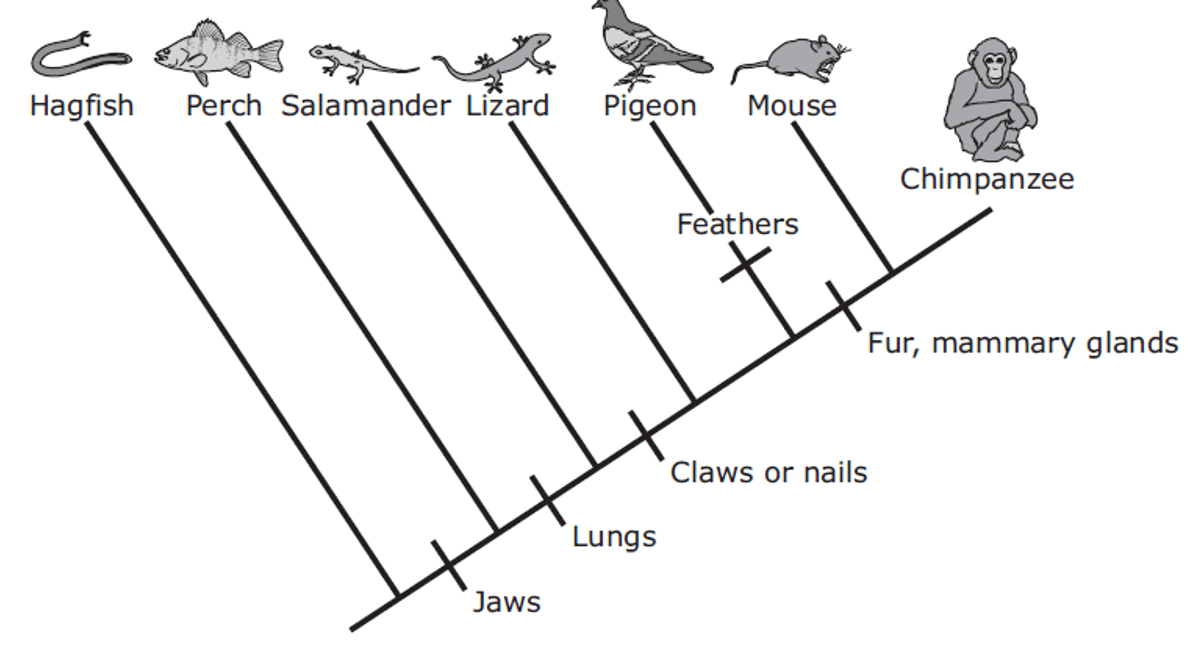
All the animals to the right of the salamander would have the derived characteristic of...
Fur
Claws or nails
Lungs
Jaws
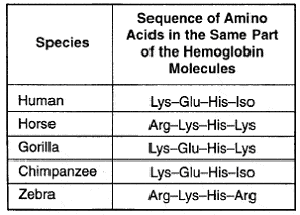
You look at two species and see very similar amino acid sequences (protein strands). What does this likely tell you?
These are the same animal.
These animals have a common ancestor.
These animals are not likely related.
These animals are likely becoming one species.
In preparation for an electrophoresis procedure, enzymes are added to DNA in order to
convert the DNA into gel
cut the DNA into fragments
change the color of the DNA
produce longer sections of DNA

The parents of a new baby believe they brought the wrong child home from the hospital. Gel electrophoresis was performed using DNA samples from the parents and the child. A section of the gel
electrophoresis results is shown below. Which conclusion is valid based on the gel electrophoresis results?
They have the correct child, because her genetic information is identical to that of the father.
They have the wrong child, because her genetic information does not match that of either parent.
They have the correct child, because her genetic information came from both parents.
They have the wrong child, because her genetic information matches only that of the mother.

This technique used to analyze DNA involves the
synthesis of new DNA strands from subunits
separation of DNA fragments based on size
production of genetically engineered DNA molecules
removal of defective genes from DNA
Sample 1: ATTCCGGTAATCCCGTAATGCCGGATAATACTCCGGTAATATC
Sample 2: ATTCCGGTAATCCCGTAATGCCGGATAATACTCCGGTAATATCThe results of DNA or RNA analysis are often used to help determine
the number of DNA molecules in an organism
if two species are closely related
the number of mRNA molecules in DNA
if two organisms contain carbohydrate molecules

What is the result of step 3?
a new type of molecular base is formed
different types of minerals are joined together
DNA from the bacterial cell is cloned
DNA from different organisms is joined together
The higher the Mean Kinship number, the more genetic diversity
True
False
Use the following sequence to determine the fragment length created by a restriction enzyme that cuts at CCT/A. List the framents length in order from negative to positive sides of the board.
AGATTTCCCT/ACTCCT/AGCGACCT
6, 9, 10
10, 8, 6
10, 9, 6
6, 8, 10
True or False: Taxonomy takes into account the genetic similarities between species.
True
False
Check all statements that are true about restriction enzymes
Sticky ends are easier to work with because of the based pair bonds and slight overlap
Gel Electrophoresis using restriction enzymes is a great way to learn you detailed genetic code.
There are hundreds of restriction enzymes, only made by Archaea bacteria
They cut DNA fragments into lengths that can be analyzed in Gel Electrophoresis
The level of domain that is specific to only one organism
(a)

