
 Worksheets
Waves Unit Review
Total questions: 151
Worksheet time: 4hrs 46mins
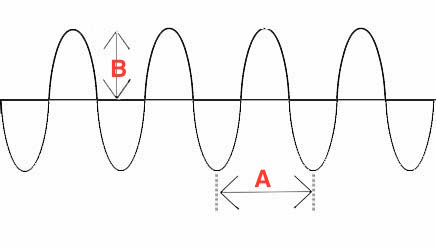
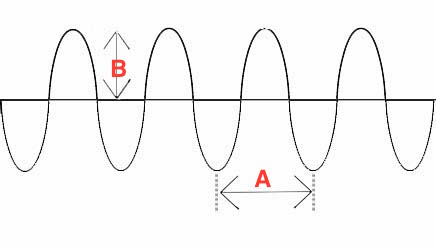

What property of the wave is represented by the letter "A"?
amplitude
crest
trough
wavelength
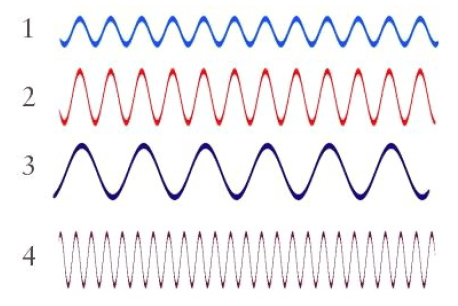


The highest point on a wave is:
the crest
the trough
the top
the coast

Which word is used to identify the distance between points C & G?
Amplitude
Crest
Frequency
Wavelength
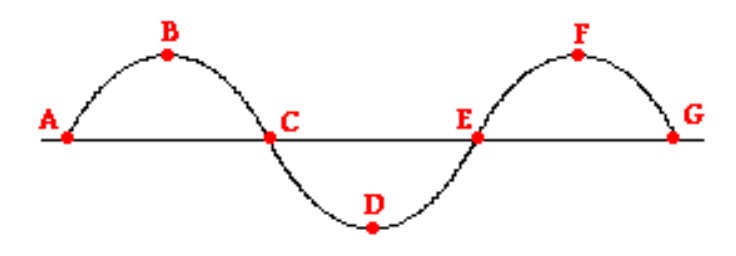
Which letter(s) represent the trough of the wave?
A
B & D
D
C & G


You can't hear sounds in outer space because there is no
medium
light
energy
heat

All waves carry ________ as they travel from one place to another.
matter
space
energy
water
What property of the wave is represented by the letter "B"?
amplitude
crest
trough
wavelength
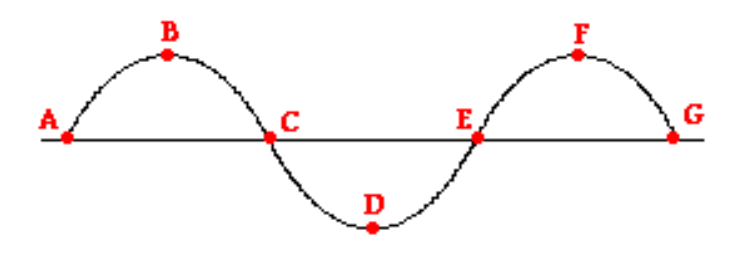
Which letter(s) represent the crest of the wave?
A
B & D
B & F
F
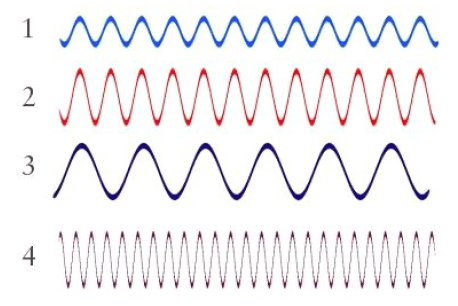
Which wave in the diagram has the greatest wavelength?
1
2
3
4
Which wave in the diagram has the greatest frequency?
1
2
3
4
How many Wavelengths does #3 show?
6
12
1
5
If this image represents one second, what is the frequency of #3?
6 Hz
12 Hz
1 Hz
3 Hz
If this image represents one second, what is the frequency of the wave?
4Hz
4.5Hz
5 Hz
If this image represents one second, what is the frequency of the wave?
1 Hz
1.5 Hz
3 Hz
When waves meet and form either a larger or smaller amplitude
Refraction
Interference
Diffraction
Reflection
The combination of two waves to form a larger amplitude is what type of interference?
Constructive
Destructive
Waves can meet and form a smaller amplitude.
If this occurs, it is called...
Constructive Interference
Destructive Interference
Reflection
Refraction
Diffraction
Waves can meet and form a smaller amplitude.
If this occurs, it is called...
Constructive Interference
Destructive Interference
Reflection
Refraction
Diffraction

These waves are experiencing...
Select ALL that apply
Reflection
Refraction
Diffraction
Interference
Destructive interference is
When the two waves add together to produce a single wave of smaller amplitude
The two waves add together and produce a single wave of greater amplitude

Which type of interaction is this?
Choose the BEST option
reflection
refraction
diffraction
interference
Interference in which waves combine to form a wave with larger amplitude than either wave originally had is called
destructive interference
amplitude enhancement
constructive interference
resonance

Two waves approach each other as shown in the diagram. What will the amplitude of the wave be produced if the crests from each wave meet?
35 cm
20 cm
15 cm
5 cm

What is being shown in the diagram?
resonance
constructive interference
standing wave
destructive interference

What is being shown in the diagram?
resonance
constructive interference
standing wave
destructive interference

What interactions are happening on the LEFT side of the obstacle? (select all that apply)
reflection
refraction
diffraction
interference


Which type of interaction is shown in the image?
Destructive Interference
Absorption
Constructive Interference
Reflection
The crest of a 2m tall wave passes the trough of a 1m deep wave. What will be the amplitude of the resulting wave?
1 meter
2 meters
3 meters
4 meters
The crest of a wave 5m tall passes the crest of a wave 3m tall. What will the amplitude of the resulting wave be?
2 meters
6 meters
8 meters
12 meters

Which type of interaction is shown in the image?
Destructive Interference
Absorption
Constructive Interference
Reflection

Interference happens when waves:
speed up
overlap
stop
change
What is true of constructive interference?
new waves created have smaller amplitudes
new waves created have no amplitudes
new waves created have greater amplitudes
no new waves are created

Standing waves are created by
Two identical waves reflecting off each other
Two identical waves being diffracted together
Two identical waves move through each other in opposite directions
Two identical waves are diffracted from two identical sources

The moving black dot is called:
a node
an anti-node
crest
trough
In the diagram which letters represent the nodes (they read ABCDE from left to right)
A B C
A C E
B D
B D E
A C D

How many antinodes does this standing wave have?
5
6
7
8
How many nodes does this standing wave have?
5
6
7
8
Which of the following is the bending of a wave, which changes its speed.
Reflection
Diffraction
Refraction
Interference
When waves meet and form either a larger or smaller amplitude
Refraction
Interference
Diffraction
Reflection

Which type of interaction is this?
reflection
refraction
diffraction
interference

Which type of interaction is this?
reflection
refraction
diffraction
interference
Which type of interaction is this?
Choose the BEST option
reflection
refraction
diffraction
interference
What interaction is happening on the RIGHT side of the obstacle?
reflection
refraction
diffraction
interference

Which type of interaction is this?
reflection
refraction
diffraction
interference

Which type of interaction is this?
reflection
refraction
diffraction
interference

Which type of interaction is this?
Choose the BEST option
reflection
refraction
diffraction
interference

Which type of interaction is this?
reflection
refraction
diffraction
interference

Which type of interaction is this?
Choose the BEST option.
reflection
refraction
diffraction
interference
The bending of a wave due to the change in speed is called
interference
diffraction
reflection
refraction
Reflection occurs when a wave
bends due to a change in speed
hits a surface and bounces back
passes through an opening
bends around a barrier
Reflection causes waves to bounce back off of an object.
True
False
Reflection causes waves to turn as they pass through an object
True
False
Diffraction causes waves to turn as they pass through an object
True
False
Light acts like a...
Wave
Particle
Neither
Both
Light is a _____wave
Select all that apply
electromagnetic
mechancial
longitudinal
transverse
The more ________ electromagnetic radiation has, the more energy it carries.
amplitude
wavelength
frequency
speed
Which travels faster?
light
sound
Does light need a medium to travel through?
Yes
No
Write the Electromagnetic Spectrum in order
Use JUST the first letter of each band.
Use ALL CAPS and no spaces.
(a)
Which band of the Electromagnetic Spectrum has the longest wavelengths?
Radio
Infrared
Visible
UV
Gamma
What does EM stand for?
Electromagnetic
Electro-Magnetic
Excuse Me
Which is the only band of the Electromagnetic Spectrum humans can detect without instruments?
Radio
Infrared
Visible
UV
Gamma
Which band of the Electromagnetic Spectrum is the most dangerous?
Radio
Infrared
Visible
UV
Gamma
Which is the only band of the Electromagnetic Spectrum humans can detect without instruments?
Radio
Infrared
Visible
UV
Gamma
Which travels faster in air?
light
sound
it depends

What wave behavior does this image best demonstrate?
reflection
refraction
diffraction
absorption

What wave behavior does this image best demonstrate?
reflection
refraction
diffraction
absorption

What wave behaviors does this image demonstrate? Select all that apply!!
reflection
refraction
diffraction
absorption

What wave behaviors does this image best demonstrate?
reflection
refraction
diffraction
absorption

What wave behaviors does this image best demonstrate?
reflection
refraction
diffraction
absorption

What wave behaviors does this image best demonstrate?
reflection
refraction
diffraction
absorption
Bending of waves around an object (such as through a doorway)
Reflection
Diffraction
Refraction
Interference
This type of wave travels fastest through solids because the molecules are closer together.
Choose the best option
all longitudinal waves
all transverse waves
mechanical waves
electromagnetic waves
The thing through which a wave travels is called a (a)
This "musical" property of sound depends on frequency and is described as being high or low.
pitch
amplitude
speed
volume
Sound waves are _______ waves.
Select all that apply
longitudinal
mechanical
transverse
electromagnetic
The part of a longitudinal wave where the particles of the medium are close together.
rarefaction
compression
crest
trough
A reflected sound wave is called an
(a)
Does sound require a medium to travel?
Think about what kind of wave it is
Yes
No
You and your father inspect an empty house with the hopes of buying it. You walk through the rooms talking to one another, and you notice that your voices and footsteps are echoing in the big, empty house. What causes the echo?
sound waves reflecting off smooth, flat surfaces throughout the house
sound waves moving at different speeds in different rooms
sound waves diffracting around corners in the empty rooms
As the fire truck approaches, the pitch of the siren gets higher. Once the fire truck passes, the siren's pitch gets lower.
This change in PITCH is because of an apparent change in the sound wave's
speed
amplitude
frequency

CHALLENGE!
After the train passed, the pitch of the train whistle became lower due to the Doppler Effect.
What would change about the above diagram if it was showing a lower pitched sound?
C would increase.
C would decrease.
D would increase.
D would decrease.
Which frequency is the LOWEST pitched sound?
50 Hz
10,000 Hz
What is the Doppler Effect
Where the wavelength of a wave is shifted due to the source moving
When a wave is shifted when a body pushes the wave
Where the apparent wavelength & frequency of a wave is shifted due to relative motion

An observer moves TOWARDS a sound source.
The frequency the moving observer hears is ________ than the actual frequency of the source.
higher
lower
What is the Doppler Effect
Where the wavelength of a wave is shifted due to the source moving
When a wave is shifted when a body pushes the wave
Where the apparent wavelength & frequency of a wave is shifted due to relative motion
The bouncing of waves off an object (such as a wall) is called
Reflection
Diffraction
Refraction
Interference
The fact that it's harder to hear you friend in a loud environment is due to
Reflection
Diffraction
Refraction
Interference
_______ in air of different temperatures can redirect sound waves.
Reflection
Diffraction
Refraction
Interference
This type of wave cannot travel through space because there is no medium to speak of.
Choose the best option
all longitudinal waves
all transverse waves
mechanical waves
electromagnetic waves
Which frequency is the HIGHEST pitched sound?
50 Hz
10,000 Hz

Which wave in the diagram has the greatest frequency?
1
2
3
4

High frequency waves have _________ wavelength.
varying
longer
the same
shorter
If this image represents one second, what is the frequency of the wave?
1 Hz
1.5 Hz
3 Hz
If this image represents one second, what is the frequency of the wave?
4Hz
4.5Hz
5 Hz
All waves carry ________ as they travel from one place to another.
matter
space
energy
water
You can't hear sounds in outer space because there is no
medium
light
energy
heat
Which wave in the diagram has the greatest wavelength?
1
2
3
4
Which wave in the diagram has the smallest frequency?
1
2
3
4
large frequencies have ____ wavelengths
small
large
Frequency is determined by
the speed of the wave
the wavelength of the wave
the medium the wave travels through
the source vibration
Wavelength is determined by
the speed of the wave
the medium the wave travels through
the source vibration
all of these are correct
Frequency is measured in
meters
meters per second
hertz
pitch
What property of the wave is represented by the letter "A"?
amplitude
crest
trough
wavelength
All waves carry ________ as they travel from one place to another.
matter
space
energy
water
What is a medium?
something between a small and a large?
the substance through which a wave can travel
a pattern of vibration that simulates when a wave is standing still
the distance from any point on a wave to an identical point on the next wave
A mechanical wave cannot travel through...
a vacuum(empty space).
water.
air.
glass.
Light can travel through a vacuum, or empty space.
True
False
You can't hear sounds in outer space because there is no
medium
light
energy
heat

