
 Worksheets
Standard 4 Review - Quizizz
Total questions: 109
Worksheet time: 55mins
Which trend in United States foreign policy is shown by the passage of the Neutrality Act of 1939, the Destroyers for Bases Deal of 1940, and the Lend-Lease Act of 1941?
withdrawal from overseas colonies
expansion of trade with the Axis powers
moving from isolationism to interventionism
reduction in war preparedness
What was the primary factor in America entering World War II?
the passage of the Lend-Lease Act
the resumption of unrestricted submarine warfare
a surprise attack on United States soil
the renewal of Nazi aggression
Why did Filipinos revolt after Spain was defeated in the Spanish American War?
The United States did not recognize their independence.
They did not want to be democratic.
They were unwilling to give up their Spanish roots.
They wanted to become a United States protectorate.
What was a MAJOR result of the Spanish-American War?
The United States formed an alliance with England.
The United States gained control of Hawaii.
The United States repealed the Monroe Doctrine.
The United States was established as a world power.
How did the Spanish American War influence the building of the Panama Canal?
The war demonstrated the need to shift naval forces quickly from the Atlantic to the Pacific.
The war demonstrated the ease with which Latin American countries could be overcome by US military force.
The war demonstrated that such tropical diseases as malaria and yellow fever could be controlled.
The war demonstrated a movement from imperialism to isolationism in Latin America.
Which foreign policy position was held by both Presidents James Monroe and Theodore Roosevelt?
Trade with other nations should be sharply reduced.
The United States should follow a policy of isolationism.
A special relationship should exist between the United States and the nations of Latin America.
The United States should send troops to aid revolutionary movements in European nations.
The Supreme Court in the Insular Cases addressed the issue of whether the Constitution follows the flag or not. What was the meaning of their decisions?
United States occupation of foreign territories entitles those people to Constitutional rights as United States citizens.
United States military will be sent in to intervene in foreign disputes to ensure capitalist desires.
United States occupation of foreign territories entitles those people to vote on accepting the Constitution or not.
United States occupation of foreign territories does not entitle people to Constitutional rights as United States citizens.
Early in the 20th century, what did President William Taft use the concept of dollar diplomacy to do?
help European nations avoid war
expand United States influence over China
protect the United States investments in Latin America
support welfare programs for immigrants to the United States
In the United States, the most controversial aspect of the Treaty of Versailles was the
principle of self-determination for smaller nations in Europe and elsewhere.
severe reparations that Germany would have to pay.
provision for trusteeship of former German colonies.
League of Nations.
The Open Door policy:
allowed a certain number of Japanese immigrants into the United States each year in return for special trading rights with Japan
allowed Cubans to enter the United States, and Americans to enter Cuba, freely
proposed that foreign powers keep the China trade open to all nations on an equal basis
pledged economic aid to struggling Latin American republics
The "victory abroad, victory at home" (Double V) campaign was an effort to achieve what goal?
gain support for women's suffrage
help African Americans in their efforts for civil rights
prepare the U.S. to oppose Germany during the Cold War
help Americans adjust to post war economic prosperity

Which World War II reality is represented in the image above?
Economic and political efforts of women during WWII led to ratification of the 19th Amendment
Wartime mobilization required participation and sacrifice from all Americans
Women were finally allowed to serve in frontline military positions
For the most part, American families were able to function unaffected by the war

What does the cartoon suggest about the U.S. strategy for ending World War II?
A full invasion of Japan was necessary to win the war unconditionally
The Battle of Okinawa was seen as a necessary evil to bring about peace
Truman felt that using atomic bombs would "save lives" and end the war
Truman knew that peace and world dominance would follow nuclear proliferation

What group of people had their civil liberties violated by Executive Order 9066?
Japanese Americans in internment camps
Chinese immigrants attempting to enter the United States
Hispanic American victims of Executive Order 8802
Jewish prisoners of Nazi Germany
Which of the following was NOT a result of the Holocaust?
Over six million Jews were executed or died in Nazi camps
Genocides were brought to an end and have not happened again
Universal Declaration of Human Rights
A Jewish homeland, Israel, was created by the United Nations

Which United States policy from 1941 is being depicted by Uncle Sam's actions?
Lend Lease Act
Isolationism
Open Door Policy
Oil Embargo
How were thousands of American women affected during World War II?
Prosperity allowed more and more women to stay at home to nurture their children
The public attitude toward women's' employment underwent a transformation, as the majority of Americans began to admit that they approved of married women working outside the home
Due to the importance of their war work, women for the first time achieved equal pay for equal work
The proportion of women in the labor force rose significantly, as many women went to work outside the home
Which of the following BEST explains America's entrance into BOTH world wars?
Aggressive imperialism and entangling alliances
Assassination of foreign leaders
Aggressor nations attacking merchant ships or naval bases
Need to have a war to end all wars
What was the significance of the Women's Army Corp, the Tuskegee Airmen, the “Code Talkers”, and members of the 442nd Infantry Regiment?
They were all units caught by surprise by Pearl Harbor.
B. They all represent opportunities created for marginalized groups during war.
They were all soldiers involved in combat in the Pacific.
They all represent minority groups denied participation in WWII military service.
As World War II was ending, what was one reason the United States decided to join the United Nations?
Sought to meet the American public's overwhelming demand for free-trade agreements
Wanted to continue to play the same role it had in the League of Nations
Recognized that efforts to achieve world peace required United States involvement
Wanted to stop the growing influence of newly independent developing nations

The change shown between 1938 and 1942 on the chart above can be attributed to
success of the Civilian Conservation Corps and Works Progress Administration
industrial mobilization related to World War II
shifting population centers of the United States
global economic boom following the Great Depression
Which of the following was the primary factor leading America to enter World War II?
Passage of the Lend-Lease Act
Resumption of unrestricted submarine warfare
Surprise attack on United States soil
Renewal of Nazi aggression
During the 1920s, consumers became able to buy "big ticket" items which were previously only affordable to the wealthy. Which factor played the GREATEST role in consumers' ability to buy refrigerators, washing machines, radios, and cars?
stock market speculation
credit or "installment buying"
decreased federal income taxes
low interest rates on home loans
In the 1930s, what was one factor that accounted for westward migration of farmers from the Great Plains?
high farm prices
new technologies
the Dust Bowl
the baby boom
In the 1930s, what was one factor that accounted for westward migration of farmers from the Great Plains?
high farm prices
new technologies
the Dust Bowl
the baby boom
Why did many United States farmers fail to benefit from the economic prosperity of the 1920s?
No technological advances were made in agriculture.
Levels of farm production declined.
Farm exports were heavily taxed.
Agricultural goods were overproduced.
Why did so many banks fail at the onset of the Great Depression?
Too many investors tried to open new accounts.
Too many depositors tried to withdraw their money all at once.
The stock market collapsed too slowly to collect on debts.
The Federal Reserve put too much money into circulation.
Which situation was a basic cause of the Great Depression?
continued increases in wages for workers
excessive profits for farmers
over regulation of the stock market
overproduction of consumer goods
Which of the following is a cause of the economic boom and the financial speculation of the 1920s?
installment buying and an unregulated stock market
the expansion of civil rights to women and minorities
the mobilization of the economy for war
increased government restrictions on big business
Which of the following BEST explains the impact of the consumer financing option on American households?
Workers were laid off from the coal industry.
Families were able to purchase items using credit that they otherwise could not have afforded.
Employers provided their employees with fringe benefits.
Women began to work in large numbers to buy newly available appliances.
How were the passage Sedition Acts of 1798 and 1918 similar?
They restricted the individual liberties of Americans.
They had no effect on aliens.
Both contributed to fear of other countries after the war.
Both required reparations to civilians.
After World War II, which precedent was established by the Nuremberg Trials?
National leaders can be held responsible for "crimes against humanity"
Only individuals who actually commit murder during war can be guilty of a crime.
Defeated nations cannot be forced to pay war reparations.
Defeated nations can be occupied by the victorious nations.
Why was the Battle of Midway an important victory for the United States?
It was considered the bloodiest battle of the war.
It meant that the war was half over.
The Japanese surrendered after the victory by the United States.
It was regarded as the turning point for the Allied forces fighting the Japanese in the Pacific.
How did World War II affect millions of American women?
Prosperity allowed more and more women to stay at home to nurture their children.
The public attitude toward women's' employment underwent a transformation, as the majority of Americans began to admit that they approved of married women working outside the home.
Due to the importance of their war work, women for the first time achieved equal pay for equal work.
The proportion of women in the labor force rose significantly, as millions of women went to work outside the home.
What conflict did the "clear and present danger" ruling of the Supreme Court in Schenck v. United States illustrate?
free speech and safety
the use of search warrants and the rights of the accused
state powers and Federal powers
religious freedom and separation of church and state
What BEST explains why the American government did not welcome Jewish refugees during WWII?
Anti-semitism in the US
Immigration quotas
Nativism and the KKK
Financial liabilities
What did the rulings of the Supreme Court in Dred Scott v. Sanford (1857), Plessy v.
Ferguson (1896), and the 1944 case Korematsu v. United States [supported Japanese internment] all demonstrate?
The Supreme Court continued to extend voting rights to minorities.
The Supreme Court protected itself from internal dissent.
The Supreme Court sometimes failed to protect the rights of minorities.
The Supreme Court often imposed restrictions on free speech during wartime.
Why did A. Philip Randolph threaten a march on Washington during World War II?
African Americans were being denied jobs in war factories.
African Americans were segregated in the armed forces.
Mexican Americans were being denied jobs in war factories.
Mexican Americans were being persecuted in Los Angeles.
What was significant about FDRs “fireside chats?"
They marked the first time a president effectively used radio to address a national audience.
They sparked controversy by suggesting that the Supreme Court should be enlarged.
They called for a guaranteed $2000 per year income for every US household.
They helped FDR get elected from 1928-1944.
How did the power of the government change during the Civil War and the Great Depression?
Presidential powers were expanded
Congress exerted greater leadership
The Supreme Court expanded civil liberties
Power shifted from the federal government to the states
What is most notable aspect of the Social Security that began during the Great Depression?
It was the only New Deal legislation deemed unconstitutional.
It was the most significant and enduring part of the New Deal.
It was the only legislation that included relief, recovery and reform.
It was the first program initiated in FDR's New Deal.
Why did President Franklin Roosevelt believe that declaring a bank holiday and creating the Federal Deposit Insurance Corporation (FDIC) would help the nation's banking system?
Both would restrict foreign investments.
Both would reduce government regulation of banks.
Both would restore public confidence in the banks.
Both would grant tax relief to individuals.
When the Great Depression began in 1929, what was the MOST COMMON economic belief supported by President Herbert Hoover?
An increase in defense spending would stimulate the economy.
Unemployed workers should receive federal unemployment benefits.
The government should assume control of industry.
The economy would recover on its own.
All the following were among the objectives of the Tennessee Valley Authority EXCEPT:
the production of cheap electric power
the development of Smoky Mountain National Park
providing jobs
creating a new market for goods that required electricity
Critics of President Franklin D. Roosevelt's plan to increase the number of Supreme Court justices believed the plan was in conflict with which principle?
the Supreme Court's practice of judicial restraint
the constitutional principle of checks and balances
attempts of Congress to limit judicial responsibilities
efforts to restrict the number of terms a resident could serve
Hoover’s early efforts to end the Depression included:
cutbacks in public works, to shore up the public treasury
a stricter credit policy by the Federal Reserve, to stop the flow of “easy money” available for speculation
an increase in aid to farmers, to allow them to produce more
asking businessmen to maintain wages and avoid layoffs, in order to keep purchasing power strong
The Bonus Expeditionary Force (AKA the Bonus Army Marchers):
consisted of angry farmers who sometimes acted outside the law to prevent the foreclosure of mortgages on their farms
toured the country to create support for the Communist party
marched on Washington in an attempt to get immediate payment of a veterans’ bonus that Congress had voted in 1924
was a special division within the U.S. Army created to help local authorities deal with disturbances
Which events best support the image of the 1920s as a decade of nativist sentiment?
the passage of the National Origins Act and the rise of the Ku Klux Klan
the Scopes Trial and the passage of women's suffrage
the Washington Naval Conference and the Kellogg-Briand Pact
the growth of the auto industry and the Teapot Dome Scandal
Which pair of circumstances represents an accurate cause-and-effect relationship?
establishment of Jim Crow laws ---> beginning of Reconstruction
Dred Scott decision ---> passage of the Fugitive Slave Law
closing of the frontier ---> completion of the transcontinental railroad
technology and the automobile--->movement from the city to the suburbs
The Scopes Trial of the 1920s represented a conflict between which of the following?
communism and capitalism
Protestants and Catholics
science and religion
labor and management
"The best day of my life was when they passed Prohibition. Before that, I was struggling to make enough money to even eat. But now...I cant count it all, the money rolls in so fast. Hey, man's gonna drink. All I can do is supply what people want. Can I sleep with myself at night? You bet I can."
Who would have most likely said the above quote?
a flapper
a speakeasy
a bootlegger
a fundamentalist
The Sacco and Vanzetti case, the Red Scare, the National Origins Act and the rise of the Ku Klux Klan all showed Americas growing fear of immigrants. What was this fear called?
communism
Marxism
xenophobia
urbanization
How did flappers look to deviate from the Victorian norms of 1920s American society?
They were able to secure equal pay for equal work.
After ratification of the Equal Rights Amendment, they were given equality under the law.
They dressed more provocatively, and pushed the envelope on moral behavior.
They discouraged female membership in national unions.
American writers of the 1920s, such as Sinclair Lewis and F. Scott Fitzgerald, have been called the "lost generation" because they:
advocated cultural isolationism in the wake of World War I
were disillusioned with the shallowness of American life
found it difficult to get their works published
seemed preoccupied with writing nostalgic stories about the "good old days"
45. The passage of the Alien and Sedition Acts of 1798, the suspension of habeas corpus in 1861, and the adoption of the Espionage and Sedition Act in 1917 all represented which of the following ideas?
A. National interest is sometimes given priority over individual rights.
B. National crises often result in restrictions on the powers of the Executive Branch.
C. The Supreme Court consistently defends the Bill of Rights.
D. The Constitution shifts more power to Congress during times of war.
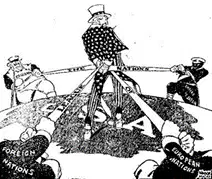
What is this cartoon suggesting the League of Nations would do to the United States?
A. The League would cause the defeat of the Central Powers in World War I.
B. It would cause the United States to implement isolationist policies.
C. It would limit the United States' sovereign powers.
D. The league would prevent the rise of Fascism.
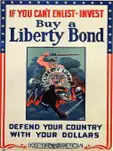
What was the intended purpose of this World War I propaganda poster?
A. Persuade enlistment in the military
B. Encourage people to ration food and other necessities
C. Convince people to help finance the war effort
D. Raise awareness about victory gardens and scrap drives
48. Which of the following BEST illustrates America's reaction to the Treaty of Versailles?
A. Bipartisan attempts to renegotiate the Treaty of Versailles
B. Founding membership in the League of Nations
C. Disillusionment and resentment towards the Republican Party
D. Re-established neutrality and a "return to normalcy"
49. Which of the following statements BEST represents Social Darwinism as it applies to American imperialism?
A. To avoid social unrest, religious and scientific worlds should be kept separate.
B. Based on the laws of nature, powerful nations were justified in dominating weaker nations.
C. Human beings had reached a point where competition among nations was no longer necessary.
D. The world's economic and social problems could best be corrected with the spread of Socialism.
Which of the following is NOT true about the experiences and contributions of the "Harlem Hellfighters" during World War I?
A. They were an all black regiment under the command of mostly white officers.
B. Racial segregation in the United States Armed forces meant the men of the 369th were only allowed to serve the war effort at home.
C. Despite their courage, sacrifice and dedication to their country, they returned home to face racism and segregation from their fellow countrymen.
D. While fighting in France, they spent 191 days in combat, and became one of the most decorated American combat units serving in World War I.
52. From 1914 to 1916, as World War I raged in Europe, why was the United States unable to remain completely neutral?
A. The United States' membership in military alliances required the nation to fight.
B. United States newspapers encouraged a policy of imperialist expansion.
C. The warring powers interfered with the United States' right to freedom of the seas.
D. President Wilson supported the war goals of Germany and Austria-Hungary.
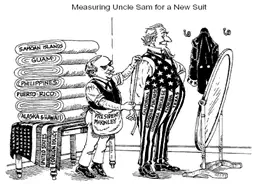
Which message is BEST represented in the political cartoon above?
A. The United States needed to complete Manifest Destiny.
B. The United States needed to continue a policy of isolationism.
C. The United States needed to acquire new foreign territories.
D. The United States needed to concentrate on domestic social issues.
I. ________________
a. Desire for new markets overseas
b. Creation of a new modern navy
c. Belief in Anglo-Saxon superiority
Which of the following titles should go on the line to BEST complete the partial outline?
A. Consequences of World War I
B. Results of the Gentlemen’s Agreement
C. Events Leading to Neutrality
D. Factors Supporting United States Imperialism
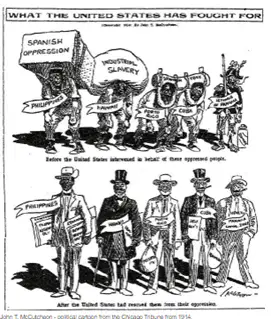
According to this cartoon, how does McCutcheon feel about American imperialism in Latin America and the Philippines?
A. America should avoid foreign responsibilities by returning to isolationism.
B. American intervention was worth the effort because of the positive effects it created.
C. American intervention often led to a decline in foreign economies.
D. American humanitarian efforts are not appreciated by people meant to be helped.
57. Which of the following statements BEST describes American participation in World War I?
A. The United States stayed out of the fight but helped broker a peace treaty that ended the conflict.
B. The United States fought alongside the Central Powers for the entire duration of the war.
C. The United States eventually joined the conflict and provided a key contribution to the Allies.
D. The United States initially allied itself with the Central Powers, but later switched sides once it became clear the Allies would win.
What assumption had to be TRUE in order for America's Open Door Policy to succeed?
A. Other foreign countries would have to give up economic control in China.
B. All the major powers of the Western Hemisphere would want China to be politically and economically independent.
C. Competing countries would agree war wasn't necessary because there was room for everyone to trade with China.
D. Civilized nations must believe in the equality and freedom of all races.
64. Which statement describes the role played by the United States journalists during the Spanish-American War?
A. Journalists ignored the signs of impending war until it was too late to inform the public of intentions to declare war on Spain.
B. Journalists exaggerated events to build support for the war, giving the president and Congress little chance to resolve the conflict diplomatically.
C. Journalists focused on bad news rather than good news in order to criticize the decisions made by the president and military leaders.
D. Journalists provided frequent reports of the fighting, allowing the public to follow a foreign war closely for the first time.
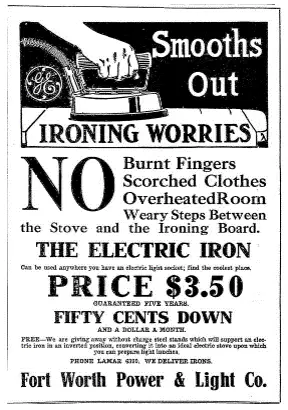
Which idea does this advertisement BEST reflect?
A. Installment plans allowed many people to purchase the latest home appliances.
B. Home appliances enabled women to work outside the home.
C. Flappers were women who used new appliances to do housework.
D. Advertisements were geared towards only the wealthiest Americans.
2. Which was radio and movies' MOST important contribution to American life in the 1920s?
A. They broadcast updates about the growing Dust Bowl.
B. They helped create a common culture in the United States.
C. They kept people informed on the war with Japan.
D. They allowed people in suburbs to listen to plays without attending them.
3. Which of the following BEST describes the New Deal?
A. It relied on deficit spending to address the effects of the Great Depression.
B. It fixed the nation's economic problems, so political leaders did not criticize it.
C. Truman proposed the plan after shocking everyone by winning the 1948 presidential election.
D. Roosevelt proposed the plan to help the nation deal with the effects of World War II.
What was the PRIMARY motive behind President Franklin D. Roosevelt's 1937 proposal to add members to the Supreme Court?
A. Remove Republican justices from the Court
B. End the Supreme Court's use of judicial review
C. Assure United States neutrality at the start of World War II
D. Protect New Deal programs from unfavorable Supreme Court decisions
What did Franklin D. Roosevelt's election to the Presidency in 1932 demonstrate?
A. A desire to return to a policy of laissez-faire.
B. A desire to abandon capitalism in favor of Socialism.
C. A desire to continue the domestic policies of Herbert Hoover.
D. A desire to have the government take an active role in solving economic problems.
9. How did the Red Scare and the resurgence of the Ku Klux Klan impact America in the 1920s?
A. Socialism increased nationwide.
B. Racism became more widespread.
C. Xenophobia grew out of nativism.
D. Urbanization led to ethnic neighborhoods.
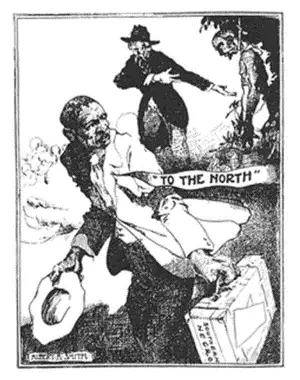
After World War I, which factor was a major reason many African Americans migrated to the North?
A. The start of the Harlem Renaissance
B. Decreased job opportunities in northern cities
C. To escape poverty and de jure segregation in the South
D. Federal government job training programs
13. Why did the Supreme Court declare some New Deal laws unconstitutional?
A. The laws overextended the power of the federal government.
B. The laws forced the federal government into heavy debt.
C. The laws ignored the rights of minority groups and women.
D. The laws failed to solve the problems for which they were intended.
Which of the following are examples of why the government instituted the Bank Holiday and the Federal Deposit Insurance Corporation (FDIC)?
A. To protect consumers from unsafe products
B. The need to intervene as a result of an economic crisis
C. To influence control on government spending
D. The federal government's attempt to regulate big business
18. What issue was addressed by the New Deal programs, Civilian Conservation Corps (CCC) and the Works Progress Administration (WPA)?
A. Excessive stock market speculation
B. High unemployment
C. Increased use of credit
D. Limited income of senior citizens
19. Which event effectively ended the Great Depression?
A. President Franklin D. Roosevelt's death in 1945
B. The United States' involvement in World War II
C. The Supreme Court's declaration that the New Deal was unconstitutional
D. President Herbert Hoover's failure to support Social Security
21. Which of the following BEST reflects the decade of the 1920s?
A. Foreign trade prospering after World War I
B. The United States assumed a leadership role in world affairs
C. Political reforms made government more democratic
D. Widespread social and economic change occurred
24. What would BEST explain the increased number of affordable cars manufactured in the 1920s?
A. The wartime rationing program created more automobiles.
B. The Great Depression ended, so people had more money to spend.
C. The assembly line improved mass production.
D. The creation of interstate highways led to a need for more cars.
28. Which of the following BEST represents one of the ways Flappers challenged cultural traditions of 1920s American society?
A. They were able to secure equal pay for equal work.
B. After ratification of the Equal Rights Amendment, they were given equality under the law.
C. They dressed more provocatively and pushed the envelope on moral behavior.
D. They discouraged female membership in national unions.
Why did the Ku Klux Klan see an increase in membership in the 1920s?
A. The Great Depression brought equal employment opportunities for men and women.
B. Increased immigration from Europe and Asia brought a new wave of nativism.
C. The end of Reconstruction led to mass migration of African Americans to the North.
D. The repeal of the 18th Amendment meant increased legal protections for bootleggers.
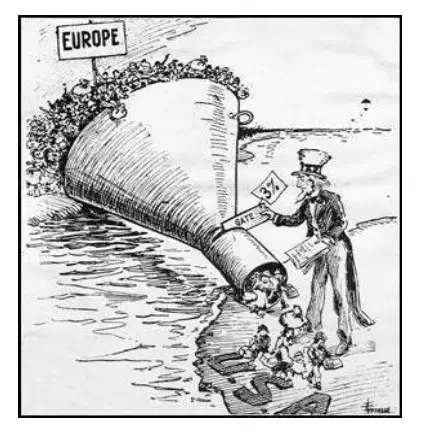
What does the drawing above show?
A. A decrease in America's popularity among European nations after World War I due to limited imports.
B. A decrease in immigration due to quotas and heightened xenophobia in the years following World War I.
C. A decrease in alcohol consumption resulting from passage of the 18th Amendment.
D. A decrease in conscription participation due to modified draft laws and a return to isolationism.
32. Which of the following BEST explains the realignment of black voters from the Republican Party to the Democrat Party in the 1930s?
A. The Republican nominee was opposed to civil rights legislation being considered in Congress.
B. Roosevelt, and other Northern Democrats, offered more assistance to poor, unemployed African Americans than any previous administration.
C. Roosevelt sought to remove conservatives from leadership roles in Congress.
D. Roosevelt worked for passage of anti-lynching and civil rights laws designed to end discrimination in the South and encouraged economic opportunities for African Americans.
33. How was the rebirth of the Ku Klux Klan in the 1920s different from the Ku Klux Klan following the Civil War?
A. They abandoned the violent intimidation tactics of its predecessor in favor of economic boycotts.
B. They found most of their support in the rural South due to the migration blacks to the North.
C. They targeted Catholic and Jewish immigrants, as well as African Americans and Prohibition violators.
D. They became increasingly popular among Hispanic and Asian populations on the West Coast.
34. All the following statements characterize American attitudes and actions during the 1920s, EXCEPT
A. African Americans enjoyed benefits from advanced employment opportunities in the South.
B. African American cultural accomplishments in music, literature, and the arts were celebrated.
C. American children enjoyed more free time and were able to shift from work to school.
D. Americans had more leisure time leading to the rise of professional sports and vacation-related industries.
35. As part of Roosevelt's New Deal measures, what impact did the Wagner Act (1935) and the Fair Labor Standards Act (1938) have on labor?
A. They protected employers right to require unpaid overtime.
B. They guaranteed worker rights, increased wages, and supported unions.
C. They prioritized the economic interests of big business in the marketplace.
D. They restricted the rights of workers to unionize and strike.
37. During the 1920s, what was the prevailing view of the national government's role in the United States economy?
A. It was to interfere as little as possible.
B. It was to control the means of production.
C. It was to promote the welfare state.
D. It was to play a major role through regulatory action.
41. Which BEST explains the reason African Americans did NOT directly benefit from the Agricultural Adjustment Act?
A. In order to gain support from Southern state governments, sharecroppers were not included in the language of the federal Act.
B. By this point, most African Americans had moved north seeking industrial jobs in large port cities.
C. As small subsistence farmers, they not produce enough crops to qualify for government aid.
D. They were intentionally omitted from the act by Northern members of Congress to provide more funds for immigrant farmers.
42. What impact did President Roosevelt’s New Deal have on the United States economy?
A. The New Deal was successful, but was completely dismantled after the Great Depression ended.
B. The New Deal was largely a failure and had little impact on the nation.
C. Although it did not end the Great Depression, New Deal programs continue to affect Americans in the 21st Century.
D. The New Deal effectively solved the economic problems of the Great Depression.
43. Which statement BEST reflects Keynesian economic policies utilized in the 1930s?
A. Labor Unions were given support by the government to legally protest and strike.
B. Trickle down policies authorized the government to award subsidies to corporate owners.
C. Deficit spending created government jobs to aid in the recovery of New Deal programs.
D. Tax increases provided a balanced budget and maintained a positive cash flow.
46. Which economic trend of the 1920s helped cause the Great Depression?
A. Widening income gap between the rich and poor
B. Rising cost of mass-produced goods
C. A major increase in immigration
D. Increasing income tax rates
49. The MAIN purpose of New Deal measures such as the Securities and Exchange Commission (SEC) and the Federal Deposit Insurance Corporation (FDIC) was to
A. provide immediate employment opportunities.
B. develop rules to limit stock market speculation and safeguard savings.
C. assure a guaranteed income for American families.
D. enable the Federal Government to take over failing industries.
The idea expressed in this quotation was the basis for President Hoover's belief that the problems of the Great Depression should best be address by
A. nationalizing major industries.
B. requiring businesses to pay a minimum wage to workers.
C. relying mostly on charity and individual initiative to improve economic conditions.
D. creating government job programs for the unemployed.
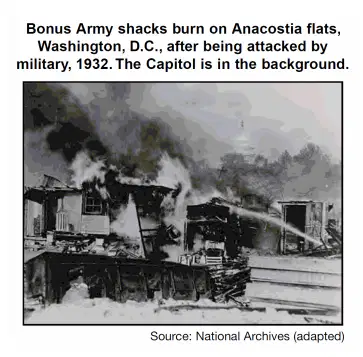
Which statement BEST describes how American citizens responded to the event pictured above?
A. Many opposed government subsidies for low-income housing and other social programs.
B. They began petitioning Congress to decrease funding for the Veterans Administration.
C. Demand for legislation to increase the power of the military spread across the nation.
D. There was widespread criticism against the government for its treatment of World War I veterans.
How did the Japanese bombing of Pearl Harbor affect the United States?
A. It caused Congress to veto the President's war declaration.
B. It led to a continuation of the United States' policy of isolationism.
C. It fully brought the United States out of isolationism.
D. It allowed the United States to act on a long-standing military rivalry with Japan.
The United States dropped two atomic bombs in August 1945. What impact did these bombs have on the outcome of World War II?
A. Germany, Italy, and Japan joined together to form the Axis Powers.
B. Japanese planes responded with a surprise attack on Pearl Harbor.
C. Germany surrendered bringing an official end to World War II.
D. Japan surrendered bringing a second-front end to World War II.
How was continuity maintained by America's unwillingness to welcome Jewish refugees during the Holocaust?
A. Nativist fears and immigration quotas allowed for restricted United States involvement.
B. Executive Order 9066 prevented the United States from admitting Eastern European immigrants.
C. The "Double V Campaign" encouraged American isolationism and anti-Semitism.
D. The German American Bund Rally intensified American desire to help the Jewish people.
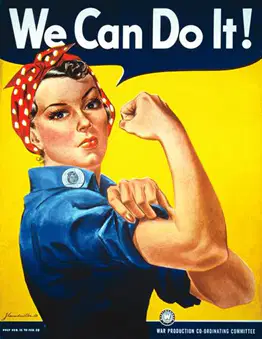
Which World War II reality is represented in the image above?
A. Economic and political efforts of women during WWII led to the 19th Amendment.
B. Wartime mobilization required participation and sacrifice from all Americans.
C. Women were finally allowed to serve in frontline military positions.
D. For the most part, American families were able to function unaffected by the war.
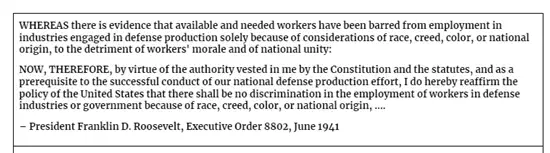
What was the significance of President Franklin Roosevelt's Executive Order 8802?
A. It desegregated public schools.
B. It banned racial discrimination in defense industries.
C. It integrated the armed forces.
D. It made it illegal for government employees to unionize.
Article 1
All human beings are born free and equal in dignity and rights. They are endowed with reason and conscience and should act towards one another in a spirit of brotherhood.
Article 3
Everyone has the right to life, liberty, and security of person.
- Universal Declaration of Human Rights
Which event inspired the United Nations to draft of the Declaration of Human Rights in 1948?
A. The use of atomic bombs against Japan
B. The ongoing conflict between NATO and the Warsaw Pact
C. The atrocities of the Holocaust during World War II
D. The failure of the League of Nations
36. Which of these explains why the Treaty of Versailles is considered a long term cause for World War II?
A. The treaty's harsh conditions caused deep resentment and hardship among the German people.
B. The treaty allowed Germany and Russia to maintain their pre-war boundaries.
C. The foundation for the treaty relied on a Germany that was strong in both economy and military.
D. The conditions of the treaty upset the global balance of power in favor of the United States.
37. Which of the following was considered an American advantage in both world wars?
A. The conflicts were preceded by economic prosperity in the United States.
B. The United States was allied with nations that wanted to make the world safe for democracy.
C. The United States had two or more years to prepare for the conflicts before entering.
D. Presidential leadership in both wars meant the United States joined early and with full strength.
What was the overall goal of American Neutrality Acts from 1935-1939?
A. To stay out of the war until FDR was no longer President
B. To establish Switzerland as the center for world peace
C. To avoid American involvement in another global war
D. To determine responsibility for reparations following World War I

According to the cartoon above, which of the following statements is true?
A. Americans should behave and speak with optimism even though Germany had a stronger military.
B. Rationing and sacrifices of American citizens would be necessary to defeat Hitler.
C. A strong American economy built around manufacturing and consumerism would eventually force Germany to surrender.
D. America had produced too many war goods and needed to join the war to earn back some of its investments.
40. Which of the following BEST explains how World War II contributed to the end of the Great Depression?
A. Economic aid from European nations turned the American economy around.
B. Over time, Keynesian Economic practices shifted money from the rich to the poor.
C. President Franklin Roosevelt's New Deal programs provided economic incentives for enlisted men.
D. Massive government spending on the war effort stimulated both the domestic and global economies.
What was the main goal of the "Double V" movement?
A. To spread capitalism across the globe
B. To achieve victory against dictators in Japan and Europe
C. To defeat racism overseas and at home
D. To secure employment opportunities for women
The war crimes trials that followed World War II were historically significant because for the first time
A. individuals were held accountable for their actions during wartime.
B. nations on both sides were found guilty of causing the war.
C. individuals were given immunity from prosecution.
D. nations were asked to pay for war damages.
In urging the United States to become the "arsenal of democracy," President Franklin
A. created a military draft.
B. provided war materials to Allied nations.
C. sent troops to Europe to fight in the war.
D. made its neutrality laws more restrictive.

