
Font size
 Worksheets
World History Post-Test review
Total questions: 100
Worksheet time: 33mins
The idea that church and State should be separate is called?
Individualism
Humanism
Secularism
Absolutism
A philosophy that focuses on humanity rather than religious works. It emphasized classic (Greek and Roman) thought.
Humanism
Secularism
Stoicism
Communism
Which of these answers are not true about the printing press?
It helped increase literacy rates
It spread information faster than ever
It allowed books like the bible to be printed in multiple languages
It was used by priests to consolidate power in the Catholic Church
Which of these was considered an example of Church corruption?
Indulgences
Usury
the printing press
The Roman inquisition
How did Henry VIII respond to the Popes refusal to grant him a divorce?
He burned down Vatican City
He declared war on the Pope
He created his own religion
Henry VIII accepted the popes decision and stayed married
John Calvin's idea that God has known who will go to Heaven since the beginning of time is called.
Incarnation
Predestination
Revelations
Incantations
The Society of Jesus or Jesuits?
Was created by the Pope to fight the spread of Protestantism
Was created by Martin Luther to spread his message
Were French protestants resisting Catholic rule
Are what we call Roman Catholics in South America
Which of these statements reflects an influence of the Renaissance?
dominance of the church
constant feudal warfare
lack of any governance
increased interest in the arts
The branches of Christianity that developed as a result of protests against the Catholic Church were called?
Greek Orthodox
Protestant
Catholic
Buddhist
This group gained much power in the Middle Ages.
The Roman Catholic Church
Serfs
Pesants
Craftsmen
Why were the Seljuk Turks important early in the Crusades?
they attacked the Byzantine Empire
they asked the pope for help in capturing Jerusalem
they attacked the Holy Roman Empire
they asked the pope for help fighting the Byzantines
Gunpowder and the longbow changed warfare during the 100 Years War because?
they could pierce a knight's armor
they were cheap to produce
they were small in size
they could not destroy a castle wall
The feudalism system was weakened by the Bubonic Plague?
because there were less European workers, they could demand more pay for their labor
the knights killed off the manor lords, leaving no one in charge
disease poisoned the soil
the church took over the feudal system
What is feudalism?
A system where peasants ruled the kingdoms of Europe
A system based on loyalty and obligation that brought social order to Europe
A kingdom where kings gained too much power
You are a peasant. You are bound to the land. You answer to a local lord. You have never left the farm in your lifetime. What is this describing?
Manorialism
Iconoclasm
Feudalism
Serfdom
The system in which the people own and control the means of production, such as mines and factories, is called?
fascism
socialism
capitalism
mercantilism
What is the laissez-faire policy?
a policy that allowed labor to set working conditions based on votes on issues relevant to their industry
a policy where labor created a committee to set working standards without interference from industry owners
a policy that taught owners of industry how to set working conditions based on government standards
a policy that let owners of industry set working conditions without government interference
How did Britain's economy affect the process of industrialization?
positively, by Britain's highly developed banking system, availability, of loans, and climate of progress
positively, by Britain allowing women and children to work long hours and grow wealthy
negatively, by Britain's decision to forbid engineers, mechanics, and toolmakers to leave the country
negatively, by Britain's overseas expansion, which took jobs away from the British citizens
Which of the following factors MOST contributed to the shorter life span of those living in cities as opposed to those in the country?
long working hours
illness caused by unhealthy living conditions
inadequate housing
excessive garbage
What was a benefit of the railroad in Britain?
it encouraged people to emigrate to other countries
it eliminated hundreds of thousands of jobs
it displaced England's agricultural and fishing industries
It offered cheap transportation for materials and goods
Urbanization is?
movement of people for religious reasons.
movement of people from the continent of North America to the continent of Africa
movement of people from rural areas, or farms, to cities
movement of people from cities to rural areas, or farms.
Democracy is?
A government which is ruled by a king.
a state of society without government or law.
Government in which all citizens share in running the government.
a nation’s direct or indirect control over the government of other usually smaller or weaker nations.
Private individuals own property and compete for profits in an open market.
Capitalism
Communism
Socialism
Marxism
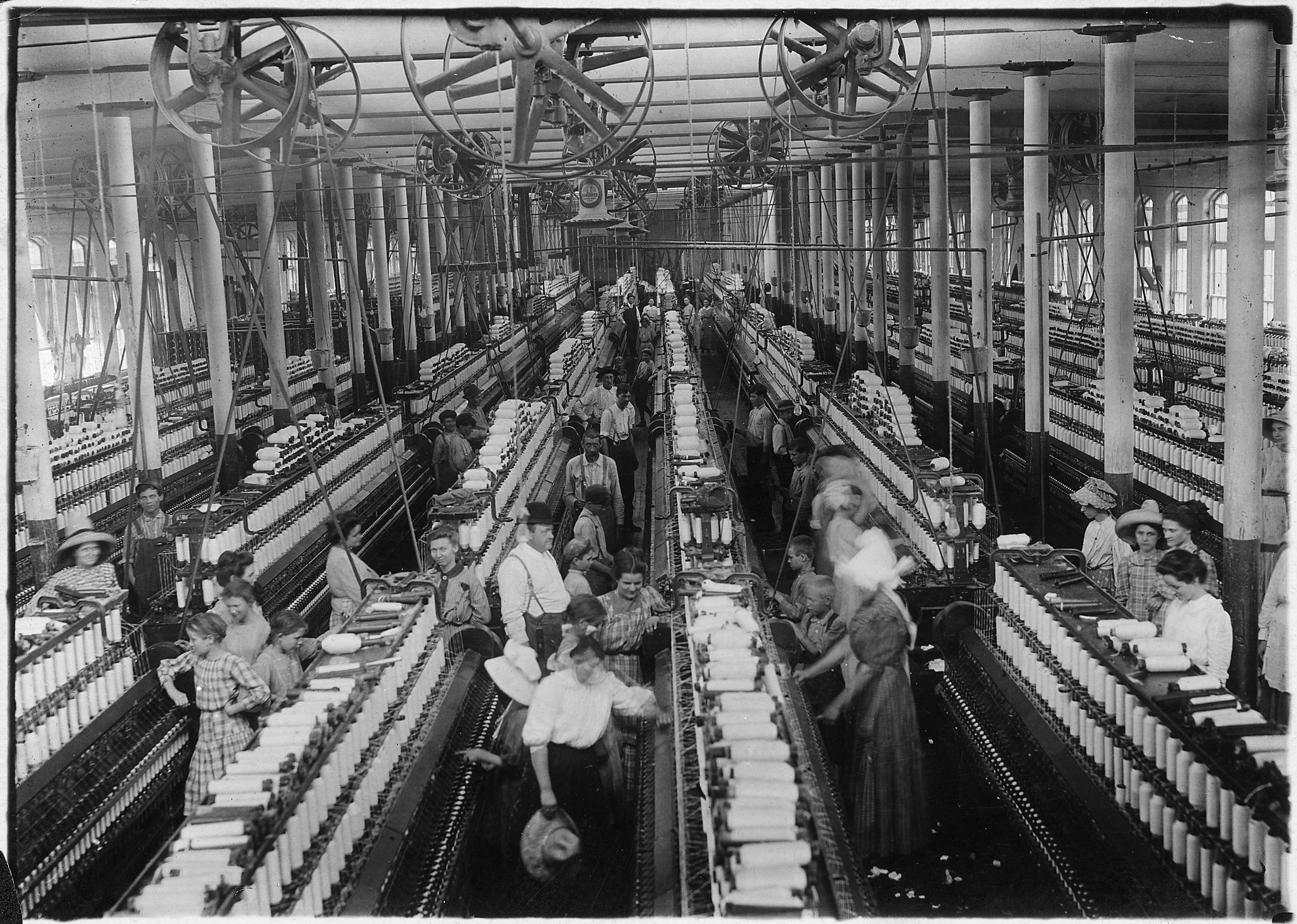
Where were most factories built at the beginning of the Industrial Revolution?
in the mountains
in the desert
along rivers
The influx of urban workers helped boom industry & modernize cities, but led to?
bad and unhealthy working and living conditions for whites.
bad and unhealthy working and living conditions for African Americans.
bad and unhealthy working and living conditions for immigrants.
bad and unhealthy working and living conditions for everyone.
During the Industrial Revolution in England, the failure of social advances to keep up with technological advances led to?
an increased demand by the working class for reform
the adoption of right-to-work laws
a change in government from a monarchy to a republic
the reinforcement of mercantile policies to increase industrial production
In The Communist Manifesto, Karl Marx and Friedrich Engels expressed the idea that?
religion should be the most important factor in society
power should be determined by a person’s wealth
profits from work should belong to the workers
supply and demand should control prices
Which action in Japanese history occurred during the Meiji Restoration?
Japan modernized its economy.
Mongols invaded the islands of Japan.
The Japanese government adopted an isolationist policy.
Buddhism became the official religion of Japan.
What was one impact of industrialization on Japan during the Meiji Restoration?
Japan became more isolated from world affairs.
Demand for natural resources increased.
Japan became a colonial possession of China.
Traditional practices of Bushido were reintroduced.
Which of the following were the results of the Berlin Conference (1884-85)?
Imperialism in Africa ended
European powers divided Africa without regard to cultural or ethnic groups.
Britain took control of Afghanistan in order to protect India from Russia.
Britain took control of the Suez Canal.
What is the term for the belief that others were more fit for survival than others is?
Social Darwinism
Humanitarianism
Natural selection
Nationalism
Which European power took control of the Suez Canal to protect its interests and trade routes?
Britain
France
Germany
Russia
Which European leaders convened the Berlin Conference in 1884?
Jules Ferry
King Leopold II
Otto von Bismarck
Cecil Rhodes
Which 2 areas of Africa remained independent during this colonial period?
Congo
Liberia
Ethiopia
Egypt
Libya
Groups of people who are similar (ex.- language, customs and institutions) that want to be an independent nation.
Conservatism
Imperialism
Nationalism
Liberalism
The strongest countries survive; Also the belief that non Europeans were inferior to Europeans.
White Man's Burden
Social Darwinism
Natural Selection
Evolutionism
Meeting of European nations to decide on rules for dividing up Africa; No African leaders were invited.
African Assembly
Berlin Conference
Concert of Europe
European Convention
The invasion, occupation division and colonization of Africa by Europeans during the period of New Imperialism.
African Divide
Scramble for Africa
Development of Africa
European Exploitation
The belief that Europeans had a duty to spread their culture and advances to the underdeveloped parts of the world which included Africa and Asia.
Social Darwinism
Natural Selection
"White Man's Burden"
Paternalism
Extending power over weaker countries or territories for the benefit of the stronger country; The desire of stronger countries to build an empire.
Nationalism
Imperialism
Conservatism
Liberalism
Chinese rebellion against foreign missionaries and business people.
Black Hand Rebellion
Boxer Rebellion
Sepoy Mutiny
Taiping Rebellion
Why did many industrialized or advanced countries need to takeover less advanced countries?
For better climate and cleaner environment
To create a democratic government
To teach the local population about recycling
To claim or takeover natural resources located in those countries
Why did the Russian Revolution happen? (Select all that apply)
Environmental pollution
Bloody Sunday Massacre
Price inflation
Disastrous wars
Late to industrialize
Who gained power after Lenin died?
Stalin
Trotsky
Kerensky
Lil Peep
The deliberate killing of a large group of people.
patricide
genocide
matricide
none of these
Required military service or draft.
Conscription
Subscription
Encryption
Egyptian
Amassing resources to get ready for war is?
Consolidation
Consideration
Mobilization
Concentration
The Triple Entente.
Great Britain, France, Russia
US, Italy, France
US, Mexico, Russia
None of these
The Triple Alliance.
Germany, Austria-Hungary, Italy
France, Russia, Denmark
Denmark, France, Sweden
Italy, Serbia, Croatia
Ideas spread to influence public opinion is called?
propaganda
conscription
Total war
Lusitania
Payment for war damages.
Conscription
Reparations
Armistice
None of these
How did total war effect women?
Women were encouraged to seek jobs.
Women were encouraged to stay home with the children.
Women were encouraged to fight in the military.
Women were encouraged to protest the war.
What was the Schlieffen Plan?
Russia’s plan to defeat Austria-Hungary
A plan to defeat Britain in unrestricted submarine warfare
Military strategy to convince Mexico to invade the United States
Military strategy for Germany to mobilize against France and Russia at the same time

What treaty is signed to end WWI?
Treaty of Versailles
Treaty of Paris
Geneva Convention
Paris Peace Accords
Which event directly caused the United States to enter World War II?
The sinking of the Lusitania
The battle of Iwo Jima
The bombing of Pearl Harbor
Germany invading Poland
What event sparked the beginning of World War II?
Germans sank the Lusitania
Germans invaded Poland
Germans started the Holocaust
Japan attacked Pearl Harbor
Why was Japan expanding their empire during the early 1900s prior to WWII?
To seek revenge on Korean and Chinese enemies
To gain power over the United States of America
To obtain resources for their factories and militaries
To destroy the European empires
What country did the United States drop atomic bombs?
Germany
France
The Soviet Union
Japan
On which two cities were the atomic bombs dropped?
Hiroshima and Nagasaki
Toyoko and Osaka
Sapporo and Beijing
Nagoya and Yokohama
The systematic killing of over 11 million innocent people by Nazis is known as ___________.
World War II
D-Day
The Holocaust
The Roaring Twenties

What is this poster intended to encourage?
It is meant to encourage women to enter the workforce.
It is meant to encourage women to use their right to vote.
It is meant to encourage women to grow Victory Gardens.
It is meant to encourage women to join the military.
Which of the following was a cause of both World War I and World War II?
The Assassination of Archduke Franz Ferdinand
The German Invasion of Poland
The concept of militarism and imperialism
Germany ignoring the Treaty of Versailles
In what ways did Hitler violate the Treaty of Versailles?
He remilitarized Germany.
He made Germany capitalist.
He established a totalitarian government.
He converted Germany to communism.
The American government's commitment to support countries that rejected Communism.
Truman Doctrine
Domino Theory
Vietnamization
Brinkmanship
When two countries instigate or become indirectly involved in another countries conflict while avoiding direct conflict between themselves.
Domino Theory
Proxy/ Surrogate War
Containment
Cold War
The belief that once one country adopted communism, its neighboring countries would soon follow suit.
Domino Theory
Containment
Truman Doctrine
Brinkmanship
The U.S. foreign policy with the goal of limiting the influence of the U.S.S.R. and stopping the spread of communism.
Domino Theory
Vietnamization
Brinkmanship
Containment
An economic aid package given to Western European countries by the United States after World War II to help them recover and rebuild.
Containment
Vietnamization
The Marshall Plan
The United Nations
An alliance of Western European countries, the United States, and Canada created in 1949 to defend Western Europe from Soviet aggression.
Warsaw Pact
North Atlantic Treaty Organization (NATO)
Cold War
Berlin Airlift
A U.S. policy with the aim of lessening tensions and reducing conflict with the Soviet Union.
Détente
Vietnamization
Brinkmanship
The Space Race
What was the purpose of the Berlin Airlift, between the years 1948 and 1949?
To bring necessary supplies to assist the Communists after World War II.
It was designed to help citizens in France to resist Communism.
Moving Allied soldiers to help fight the Nazis during World War II.
To supply the citizens of West Berlin while the Soviet blockade continued.
What wars were fought during the Cold War as a result of containment and the Domino Theory?
Korean & Vietnam War
WWI & WWII
Civil War & Spanish American War
Persian Gulf & War on Terror

How did the media (television) impact the Vietnam War?
Negative press coverage contributed to the public disillusionment with the war.
The positive press coverage encouraged enlistment in the military.
The impact of the media in Vietnam was rather minimal.
The media showed that the majority of Americans supported the war effort.

Yalta Conference
1945 Meeting with US president FDR, British Prime Minister(PM) Winston Churchill, and and Soviet Leader Stalin during WWII to plan for post-war
July 26, 1945 - Allied leaders Truman, Stalin and Churchill met in Germany to set up zones of control and to inform the Japanese that if they refused to surrender at once, they would face total destruction.
1947, President Truman's policy of providing economic and military aid to any country threatened by communism or totalitarian ideology, mainly helped Greece and Turkey
A 1949 defense alliance initiated by the US, Canada, and 10 Western European nations

Communism
A theory or system of social organization based on the holding of all property in common, actual ownership being ascribed to the community as a whole or to the state.
A political system in which the supreme power lies in a body of citizens who can elect people to represent them
A conflict that was between the US and the Soviet Union. The nations never directly confronted each other on the battlefield but deadly threats went on for years.
The term associated with Senator Joseph McCarthy who led the search for communists in America during the early 1950s through his leadership in the House Un-American Activities Committee.

Mao Zedong
(1893-1976) Leader of the Communist Party in China that overthrew Jiang Jieshi and the Nationalists. Established China as the People's Republic of China and ruled from 1949 until 1976.
Couple executed for giving military secrets to the Soviets in the 1950's
1947, President Truman's policy of providing economic and military aid to any country threatened by communism or totalitarian ideology, mainly helped Greece and Turkey
A country that is dominated politically and economically by another nation.

What do Mikhail Gorbachev's policies of Glasnost & Perestroika mean in English?
crash & burn
Tear down this wall
openness & restructuring
I am a jelly donut
democracy & capitalism
Which event during the Cold War years brought the U.S. and the Soviet Union closest to nuclear war?
the Cuban Missile Crisis
the Persian Gulf War
the Vietnam War
the Korean War


This graph describes?
The beginning of the Industrial Revolution.
The increase in artwork, paid for by patrons of the Renaissance.
The rising unemployment rate in Great Britain, Germany, and the United States during the early 1930s.
The decrease in foreign trade during the Great Depression.

The depression in Germany caused money to lose its value. When prices go up but the value of money goes down it is called?
depression
unemployment
inflation
Communism

