
 Worksheets
APES Unit 9 Review
Total questions: 84
Worksheet time: 4hrs 12mins


Earth's average temperature has increased 1°C in the past century. Which reason best explains this increase in temperature?
lower levels of ozone in the atmosphere
lower levels of nitrogen in the atmosphere
higher levels of carbon dioxide in the atmosphere
higher levels of oxygen in the atmosphere
Which of the following gases is NOT a greenhouse gas?
carbon dioxide (CO2)
nitrogen (N2)
water vapor (H20)
methane (CH4)
Which of the following are evidence of climate change?
extreme weather events
increase in the average global temperature
melting of polar ice caps
all of the above
The main human activity that releases carbon dioxide (CO2) into the atmosphere is...
using bottled water
burning fossil fuels
texting on cellphones
eating meat
Which of the following is contributing to an increase in carbon dioxide (CO2) in the atmosphere?
deforestation
burning fossil fuels
burning down trees
all of the above
Which of the following is produced by cows?
Carbon Dioxide
Water Vapor
Argon
Methane
an area's climate changes and it gets LESS rainfall. what can happen?
more hurricanes
more forest fires
floods
more diseases
what human activities lead to an increase in the amount of greenhouse gases and therefore lead to climate change?
burning fossil fuels for energy
transportation (cars, planes, trains)
farming
all of the above
human activities lead to climate change and global warming because
there are LESS greenhouse gases in the atmosphere and the temperature decreases
there is the SAME amount of greenhouse gases in the atmosphere and the temperature stays the same
there are MORE greenhouse gases in the atmosphere and the temperature is increasing
Warming seas will...
Increase the number of storms
Decrease the number of storms
The number if storms will stay the same
Climate Change will cause...
More intense tropical storms
Less intense tropical storms
no more storms
An example of a climate change mitigation strategy is
mandating more fuel efficient vehicles
building structures to protect from rising sea levels
species migration
using drought resistant crops
CFCs alter the natural formation of ozone by:
breaking up ozone
bonding with O3
preventing UV radiation to strike ozone

What is the main cause of coral bleaching?
Higher ocean temperatures
Not enough carbon dioxide is dissolved in ocean water
Whales chewing on coral reefs
Too much sunlight
One possible positive consequence of an increase in CO2 in the atmosphere?
Plants may grow faster and produce more sugars
Pests like pine beetles will die
Forest fires will be extinguished by the lack of oxygen
Corals will grow faster
What is Arctic (or polar) amplification?
the phenomenon that temperature near the poles is increasing at a higher rate than at lower latitudes
the intensification of the polar jet stream due to melting ice caps
the increased productivity of Arctic ecosystem due to increased upwelling
the migration of the polar front due to stronger pressure contrasts
Which of the following best describes the primary goal of the Paris Agreement?
to create a fund to help countries deal with disaster relief
to validate the science behind climate change for the global community
to keep the global climate temperature increase to under 2 degrees Celsius
to reduce deforestation worldwide

Which law regulates and protects endangered species within the US?
CITES
Endangered Species Act
Kyoto Protocol
Montreal Protocol
Which law regulates the trade in endangered species between countries?
CITES
Endangered Species Act
Kyoto Protocol
Montreal Protocol
Which of these attempts to reduce the rate of Global Warming by reducing greenhouse gas emissions?
CITES
Endangered Species Act
Kyoto Protocol
Montreal Protocol
Pick all of the following traits that make a species LESS likely to go extinct:
Ability to move to a new habitat
Inability to move to a new habitat
Being a specialist
Being a generalist
Pick all of the following traits that make a species More likely to go extinct:
Ability to move to a new habitat
Inability to move to a new habitat
Being a specialist
Being a generalist
Which of the following traits are most likely to be present in an invasive species?
Generalist
Specialist
r-selected species
K-selected species
Which of these is true about the melting of sea ice?
The cold, fresh water added helps to cools the ocean, counteracting the warming.
Ice has a higher albedo than the ocean's surface and so as ice melts, the ocean absorbs more heat.
The melting of sea ice strands polar bears who cannot swim between the "islands" of ice.
AcTUalLY ice ISN'T melting, it's all a conspiracy.
What is true about the melting of permafrost?
The melting of permafrost releases greenhouse gasses, which increases warming.
The melting of permafrost helps to regulate and cool down the air temperature in the arctic.
The melting of permafrost has no affect on anything.
The permafrost is a lie.
What is one of the main reasons for sea level rise?
As water melts, it expands.
Higher amounts of rainfall into the ocean.
As water heats up, it expands.
The ground is sinking down into the ocean.
"Bad ozone" occurs in the
Lithosphere
Mesosphere
Stratosphere
Troposphere
The main elements in CFCs are
Carbon, Calcium, Francium
Carbon, Chlorine, Fluorine
Chromium, Chlorine, Fluorine
Chlorine, Fluorine, Calcium
Which of the following best exemplifies global collaboration for a sustainable environment? (Getting rid of CFCs)
The Antarctic Treaty of 1961
The Clean Air Act of 1972
CERCLA (Superfund)
The Montreal Protocol
Which of the following best describes the importance of ozone in the stratosphere to life on Earth?
Ozone reflects X-rays from the Sun back into space.
Ozone absorbs most of the ultraviolet radiation from the Sun.
Ozone helps to moderate surface temperature by absorbing CO2 and CH4.
Ozone increases mutation rates and accelerates evolution in a variety of species.
The drop in stratospheric ozone levels in the Southern Hemisphere (the "ozone hole") is most evident during which season?
Antarctic spring (October)
Antarctic autumn (April)
Antarctic summer only (January)
Antarctic winter only (July)
Most ozone is formed in the stratosphere by reaction between carbon dioxide and free oxygen atoms.
True
False
The second step of ozone formation involves atomic oxygen combining with what molecule?
CO2
O2
NO2
2H2O
The breakdown of CFCs in the atmosphere is caused by UV rays.
True
False
In the breakdown of ozone, chlorine acts as a
(a)
Which of the following is a greenhouse gas that comes only from human sources?
Nitrous oxide
Carbon dioxide
Methane
Chlorofluorocarbons
Although levels of CFCs in the atmosphere are much lower than those of CO2 , CFCs are still potent greenhouse gases because they
remain in the atmosphere for only a brief time
lack natural sources
are much more efficient at absorbing thermal radiation
are more difficult to remove from smokestacks and tailpipes
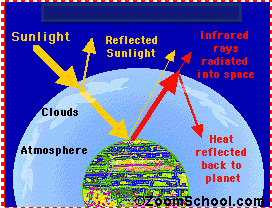
Which of the following best describes the mechanism of the greenhouse effect in Earth's atmosphere?
Infrared radiation from Earth's surface is absorbed by gases in the atmosphere.
Cosmic radiation from deep space is absorbed by gases in the atmosphere.
Alpha radiation from the Sun is absorbed by water vapor in the atmosphere.
Ultraviolet radiation from the Sun is absorbed by ozone gas in the stratosphere.
All of the following gases have been implicated in contributing to the increase in global temperature via the greenhouse effect EXCEPT
CFC's
O2
N2O
CO2
Why is water vapor not considered a significant contributor to global climate change?
The concentration of water vapor is very low compared to the other gases.
Water vapor is inefficient at absorbing heat and does not absorb much of the infrared spectrum.
Trees and other organisms naturally release water vapor during the process of decomposition.
Water vapor has a relatively short residence time in the atmosphere.
A greenhouse gas that, in the lower troposphere, is formed by photochemical reactions
H2O
CO2
CH4
O3
Introduced species can become pests because they;
Produce only a few young after a long period of gestation.
Inhabit only niches that have recently become available after the local extinction of another species.
Can live in many niches, easily adapting to many variables and eating a wide variety of food.
Have a low genetic variability, enabling them to live in a wide variety of habitats.
Increase biodiversity because they attract more species to the areas in which they settle.
Which of the following are ways that an invasive species may enter an aquatic ecosystem?
I. Releasing the ballast water of ships.
II. Dumping household aquariums into lakes.
III. Escaping a coastal aquaculture farm.
I only.
II only.
III only.
I and II only.
I,II, and III.
Presently, the biggest threat to biodiversity is;
Asteriod strikes, such as what happened 65 million years ago and resulted in the extinction of the dinosaurs.
Human population growth, because as population increases, so does the number of plants and animals it consumes, resulting in a decrease of those organisms.
Habitat destruction, such as cutting down portions of tropical rain forest, which destroys the niches occupied by tropical organisms.
The proliferation of zoos and botanical gardens, causing causing people to care less about preserving species in the wild because they are being cared for those in sanctuaries.
Climate change, because it will result in many species moving northward or to higher elevations, seeking out suitable new habitats.
Which of the following is least likely a cause of a species becoming endangered?
Introduction of invasive species
Selective breeding in zoos
Overhunting
Habitat destruction
Pollution
The depleation of the world's marine fish stocks due to overfishing is an example of;
The sustainable use of resources.
The competitive exclusion principle.
The failure of international treaties.
The eminent domain principle.
The tragedy of the commons.
The sale of a large forest to a developer causing the building of roads, logging, and urban development would most likely lead to;
An increase in the number of indicator species because the loss of species durring development would cause the remaining species to become indicators.
An increase in biodiversity because niches are created along roads where the trees are cut down and in new urban areas.
A net increase in available biomass because more sunlight is available for autotrophs.
A loss of biodiversity because of habitat fragmentation, since small populations of species are more vulnerable to predation, competition, and disease.
A decrease in invasive species because they would have a difficult time surviving in fragmented land that has lost many of its resources.
Which of the following would prevent invasive species from being introduced and becoming established?
I. Inspecting foreign goods before they enter the country.
II. Allowing ships to discharge their ballast water as they enter a port.
III. Establishing international treaties, banning the transfer of species across borders.
I only
II only
I and II only
II and III only
I and III only
Which of the following international treaties bans the hunting, capture, and sale of threatened or endangered species in 181 countries?
Endangered Species Act (ESA)
The National Marine Fisheries Act
The Convention on International Trade in Endangered Species (CITIES)
National Enviornmental Policy Act (NEPA)
The Marine Mammal Protection Act
Biological extinction occurs when;
A species becomes extinct in a specific area, such as the gray wolf in the American Northeast.
A species is found nowhere on earth, such as the passenger pigeon.
Additional species are preyed upon, such as when bats adapt their ecolocation ability to hear moths whose ears had adapted to hear the sound frequencies of bats.
There is a loss of indicator species, such as if a population of butterflies quickly declines in an area where they previously had been plentiful .
An event, such as a volcanic eruption, results in some members of a species becoming seperated from other members, and ultimately each group becomes genetically different and can no longer interbreed and produce offspring who can interbreed.
The continuous natural extinction rate of species which is typically balanced by the formation of new species is known as;
Mass extinction.
Background extinction.
Ecological extinction.
Biological extinction.
Instrumental extinction.
Most extinction experts believe that the extent of biodiversity loss will increase over the next 50 to 100 years because of;
The projected growth of the world's human population and resource per person.
The increased loss due to poaching and the demand for endangered species.
the reduced input of solar energy cooling the planet and altering the earth's life.
The acceleration of natural disease processes.
The reduced fragmentation of biodiverse regions.
The giant panda is prone to ecological and biological extinction because of all the following reasons EXCEPT;
It has a low reproductive rate, and it is not usual for pandas to successfully breed in captivity so they can be reintroduced to their habitat.
It lives in specific areas in Asia in a narrow distribution.
It is a specialist, living in a specific habitat and eating only a certain food.
There are limited numbers of giant andas living in the wild.
It is a top predator becasue no other large animal in the area eats only bamboo.
Areas that have been set aside for the protection of threatened or endangered species and their habitats are known as;
National parks.
National zoos
National wildlife refuges.
National recreation areas.
National forest reserves.
A biodiversity hotspot is defined as;
An island habitat that suffers from low immigration rates.
An area that has extinction rates lower than the global average.
An area that has suffered from wetland degradation.
An area that is already a highly endangered center of biodiversity.
A tropical area near the equator
Marine biodiversity is difficult to protect due to;
I. The perception that the seas contain inexhaustible resources.
II. The difficulties in developing, monitoring, and enforcing international agreements.
III. Much of it being out of view of most people.
I only.
II only.
III only.
II and III only.
I, II, and III
Which of the following best demonstrates the effects of biomagnification?
Nutrients from a nearby farm are washed into a pond, resuting in an increase of algae and a loss of oxygen, and eventually a deadzone.
After wolves were domesticated, people chose to breed individuals who had characteristics they desired,resulting in a wide variety of dog breeds with different abilities and physical appearances.
Individual elephants had traits that enabled them to better survive in their habitat, and they became more likely to produce offspring with those traits, enabling the offspring to survive and reproduce.
DDT was a pesticide used universally during the 1950s and 1960s. This chemical entered the food chain and worked its way up eventually making the eggs of predatory birds so fragile, they could not successfully reproduce.
A road built, fragmenting a forest and exposing the animals to introduced species, local climate changes, and diseases.
Choose the option that expresses the definition the best.
"Sale of exotic pets and decorative plants."
Habitat destruction, degradation, and fragmentation.
Invasive (nonnative species).
Population and resource use growth.
Greenhouse effect.
Overexplotation.
Choose the option that expresses the definition the best.
"Logging, mining, building of roads, and urban development."
Habitat destruction,degradation, and fragmentation.
Invasive (nonnative species).
Population and resource use growth.
Greenhouse effect.
Overexplotation.
Choose the option that expresses the definition the best.
"No natural predators, generalist, and high reproductive rate."
Hasbitat destruction, degradation, and fragmentation.
Invasive (nonnative species).
Population and resource use growth.
Greenhouse effect.
Overexplotation.
Severe damage to lichens is especially common ion cities with chronic air pollution; lichens are sensitive to the toxic gases that are present in these pollutants. Lichens are an example of;
An endangered species.
An indicator species.
A keystone species.
An invasive species.
An indigenous species.

Since 1901, the sea level across the globe has risen over 20cm . The change in sea level can be affected by land movement. Land movement itself can be caused by subsiding coastal lands, oil and water extraction, and plate tectonics. The diagram shows the relative sea level rise at various coastal locations in the United States from 1960 to 2014.
Based on the information in the map, which areas in the United States have experienced the greatest sea level rise?
The Northeast and the Gulf of Mexico
The Southeast and the West Coast
The state of California and the state of Hawaii
The Pacific Northwest and the state of Alaska

The graph above shows CO2 measurements taken from Mauna Loa, Hawaii, and the Vostok ice core, which was drilled from ice sheets in Antarctica.
Based on the data shown in the graph, which of the following is the most plausible hypothesis for the cause of the trend in CO2 levels from about 5,000 years ago to the present?
Volcanic activity, which can release over 6 million tons of carbon dioxide per year, has contributed to an increase in ash and dust in the atmosphere, which trap CO2 . This has caused an increase in CO2 in the atmosphere over the past 5,000 years.
Human activity, especially the burning of fossil fuels, has led to an increase in anthropogenic carbon dioxide emissions. This has caused a doubling in the concentration of CO2 in the atmosphere.
Erosion of limestone from sedimentary rock, a result of physical and biological weathering, has released a large amount of carbonic acid into the atmosphere. This has caused a decrease in the concentration of CO2 in the atmosphere.
Increasing rates of photosynthesis in the summers, which are a direct result of increased global temperatures, have led to an increased release of CO2 in warmer months. This has caused the seasonal cycle of CO2 concentrations in the atmosphere.

American crocodiles thrive in healthy estuaries and are found distributed across southern Florida, the Caribbean islands, and in parts of northern South America. The American crocodile has always been considered rare in the state of Florida, and restoration efforts have been in effect for decades to aid the crocodile in heavily populated coastal areas.
Which of the following claims about crocodile nests is best supported by the data in the maps?
Crocodiles now nest in areas where they did not nest historically as a result of restoration projects at public beaches, county parks, and other areas.
The nesting sites for crocodiles is shifting southward as a result of global climate change.
Crocodile eggs are laid during the months of April and May but do not hatch until the fall.
The number and range of crocodiles in southern Florida have decreased over the past 25 years.
The stratospheric ozone layer benefits life on Earth by
absorbing 99% of incoming UV-B and UV-C radiation
contributing to the formation of ground-level ozone
holding large amounts of stratospheric moisture
binding to chlorofluorocarbons (CFCs
CFCs) and breaking down the pollutants
Which of the following best describes why there has been a reduction in ozone depletion over the last half of the twentieth century?
The United States began decreasing CFC emissions under regulations in the Clean Air Act.
Less developed countries developed a global plan to decrease CFC emissions by signing Comprehensive Environmental Response, Compensation Liability Act ( CERCLA ).
Several more developed countries signed the Kyoto Protocol as an agreement to reduce greenhouse gas emissions
A global plan to decrease CFC emissions was enacted by signing the Montreal Protocol
Which of the following best describes why carbon dioxide has a significant effect on global climate change?
Carbon dioxide is a highly reactive molecule.
Carbon dioxide is the largest contributor to anthropogenic greenhouse gas emissions.
Carbon dioxide has the highest global warming potential of all gases in the atmosphere.
Carbon dioxide reflects infrared radiation, which gradually heats the Earth’s surface.
Which of the following best describes the cause of the greenhouse effect on Earth?
Ocean currents redistribute heat from the equator to higher latitudes.
Gases in the atmosphere absorb infrared radiation and radiate the energy back toward Earth’s surface.
Ozone thinning over polar regions allows more ultraviolet (UV) light to reach Earth’s surface.
Surface water temperatures in the Pacific Ocean increase off the coast of South America during El Niño years.

Based on the information in the diagram, which of the following best supports the claim that a change in the duration of warm seasons would result in a higher prevalence of vector-borne diseases?
Ice sheets are melting because of increased temperatures, which is eliminating vector food sources.
A shorter warm season leads to increased competition for mates, resulting in heightened vector aggression.
Increased temperatures provide an expanded breeding range and duration, which will likely increase the size of vector populations.
Climate change has led to a decrease in vector predators, which will lead to an increase in size of vector populations.
Which of the following best describes the effect of increasing global temperature on coral ecosystems?
Warmer water will have higher dissolved oxygen, which will lead to an increase in coral reef ecosystem biodiversity.
White algae will cover the coral reefs, causing the reefs to appear bleached.
Algae that live symbiotically with the corals leave the reef, causing coral bleaching.
Brown algae outcompetes the coral for food, causing the corals to die off.
Which of the following best identifies the primary cause of increasing acidity in the oceans?
Microplastic pollution from personal-care products
Agricultural fertilizer runoff into rivers that feed into the ocean
Petroleum pollution from large-scale oil tanker spills
Carbon dioxide emissions from the combustion of fossil fuels
Which of the following best describes an example of a harmful effect of an invasive species on biodiversity?
Asian carp outcompete native fish species in rivers in the United States.
Invasive zebra mussels increase the population size of several native mollusks in a lake ecosystem.
Polar bears prey on ringed and bearded seals in an Arctic ecosystem.
Wind-blown seeds from a grass species colonize a new volcanic island in the Pacific Ocean.
Which of the following would most likely promote biodiversity in a given area?
Increased use of habitat corridors between fragmented ecosystems
Increased edge effect following the addition of roads, pipelines, electrical wires, and trails in an ecosystem
Increased fires from human activities such as fireworks or campfires
Increased newly introduced species from humans in areas with abundant specialist species

