
 Worksheets
Chapter #15 Infection Control
Total questions: 80
Worksheet time: 1hrs 5mins
True or False: Masks must be changed if they become moist or wet.
True
False
True or False: Gloves should be worn whenever contact with blood, body fluids, secretions, excretions, mucous membranes, tissue specimens, or nonintact skin is possible.
True
False
True or False: Hot water should be used for handwashing because it destroys pathogens.
True
False
True or False: Liquid soap from a dispenser should be used whenever possible because bar soap can contain microorganisms
True
False
True or False: The National Institutes of Health published the Bloodborne Pathogen Standard.
True
False
True or False: Any cut or injury, needlestick, or splashing of blood or body fluid must be reported immediately.
True
False
True or False: Pathogens travel faster through a dry paper towel.
True
False
True or False: Most healthcare facilities prohibit artificial nails.
True
False
How long should you scrub your hands for while washing?
35 seconds
30 seconds
25 seconds
20 seconds
What is a puncture-resistant box used for needles, razor blades, and surgical blades called?
Biohazardous Bag
Waste container
Trash receptacle
Sharps container
What can be used to clean under your fingernails while handwashing?
Select all that apply
nail brush
blunt end of a cuticle/orange stick
rub nails against the palm of the opposite hand
paper towel
What is the first step of taking your gloves off?
Slip the fingers of the ungloved hand inside the cuff of the glove
Grasp the contaminated glove in the palm of the gloved hand
Pull the glove down and turn it inside out while removing it
Use a gloved hand to grasp the outside of the glove of the opposite hand
List 3 examples of Personal Protective Equipment (PPE).
What is the most important method used to practice aseptic technique?
What 3 Bloodborne Pathogens are Healthcare workers MOST concerned about?
What is the name of the federal agency that developed Standard Precautions?
Identify 2 specific body fluids, secretions, or excretions that can be potential sources of infection.
Name 2 procedures where gloves must be worn at ALL times.
What does "OSHA" stand for?
Sharps containers should never be...
BONUS QUESTION (+1 point):
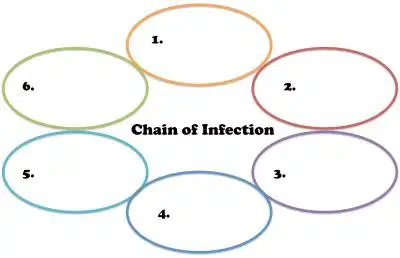
What is the 1st link in the Chain of Infection?
Susceptible Host
Infectious Agent
Portal of Entry
Mode of Transmission
BONUS QUESTION (+1 point):
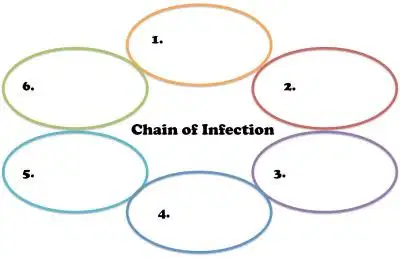
What is the 4th link in the Chain of Infection?
Portal of Exit
Mode of Transmission
Portal of Entry
Susceptible Host
BONUS QUESTION (+1 point):
What is type of Personal Protective Equipment (PPE) that should be worn if splashing of blood, body fluids, secretions or excretions is likely?
BONUS QUESTION (+1 point):
What does the second "S" stand for in the acronym PASS?
Sprinkle
Spray
Sweep
Squeeze
BONUS QUESTION (+1 point):
Before leaving a patient or resident in a bed, observe ALL safety checkpoints! The patient's or resident's bed should be left in the...
waist level
lowest level
working level
highest level
How should a sharp disposed?
Wrap the sharp in a paper towel and place it in a biohazardous waste container
Recap or break any needles and drop into a sharps container
Rinse the sharp under running water and place in the biohazardous waste container
Drop the entire sharp into a sharps container
Which patients should be considered infectious?
A patient you know to have a drug problem
Senior patients who a weak and frail
All patients should be considered infectious
An infant with a high fever
When should a healthcare provider wash their hands with soap and water as opposed to using an alcohol-based hand rub (hand sanitizer)?
When lowering the patient's bed
When the healthcare provider's hands are visibly soiled
When the healthcare provider has not touched anything in the patient's room
When sitting and visiting with a apatient
Which of the following is NOT considered a sharp?
Needles
Syringes
Tongue Depressor
Surgical Blades
How long can a single pair of gloves be used?
During the care for a couple of patients
During the care for one patient
Until a glove looks visibly contaminated
Until the gloves tear
What causes infectious disease?
Pathogens
Invaders
Cells
Nonpathogens
What are health care - associated infection (HAI) formerly known as nosocomial infections?
It is the reservoir in which pathogens like to reside and reproduce
It is a type of infection that was acquired by a person while in a healthcare setting in which they didn't have prior to being in the hospital
It is a standard that states all blood, and body fluids are treated as if they are infectious
It is a type of fungal infection
This is a type of cleaning measure that destroys ALL microorganisms, including viruses and spores.
Antisepsis
Disinfection
Sterilization
Handwashing
This particular type of microorganism is the smallest and is only visible using an electron microscope.
protozoa
bacteria
viruses
helminths
This is an example of a fungal infection.
Malaria
Trichomonas
Athlete's Foot
Monkeypox
How long do you wash your hands?
5 seconds
10 seconds
15 seconds
20 seconds
Standard Precautions must be followed at all times by all health care professionals.
True
False
While washing hands, use hot water to help kill pathogenic organisms.
True
False
Viruses cannot reproduce unless they are inside another living cell.
True
False
After use, needles must be re-capped and placed in a puncture-resistant sharps container.
True
False
Fingertips must be pointing downward while washing hands.
True
False
AIDS is caused by the HBV.
True
False
Airborne precautions are used for patients known or suspected to be infected with rubella (measles) and tuberculosis.
True
False
Any cut, injury, or needlestick no matter how minor or small must be reported immediately.
Ture
False
Anyone entering an Airborne Precaution room must wear a high-efficiency particulate air (HEPA) mask.
True
False
Linens contaminated with body fluids such as urine can be placed in a regular linen hamper.
True
False
Viruses that infect animals can mutate to infect humans, often with lethal results.
True
False
Chemicals are used to disinfect instruments that do not penetrate body tissue.
True
False
Antiseptics can irritate the skin and are used mainly on instruments, not people.
True
False
Standard Precautions do not have to be used on infants and children under 3.
True
False
Protozoa cause diseases such as ringworm and athlete's foot.
True
False
Gloves can be washed between patients and reused.
True
False
If a sterile towel gets wet, it is contaminated and should not be used.
True
False
An exogenous infection or disease originates outside of the body.
True
False
Most waterless hand cleaning products contain bleach for antisepsis and a moisturizer to prevent drying of the skin.
True
False
Microorganisms prefer a light, cold environment to grow and reproduce.
True
False
Every patient must be considered a potential source of infection.
True
False
To remove a contaminated mask, handle it by grasping the straps or by the loops behind the ears.
True
False
Rod shaped bacteria are called spirilla.
True
False
Microorganisms that cause infection and disease are called nonpathogens.
True
False
The immune response of the body allows the body to produce antigens (protective proteins that combat pathogens).
True
False
Many microorganisms are part of the normal flora of the body and are beneficial in maintaining certain body processes.
True
False
A N-95 masks or a more powerful filtering mask, such as a high-efficiency particulate air (HEPA) mask must be worn for?
Droplet Precautions
Contact Precautions
Airborne Precautions
Standard Precautions
Antibiotics are effective medications for viral diseases and infections.
True
False
Which of the following diseases is not caused by a virus?
Common Cold
Hepatitis
Tuberculosis
Measles
Standard Precautions were developed by
World Health Organization
Centers for Disease Control and Prevention
Federal Drug and Food Administration
Occupational Safety and Health Administration
Which of the following is NOT a Bloodborne Pathogen Standard?
Provide PPE
Enforce rules of no eating, drinking, smoking, or applying cosmetics in any area that can be contaminated by blood or other body fluids
Provide training on all regulations to all employees at no cost during work hours
Provide Hepatitis C vaccine free of charge to anyone with an occupational exposure
In the chain of infection, an instrument contaminated with blood acts a a
Portal of Entry
Infectious Agent
Portal of Exit
Reservoir
What part of a sterile field is considered to be contaminated?
1 inch border around it
2 inch border around it
3 inch border around it
4 inch border around it
What type of patient would require to be place in Protective or Reverse Isolation?
What type of bacteria are round or spherical in shape?
Bacilli
Cocci
Spirilla
What type of microorganism live and reproduce in the absence of oxygen?
aerobic
endogenous
anaerobic
exogenous
What class of microorganism are one-celled animal-like organisms often found in decayed materials, animal or bird feces, insect bites, and contaminated water?
Fungi
Rickettsia
Protozoa
Bacteria
What type of microorganism are simple, plant-like organisms that live on dead organic matter?
Bacteria
Fungi
Rickettsiae
Protozoa
What type pf bacteria is rod shaped?
Bacilli
Cocci
Spirilla
What type of microorganisms require oxygen to live?
anerobic
endogenous
exogenous
aerobic
What type of infection occurs when the body's defenses are weak?
HAI
Endogenous
Exogenous
Opportunistic
What is the name of the infection that originates within the body?
Opportunistic
Exogenous
HAI
Endogenous
What type of bacteria are spiral or corkscrew shaped?
Bacilli
Cocci
Spirilla
What means that organisms and pathogens are present?
Contact
Sterile
Contaminated
Asepsis

