wayground logo

Free Printable Worksheets

NEW

Font size

S
M
L
XL
Worksheets

DNA/RNA Scientific Method

Total questions: 40

Worksheet time: 43mins

Name
Class
Date
1.
What is the correct order of the scientific method?
a)
Hypothesis, Experiment, Observation , Conclusion
b)
Conclusion, Observation, Hypothesis, Expiermiment
c)
Observation, Hypothesis, Experiment, Conclusion 
d)
None of these
2.
How many individual chromosomes are there in the Human Genome?
a)
12
b)
48
c)
46
d)
23
3.
What is the definition of Hypothesis?
a)
An educated guess explaining what you are observing, or how to change what you are observing
b)
Carefully watching something around us in the enviroment
c)
Testing your observation and carrying out an experiment 
d)
Judging your ideas based on data from your experiment 
4.
You will use this to determine if your hypothesis was correct
a)
Data
b)
Feelings
c)
Cause and Effect
d)
Hypothesis 
5.
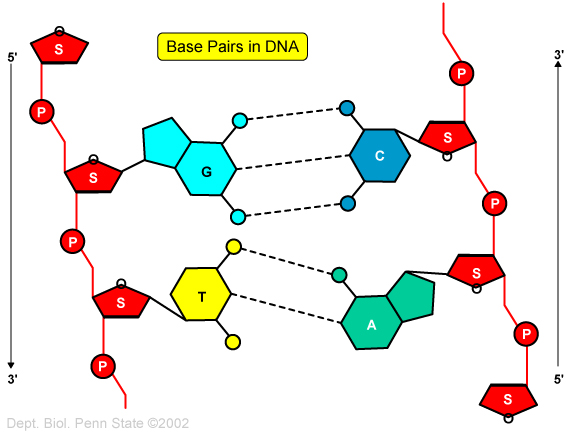
Adenine binds with which nitrogenous base?
a)
Cytosine
b)
Guanine
c)
Thymin
d)
Pronine
6.
Cytosine binds with 
a)
Adenine
b)
Guanine
c)
Thymine
d)
Pronine
7.
This is a random change in DNA 
a)
Mutation
b)
Environment
c)
Double Helix 
d)
genetic engineering 
8.
Which sequence of DNA bases would pair with this partial strand
ATG TGA CAG
a)
ATG TGA CAG
b)
TAC ACT GTC
c)
GTA AGT GAC
d)
CAT TCA CTG
9.
Which of the following best describes a DNA molecule?
a)
double helix
b)
contains ribose
c)
made of amino acids
d)
contains Uracil
10.
Which of the following units are repeatedly joined together to form a strand of DNA?
a)
amino acids
b)
nucleotides
c)
fatty acids
d)
polysaccharides
11.
In a molecule of double-stranded DNA, the amount of Adenine present is always equal to the amount of
a)
cytosine
b)
guanine
c)
thymine
d)
uracil
12.
Why is DNA important?
a)
it is very small and very complicated
b)
it's in everything
c)
it serves as the blueprint for traits of all living things
d)
because we eat it every day for energy
13.
What determines the code, or information, of a DNA molecule?
a)
the shape (structure) of the nitrogen bases
b)
the order (sequence) of the nitrogen bases
c)
the color of the nitrogen bases
d)
the frequency (number) of nitrogen bases
14.
Which 2 molecules form the sides (backbone) of the DNA ladder?
a)
deoxyribose sugar and adenine
b)
deoxyribose sugar and a hydrogen bond
c)
deoxyribose sugar and the nucleus
d)
deoxyribose sugar and phosphate
15.
What are the three components of a nucleotide?
a)
sugar, hydrogen, nitrogen base
b)
sugar, oxygen, nitrogen base
c)
sugar, phosphate, nitrogen base
d)
sugar, phosphate, protein
16.
A process in which DNA has the unique ability to make an exact copy of itself.
a)
Replication
b)
Translation
c)
Transcription
17.
Nitrogenous bases are joined by which type of bond?
a)
polar bonds
b)
ionic bonds
c)
covalent bonds
d)
hydrogen bonds
18.
The following picture must be
a)
DNA because it's double stranded
b)
RNA because it's single stranded
c)
DNA because it's single stranded
d)
RNA because it's double stranded
19.
A process in which DNA has the unique ability to make an exact copy of itself.
a)
Replication
b)
Translation
c)
Transcription
20.
Which of the following units are repeatedly joined together to form a strand of DNA?
a)
amino acids
b)
nucleotides
c)
fatty acids
d)
polysaccharides
21.
RNA contains the sugar
a)
ribose
b)
deoxyribose
c)
glucose
d)
lactose
22.
What is the difference between DNA and RNA in terms of bases?
a)
RNA contains uracil in place of thymine
b)
RNA contains uracil in place of adenine
c)
RNA contains uracil in place of guanine
d)
RNA contains uracil in place of  cytosine
23.
Which type of RNA takes the instructions from the nucleus to the cytoplasm?
a)
mRNA
b)
tRNA
c)
rRNA
d)
RNA polymerase
24.
What is the template for mRNA?
a)
DNA
b)
tRNA
c)
rRNA
d)
proteins
25.
What is the product of translation?
a)
DNA
b)
mRNA
c)
tRNA
d)
proteins
26.
What is the product of transcription?
a)
DNA
b)
mRNA
c)
tRNA
d)
proteins
27.
How many nucleotides make a codon?
a)
1
b)
2
c)
3
d)
6
28.
What is the central dogma of molecular biology?
a)
RNA-protein-DNA
b)
RNA-DNA-protein
c)
DNA-protein-RNA
d)
DNA-RNA-prtein
29.

This variable in an experiment is the one being deliberately changed by the scientist.

a)

dependent variable

b)

independent variable

c)

data

d)

control group

30.

An experiment is performed on plants to see how different liquids affect plant growth. Each plant in the experiment is given a different liquid; water, apple juice, or milk. Each plant has the same amount of soil, sunlight, and listens to the same music. In this investigation, the manipulated/independent variable is ...

a)

The type of plant

b)

The amount of sunlight

c)

The type of music

d)

The type of liquid

31.

On what axis should the manipulated/independent variable always be?

a)

X

b)

Y

32.

Susan said, “If I fertilize my geranium plants, then they will blossom.” Which step of the scientific method is this?

a)

recognize a problem

b)

test the hypothesis with an experiment

c)

form a hypothesis

d)

draw conclusions

33.
This is the group that we will compare our experimental group to. This group stays "normal."
a)
Control Group
b)
Experimental Group
c)
 Normal Group
d)
Weird Group
34.

Living things are based on a universal genetic code. What molecule is responsible for that code?

a)

RNA

b)

Lipid

c)

Protein

d)

DNA

35.

The combination of chemical reactions through which an organism builds up or breaks down materials as it carries out its life processes is called ...

a)

absorption

b)

metabolism

c)

digestion

d)

consumption

36.

Maintaining a stable internal environment is called

a)

homeostasis

b)

equilibrium

c)

balance

d)

evenness

37.

Reproduction that involves two cells from different parents unite to produce the first cell of a new organism.

a)

Asexual

b)

Sexual

c)

Budding

d)

Division

38.

Living things are made up of units called

a)

DNA

b)

Cells

c)

Homeostasis

d)

Seeds

39.

A stimulus can be external or internal.

a)

False

b)

True

40.
A worm turns away from light is an example of a worm
a)
reproducing
b)
doing cellular respiration
c)
having cells
d)
responding to its environment