
NEW
Font size
 Worksheets
ES Regents - Sun's Path
Total questions: 35
Worksheet time: 35mins

The diagram shows Earth on a particular day in its orbit around the Sun. The dashed line represents Earth’s axis.
Which date is represented by the diagram?
March 21
June 21
September 23
December 21

Base your answers on the diagram, which shows the tilt of Earth on its axis in relation to the Sun on one particular day. Points A through E are locations on Earth’s surface. Point D is located in New York State. The dashed line represents Earth’s axis.
Which diagram best represents the angle of the Sun’s rays received at location C at noon on this day?


Base your answers on the diagram, which shows the tilt of Earth on its axis in relation to the Sun on one particular day. Points A through E are locations on Earth’s surface. Point D is located in New York State. The dashed line represents Earth’s axis.
What is the latitude of location A?
0°
23 1/2 ° N
63 1/2 ° S
90° N
Base your answers on the diagram, which shows the tilt of Earth on its axis in relation to the Sun on one particular day. Points A through E are locations on Earth’s surface. Point D is located in New York State. The dashed line represents Earth’s axis.
On this day, which location has the greatest number of hours of daylight?
E
B
C
D

Base your answer on the diagram, which represents the position of the Sun with respect to Earth’s surface at solar noon on certain dates. The latitudes of six locations on the same line of longitude are shown. The observer is located at 42° N in New York State. The date for the Sun at position A has been deliberately left blank.
At which New York State location could the observer be located?
Plattsburgh
Mount Marcy
New York City
Slide Mountain
Base your answer on the diagram, which represents the position of the Sun with respect to Earth’s surface at solar noon on certain dates. The latitudes of six locations on the same line of longitude are shown. The observer is located at 42° N in New York State. The date for the Sun at position A has been deliberately left blank.
When the Sun is at position A, which latitude receives the most direct rays of the Sun?
Tropic of Cancer (23.5° N)
Tropic of Capricorn (23.5° S)
Equator (0°)
Antarctic Circle (66.5° S)
Base your answer on the diagram, which represents the position of the Sun with respect to Earth’s surface at solar noon on certain dates. The latitudes of six locations on the same line of longitude are shown. The observer is located at 42° N in New York State. The date for the Sun at position A has been deliberately left blank.
When the Sun is at the March 21 position, New York State will usually have
longer days than nights
12 hours of daylight and 12 hours of darkness
the lowest annual altitude of the Sun at solar noon
the highest annual altitude of the Sun at solar noon

Base your answer on the diagram, which shows a model of the apparent path and position of the Sun in relation to an observer at four different locations, A, B, C, and D, on Earth’s surface on the dates indicated. The zenith (z) and the actual position of the Sun in the model at the time of the observation are shown. [The zenith is the point directly over the observer.]
According to the Sun’s actual position shown in the diagrams, the most intense insolation is being received by the observer at location
A
B
C
D
Base your answer on the diagram, which shows a model of the apparent path and position of the Sun in relation to an observer at four different locations, A, B, C, and D, on Earth’s surface on the dates indicated. The zenith (z) and the actual position of the Sun in the model at the time of the observation are shown. [The zenith is the point directly over the observer.]
Where on Earth’s surface is the observer at location C located?
at the Equator
at the South Pole
at the North Pole
in Oswego, New York
Base your answer on the diagram, which shows a model of the apparent path and position of the Sun in relation to an observer at four different locations, A, B, C, and D, on Earth’s surface on the dates indicated. The zenith (z) and the actual position of the Sun in the model at the time of the observation are shown. [The zenith is the point directly over the observer.]
From sunrise to sunset at location B, the length of the observer’s shadow will
increase, only
decrease, only
increase, then decrease
decrease, then increase

Base your answer on the diagram, which shows sunlight entering a room through the same window at three different times on the same winter day.
The apparent change in the Sun’s position shown in the diagram is best explained by
the Sun rotating at a rate of 15° per hour
Earth rotating at a rate of 15° per hour
the Sun’s axis tilted at an angle of 23.5 °
Earth’s axis tilted at an angle of 23.5 °
Base your answer on the diagram, which shows sunlight entering a room through the same window at three different times on the same winter day.
This room is located in a building in New York State. On which side of the building is the window located?
north
south
west
east

Base your answer on the diagram, which shows the angle of the Sun’s noontime rays received at different Earth latitudes on May 1.
Which changes can be expected to occur at 45° N over the next 30 days?
The duration of insolation will decrease and the temperature will decrease.
The duration of insolation will decrease and the temperature will increase.
The duration of insolation will increase and the temperature will decrease.
The duration of insolation will increase and the temperature will increase.
Base your answer on the diagram, which shows the angle of the Sun’s noontime rays received at different Earth latitudes on May 1.
At which latitude can the noontime Sun be observed in the northern part of the sky?
0°
30° N
60° N
90° N
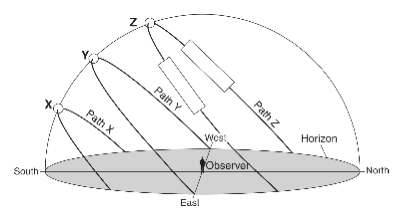
Which model best represents the apparent path of the Sun observed at various times during the year at the Equator?


On June 21, where will the Sun appear to rise for an observer located in New York State?
due west
due east
north of due east
south of due east
How many times will the Sun’s perpendicular rays cross Earth’s Equator between March 1 of one year and March 1 of the next year?
1
2
3
4

Base your answers on the diagram and on your knowledge of Earth science. The diagram shows a pin perpendicular to a card. The card was placed outdoors in the sunlight on a horizontal surface. The positions of the pin’s shadow on the card were recorded several times on March 21 by an observer in New York State.
Which diagram best represents the length of the pin’s shadow at 2 p.m. on March 21?


Base your answers on the diagram and on your knowledge of Earth science. The diagram shows a pin perpendicular to a card. The card was placed outdoors in the sunlight on a horizontal surface. The positions of the pin’s shadow on the card were recorded several times on March 21 by an observer in New York State.
The changing location of the pin’s shadow on March 21 is caused by
the Sun’s rotation
the Sun’s revolution
Earth’s rotation
Earth’s revolution
The intensity of insolation at solar noon from November 1 to February 1 in New York State will
decrease, only
increase, only
decrease, then increase
increase, then decrease
In New York State, the number of hours of daylight each day increases continuously from
March 1 to May 1
June 1 to August 1
September 1 to November 1
December 1 to February 1
In New York, which day has the shortest duration of insolation?
March 21
June 21
June 21
December 21
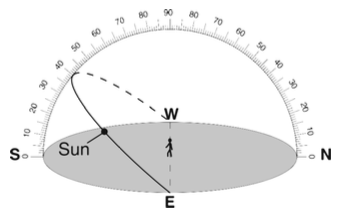
How many degrees does the Sun appear to move across the sky in four hours?
60°
45°
15°
4°
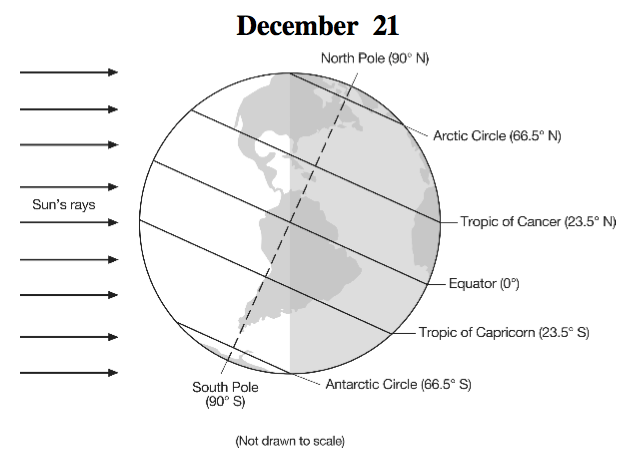
What latitude experiences direct sun rays on December 21st?
23.5°N
0° (Equator)
23.5° S
66.5° S
What would most likely happen to New York State’s summer and winter temperatures if the tilt of Earth’s axis increased from 23.5° to 30°?
Both the summers and winters would become cooler.
Both the summers and winters would become warmer.
The summers would become cooler and the winters would become warmer.
The summers would become warmer and the winters would become cooler.

