
 Worksheets
ER: Flow of Energy and Stability
Total questions: 21
Worksheet time: 40mins

What is the carrying capacity of the following graph?
1000
8000
800
600



Which answer is true regarding biodiversity?
As long as there are enough producers, an ecosystem is considered to have a good amount of biodiversity.
The rain forest has an unhealthy ecosystem because its biodiversity is too great.
An ecosystem is healthier when the biodiversity is great.
Biodiversity is positively affected when non-native species are introduced into an environment
Which ecosystem below describes a stable ecosystem?
An invasive species decreased the amount of biodiversity by half
This ecosystem’s deer have increased due the loss of a predator population, now the producer population has decreased by ¼.
This ecosystem suffered a tornado, but due to great biodiversity, it was able to be restored.
This ecosystem is impacted by overfishing, causing 3 fish species to become extinct.

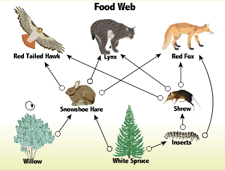
How might deforestation impact this ecosystem?
Birds will increase
Squirrels will increase
Insects and birds will decrease
Insects and birds will increase

Describe what would happen to the zebra population and the plant population if the cheetah and hyena both left the ecosystem.
The zebra population would decrease with the absence of predators; the plant population would stay the same.
The zebra population would greatly increase, causing the plant population to decrease.
The zebra population would decrease, causing the plant population to increase.
The zebra population would greatly increase, causing the plant population to also increase.
The San Marcos salamander, Eurycea nana, is a light reddish-brown translucent salamander about 2-5 cm in length. E. nana is found only in Spring Lake and a portion of the San Marcos River.
Which human activity would most likely decrease the ability of the salamanders to survive?
Increasing water consumption that decreases the flow of clean water from the springs that feed the river.
Public transportation that reduces the number of automobiles that contribute to pollution runoff into the river.
Tourism that helps fund the education programs related to tiver ecosystem conservation.
The addition of a new food source into the river that limits competition for resources.
In the mid-1980s an aggressive strain of algae known as Caulerpa was accidentally introduced into the Mediterranean Sea when a seaside aquarium cleaned out its tanks. The algae contains a toxin that prevents native herbivores from consuming it. Caulerpa quickly spread over the sea floor, crowding out many species including sponges, corals, sea fans, and lobsters.
Which statement explains the most likely impact Caulerpa has had on the biodiversity of the Mediterranean Sea?
The presence of Caulerpa within an ecosystem is an indicator of the ecosystem's health.
The spread of Caulerpa improved the habitat for many species of sea grasses, and increased the biodiversity.
Caulerpa interbred with native species with the smae adaptations within the ecosystem.
Caulerpa became dominant within the ecosystem and reduced the biodiversity.

Food webs such as the one shown were first used in 1927 by the animal ecologist Charles Elton. The food web below represents the feeding relationships among organisms in an Alaskan ecosystem.
An environmental change that removed which of these organisms from the ecosystem would cause the most instability in the ecosystem?
Auklets
Foxes
Salmon
Zooplankton

Pink salmon were nearly eliminated after the oil spill
Pink salmon populations steadily declined in the 10 years following the spill
Pink salmon populations declined and never fully recovered
Pink salmon populations seemed to be minimally affected

The ecosystems will become unstable because predators will have fewer prey, the birds will have fewer nesting sites, and the area downriver will become vulnerable to flooding without the burrows to aerate the soil and provide drainage for monsoon rains.
The ecosystem will become more stable because the pika will be replaced by other species of small mammals that can fill the niche, bird species will adapt to nesting aboveground, and the soils will become compacted without the burrows.
The ecosystem will become unstable because the predators will migrate to nearby ecosystems, the birds will nest in nearby trees, and the soils will be aerated by other small mammals.
The ecosystem will become more stable because the pika will no longer be there to eat the grasses, the birds will migrate to other ecosystems during nesting season, and the soils will be able to absorb more of the monsoon rains without the pika burrows.
The introduction of a non-native, or (a) species, like the Zebra mussel, is problematic because these species may (b) with native species and reduce (c) .

If a blue catfish is introduced and eats the large fish who eat the smaller fish, the population of the smaller fish will (a) .
THE CODE TO THE ANSWER FORM is: Monstera
Pick both answers to get it right
Perfect! i copied it!
YEP! I got the code!
![[Practice Test] Skeletal & Muscular Systems](https://cf.quizizz.com/image/image-loader.svg)
