Wayground logo

Free Printable Worksheets

Font size

S
M
L
XL
Worksheets

Physical Science Pt. 2

Total questions: 67

Worksheet time: 49mins

Name
Class
Date
1.
Some students observing a classroom device being used, noticed the below energy transformations. 
Electrical → Mechanical → Sound
Which device were the students most likely observing?
a)
A triple beam balance measuring an object’s mass.
b)
A pencil sharpener plugged into a wall outlet.
c)
A projector displaying a diagram on the screen.
d)
A working flashlight used to light up a dark corner.
2.
Which type of energy transformation occurs when a flashlight shines?
a)
chemical → thermal → electrical
b)
chemical → electrical → light
c)
thermal → chemical → light
d)
chemical → electrical → chemical
3.
When water falls through a dam and turns a turbine connected to a generator, electricity is produced. This electricity is often used to light our homes and offices. Which of the following shows the energy transformations that occurs?
a)
electrical → light → mechanical
b)
chemical → mechanical → electrical
c)
mechanical → chemical → light
d)
mechanical → electrical → light
4.
A lamp that plugs into a wall socket draws energy which flows through a thin wire in the bulb causing it to glow. What energy transformations are taking place?
a)
chemical → light → electrical
b)
mechanical → sound → light
c)
thermal → solar → electrical
d)
electrical → thermal → light
5.
Which of the following shows the correct order of the energy transformations that occur when green plants produce their food from the Sun’s energy?
a)
chemical → thermal
b)
light → chemical
c)
thermal → light
d)
chemical → electrical
6.
The Theory of the Conservation of Energy states -
a)
Energy can be created, just not destroyed. It changes its form from one type to another.
b)
Energy can never be created nor destroyed. It can only change its form from one type to another.
c)
The total energy in our Universe changes, as different forms of energies can be transformed from each other under certain circumstances.
d)
Energy transformations do not passively occur in our lives, rather we actively make use of energies and transform energies.
7.
Solar Energy is transferred to _____ Energy.
a)
Mechanical
b)
Solar
c)
Sound
d)
Electrical
8.
Electrical Energy is transferred to _____ Energy.
a)
Thermal
b)
Solar
c)
Electrical
d)
None
9.
Kinetic Energy is transferred to _____ Energy.
a)
Solar
b)
Electrical
c)
Thermal
d)
Potential
10.
Which of the following shows an energy transformation from chemical energy to electrical to light energy?
a)
A bolt of lightning lights the night sky.
b)
A candle glows brightly in the dark.
c)
A fire in a fireplace lights up a room.
d)
A battery causes a flashlight to shine.
11.
People get energy from the food that they eat and transform that energy as they move. Which energy transformations occur as a student rapidly rubs the palms of his hands together?
a)
mechanical to thermal to electrical
b)
chemical to mechanical to thermal
c)
mechanical to chemical to sound
d)
chemical to sound to electrical
12.
A television works by transforming electrical energy into what other kinds of energy?
a)
Light, thermal, and sound
b)
Thermal, chemical, and solar
c)
Sound, mechanical, and electrical
d)
Light, chemical, and mechanical
13.
Energy transformations occur when...
a)
energy is created through conduction
b)
energy changes from one form to another
c)
two forces slide together that are touching
d)
a chemical reaction takes place
14.

Energy is the ability to do work or cause changes.

a)

True

b)

False

15.

Which of following are types of kinetic energy? Check all that apply.

a)

sound energy

b)

light energy

c)

thermal energy

d)

mechanical energy

e)

potential

16.

We receive ________ and heat energy from the Sun.

a)

sound

b)

mechanical

c)

light

d)

kinetic

17.

Vibrations produce _______ energy.

a)

chemical

b)

sound

c)

potential

d)

light

18.

Which of the following is an example of kinetic energy?

a)

A rock at the top of a hill.

b)

Water falling down a waterfall.

c)

A pencil sitting on a desk.

d)

A backpack on the ground.

19.
Energy is stored in the ___ of an atom.
a)
proton
b)
neutron
c)
electron cloud
d)
nucleus
20.
How do nuclear power-plants work?
a)
Fusion
b)
Half-life
c)
Fission
d)
Fusion or fission
21.
What would be the effect on the particles if more heat is supplied to the system?
a)
They would slow down
b)
They would stop moving
c)
They would speed up
d)
There would be no effect
22.
Heat transfers from ______ objects to cold objects. 
a)
Cold
b)
Hot
c)
Convection
d)
Radiation 
23.
What type of heat transfer happens in liquids and gases?
a)
Conduction
b)
Convection
c)
Radiation
24.
Touching hot sand is.... 
a)
Conduction
b)
Convection
c)
Radiation 
25.
Hot air ______ while cool air ____
a)
Sinks, Rises
b)
Rises, Rises
c)
Rises, Sinks
d)
Convection, Radiation 
26.
Hot air rising from a campfire is...
a)
Conduction
b)
Convection
c)
Radiation 
27.
Boiling water is an example of what two types of heat transfer
a)
Conduction and Radiation
b)
Conduction and Convection
c)
Radiation and Convection
28.
When water from a lake evaporates...
a)
Conduction
b)
Convection
c)
Radiation 
29.
Rubber is considered an _____
a)
Conductor
b)
Insulator
c)
Radiation 
d)
None of the above
30.
Objects that allow energy to pass through them easily are _______
a)
Insulators
b)
Conduction
c)
Conductors
d)
None of the above
31.
Sun tanning is an example of....
a)
Conduction
b)
Convection
c)
Radiation 
32.
Temperature is the measurement of the average ________ energy of the molecules in an object
a)
Kinetic 
b)
Heat
c)
Motion
d)
None of the above
33.
Which of the following is not a conductor 
a)
Wood
b)
Copper
c)
Iron
d)
Silver 
34.
When you touch a cold window, how is energy being transferred?
a)
The window transfers heat to you 
b)
You transfer heat to the window
c)
The sun transfers heat to you
d)
None of the above
35.
Ice melting in a cup is caused by....
a)
The ice is heated up by the drink
b)
Ice is cooling down the liquid
36.
Which of the following is not an example of convection
a)
Cool breeze coming off the ocean
b)
Water boiling when you make Mac & Cheese
c)
A fireplace heating up a room
d)
Lighting a candle 
37.

How will heat flow?

a)

From A to B

b)

From B to A

c)

There is no heat flow.

38.
(T or F?) A balanced force is only an object that is not moving. 
a)
True 
b)
False
39.
What will cause an object to move?
a)
Applied forces
b)
Balanced forces
c)
Unbalanced forces
40.
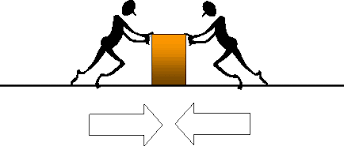
If an object is stationary (not moving) the forces acting upon it are _____________
a)
unbalanced
b)
weak
c)
balanced
d)
Hulk Smash!
41.
The force that pulls things toward earth.
a)
Speed
b)
Gravity
42.
Which one is balanced?
a)
top
b)
bottom
c)
both
43.
With unbalanced forces, the object will move in the direction of the _______ force.
a)
larger 
b)
smaller 
c)
equal 
d)
cannot be determined
44.
At which letter is potential energy the highest?
a)
b
b)
c
c)
a 
d)
d 
45.
At which letter is kinetic energy the highest?
a)
a
b)
b
c)
c
d)
d
46.
In the diagram, a wind turbine is transforming energy from the wind. Between which two steps in the diagram is mechanical energy being converted into electrical energy?
a)
1 and 2
b)
2 and 3
c)
3 and 4
d)
4 and 5
47.
(6.9C) When a lion eats a zebra and then uses the energy from the zebra to run, the lion's body converts- 
a)
chemical energy to mechanical energy
b)
electrical energy to chemical energy
c)
chemical energy to light energy
d)
mechanical energy to chemical energy
48.

When a pendulum swings, at which point is potential energy at its greatest? (6.8A)

a)

1

b)

2

c)

3

d)

4

49.

As a boulder rolls from the top of the hill to the bottom, how does its potential and kinetic energy change? (6.8A)

a)

Potential and kinetic energy both increase

b)

Potential increaes and kinetic decreases

c)

Potential decreases and kinetic increases

d)

Potential and kinetic energy both decrease

50.

The area around a magnet is called the .....

a)

attraction zone

b)

work area

c)

magnetic field

d)

hot zone

51.

What would happen is a north pole of a magnet came close to a north pole of another magnet?

a)

they would be attracted to each other

b)

they would be repelled from each other

52.

Where is the the pushing or pulling force of a magnet strongest?

a)

In the middle of the magnet

b)

At the ends of the magnet

c)

Same all the way through the magnet

d)

none of them

53.

What happens if you hold the south pole of one magnet close to the north pole of another magnet?

a)

They will attract each other

b)

They will repel each other

c)

They will grow very hot

d)

Nothing will happen

54.
What subatomic particle causes magnetism in an atom? 
a)
protons
b)
neutrons
c)
electrons
d)
nucleus
55.

How is Earth's magnetic field similar to that of a magnet?

a)

It's shaped like a horseshoe.

b)

It has north and south poles.

c)

It is made plastic.

d)

It is hundreds of miles long.

56.
This is a picture of a simple electromagnet. How can the electromagnet be made stronger?
a)
Add more coils of wire to the nail.
b)
Use a smaller battery.
c)
Reverse the poles of the magnet.
d)
Remove all the coils and the nail.
57.
How are electromagnets different from magnets?
a)
magnets can be turned on/off
b)
you can turn an electromagnet on/off
c)
magnets are more powerful
d)
magnets have a North and South pole
58.

Why does a compass needle point north?

a)

Because it is being attracted to the Magnetic South Pole

b)

Because north is up

c)

Because it is being attracted to the Magnetic North Pole

d)

Because north is down

59.
A magnet cannot not move which of the following objects?
a)
a paper clip
b)
a nail
c)
a toothpick
d)
a staple
60.
Magnetic force between two magnets gets weaker the more ________________ between them.
a)
distance
b)
attraction
c)
metal
d)
lightsabers
61.
Charged objects can be attracted to:
a)
Neutral objects 
b)
Objects with the opposite charge
c)
Both
62.
The transfer of what type of atomic particle is responsible for the static charges on objects?
a)
neutrons
b)
protons
c)
electrons
d)
none of these
63.
What types of charges repel?
a)
Positive and Positive
b)
Positive and Neutral
c)
Negative and Neutral
d)
Neutral and Neutral
64.
If a substance has a higher number of electrons than protons on its surface, what type of charge does it have?
a)
A positive charge.
b)
A negative charge.
c)
A neutral charge
d)
No charge at all
65.
Walking across a carpet is an example of charge being transferred by
a)
friction.
b)
induction.
c)
contact.
d)
static electricity
66.
Which part of the atom is positively charged?
a)
Proton
b)
Neutron
c)
Electron
67.
A balloon has a negative charge.  The glass rod has a positive charge.  What will happen when the glass rod is brought near the balloon?
a)
The balloon will be attracted to the rod
b)
The balloon will be repelled by the rod
c)
The balloon will remain in place
d)
The balloon will spin in circles