
NEW
Font size
 Worksheets
Unit 6 - Solubility Practice
Total questions: 40
Worksheet time: 2hrs 0mins

How many grams of K2Cr2O7, are soluble in 100 g of water at 95 ºC?
83 grams
75 grams
40 grams
12 grams


How many grams of CaCl2, are soluble in 100 g of water at approximately 17 ºC?
58 grams
70 grams
0 grams
12 grams
In a solution, the part that DOES the dissolving-
Strainer
Solvent
Solute
Magnetism
The substance which dissolved in the solvent
Dissolve
Solubility
Solvent
Solute
In a solution of salt water, _________ is the solvent.
salt
water
In a solution of salt water, the __________ is the solute.
salt
water
It does NOT dissolve in water.
soluble
insoluble
solute + solvent =
solution
equation
Solutes dissolve quicker in _________ water.
cold
warm
Solutes dissolve quicker if you stir them.
true
false
The substance BEING dissolved in a solution.
sands
solute
solvent
alloy
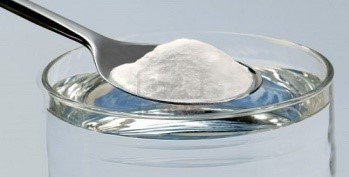

In which beaker does salt dissolves faster?
Hot water
Room temperature
Ice watet

solvent
solute

solvent
solute

Hydrogen attractions between water molecules are called
Covalent bonds
Ionic bonds
Polar bonds
Hydrogen bonds

soluble
insoluble
Which of the following would NOT increase the rate at which a sugar cube dissolves?
Reducing the amount of solvent
Crushing the sugar cube
Stirring the solution
Heating the solvent
You can make a solute dissolve more quickly in a solvent by
adding more solute.
adding ice.
heating the solvent.
removing some solvent.
Which of the following would result in being able to dissolve a greater amount of solid in a solution?
Lower the temperature.
Decrease the pressure of the solution.
Increase the pressure of the solution.
Heat the solution.
Stirring the solution...
decrease the rate of solubility
Doesn't change the rate of solubility
increase the rate of solubility
None of the above
When you measure how fast a solute dissolves, you are measuring the
amount of dissolving
rate of particle movement
amount of particle movement
rate of solubility
The smaller the particle size results in a....
increase in solubility
decrease in solubility
decrease in surface area
increase in bond strength

Use the Solubility Rules to determine if the following compound is soluble in water:
MgCl2
Soluble
Insoluble
CaCl2(aq) + 2 AgNO3(aq) → Ca(NO3)2(aq) + 2 AgCl(s)
Which product above is the precipitate?
CaCl2(aq)
AgNO3(aq)
Ca(NO3)2(aq)
AgCl(s)
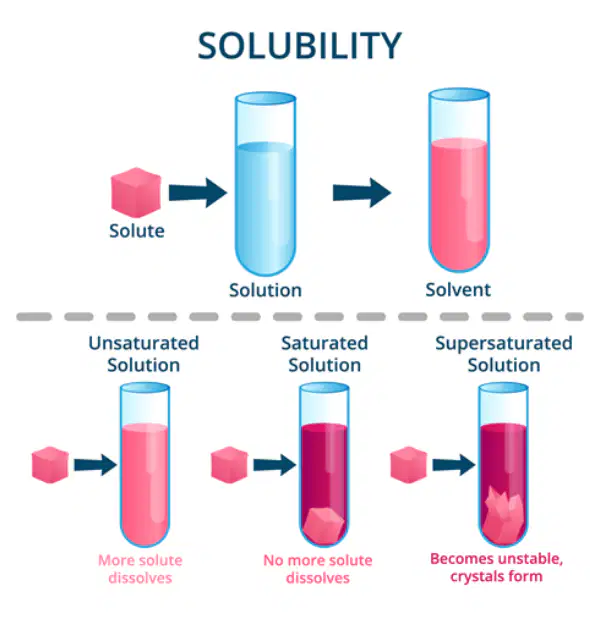
Which type of solution contains the maximum amount of solute?
Saturated
Unsaturated
Supersaturated
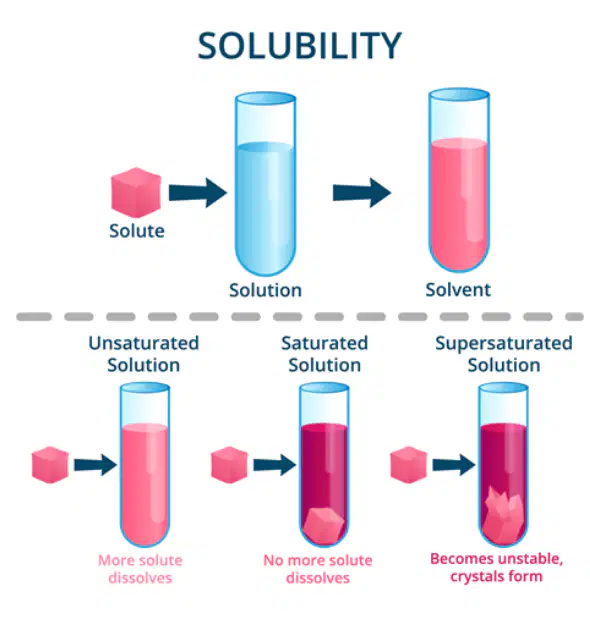
Which type of solution is considered “unstable”?
Supersaturated
Saturated
Unsaturated
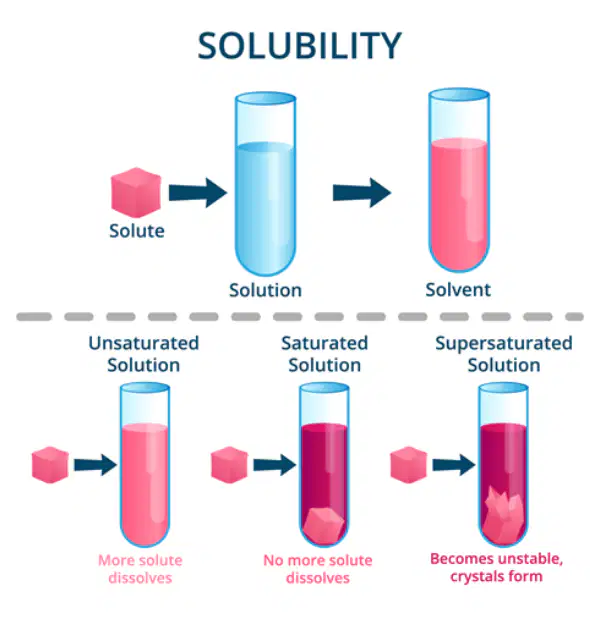
Which type of solution has the capability of dissolving more solute without a change in temperature?
Supersaturated
Saturated
Unsaturated

Determine the type of solution present when 60 grams of Ammonia are dissolved at 10°C
Supersaturated
Saturated
Unsaturated
Determine the type of solution present when 70 grams of Ammonium Chloride are dissolved at 90°C
Supersaturated
Saturated
Unsaturated


When 40 grams of NaCl is dissolved in 100 grams of water at 90 ºC, the solution can be correctly described as:
supersaturated
saturated
unsaturated

