Wayground logo

Free Printable Worksheets

Font size

S
M
L
XL
Worksheets

Quizizz: second semester review!

Total questions: 55

Worksheet time: 2hrs 30mins

Name
Class
Date
1.

Photosynthesis occurs in:

a)

Mitochondria

b)

Chloroplasts

c)

Humans

d)

Animals

2.

What are the reactants in Photosynthesis?

a)

Sun, CO2, glucose

b)

glucose and oxygen

c)

sun, carbon dioxide, water

d)

water, glucose

3.

Organisms that use energy from the sun to make their own food are called

a)

carnivores.

b)

consumers.

c)

omnivores.

d)

producers.

4.

Using the above scenario, which of these would have the largest amount of available energy? Using the scenario, which of these would have the largest amount of available energy?

a)

Grass

b)

Grasshopper

c)

Snake

d)

Hawk

5.
The Coriolis Effect is caused by
a)
Earth rotating around the sun
b)
Earth rotating on its axis
c)
The tides
d)
Gravity
6.
Warm ocean currents generally come from
a)
The North Pole
b)
The South Pole
c)
The Equator
d)
Both A and B
7.
Deep Ocean currents are a result of
a)
Global Wind Patterns
b)
Earth's Rotation
c)
Density
d)
All of the above
8.

________ and _______ affect the ocean's density and cause the Global Conveyor Belt to travel

a)

gravity and the Coriolis Effect

b)

temperature and salinity

c)

wind and climate

d)

temperature and the Coriolis Effect

9.
All of the living AND non-living things in an area that interact with each other are called a/an __________.
a)
community
b)
habitat
c)
population
d)
ecosystem
10.
ALL energy flow for an ecosystem begins with ...
a)
plants
b)
the moon
c)
the sun
d)
algae
11.
What are biotic factors?
a)
dead things
b)
living things/ organisms
c)
weather
d)
plants
12.
Which is an example of an ABIOTIC factor?
a)
hummingbird
b)
water
c)
dead tree branch
d)
skunk
13.
Which is an example of a BIOTIC factor?
a)
lightning
b)
algae
c)
sand
d)
clouds
14.
Which are located at the very BOTTOM of an energy pyramid? 
a)
producers
b)
consumers - Level 1
c)
consumers - Level 2
d)
decomposers
15.
A relationship where both organisms benefit is called __________.
a)
mutualism
b)
commensalism
c)
parasitism
16.
A relationship where one organism benefits and one organism is harmed is called __________.
a)
mutualism
b)
commensalism
c)
parasitism
17.
Which population would be most affected if there is a decrease in the population of aquatic insects?
a)
elk
b)
frog
c)
moose
d)
squirrel
18.
Below is an example of a simple food chain.

Acorn → Squirrel → Fox → Mountain Lion 

What will most likely happen if squirrels are removed from the food chain?
a)
The fox will eat acorns
b)
The fox population will decrease
c)
The trees will produce fewer acorns.
d)
The mountain lion population will increase
19.

This sphere includes the continents, the ocean floor, all the rocks on the surface, and all of the sand in the deserts.

a)

Hydrosphere

b)

Biosphere

c)

Atmosphere

d)

Geosphere

e)

Cryosphere

20.

Composed of all the water on or near the earth

a)

Hydrosphere

b)

Biosphere

c)

Atmosphere

d)

Geosphere

e)

Cryosphere

21.

This sphere is composed of all the living things

a)

Hydrosphere

b)

Biosphere

c)

Atmosphere

d)

Geosphere

e)

Cryosphere

22.

Body of air surrounding our planet.

a)

Hydrosphere

b)

Biosphere

c)

Atmosphere

d)

Geosphere

e)

Cryosphere

23.

Which layer of the atmosphere contains the ionosphere?

a)

troposphere

b)

stratosphere

c)

mesosphere

d)

thermosphere

24.

Which layer of the atmosphere has weather?

a)

troposphere

b)

stratosphere

c)

mesosphere

d)

thermosphere

25.

Which layer of the atmosphere contains the ozone?

a)

troposphere

b)

stratosphere

c)

mesosphere

d)

thermosphere

26.

Temperature increases with height in the ______ due to the ozone trapping heat.

a)

troposphere

b)

stratosphere

c)

mesosphere

d)

thermosphere

27.

Which gas makes up the largest portion of air?

a)

oxygen

b)

nitrogen

c)

carbon dioxide

d)

methane

28.

What do you call the part of the atmosphere where molecules escape into space?

a)

doldrums

b)

ionosphere

c)

exosphere

d)

dead zone

29.

What protects the earth from harmful UV rays from the sun?

a)

clouds

b)

ionosphere

c)

nitrogen gases

d)

the ozone

30.
What is formed during primary succession that doesn't need to be formed during secondary succession?
a)
pioneer species
b)
soil
c)
climax community
d)
lichens
31.
After a forest fire, an ecosystem would start regrowth through -
a)
primary succession
b)
secondary succession
c)
climax community
d)
limiting factors
32.
starts with bare rock followed by lichen
a)
primary succession 
b)
secondary succession
c)
both types of succession
33.

Which experiences the least change over time?

a)

Pioneer Species

b)

Primary Succession

c)

Aquatic Succession

d)

Climax Community

34.

Breaking News! A new island has formed off of Hawaii! What must occur for it to become an ecosystem?

a)

Secondary Succession

b)

Aquatic succession

c)

Primary Succession

d)

Ferns must grow

35.
When taken to a new habitat, non-native plants often threaten native plants of the new habitat.  Why do they do this?
a)
Non-native plants are able to mutate rapidly
b)
Non-native  plants cause native animals to relocate
c)
Non-native plants are able to be used for medicine
d)
Non-native plants compete with native plants for resources
36.
The lack of natural predators makes populations of invasive species unmanageable?
a)
True
b)
False
37.

This biome has very little rainfall, also extremely cold temperatures for most of the year, and frozen soil makes ponds form.

a)

Deciduous forest

b)

Tundra

c)

rain forest

d)

Grassland

38.

This biome is very hot all year long, found close to the equator, and has high amounts of rain fall.

a)

Rain forest

b)

Deciduous forest

c)

Taiga

d)

desert

39.
Which biome covers most of the land mass near the Earth's equator?
a)
tundra
b)
desert
c)
grassland
d)
tropical rainforest
40.
Which biome, because of its climate, has the largest number of species of plants and animals?
a)
tundra
b)
desert
c)
tropical rainforest
d)
pine forest
41.
Which biome contains large populations of grazing herbivores, few species of birds, and deep, rich soil?
a)
taiga
b)
tundra
c)
deciduous forest
d)
grassland
42.
This biome contains mostly spruce trees and Douglas firs, which are both evergreen.  The winters are long and cold and the summers are short and rainy.  The soil is very rich.  Moose and elk live here.  This biome is classified as a
a)
taiga
b)
tundra
c)
deciduous forest
d)
temperate forest
43.
The biome known for trees with broad leaves that fall off the trees in the winter.
a)
Coniferous Forests
b)
Deciduous Forests
c)
Deserts
d)
Tropical Rain Forests
44.
What are the key features of the Tundra?
a)
cold winter, thin acidic soil, evergreen trees
b)
treeless, permafrost, cold dark winters
c)
ong cool summers, short dark winters, migrating animals
d)
many evergreen trees, short moist summers, long snowy winters
45.
Areas defined by their geographical location and ecological similarity are called?
a)
ecozones
b)
biotopes
c)
biomes
d)
biodomes
46.
Name the phase of the moon for letter a
a)
First Quarter
b)
Last Quarter
c)
Waxing Gibbous
d)
Waning Gibbous
47.
Name the phase of the moon for letter f
a)
Waning Gibbous
b)
Waxing Gibbous
c)
Waning Crescent
d)
Waxing Crescent
48.

What does the rotation of the earth cause us to experience?

a)

Seasons

b)

Day and night

c)

Year

d)

Summer

49.

Which of the following best describes the tilt of the earth when it is summer in the southern hemisphere?

a)

The northern hemisphere is tilted toward the sun

b)

The northern hemisphere is tilted away from the sun

c)

The southern hemisphere is tilted toward the sun

d)

The southern hemisphere is tilted away from the sun

50.

One rotation of Earth is equal to _____

a)

a year

b)

a day

51.
A solar eclipse only happens during a ________ moon.
a)
New
b)
Cresent
c)
Gibbous
d)
Full
52.
A lunar eclipse only happens during a ________ moon.
a)
New
b)
Cresent
c)
Gibbous
d)
Full
53.
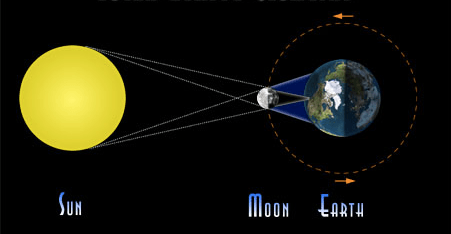
Which type of eclipse is shown in this picture?
a)
Solar Eclipse
b)
Orbit
c)
Lunar Eclipse
d)
Total Eclipse
54.
What do we call tides that have a smaller range that happen when the sun and moon are at right angles to each other?
a)
Neap Tide
b)
Spring Tide
c)
Larger Change
d)
Smaller Change
55.
What type of tides would this arrangement of earth-moon-sun create?
a)
neap tide
b)
spring tide
c)
new moon tide
d)
full moon tide