
 Worksheets
Electricity Review
Total questions: 69
Worksheet time: 59mins
The continuous flow of electrons is ______
Current
Static electricity
Voltage
Resistance
The amount of "push" available to move electrons is _____
Current
Resistance
Voltage
Static Electricity
The one time "jump" of electrons to distribute charge
Current
Voltage
Static electricity
Resistance
The opposition to electron movement
Voltage
Static electricity
current
Resistance

If a bulb is added between the battery and the switch, ____
The bulbs get brighter
The bulbs get dimmer
The bulb brightness stays the same
All the bulbs go out

If you add another bulb in parallel,_____
The bulbs get brighter
The bulbs get dimmer
The bulb brightness stays the same
All the bulbs will go out

If the top bulb goes out,
All the bulbs go out
The other bulbs get dimmer
There is no effect on the other bulbs
The other bulbs get brighter

If the middle bulb goes out, _______
The other bulb gets brighter
The other bulb goes out
The other bulb's brightness stays the same
The other bulb gets dimmer
Devices in a parallel circuit receive
equal current but different voltage
equal voltage but different current
equal voltage and equal current
different voltage and different current
Devices in a series circuit receive
Equal current but different voltage
Equal voltage but different current
Equal voltage and equal current
different voltage and different current
If something is positively charged it
Has an excess of electrons
is lacking protons
is lacking electrons
has an excess of protons

In a parallel circuit
All devices receive the same current
There are 2 or more paths for current to flow
All devices always go on and off together
Each device operates with a different voltage
A light switch
is a resistor
opens and closes a circuit
changes voltage
generates electricity
Electrons flow only in
series ciruits
parallel circuits
closed circuits
open circuits




What charge does an electron have?
negative (-)
positive (+)
neutral or no charge (0)
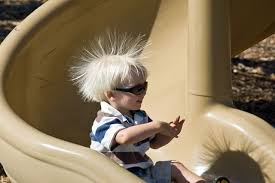

If an object has more positive than negative charges, its electrical charge is...
positive
negative
neutral or no charge
opposite
Ms Jo Jo rubbed two balloons with a piece of wool. What will happen when the balloons are brought near each other?
The balloons will repel each other.
The balloons will attract each other.
The balloons will become positively (+) charged.
The balloons will pop.

If an object has more negative charges than positive charges, its electrical charge is...
positive
negative
neutral or no charge
opposite


Which of these items is NOT an insulator?
Glass
Rubber
Aluminum
Silicone
The purpose of grounding is:
To punish teenagers
To complete a circuit
To neutralize a charged object
To polarize a conductor
There are ___ kinds of charge: __________
3; positive, negative, neutral
3; positive, nuclear, negative
2; negative, positive
2; negative, neutral
1 KiloWatt is equal to:
10 watts
100 watts
1000 watts
10 000 watts
If two objects are strongly attracted to each other they must...
Carry the same charge
Carry opposite charges
Carry no charge
Carry current
Positive charges are fixed (do not move).
True
False
Neither true nor false.
Electric current is created by...
Moving electrons
The sun
Moving atoms
Conductors
The two types of electric current are
Alternating Current and Direct Current
Direct Current and Indirect Current
Flat Current and Wavy Current
Alternating Current and Different Current
Which kind of current is found in our outlets?
AC
DC
both
How does resistance affect current?
more resistance = more current
more resistance = less current
resistance does not affect current
This does not allow electrons to flow and does not conduct electricity
insulator
conductor
semiconductor
electrolyte
Which is NOT an insulator


How much the material prevents electrons from moving through it is
Current
Resistance
Voltage
Power
This allows electrons to flow and conducts electricity
insulator
conductor
semiconductor
electrolyte

