wayground logo

Free Printable Worksheets

Font size

S
M
L
XL
Worksheets

IPC Spring Semester Final Exam Review

Total questions: 165

Worksheet time: 3hrs 11mins

Name
Class
Date
1.
The flow of electricity in a circuit-
a)
current
b)
flow
c)
circuit
2.
____________ stops the flow of electricity.
a)
A conductor
b)
An insulator
c)
A magnet
3.
Two batteries in a circuit make the lights in the circuit brighter than one battery.
a)
true
b)
false
4.
An example of a parallel circuit is
a)
the wiring in a house
b)
a flashlight
c)
a single circular path
5.
The flow of electricity requires a
a)
complete path
b)
incomplete path
c)
insulated current
6.
What kind of circuit is this?
a)
series
b)
parallel
7.
Electricity is the flow of ______.
a)
electrons
b)
protons
c)
neutrons
d)
atoms
8.
A material in which electrons are able to move easily
a)
Circuit
b)
Insulator 
c)
Resistance 
d)
Conductor 
9.
provides more than one path for the electrons to follow
a)
series circuit
b)
parallel circuit
c)
insulator
d)
conductor
10.
the type of current that is used in  outlets
a)
apparating current
b)
diverting current
c)
AC
d)
DC
11.
measure of electric current
a)
watt
b)
ohm
c)
volt
d)
amp
12.
measure of resistance
a)
watt
b)
ohm
c)
volt
d)
amp
13.
measure of power
a)
watt
b)
ohm
c)
volt
d)
amp
14.
What does the switch do in a circuit?
a)
It supplies the power.
b)
It carries electricity.
c)
It opens and closes the circuit.
d)
It is an insulator.
15.
What type of circuit is this?
a)
series
b)
parallel
16.
) What would happen if an extra battery cell is added?
a)
A)The lights will glow dim
b)
The wire will glow
c)
The lights will glow brighter
d)
None of the above
17.
What is one benefits of using a parallel circuit?  
a)
It gets confusing.
b)
There are no problems.
c)
If one goes down, it does not affect the others. 
d)
Porque es para llelio. 
18.
What is one problem with using a series circuit? 
a)
It has a lot of series. 
b)
If one goes down, they all go down! 
c)
It doesn't work properly.
d)
There are no problems. 
19.
What types of charges attract?
a)
Positive and Positive
b)
Positive and Neutral
c)
Negative and Neutral
d)
Positive and Negative
20.
What charge does an electron have?
a)
negative (-)
b)
positive (+)
c)
neutral or no charge (0)
21.
A continuous flow of electricity is called_____________
a)
series
b)
circuit
c)
static
d)
current
22.
What is voltage?
a)
how hard electrons are being pushed
b)
how light their being pushed 
c)
how electrons are made 
d)
how electrons do work 
23.
What is an amp?
a)
How many electrons are being pushed 
b)
How many electrons are being pulled
c)
How hard electrons are being pushed
24.
A Charging system producing 14.5 Volts with a current flow of 43.5 Amps, what is the circuit resistance
a)
58 Amps
b)
0.33 Amps
c)
13 Amps
d)
1 Amp
25.
What would the circuit resistance be if a 7.5 Amp draw was present with the engine running and the charging system producing 15 Volts
a)
15 Ohms
b)
4 Ohms
c)
0.3333 Ohms
d)
2 Ohms
26.
What is the power of a 10V bulb with 5A through it?
a)
2W
b)
2V
c)
50W
d)
50A
27.
What is the current through a 4V bulb with a power of 36W?
a)
9W
b)
9A
c)
60V
d)
60A
28.
You rub your socks on the rug on a dry winter day. You build up a charge of positive and negative ions. It's called ________ energy.
a)
overload
b)
static
c)
electronic
d)
regulated
29.
You plug in an extension cord and have to be very careful around the electrical outlet. However, you can handle the extension cord without worry of being shocked by the electrical charge. Which statement best explains why you can do this?
a)
A. The cord is made of a combination of materials, which are good conductors of electricity. The combination of two conductors directs the flow of electricity away from you and down the cord.
b)
B. The extension cord is made of plastic which only conducts electricity for a certain period of time. If you handle the cord, the electricity passes through it so fast that you are not in danger of being shocked.
c)
C. The extension cord is made of copper wire, which is a good conductor of electricity; however, it is covered with plastic, an insulator, which does not allow the electrical current to flow to you.
d)
D. The cord has a plastic cover, which is a good conductor of electricity so it carries the electrical current away from your hand, which is an insulator.
30.
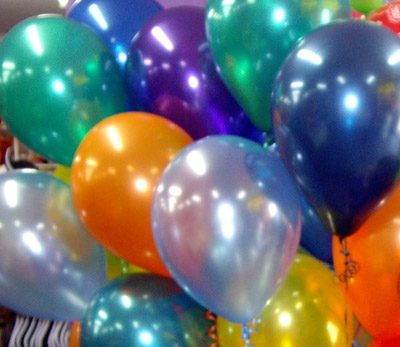
Using the diagram of the balloons wall and sweater why does the balloon "stick" to the sweater and wall? 
a)
The negative charge of the balloon is attracted and pulled toward the negative charge on the sweater and wall
b)
The positive charge of the balloon is attracted to and pulled toward the positive charge on the sweater and wall
c)
The negative charge of the balloon is attracted to and pulled toward the positive charge of the sweater and the wall
d)
The neutral charge (positive and negative) of the balloon is attracted and pulled toward the positive charge of the sweater and wall 
31.
A current of 0.5 A flows through a resistance of 10 ohms for half an hour. Find the amount of electrical energy consumed by the resistance.
 
Remember:
V = IR
P = VI
E = Pt
a)
22500 J or 22.5 KJ
b)
4500 J or 4.5 KJ
c)
79.2 W
d)
2.5 A
32.

An electric meter reads 1,346 kWh at the end of the month. Find the cost of electrical energy consumed in that month if 1 kWh of energy costs $0.12. What was the electric bill for that month?

a)

$161.52

b)

$52.80

c)

$27.00

d)

$96.00

33.
 A flashlight bulb with a potential difference of 4.5 V across its filament has a power output of 8.0 W. How much current is in the bulb filament? 
a)
3.7 A
b)
0.23 A
c)
1.8 A
d)
0.56 A
34.
Calculate the electric power of an electrical appliance in which 10 A of current is flowing through a resistor of 2 ohms.
 
Remember: V=IR and P=VI
a)
80 W
b)
200 W
c)
2.5 A
d)
22.5 KJ
35.
Calculate the electric power of an electrical appliance of 20 V having a resistance of 10 ohms.
 
Remember: I=V/R and P=VI
a)
200 W
b)
40 W
c)
2.5 A
d)
79.20 KJ
36.
What is the unit of electrical power?
a)
watt
b)
volt
c)
ampere
d)
ohm
37.

How much energy does a 100-W light bulb use in 8.0 hours?

a)

0.0080 kWh

b)

0.80 kWh

c)

13 kWh

d)

800 kWh

38.

When 5.00 A is flowing through an 10.0-Ω device, how much power is being dissipated in the device?

a)

50.0 W

b)

250 W

c)

500 W

d)

2.50 kW

39.

If a blender is plugged into a 110 V outlet that supplies 2.7 A of current, what amount of power is used by the blender?

a)

40.7 W

b)

297 W

c)

112.7 W

d)

378 W

40.

Using the diagram above, how much current would be measured in each circuit if the light bulb has a resistance of 6 ohms?

a)

circuit A= 1A ; circuit B= 1A

b)

circuit A= 2A ; circuit B= 2A

c)

circuit A= 1A ; circuit B= 2A

d)

circuit A= 1A ; circuit B= 6A

41.

A balloon is rubbed against hair. Afterwards it sticks to a wall. Explain these observations.

a)

the balloon is repelled by the wall.

b)

the balloon and wall are oppositely charged.

c)

the balloon and wall are equally charged.

d)

the balloon was sticky.

42.
Which of the following will not cause a magnet to lose its magnetism?
a)
striking it with a hammer
b)
cooling it
c)
dropping it repeatedly on the ground
d)
heating it
43.
In an unmagnetized object, the domains point:
a)
in the same direction
b)
in a north-south direction
c)
in different directions
d)
in an east-west direction
44.
A device that converts electric energy into mechanical energy is called a:
a)
motor
b)
generator
c)
transformer
d)
galvanometer
45.
A region in which the magnetic fields of atoms are grouped together is called a(an):
a)
pole
b)
domain
c)
force line
d)
magnetosphere
46.
Which of the following will not strengthen an electromagnet?
a)
increasing the number of loops of wire around the core
b)
increasing the current flow
c)
decreasing the voltage
d)
all of these
47.
A generator is a device that converts:
a)
heat energy into electric energy
b)
electric energy into mechanical energy
c)
electric energy into heat energy
d)
mechanical energy into electric energy
48.
Unlike poles of a magnet will:
a)
attract each other
b)
repel each other
c)
cancel out each other
d)
first attract and then repel each other
49.
In a magnetized object, the domains point:
a)
in the same direction
b)
in an east-west direction
c)
in different directions
d)
perpendicular to one another
50.
Wrapping a coil of wire around a soft iron core produces a(an):
a)
generator
b)
motor
c)
electromagnet
d)
transformer
51.
If you increase the current in an electromagnet:
a)
the north and south poles will be switched
b)
the magnetic field will be stronger
c)
the magnetic field will disappear
d)
a short circuit will be created
52.
The positive particles of an atom are 
a)
electrons 
b)
positrons 
c)
neutrons 
d)
protons 
53.

The kinetic theory of matter states that

a)

matter expands when it gets cooler

b)

tiny particles in motion make up all matter

c)

particles arrange in repeating geometric patterns

d)

pressure applied to a fluid is transmitted throughout a liquid

54.

Plasma

a)

is particles arranged in geometric patterns

b)

is water in the solid state

c)

is a solid that is not made of crystals

d)

is a gaslike mixture of charged particles

55.
Bernoulli’s principle states that the pressure in a fluid decreases as its velocity increases. 
a)
True
b)
False
56.
Archimedes Principle states that the buoyant force acting on a submerged object is equal to the density of the fluid displaced by the object.
a)
True
b)
False
57.
Pascal's Principle states that the pressure at a point in a fluid at rest is the same in all directions.
a)
True
b)
False
58.
According to Pascal’s principle, in a hydraulic system a pressure exerted on a piston produces an equal increase in pressure on another piston in the system. If the second piston has an area 10 times that of the first, the force on the second piston is 10 times greater, though the pressure is the same as that on the first piston.
a)
True
b)
False
59.
Bernoulli’s Principle explains how an airplane can stay aloft.
a)
True
b)
False
60.
A buoyant force is an upward force applied on an object by a 
a)
Substance
b)
Fluid
c)
Pressure
d)
Displacement
61.
Archimedes' principle states that the weight of the fluid an object displaces is equal to the buoyant force acting on the object. 
a)
True
b)
False
62.
When the weight of an object is greater than the buoyant force, the object will ... 
a)
Sink
b)
Float 
c)
Expand
d)
Shrink
63.
3. If the atoms of an object are moving or vibrating fast, the temperature would be...
a)
Hot
b)
Cold
c)
Unknown
64.
What is Thermal expansion?
a)
The transfer of thermal energy between materials by the collisions of particles 
b)
Is a decrease in a materials volume when temperature decreases 
c)
An increase in a materials volume when temperature increases
d)
Chicken fried rice
65.
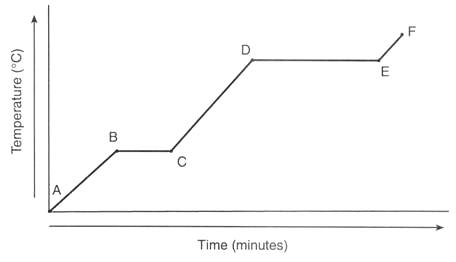
What state(s) of matter are present at D-E?
a)
Solid-liquid
b)
Liquid
c)
Liquid-gas
d)
Gas-Solid
66.
Between which points is the substance changing state?
a)
A-B only. 
b)
A-B, C-D, E-F
c)
B-C only. 
d)
B-C, D-E
67.

How hot will a 2.3L balloon have to get to expand to a volume of 400L? Assume the initial temperature of the balloon is 25oC.

a)

248C

b)

256C

c)

49, 725K

d)

51,826K

68.
A substance's heating curve is shown in the graph.  What is its boiling point?
a)
100 C
b)
60 C
c)
80 C
d)
20 C
69.
The changing of a gas into a liquid
a)
Evaporation
b)
Condensation
c)
Melting Point
d)
Sublimation
70.
A change from a solid into a gas
a)
Density
b)
Condensation
c)
Sublimation
d)
Boiling Point
71.

Absolute zero has a temperature of __ and no particle movement.

a)

-273C

b)

273C

c)

173C

d)

-173C

72.
When Pressure increases then the Volume must...
a)
Increase
b)
decrease
73.
A gas at a volume of 4 liters is at a pressure of 8 Pa. The volume is changed to 16 Liters, what must the new pressure be?
a)
1 Pa
b)
12 Pa
c)
10 Pa
d)
2 Pa
74.
In order to solve gas law calculations, temperature must be measured in:
a)
Fahrenheit
b)
Celsius
c)
Kelvin
d)
It doesn't matter 
75.
If a balloon is cooled what will happen to the volume?
a)
Volume will increase
b)
Volume will decrease
c)
Volume will not change
76.

Bernoulli’s principle explains why ____.

a)

boats float

b)

heat of fusion exists

c)

heated objects expand

d)

planes fly

77.
A force is applied in a closed container, the pressure increases the same amount. EX: squeezing a water bottle or toothpaste
a)
Archimede's Principle
b)
Pascal's Principle
c)
Bernoulli's Principle 
78.
What pressure does a 4000N horse exert on the ground if each foot is 10cm2?
a)
40 N/cm2
b)
100 N/cm2
c)
400 N/cm2
d)
10 N/cm2
79.
What principle is this hydraulic press showing?
a)
Archimedes' Principle
b)
Bernoulli's Principle
c)
Pascal's Principle
d)
Principle Testa
80.
What is buoyant force?
a)
An upward force exerted by fluids on an object.
b)
An downward force exerted by fluids on an object.
81.
If an object weighing 50.0 N displaces a volume of water with a weight of 10.0 N, what is the buoyant force on the object?
a)
10 N
b)
60 N
c)
40 N 
d)
20 N 
82.

Bernoulli’s principle states that the pressure in a fluid decreases as its velocity increases.

a)

True

b)

False

83.

A box that is 3cm x 3cm in size would apply what force in order to create a pressure of 140.8 N/cm2.

a)

23.5 N

b)

1267.2 N

c)

844.8 N

d)

15.6 N

84.
Which particle has a positive charge?
a)
electron
b)
orbital
c)
proton
d)
neutron
85.
Choose the particle that has no charge.
a)
nucleus
b)
neutron
c)
proton
d)
electron
86.
An electron has a _____ charge.
a)
negative
b)
positive
c)
neutral
87.
Which particles make up the nucleus of an atom?
a)
protons and neutrons
b)
electrons and protons
c)
electrons, protons, and neutrons
d)
electrons and neutrons
88.
What charge does the nucleus have and why?
a)
positive - the neutrons do not have a charge
b)
positive - the neutrons and protons are positively charged particles
c)
neutral - the neutral charge dominates the positive charge
d)
neutral - electrons cancel out the positive charge of the atom
89.
Matter that cannot be broken down into a simpler substance – building blocks of life.
a)
neutron
b)
atom
c)
electron
d)
quarks
90.
The _________ of an element equals the number of protons in an atom of that element.
a)
mass number
b)
neutrons
c)
atomic number
d)
isotopes
91.
Atomic mass is equal to the number of...
a)
Protons + Electrons
b)
Electrons + Neutrons
c)
Protons + Neutrons
d)
Electrons
92.

Anne wants to have an ice sculpture at her wedding. She would like to have a rectangular pyramid on top of a rectangular prism. She wants each figure to have a base of 40 square feet and a height of 3 feet. How much ice is needed to create the sculpture?

a)

40 ft3

b)

80 ft3

c)

120 ft3

d)

160 ft3

93.

Anne wants to have an ice sculpture at her wedding. She would like to have a rectangular pyramid on top of a rectangular prism. She wants each figure to have a base of 40 square feet and a height of 3 feet. How much ice is needed to create the sculpture?

a)

40 ft3

b)

80 ft3

c)

120 ft3

d)

160 ft3

94.
Which is a Chemical property?
a)
Thermal Conductivity 
b)
Density
c)
Malleability 
d)
Flammability 
95.
Which of the following is a chemical property of water?
a)
Reacts with pure sodium.
b)
Boils at 100 oC.
c)
Dissolves sugar easily. 
d)
Has a density of 1 gm/mL
96.
What kind of properties can only be observed when a substance changes into a different substance?
a)
physical properties
b)
chemical properties
c)
liquid properties
d)
real properties
97.
Which of the following properties is a physical property?
a)
magnetism
b)
reactivity with oxygen
c)
flammability
d)
non-reactive
98.
Which of the following is a sign that a chemical reaction has occurred?
a)
change in shape
b)
melting
c)
formation of a gas
d)
dissolving
99.
What characteristic defines all chemical changes?
a)
There is a change of state.
b)
Electricity is produced.
c)
A new material is formed.
d)
Bubbles are produced. 
100.
Which of the following is a Chemical Property?
a)
Radicallity
b)
Color
c)
Boiling Point
d)
Reactivity
101.
Is burning wood a chemical or physical change?
a)
chemical
b)
physical
102.
Is bleaching your hair a physical or chemical change?
a)
physical
b)
chemical
103.
A change in the size, shape, or state of matter.
a)
chemical change
b)
physical change
c)
chemical reaction
d)
electron change
104.
Which of the following is NOT an example of a physical change?
a)
crumpled paper
b)
pencil sharpening
c)
shrunken clothing
d)
sour milk
105.
Which of the following does the discoloration of a coin  describe?
a)
Chemical Change
b)
Physical Change
c)
None of the above
d)
Both
106.
An atom is electrically neutral when
a)
protons and neutrons are the same
b)
protons and electrons are the same
c)
neutrons and electrons are the same
d)
neutrons balance the protons and electrons
107.
Which particle has a positive charge?
a)
electron
b)
orbital
c)
proton
d)
neutron
108.
Choose the particle that has no charge.
a)
nucleus
b)
neutron
c)
proton
d)
electron
109.
An electron has a _____ charge.
a)
negative
b)
positive
c)
neutral
110.
The particles of the atom you can find by knowing the atomic number.
a)
neutrons
b)
protons and electrons
c)
protons and neutrons
d)
atomic mass
111.
The subatomic particle that determines the identity of an element.
a)
neutron
b)
proton
c)
electron
d)
outer shell
112.
What charge does the nucleus have and why?
a)
positive - the neutrons do not have a charge
b)
positive - the neutrons and protons are positively charged particles
c)
neutral - the neutral charge dominates the positive charge
d)
neutral - electrons cancel out the positive charge of the atom
113.
Elements on the periodic table increase by...
a)
atomic mass
b)
size
c)
mass number
d)
atomic #
114.
How many neutron are in the atom of Potassium?
a)
7
b)
2
c)
39
d)
20
115.
How many neutrons are in an atom of Beryllium?
a)
4
b)
9
c)
9.01
d)
5
116.
How many electrons are in an atom of Lithium?
a)
3
b)
6
c)
7
d)
6.941
117.
The _________ of an element equals the number of protons in an atom of that element.
a)
mass number
b)
neutrons
c)
atomic number
d)
isotopes
118.
Isotopes have different numbers of
a)
protons
b)
neutrons
c)
electron
d)
properties
119.
Atomic mass is equal to the number of...
a)
Protons + Electrons
b)
Electrons + Neutrons
c)
Protons + Neutrons
d)
Electrons
120.

Neutrons can be found by

a)

rounding the atomic weight to a whole number and subtracting the number of protons

b)

looking at the number of electrons

c)

looking at the number of protons

d)

by adding the number of electrons and protons

121.

What is the mass number?

a)

the number of protons

b)

the number of protons and neutrons

c)

the number of neutrons

d)

the number of protons and electrons

122.

What is the mass number of this nucleus?

a)

1

b)

3

c)

4

d)

7

123.
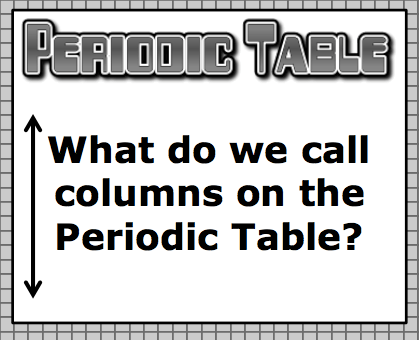
a)
Periods
b)
Groups
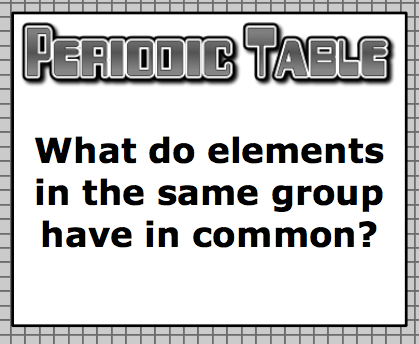
124.
a)
energy levels
b)
valence electrons
c)
protons
d)
neutrons
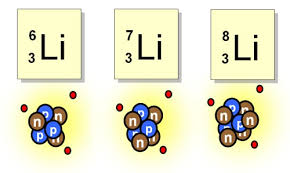
125.
which atom has  4 neutrons?
a)
Li-6
b)
Li-7
c)
Li-8
d)
they have the same # of neutrons
126.
An atom is electrically neutral when
a)
protons and neutrons are the same
b)
protons and electrons are the same
c)
neutrons and electrons are the same
d)
neutrons balance the protons and electrons
127.
Why were there blank spaces left in Mendeleev's periodic table?                                              
a)
He didn't know what to put there.
b)
 Undiscovered elements not yet known.
c)
Multiple elements could have fit
d)
He forgot to add the elements in.
128.

Who arranged the periodic table by increasing atomic number?

a)

Mendeleev

b)

Rutherford

c)

Bohr

d)

Moseley

129.

5. The group number equals?

a)

The number of energy levels

b)

The number of neutrons

c)

The number of protons

d)

The number of valence electrons

130.

Elements in the same ____________ have similar chemical properties

a)

period

b)

staircase

c)

group

d)

row

131.
Who discovered the proton?
a)
Thomson
b)
Dalton
c)
Bohr
d)
Rutherford
132.
The scientist responsible for "discovering" the nucleus is:
a)
Bohr
b)
Rutherford
c)
Schroedinger
d)
Einstein
133.
Electrons are not factored into atomic mass because:
a)
They are so small their mass is negligible
b)
They're not in the nucleus
c)
They're too big
d)
They move so quickly their mass is zero
134.
Electrons are not factored into atomic mass because:
a)
They are so small their mass is negligible
b)
They're not in the nucleus
c)
They're too big
d)
They move so quickly their mass is zero
135.

Which color on the image of the periodic table corresponds with the halogens.

a)

red (group 17)

b)

black (group 18)

c)

royal blue (group 3-12)

d)

orange (period 6)

136.
Who performed the gold foil experiment?
a)
Joseph Thomson
b)
John Dalton
c)
Ernest Rutherford
d)
Schroedinger
137.

Atoms of the same element which have a different number of neutrons are called _________________.

a)

ions

b)

isotopes

c)

quarks

d)

molecules

138.

Isotopes have different numbers of

a)

protons

b)

neutrons

c)

electron

d)

properties

139.

The number in Kr-84 represents what about Krypton?

a)

The number of electrons

b)

The number of protons

c)

The mass number

140.

Which color on the image of the periodic table corresponds with the transition metals.

a)

red (group 17)

b)

black (group 18)

c)

blue (group 3-12)

d)

teal (group 1)

141.

Which color on the image of the periodic table corresponds with the metalloids.

a)

bright yellow (between metals and nonmetals)

b)

gold (period 7)

c)

teal (group 1)

d)

light blue (group 2)

142.
What element is will have the most similar physical and chemical properties to the element Sulfur (S)?
a)
Carbon (C)
b)
Phosphorous (P)
c)
Oxygen (O)
d)
Neon (Ne
143.

Mass minus Atomic Number Equals

(M-A=?)

a)

atoms

b)

protons

c)

neutrons

d)

nucleus

144.

The atomic number gives the “identity” of an element as well as its ____ on the periodic table. No two different elements will have the ____ atomic number.

a)

location, same

b)

same, location

c)

mass number, different

d)

different, mass number

145.

How are the number of neutrons found on the periodic table?

a)

Round the atomic mass to a whole number, which makes it the mass number, and subtract the number of protons.

b)

Use the atomic number

c)

Add the atomic mass with the atomic number

d)

You can't. it is impossible to find the number of neutrons on the periodic table as you have to have a picture to see.

146.
When metals bond with non-metals they form what type of bonds
a)
covalent
b)
ionic
c)
cooperative
d)
lewis
147.
The chemical bond formed when two atoms share electrons is called a(n)
a)
ionic bond.
b)
orbital bond.
c)
Lewis structure.
d)
covalent bond.
148.
Which of the following is an example of an IONIC COMPOUND?
a)
NaCl
b)
H2O
c)
CO2
d)
NO
149.
Which of the following is an example of a COVALENT COMPOUND?
a)
H2S
b)
KI
c)
CaCl2
d)
MgO
150.
Covalent bonds are formed by sharing an electron from a _______ to a ________.
a)
Metal to a metalloid
b)
Metalloid to a nonmetal
c)
Nonmetal to a nonmetal
d)
Metal to a nonmetal
151.

In which area of the periodic table do you find elements whose atoms easily gain electrons?

a)

across the top two rows

b)

across the bottom row

c)

on the right side

d)

on the left side

152.

Metals tend to __ electrons when they make an ion.

a)

gain

b)

lose

153.
What type of bond forms when 2 or more electrons are SHARED?
a)
Covalent bond
b)
Incomplete bond
c)
Ionic bond
d)
Metallic bond
154.
What type of bond forms between two or more atoms that are charged (+/-)?
a)
Covalent bond
b)
Incomplete bond
c)
Ionic bond
d)
Metallic bond
155.
Which of the following is NOT a characteristic of IONIC COMPOUNDS?
a)
High melting point
b)
Conducts electricity
c)
Strong bonds
d)
Low boiling points
156.
Ionic bonds are between _______ and ________. 
a)
nonmetals and nonmetals 
b)
metals and metals 
c)
metals and nonmetals
d)
none
157.
High Melting & Boiling Points
a)
Ionic
b)
Covalent
158.

____ are formed when atoms lose electrons.

a)

Positive ions

b)

Negative ions

c)

elements

d)

compounds

159.

Nonmetals, which ____, form negative ions.

a)

lose protons

b)

gain protons

c)

gain electrons

d)

gain protons

160.
If I gain electrons I become
a)
Positive because I've added to my atom
b)
negative because I've added electrons
c)
same because i'm balanced
d)
equal because now I have electrons
161.
How many valence electrons does chlorine have?
a)
1
b)
7
c)
4
d)
2
162.
What is a repeating three-dimensional pattern that forms when ions bond called?
a)
Crystal Lattice
b)
Crystal Lettuce 
c)
Crystal Configuration
d)
Quartz
163.
Predict the bond that will form between Be and F.
a)
Ionic
b)
Covalent
164.

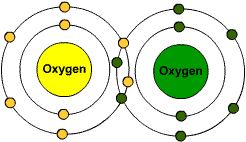
Is this image an example of covalent bonding?

a)

Yes

b)

No

165.
What would happen if I move a bar magnet in and out of a coil of copper wire?
a)
Electric current would disappear 
b)
The magnet would explode 
c)
Electric current will flow through the wire
d)
It would produce a gravitational field