
 Worksheets
Growing and Flowing EOY Review
Total questions: 46
Worksheet time: 57mins
Name
Class
Date
1.

If we ranked all of the things that plants need in order to survive, dirt would be _____
a)
at the top
b)
near the top
c)
near the middle
d)
at the bottom
2.

A useful material that can be drawn from when needed is called _____
a)
a resource
b)
an organ
c)
photosynthesis
d)
roots
3.

Special body parts that perform a specific function are called _____
a)
resources
b)
organs
c)
leaves
d)
soil
4.

Which of these is NOT a main organ of a plant?
a)
roots
b)
stems
c)
leaves
d)
lungs
5.

The process that plants use to turn light energy into chemical energy is called _____
a)
combustion
b)
photosynthesis
c)
respiration
d)
digestion
6.

Plants use nutrients to make chlorophyll, which they use for the process of _____
a)
combustion
b)
photosynthesis
c)
respiration
d)
digestion
7.

Which organ is mostly involved in photosynthesis and the exchange of gases?
a)
the leaves
b)
the stem
c)
the roots
d)
the lungs
8.

The leaf is the plant organ where the exchange of _____ takes place.
a)
gases
b)
dirt
c)
water
d)
soil
9.

Which organ is mostly involved in the transport of materials?
a)
the leaves
b)
the stem
c)
the roots
d)
the lungs
10.

Which organ holds the plant in place and absorbs water and minerals?
a)
the leaves
b)
the stem
c)
the roots
d)
the lungs
11.
How can photosynthesis be related to cellular respiration?
a)
What's produced by one is needed for the other
b)
They both produce the same products
c)
They both have the same reactants (need the same things)
d)
These 2 processes have nothing in common
12.
What is another name for glucose?
a)
Chlorophyll
b)
Chloroplasts
c)
Stomata
d)
Sugar
13.
The main source of energy for all life comes from ____.
a)
the Earth
b)
the moon
c)
the sun
d)
the food we eat/make
14.
A plant growing in response to the sunlight.
a)
Gravitropism
b)
Phototropism
c)
Thigmotropism
d)
Hydrotropism
15.
When a plant responds to gravity it is called:
a)
Phototropism
b)
Thigmotropism
c)
Gravitropism
d)
Hydrotropism
16.
Which of the following responses is a plant growing toward or leaning toward touch?
a)
thigmotropism
b)
hydrotropism
c)
phototropism
d)
gravitropism
17.
Cellular Respiration's goal is to
a)
make water
b)
make ATP
c)
make glucose
d)
make oxygen
18.
What gas is released into the air during cellular respiration?
a)
oxygen
b)
carbon dioxide
c)
water
d)
glucose
19.
What are the products in cellular respiration?
a)
water and carbon dioxide
b)
water and glucose
c)
carbon dioxide and oxygen
d)
glucose and oxygen
20.
Which of the following organelles is responsible for cellular respiration?
a)
Mitochondria
b)
Nucleus
c)
Endoplasmic Reticulum
d)
Ribosome
21.

The power needed to do work, such as staying alive, is called _____
a)
food
b)
energy
c)
food chains
d)
pizza
22.

The flow of energy between living things is often described as _____
a)
the water cycle
b)
a food chain
c)
the carbon cycle
d)
an ecosystem
23.

Which animal is often said to be at the "top of the food chain"?
a)
raccoons
b)
bugs
c)
hawks
d)
humans
24.

A food chain is a model that shows how energy flows between _____
a)
plants and bugs
b)
living things
c)
Earth's spheres
d)
bears and monsters
25.

What is the scientific name for the area in which plants and animals live?
a)
a habitat
b)
an ecosystem
c)
a neighborhood
d)
a food chain
26.

A self-contained collection of different things that all work together as a whole is called _____
a)
a system
b)
a habitat
c)
a food chain
d)
a neighborhood
27.

A system of living things and their environment is called _____
a)
an ecosystem
b)
a food chain
c)
a habitat
d)
a neighborhood
28.

All of the energy that's in a food chain starts with _____
a)
decomposers
b)
plants
c)
animals
d)
the sun
29.

Plants take the energy from the sun's rays and change it into _____
a)
light
b)
water
c)
chemical energy
d)
plants
30.

In the example from the video, what was at the top of the food chain?
a)
the sun
b)
grass
c)
a rabbit
d)
a hawk
31.

A habitat is home to a tangle of food chains called ___
a)
a nutrient hub
b)
an energy chain
c)
a food web
d)
the carbon cycle
32.
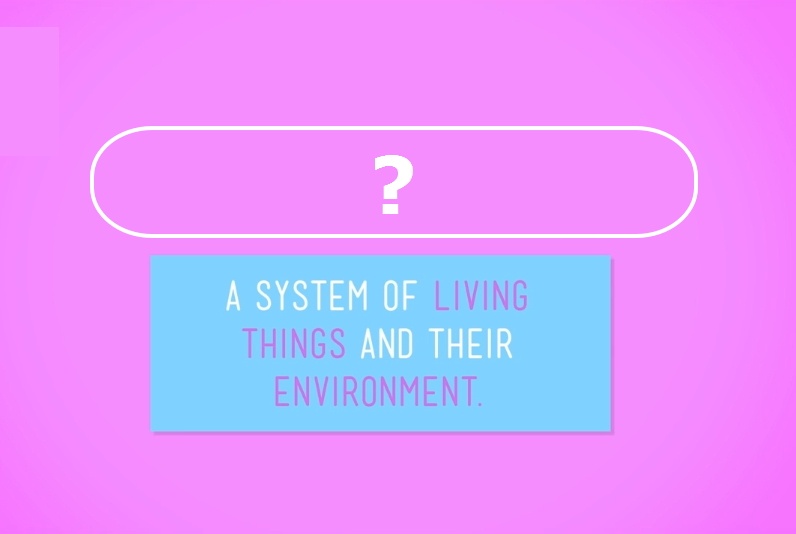
The interaction of living and non-living things in a habitat is called ___
a)
an environment
b)
an ecosystem
c)
a food web
d)
a food chain
33.

The things in an ecosystem are all ___
a)
separate
b)
connected
c)
scattered
d)
unrelated
34.

Spider monkeys eat mostly ___
a)
leaves
b)
toucans
c)
nuts
d)
fruit
35.

What is distributed by spider monkeys as they travel throughout the forest?
a)
whole fruit
b)
fruit seeds
c)
dried leaves
d)
insects
36.
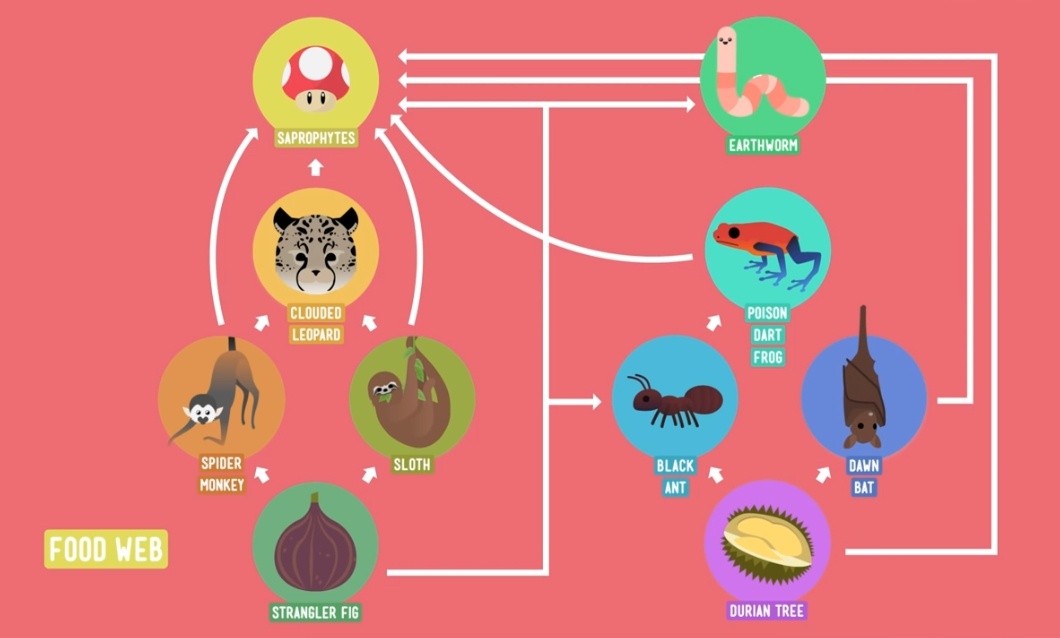
Leopards dine on ___
a)
figs and spider monkeys
b)
sloths and strangler figs
c)
sloths and spider monkeys
d)
ants and bats
37.
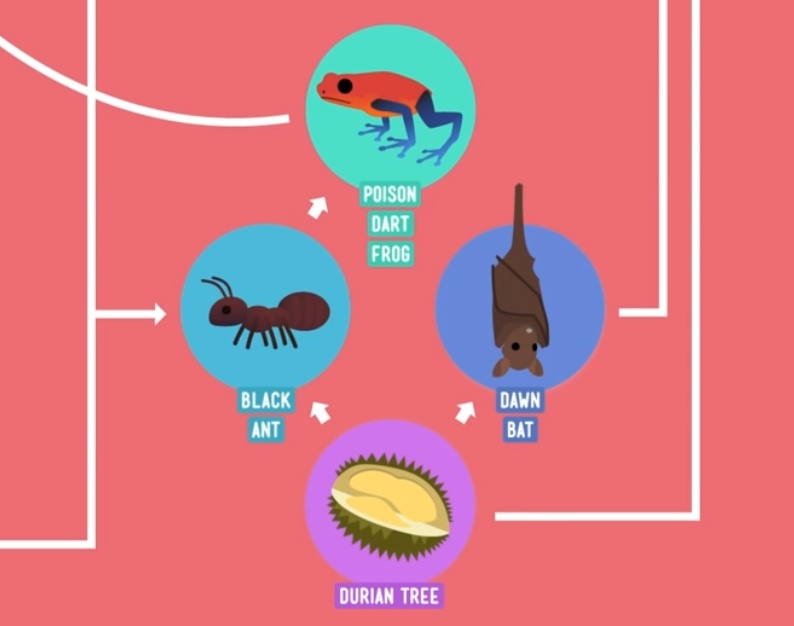
Frogs eat ___
a)
bats
b)
insects
c)
spider monkeys
d)
strangler figs
38.
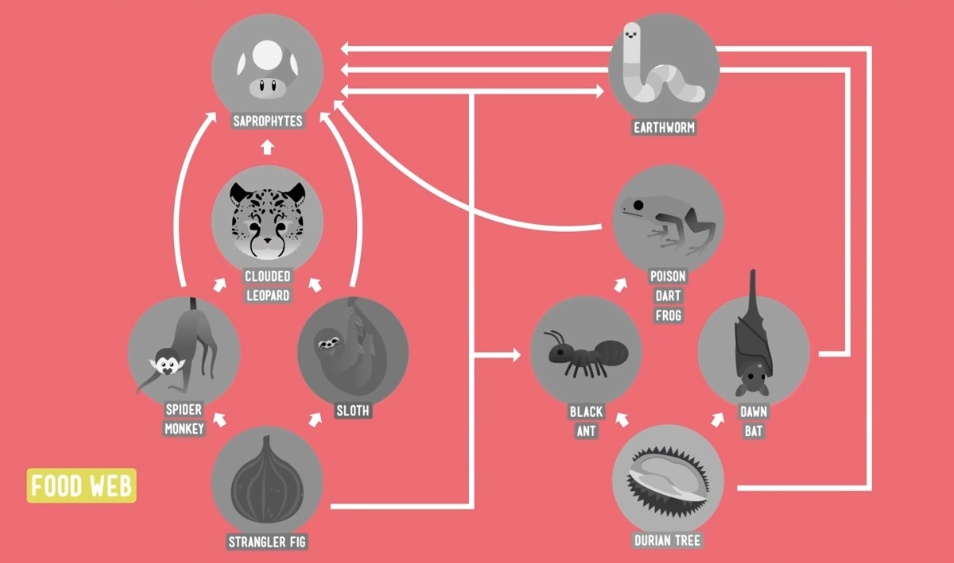
In the example, none of the animals had enough to eat, all because of the loss of ___
a)
one species
b)
two species
c)
three species
d)
several species
39.

In every ___, the plants and animals are connected.
a)
ecosystem
b)
organization
c)
entanglement
d)
spider web
40.

The good news is that ecosystems tend to be ___
a)
in decline
b)
out of balance
c)
delicate
d)
in balance
41.

Organisms, like bacteria, insects and worms, that break down waste are called ___
a)
carnivores
b)
herbivores
c)
decomposers
d)
omnivores
42.

Where do decomposers fit in a food chain?
a)
at the beginning
b)
at the end
c)
in the middle
d)
any time there's waste
43.

Decomposers break waste down into ___
a)
bacteria and some fungi
b)
nutrients and other chemicals
c)
plants and trees
d)
insects and worms
44.

Chemicals go into the ground and are taken up by ___
a)
the sun
b)
plants
c)
decomposers
d)
animals
45.

In an ecosystem, decomposers break down ___
a)
nutrients
b)
waste
c)
insects
d)
worms
46.

Which organisms keep waste from piling up in an ecosystem?
a)
decomposers
b)
plants
c)
mice
d)
owls
100 %

