wayground logo

Free Printable Worksheets

NEW

Font size

S
M
L
XL
Worksheets

Physics 2021 Sem 2 Final Exam Review

Total questions: 63

Worksheet time: 3hrs 58mins

Name
Class
Date
1.

Energy is measured in which units?

a)

Watts

b)

Joules/Sec

c)

Joules

d)

Newtons

2.

Energy that is stored by an object due to its position or height?

a)

Kinetic

b)

Potential

c)

Thermal

d)

Elastic

3.

A baseball thrown at high speed has a lot of what kind of energy?

a)

Kinetic

b)

Potential

c)

Both Potential and Kinetic

d)

Magic

4.

Mechanical energy is the sum of what two kinds of energy?

a)

Potential and Kinetic

b)

Kinetic and Gravitational

c)

Potential and Elastic

d)

Potential and Gravitational

5.

At which position(s) does the pendulum have the most kinetic energy?

a)

A

b)

B

c)

C

d)

D

6.

At which position(s) does the pendulum have the most potential energy?

a)

A

b)

B

c)

C

d)

D

7.

What does "mass x gravity x height" calculate?

a)

Mechanical Energy

b)

Kinetic Energy

c)

Potential Energy

d)

Thermal Energy

8.

How much PE does a 5 kg cat have when it is 45 feet off the ground?

a)

22.5 J

b)

225 J

c)

525 J

d)

2205 J

9.

What does (1/2mass x velocity2) calculate?

a)

Potential Energy

b)

Kinetic Energy

c)

Mechanical Energy

d)

Thermal Energy

10.

How much kinetic energy does a 1500 kg car have when it is moving at 15 m/s?

a)

174,375 J

b)

11,250 J

c)

22,500 J

d)

168,750 J

11.

If the speed of an object is doubled, its kinetic energy will be?

a)

doubled (x2)

b)

halved (x 1/2)

c)

quadrupled (x4)

d)

quartered (x 1/4)

12.

If the mass of an object is doubled, its kinetic energy will be?

a)

doubled (x2)

b)

halved (x 1/2)

c)

quadrupled (x4)

d)

quartered (x 1/4)

13.

What is the speed of a 1600 kg race car that has a kinetic energy of 2,400 J?

a)

1.73 m/s

b)

960,000 m/s

c)

28.3 m/s

d)

1,920,000 m/s

14.
You drop a 5 kg ball from a height of 2 m. Just before it reaches the ground, what is the ball's velocity?
a)
6.32 m/s
b)
40 m/s
c)
4.47 m/s
d)
100 m/s
15.
A 70 kg runner has a velocity of 5 m/s. Her kinetic energy is
a)
875 J
b)
175 J
c)
1750 J
d)
350 J
16.

What is the relationship between force of gravity and the mass of an object?

a)

Direct and Linear

b)

Inverse and linear

c)

Direct nd Exponential

d)

Inverse an Exponential

17.
Two factors effecting the magnitude of the force of gravity between 2 objects are...
a)
mass and distance 
b)
mass and matter
c)
distance and weight 
d)
weight and mass
18.

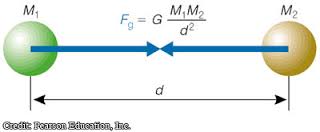
What is the Universal law of gravitation equation?

a)

G=F ⋅ m1⋅m2/d2

b)

F=G ⋅ m1⋅m2/ d2

c)

F=G ⋅ d2/m1⋅m2

d)

G=F ⋅ d2/m1⋅m2

19.

How does the force of gravity vary between two objects as the distance between them increases? The relationship is:

a)

Direct and Linear

b)

Inverse and linear

c)

Direct nd Exponential

d)

Inverse an Exponential

20.

There is gravity between any two objects. If the mass of either or both objects is decreased, how would the force of gravity change?

a)

It would increase

b)

It would decrease

c)

It would not change

21.

If the distance of two objects is reduced to 1/4, what happens to the force of gravity between them?

a)

It doubles

b)

It is 1/2 as much as before

c)

It is four times stronger than before

d)

It is 16 time stronger than before

22.

What is the gravitational force between two identical 50,000 kg asteroids whose centers of mass are separated by 1000 m?

a)

2500 N

b)

3.3 x 10⁻¹² N

c)

1.67 x 10⁻⁴ N

d)

1.67 x 10⁻⁷ N

23.

Two spherical objects have masses of 8000 kg and 1500 kg. Their centers are separated by a distance of 1.5 m. Find the gravitational attraction between them

a)

5.4 X 10⁻⁴ N

b)

1.2 X 10⁷ N

c)

3.6 X 10⁻⁴ N

d)

5.33 N

24.

Calculate the gravitational force between two objects when they are 0.750m apart. Each object has a mass of 5.00kg.

a)

2.96x10⁻⁷N

b)

3.00x10⁻⁶N

c)

2.22x10⁻⁹N

d)

2.23x10⁻⁸N

25.

Complete the following statement: The farther away two planets are the _______ the gravitational force is between them.

a)

more

b)

same

c)

dosen't matter

d)

less

26.

The gravitation force between two masses is 25N. If the magnitude of both masses were doubled, what would the force between them be?

a)

50N

b)

25N

c)

100N

d)

2.5N

27.

If the distance between two objects is tripled, what happens to the force of gravity between them?

a)

It triples

b)

It is 1/3 as much as before

c)

It is 9 times stronger than before

d)

It is 1/9 as much as before

28.
The gravitational force between two objects that are   2.1x10‐1 m apart is   3.2x10‐6 N.  If the mass of one object is 55 kg, what is the mass of the other object?         
a)
50.1 kg
b)
55.5 kg
c)
38.4 kg
d)
Asteroid 2 has no mass
29.
How often a wave occurs is the wave's __________________
a)
crest
b)
frequency
c)
wavelength
d)
resting point
30.
How often a wave occurs is the wave's __________________
a)
crest
b)
frequency
c)
wavelength
d)
resting point
31.
The distance between 2 corresponding parts of a wave  (example- crest to crest) is its _____________________
a)
trough
b)
frequency
c)
amplitude
d)
wavelength
32.
The frequency of a wave is measured in __________________. 
a)
inches
b)
hertz
c)
periods
d)
eras
33.
Any material that a wave travels through is called a ____________________.
a)
vibration
b)
compression
c)
medium
d)
crest
34.
In what type of wave does the medium vibrate parallel to the direction of the wave?
a)
surface wave
b)
longitudinal wave
c)
transverse wave
d)
electromagnetic wave
35.
What are the highest parts of a transverse wave called?
a)
amplitude
b)
trough
c)
resting point
d)
crest
36.
In what type of wave does the medium move perpendicular to the movement of the wave?
a)
Transverse
b)
Longitudinal
c)
Electromagnetic
d)
Radio
37.
What number represents the wavelength?
a)
1
b)
2
c)
3
d)
4
38.
As the frequency of a wave increases, the __________________ decreases.
a)
amplitude
b)
resting point
c)
wavelength
d)
crest
39.
What number represents the amplitude?
a)
1
b)
2
c)
3
d)
4
40.
When wavelength increases, what happens to the frequency?
a)
it increases
b)
it decreases
c)
it stays the same
41.
What is the speed of a wave that has a wavelength of 2 and a frequency of 2.5?
a)
2.5 m/s
b)
5 m/s
c)
4.5 m/s
d)
6 m/s
42.
Which wave has a longer wavelength?
a)
wave C
b)
wave D
43.
Which wave has a greater frequency?
a)
wave B
b)
wave C
44.
What is interference?  
a)
occurs when two or more waves overlap and combine 
b)
occurs when two or more waves combine and neutralize each other 
c)
when one waves travels alone
45.
A wave source that appears to move toward a viewer creates an apparent...
a)
red-shift
b)
blue-shift
c)
no shift
d)
the doppler effect
46.

The length of a wave is measured in meters. What is the symbol used for it?

a)

A

b)

f

c)

c

d)

λ

47.

A wave is traveling at a speed of 500 m/s. If the wave is as long as a soccer field, 100 m, what is the frequency of the wave?

a)

500,000 Hz

b)

5 Hz

c)

0.2 Hz

d)

1/5 Hz

48.

What is a red-shift?

a)

The apparent bunching-up of waves as they move toward you.

b)

The apparent spreading out of waves as they move away from you.

49.
If 10 waves pass every second, what is the frequency?
a)
10 Hz
b)
0.1 Hz
50.
If 6 waves pass in 2 seconds, what is the period?
a)
6
b)
3
c)
2
d)
0.33
51.
A wave has frequency of 50 Hz and a wavelength of 10 m. What is the speed of the wave?
a)
0.2
b)
5
c)
500
d)
20
52.
A wave has a wavelength of 2 meters and a frequency of 1.5 Hz.What is its speed?
a)
0.75
b)
3
c)
1.33
d)
3.5
53.
What do the light waves of a galaxy that is moving AWAY from us look like?
a)
red shifted
b)
blue shifted
c)
green shifted
d)
yellow shifted
54.
What do the light waves of a galaxy that is moving TOWARD us look like?
a)
red shifted
b)
blue shifted
c)
green shifted
d)
yellow shifted
55.
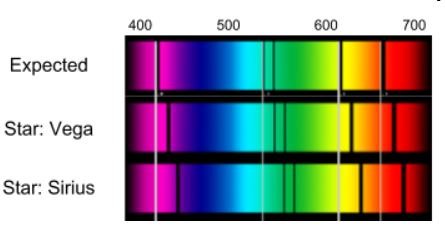
Use the image to identify the motion of the object relative to Earth.  Compare the absorption spectra of the star to what the star would look like if it were not moving at all relative to Earth.
a)
It is not moving
b)
It is moving away from Earth (Redshift)
c)
It is moving towards Earth (Blueshift)
d)
It is moving towards Earth (Redshift)
56.
Use the image to identify the motion of the object relative to Earth.  Compare the absorption spectra of the star to what the star would look like if it were not moving at all relative to Earth.
a)
It is not moving relative to Earth
b)
It is moving away from Earth (Redshift)
c)
It is moving towards Earth (Blueshift)
d)
It is moving towards Earth (Redshift)
57.

when the frequency is higher what happens to the wavelength?

a)

the wavelength gets longer

b)

The wavelength gets shorter

c)

the wavelength doesn't change

d)

I have no idea

58.

What is true about these stars?

a)

Both of these stars are moving away from us.

b)

Both of these stars are moving towards us.

59.
The change in wavelength of light or sound that is due to the relative motion of the source towards or away from an observer.
a)
Radar Effect
b)
Doppler Effect
c)
Light Effect
d)
Reflection
60.

Which of the following has the shortest wavelength?

a)

Infrared

b)

The color Indigo

c)

Infrared

d)

TV

61.

Which of the following has the least amount of energy?

a)

UV rays

b)

The color yellow

c)

Radio waves

d)

Gamma rays

62.

Which of the following has the longest wavelength?

a)

Gamma rays

b)

The color blue

c)

TV

d)

Infrared

63.

Which of the following has the most energy?

a)

TV

b)

Microwaves

c)

Radiowaves

d)

Infrared