
 Worksheets
EM Radiation & Mirrors
Total questions: 60
Worksheet time: 1hrs 5mins
Electromagnetic waves vary in
the speed they travel in a vacuum
wavelength and frequency
the way they reflect
the orientation of their electric and magnetic fields
Infrared rays have a shorter wavelength than
Ultraviolet ray
X-rays
gamma rays
radio waves
The full range of frequencies of electromagnetic radiation is called
visible light
the electromagnetic spectrum
radio waves
invisible radiation
The waves with the longest wavelengths in the electromagnetic spectrum
Infrared rays
gamma rays
radio waves
X-rays
The visible light spectrum ranges between
radio waves and X-rays
infrared rays and ultraviolet rays
television waves and infrared rays
ultraviolet rays and gamma rays
What happens to frequency when the energy increases?
it increases
it stays the same
it decreases

What part of the wave is shown at letter A?
crest
wavelength
trough
frequency
What does a wave carry?
boats
energy
matter
water

Which wave has a longer wavelength?
wave C
wave D

Which wave has a greater frequency?
wave B
wave C
Select the correct order of waves on the EMS from low to high energy
Radio wave, Microwave, Infrared, Visible, Ultraviolet, X-ray, Gamma
Visible, Microwave, Infrared, Ultraviolet, X-ray, Gamma, Radio wave
Gamma, X-ray, Ultraviolet, Visible, Infrared, Microwave, Radio wave
Microwave, Radio wave, Visible, Infrared, Ultraviolet, X-ray, Gamma
Which has the LONGEST wavelength and, therefore, the LOWEST frequency/energy
Gamma Rays
Visible Light
Ultraviolet
Infrared rays
Which of the following electromagnetic waves has the lowest frequency?
gamma ray
visible light wave
infrared wave
microwave
High frequency in EM waves equals
high energy and short wavelength
low energy and short wavelength
high energy and long wavelength
low energy and long wavelength


Solve this problems using the equation: C = λν If an AM radio station broadcasts at 9.95 x 10⁵ Hz, what is the wavelength of this radiation?
(c = 3 x 10⁸ m/s)
6.59 x 10⁻²⁸ m
1.01 x 10⁻⁶ m
3.32 x 10⁻³ m
302 m

Calculate the wavelength of light that has a frequency of 5.2 x 10¹² HZ
(c = 3 x 10⁸ m/s)
5.8 x 10 -5 m
5.8 x 10 -7 m
5.19 x 10 14 m
1.56 x 10 23 m

IRAS, the Infrared Astronomy Satellite launched by NASA in 1983, had a detector that measured infrared or heat radiation from different regions of space. What is the frequency of infrared light that has a wavelength of
1.10 X 10⁻⁶ m? (c = 3 x 10⁸ m/s)
3.67 x 10⁻¹⁵ Hz
3.67 x 10⁻³ Hz
2.73 x 10² Hz
2.73 x 10¹⁴ Hz
What is the variable c used for?
frequency
wavelength
Energy
speed of light
What is the variable λ used for?
frequency
wavelength
Energy
speed of light

Which wave has a greater frequency?
A
B

The incident ray is shown by letter......
A
B
C
H

The normal is shown by letter......
A
B
C
F

Which letter represents the reflected ray?
A
B
C
D

The letter that represents the point of incidence is?
F
H
G
B

Which letter represents the reflected angle?
F
D
E
G

What is the other name for a plane mirror?
Flat
Normal
Diffused
When measuring the angle of incidence or angle of reflection we must always measure from.....
The normal
The mirror
The left
The right
On a plane mirror, if the angle of incidence is 20 degrees then the angle of reflection would be?
two times as much.. 40 degrees
1/2 of the angle of incidence, 10 degrees
Same as the angle of incidence 20 degrees
You wouldn't be able to tell.

Which is the reflected ray?
A
B
C
D
Which of the following best suits the definition of Reflection of Light.
change in the path of light when passing from one medium to another
return of light into the same medium after striking a surface
Define 'Normal'
light ray striking the reflecting surface
perpendicular drawn to the surface at the point of incidence
light ray obtained after reflection
Tick all the characteristics true for a real image
can be obtained on a screen
inverted with respect to the object
formed by a concave mirror for a distant object
cannot be obtained on a screen
formed by the actual intersection of the reflected rays
Characteristics of the image formed by a plane mirror
virtual
upright
same size as the object
laterally inverted
same distance behind the mirror as the object in the front of it
An object is at a distance of 25 cm in front of a plane mirror.The mirror is shifted 5 cm away from the object.Find the new distance between the object and it's image.
30 cm
60 cm
20 cm
40 cm
The image formed in a plane mirror is
erect and diminished
erect and enlarged
inverted and of the same size
erect and of the same size
What is the distance of your image from you if you stand 1.5 m in front of a plane mirror?
1.5 m
2.0 m
3.0 m
4.5 m
A man runs towards mirror at a speed of 15m/s. What is the speed of his image
15m/s
30m/s
7.5m/s
none
The mirror which reflecting surface is curved outward ?
convex mirror
plane mirror
concave mirror
Light is a form of energy that helps us see around us.
True
False

Image formed by a plane mirror is
virtual and erect
real and erect
real and inverted
virtual and inverted

The inner surface of a steel spoon acts as a
concave mirror
convex mirror
None of the above
image above the principal axis (PA) is
virtual
real
upright
upside down
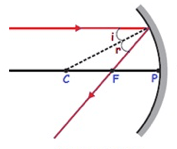
This ray diagram is for which mirror?
concave
convex
plane
window
From which point does a ray of light pass after reflection when incident parallel to Principal axis
focus
centre of curvature
radius of curvature
pole

The size of an object and its image are the same in this type of mirror...
Plane
Convex
Concave
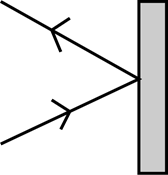
In the illustration, the light ray striking the object is-
What do you call a flat mirror?
plane mirror
convex mirror
concave mirror
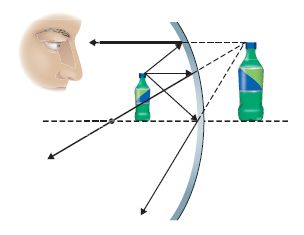
If the object is between C and f, the image is ...
image is real, smaller, and inverted
image is real, smaller, and upright
image is virtual, smaller, and inverted
image is real, bigger, and inverted
If the object is between f and the mirror, the image is ...
image is real, smaller, and inverted
image is virtual, larger, and upright
image is virtual, smaller, and inverted
image is real, bigger, and inverted

