Worksheets
Waves Study Guide
Total questions: 62
Worksheet time: 53mins
Radio Waves are an example of _________ waves.
mechanical
electromagnetic
light
The distance in between two waves.
wave speed
frequency
wavelength
Frequency is always measured in _________
kilometers
Hertz
centimeters
when a wave hits a barrier and bounces
diffraction
reflection
You're in your room blasting music with the door shut, your mom opens your door. Now your music is heard throughout your home. This is an example of _______
interference
diffraction
reflection
When two waves overlap each other, this behavior is known as _______.
interference
refraction
frequency

This is a high frequency wave. Which part of the wave is "B"
crest/peak
wavelength
trough

Which wave has the longest wave length?
top wave
bottom wave

What do all waves transfer?
Matter
Heat
Electricity
Energy

Which of the following can waves transfer energy through?
solid
liquid
gas
empty space
all of the above

What are the two types of waves?
longitudinal and transverse
sound and light

What is the number of complete waves passing a fixed point in a given amount of time?
Amplitude
Intensity
Wavelength
Frequency

Which type of waves have the longest wavelength?
Visible light
Radio waves
X-rays
Gamma-Rays

Wavelengths are usually measured in ....
seconds
Hz
inches
meters

Shorter wave lengths can carry more energy. Which of these probably carries the MOST energy:
Infrared light
Visible light
X-rays
UV light

What does #1 represent?
Period
Frequency
Wavelength
Amplitude

What does #2 represent?
Period
Frequency
Wavelength
Amplitude

What does #3 represent?
Period
Frequency
Wavelength
Amplitude
If the amplitude increases, the energy of the wave:
increases
decreases
stays the same
Waves that require a medium to travel are:
mechanical waves
transverse waves
electromagnetic waves
light waves
What happens when you increase the amplitude of a sound?
it makes the sound louder
it makes the sound travel faster
it makes the sound softer
it changes the pitch or note of the sound

What kind of wave is pictured below?
compressional wave
transverse wave
longitudinal wave
mechanical wave
What can electromagnetic waves travel through (select all that apply)?
solids
empty space
liquids
gases

Which wave is pictured?
Transverse
Longitudinal
Electromagnetic
Light
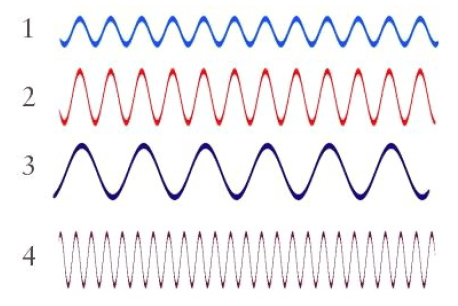
Which wave in the diagram has the greatest frequency?
1
2
3
4
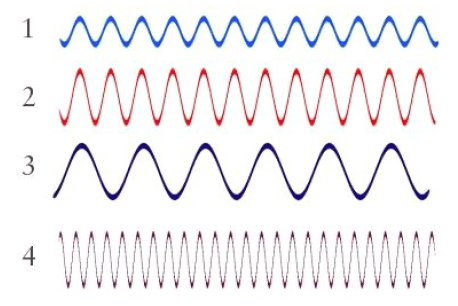
Which wave in the diagram has the longest wavelength?
1
2
3
4
Which of the following can a mechanical wave travel through (select all that apply)?
solid
liquid
gas
empty space
If a wave has a greater frequency, what happens to the wavelength?
increases
decreases
stays the same
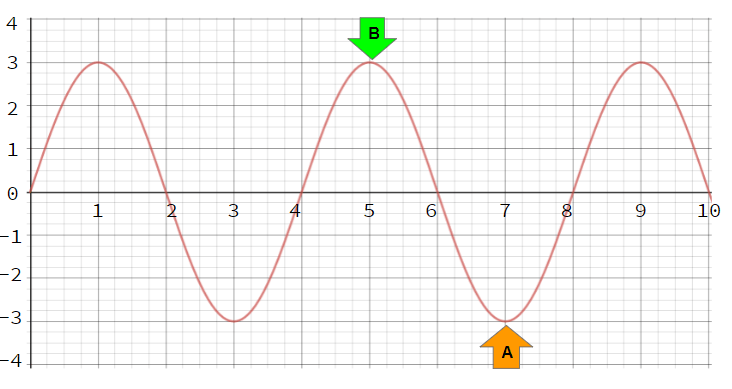
What property does the orange arrow (A) represent?
Crest
Trough
Wavelength
Peak
This sound has high pitch, which means it has a(n):
Higher frequency
Lower frequency
Higher amplitude
Lower amplitude
How are the frequency of a wave and the period related?
They both equal the wavelength.
They are both the inverse of the wavelength.
They are the inverse of each other
They are both related to the amplitude.
Longitudinal waves move __________ to the energy of the wave (select all that apply).
Parallel
Perpendicular
At a 90 degree angle
In the same direction
Transverse waves move __________ to the energy in the wave (select all that apply).
Parallel
Perpendicular
At 90 degree angle
In the same direction
The area of a longitudinal wave where particles are pushed close together are called:
rarefactions
compressions
amplitude
wavelength
The areas of a longitudinal waves where particles are spread far apart from each other are called:
rarefactions
compressions
amplitude
wavelength
Sound waves can travel through a vacuum because they don't require particles.
True
False


The number of cycles that are completed per second is called the ________ and is measured in _________.
frequency, Hertz
wavelength, meters
amplitude, meters
period, seconds

Which of the following has the lowest energy?
The color yellow
The color blue
The color indigo
The color orange
A wave has a frequency of 2.5 hz and a wavelength of 20 m. What is the velocity of the wave?
50 m/s
8 m/s
40 m/s
A wave has a velocity of 4 m/s and a wavelength of 2 m. What is the frequency of the wave?
2 hz
8 hz
18 hz
A wave has a frequency of 6 Hz. What is the period of the wave?
0.167 s
6 m
0.167
6 Hz
A radio wave has a wave length of 4 m and a frequency of 4 Hz. What is the speed of the wave?
16 m/s
16 m
4 Hz
8 m/s
Wavelength= .5m
Frequency= 150 hertz
Wavelength= 2.0m
Frequency= _________
Wavelength= 80 m
Frequency= ___________
Wavelength= ___________
Frequency= 300 hertz
The bigger the amplitude, the ________ energy carried by the wave.
more
less

A wave has a frequency of 8 Hz and a speed of 32m/s meters. By using formula above, what is the wavelength of the wave?
2 meter
3 meter
4 meter
5 meter

What wave has the slowest frequency?
green
red
yellow
blue
If a sound has a high amplitude then it also has a ____________!
fast echo
slow pitch
high volume
low volume
What is how loud or quiet a sound is?
pitch
volume

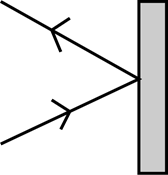
In the illustration, the light ray striking the object is-