wayground logo

Free Printable Worksheets

Font size

S
M
L
XL
Worksheets

Solids, Liquids & Gases / Changes of State

Total questions: 67

Worksheet time: 1hrs 22mins

Name
Class
Date
1.

Any sample of matter has mass and takes up space. The main reason for this is because:

a)

All matter is heavy.

b)

Matter can be a gas.

c)

Matter is made up of tiny particles that have mass and take up space.

d)

The Earth is made of matter.

2.

The molecules of the liquid inside the thermometer increase in speed when the thermometer is ___.

a)

heated

b)

cooled

3.

When a thermometer is cooled, the red liquid inside moves down. This is mainly because:

a)

Cold liquids sink.

b)

The glass of the thermometer gets cold.

c)

The molecules of the liquid move slower and get a little closer together.

d)

The red liquid is thick.

4.

When a thermometer is heated, the red liquid inside the thermometer moves up. This is mainly because:

a)

The red liquid is thin.

b)

The molecules move faster and get a little further apart.

c)

Hot liquid is lighter.

d)

The glass of the thermometer gets hot.

5.

An increase in temperature increases molecular motion and increases the distance between atoms and molecules in liquids.

a)

true

b)

false

6.

SELECT ALL CORRECT ANSWERS: To describe a gas, you could say:

a)

particles are very attracted to each other

b)

particles are NOT very attracted to each other

c)

particles are close together like a liquid

d)

particles of a gas are further apart than those in a liquid or solid

7.

SELECT ALL CORRECT ANSWERS: To describe a solid, you could say:

a)

the particles are attracted to each other

b)

the particles can move past each other

c)

the particles vibrate but do not move past each other

d)

a solid has mass and takes up space

8.
If a balloon is cooled what will happen to the volume?
a)
Volume will increase
b)
Volume will decrease
c)
Volume will not change
9.
Particles in a __________ have very little movement and the object keeps its shape and volume.
a)
solid
b)
liquid
c)
gas
10.
__________ have a definite volume and tend to take the shape of their container. 
a)
solids
b)
liquids
c)
gases
11.
Which of these is the correct term for turning a gas into a liquid?
a)
Evaporating
b)
Boiling
c)
Condensing
d)
Freezing
12.
Which of these is the right word for the process of turning a solid into a liquid?
a)
Boiling
b)
Melting
c)
Condensing
d)
Evaporating
13.

Freezing point

a)

The classification of matter as a solid, a liquid, or a gas

b)

Physical change in matter from a gas to a liquid

c)

The temperature at which a substance changes states from a solid to a liquid

d)

The temperature at which a substance changes from a liquid to a solid

14.
When a gas forms directly from a solid, skipping the liquid phase. it is called
a)
deposition
b)
sublimation
c)
evaporation
d)
condensation
15.

The change in state from liquid to gas is called

a)

vaporization

b)

sublimation

c)

condensation

d)

deposition

16.
This water is changing from a liquid to a gas via _______.
a)
precipitation
b)
boiling
c)
evaporation
d)
condensation
17.
True/False: There is very little space between the molecules of a liquid. There is a lot of space between the molecules of a gas.
a)
True 
b)
False 
c)
WRONG
d)
Nope
18.
The molecules in which state of matter spread out until they fill the container no matter how big this container is? 
a)
solid
b)
liquid
c)
gas
d)
WRONG
19.
When enough energy is added to a liquid, it changes phase to a ___. 
a)
solid
b)
liquid
c)
gas
d)
Mr.C
20.
When a liquid loses enough energy it changes phase to a _____.
a)
solid
b)
liquid
c)
gas
d)
Mr.C
21.
Rank these in order from least dense to most dense.
a)
Solid, Liquid, Gas
b)
Liquid, Gas, Solid
c)
Gas, Solid, Liquid
d)
Gas, Liquid, Solid
22.
Liquids have...
a)
A definite shape and volume
b)
A definite shape but no definite volume
c)
No definite shape but a definite volume
d)
No definite shape or volume
23.
The speed of the molecules determines the _____.
a)
Temperature
b)
density
c)
pressure
24.

Color, size and shape are ______________ of matter.

a)

solids, liquids, and gases

b)

molecules

c)

properties

d)

the mass

25.
If a liquid has high viscosity, it probably has:
a)
strong resistance to flow
b)
weak resistance to flow
26.
Which characteristic of water will allow a paperclip to remain floating on water when the paperclip is gently placed on top of the water?
a)
adhesion
b)
surface tension
c)
solvent properties
d)
nonpolar
27.
Two liquids are poured out of containers at the same height & time. Liquid 1 empties from the container before liquid 2. Which liquid has a lower viscosity? 
a)
liquid 1
b)
liquid 2
c)
both liquids have the same viscosity
d)
cannot be determined
28.

What state of matter is the object at 5?

a)

solid

b)

liquid

c)

gas

d)

solid & liquid

29.

What state of matter is the object at 2?

a)

solid

b)

liquid

c)

gas

d)

solid & liquid

30.
How do gases move?
a)
They flow into any container.
b)
The keep their shape and are rigid.
c)
They vibrate and move freely at high speeds.
31.
Which phrase best describes the particles in a solid?
a)
not moving
b)
very far apart
c)
vibrating in place
d)
able to slip past one another
32.
Sublimation is
a)
when solid turns into gas
b)
when gas turns into plasma
c)
when liquid turns into gas
d)
when gas turns into solid
33.

Looking at this picture, what is one thing you notice about the melting and freezing points?

a)

The melting point is higher than the freezing point

b)

They are the same

c)

The freezing point is higher than the melting point

34.
When a gas changes its phase and turns into a solid it is known as
a)
deposition.
b)
sublimation.
c)
condensation.
d)
freezing or solidification.
35.
Electrically charged state of matter similar to a gas.
a)
temperature
b)
liquid
c)
plasma
d)
gas
36.
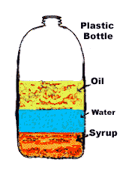
Which liquid is the least dense?
a)
oil
b)
water
c)
syrup 
d)
plastic bottle
37.
What is the measuring unit for mass?
a)
centimeter 
b)
millimeter 
c)
grams 
d)
pounds
38.
The density of this material is 2 g/cm3.
There are 24 cm3  Find the total mass.
a)
12 grams
b)
48 grams
c)
12 g/cm3
d)
48 g/cm3
39.
A diamond has a mass of 1.2 g.  If diamond has a density of 3.51 g/mL, what is the volume of the diamond.
a)
0.34 mL
b)
2.9 g/mL
c)
2.3 mL
d)
4.2 mL
40.
The density of gold is 19.32 g/mL.  The king's gold ring displaces 0.4 mL when placed in water.  What is the mass of the ring?
a)
48.3 g
b)
7.7 g
c)
0.02 g
d)
19.28 g
41.
Which liquid is the least dense?
a)
oil
b)
water
c)
syrup 
d)
plastic bottle
42.
Where can matter be found?
a)
Everywhere
b)
On Earth only
c)
In a solid and liquid only
43.
How does the mass of a bowling ball on Earth compare to its mass on the moon?
a)
The mass will be greater on the moon
b)
The mass will be less on the moon
c)
The mass will stay the same
44.
What is this tool to get mass?
a)
triple beam balance
b)
ruler
c)
thermometer
d)
graduate cylinder
45.
What is the formula for density?
a)
density = mass x volume
b)
density = mass / volume
c)
density = mass + volume
d)
density = mass - volume
46.
Jack has a rock. The rock has a mass of 14 g and a volume of 2 cm3. What is the density of the rock?
a)
7 mL
b)
7 g/cm3
c)
28 g/cm3
d)
1/7 g/cm3
47.
Frank has an eraser. It has a mass of 4 g, and a volume of 2 cm3. What is its density?
a)
8 g/cm3
b)
2 g/cm3
c)
1/2 g/cm3
d)
24 g/cm3
48.
Frank has a paper clip. It has a mass of 9g and a volume of 3cm3. What is its density?
a)
3 g/cm3
b)
1/3 g/cm3
c)
27 g/cm3
d)
39 g/cm3
49.
Jill has a gel pen. The gel pen has a mass of 8g and a volume of 2cm3. What is the density of the pen?
a)
4 g/cm3
b)
16 g/cm3
c)
.25 g/cm3
d)
64 g/cm3
50.
Why do some substances float on water?
a)
they are warmer than water
b)
they are cooler than water
c)
they are more dense than water
d)
they are less dense than water
51.

Surface tension is the property of water in which...

a)

water molecules at the surface tend to stick together.

b)

water spills easily.

c)

water tends to be see-through.

52.
Which characteristic of water will allow a paperclip to remain floating on water when the paperclip is gently placed on top of the water?
a)
adhesion
b)
surface tension
c)
solvent properties
d)
nonpolar
53.
What is the formula for density?
a)
density = mass x volume
b)
density = mass / volume
c)
density = mass + volume
d)
density = mass - volume
54.

Molecules that have a positively charged side and a negatively charged side are called ____ molecules.

a)

polar

b)

nonpolar

c)

imbalanced

d)

weird

55.

Molecules that have a positively charged side and a negatively charged side are called ____ molecules.

a)

polar

b)

nonpolar

c)

imbalanced

d)

weird

56.

Where is the nucleus found in this picture?

57.

Protons have what charge?

a)

Positive

b)

Neutral

c)

Negative

58.

Neutrons have what charge?

a)

Protons

b)

Neutral

c)

Negative

59.

Neutrons have what charge?

a)

Protons

b)

Neutral

c)

Negative

60.

Electrons have what charge?

a)

Positve

b)

Neutral

c)

Negative

61.

Where do you find protons?

a)

Nucleus

b)

Electrons cloud

c)

Outside the nucleus

62.

Where do you find neutrons?

a)

Nucleus

b)

Electrons cloud

c)

Outside the nucleus

63.

Where do you find electrons? Check all that apply.

a)

Nucleus

b)

Electrons cloud

c)

Outside the nucleus

64.

The small, dense, positively charged center of an atom

a)

Neutron

b)

Proton

c)

Nucleus

d)

Electron

65.

The number 18 represents the

a)

Atomic number

b)

Neutrons

c)

Element Name

d)

Element symbol

66.

What is the element name?

a)

Argon

b)

Neon

c)

18

d)

Ar

67.

What is the element symbol?

a)

Argon

b)

Ar

c)

18

d)

39.948