
 Worksheets
Physical Science Midterm Review
Total questions: 64
Worksheet time: 2hrs 52mins
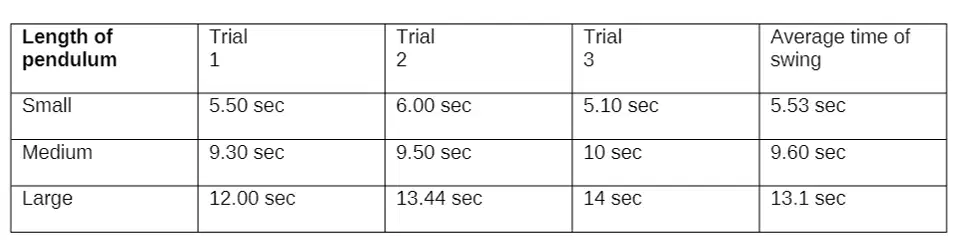
Students swung three pendulums of different lengths back and forth ten times and recorded the finish times of each. Which of the following describes the “type of string” used in the experiment?
Control group
Constant
Independent variable
Dependant variable
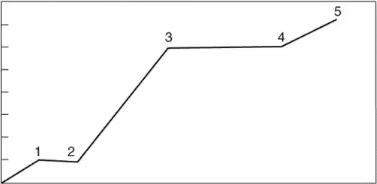
The temperature of an ice-filled beaker is measured and recorded every minute as the beaker is heated continuously. The resulting temperature and time data are shown in the following graph. Which of the statements below provide the best interpretation of the information in the graph?
The temperature of water constantly increased with time.
The greatest increase in temperature took place between points 2 and 3.
The greatest increase in temperature took place between points 4 and 5.
The temperature of the water remained constant the longest between points 1 and 2.
SC.7.N.1.2
Scientists frequently repeat the experiments of others scientists. Why is this important in science?
a. Scientists often ask each other for help in performing experiments.
b. Replication of experiments helps to confirm and verify results.
c. Scientists frequently perform other scientists’ experiments in order to practice their technique.
d. Repeating experiments is an effective way to make sure a laboratory is in optimal condition.


What is a scientific law?
A hypothesis that has been proven over and over again
A rule that describes a pattern in nature that only states that an event will occur under certain circumstances
An untested idea that scientists have studied
A philosophical concept
While speaking to a colleague, a scientist makes the following statement: "I propose that bald eagle eggs in northern Maine will have thinner shells than those from birds in southern Alaska due to increased levels of pesticides in the water. This statement is a
Theory
Law
Conclusion
Hypothesis
Which statement below correctly identifies the difference between laws and theories?
Laws describe phenomena, while theories explain why and how phenomena exist
Laws are a statement of fact, while theories are a statement of opinion
Laws explain why phenomena exist, while theories explain how
Laws are a prediction of phenomena, while theories are an explanation

This image is an example of a scientific
theory
law

An osmosis investigation was conducted using chicken eggs to represent cells with semipermeable membranes. The mass of each egg was measured to determine how much water diffused into or out of the eggs. The eggs were first soaked in vinegar to dissolve the shell. Each egg was then placed in one of three different solutions for 24 hours. The table above shows the results of the investigation.
Based on this experiment, which of the following should be inferred about cells with semipermeable membranes?
A. Substances other than water may also cross the cell membrane.
B. Substances other than water may block pores in the cell membrane.
C. Water enters the cell when placed in environments of high water concentration.
D. Water leaves the cell when placed in environments with a low concentration of solutes
Carmen conducted an experiment to determine if listening to different types of music would affect a person’s pulse. Her hypothesis was that pulse rate would change with different types of music. Each person listened to seven different selections of music for 30 seconds each. Each person’s pulse was taken before the music and then after each 30-second interval of music. The pulses were taken again after the music selections were completed. Based on her experiment, Carmen concluded that a person’s pulse rate changed when the person listened to different types of music.
Which component is missing from Carmen’s experiment?
A. a question
B. a hypothesis
C. a control group
D. a description of the experiment

Jill wanted to see which type of food her rabbit liked the most. She thinks that they will eat more apples than cabbage. For several days she feed the rabbit equal amounts of cabbage, lettuce and apples. She recorded the results in the chart. Was her hypothesis supported or rejected?
Supported
Rejected

Green object is moving at a faster constant speed than Red
Red object is moving at a faster constant speed than Green
Green object is moving at a slower constant speed than Red
Red object is moving 2 times faster than Green
The red car rolled 0.5 meters across the table for 2 seconds. The table was 4 meters high. What was the average speed of the red car in m/sec?
0.25 m/sec
2 m/sec
2.25 m/sec
4 m/sec
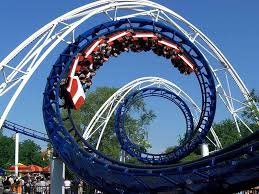

The three examples pictured are of
Non-contact Forces
Contact Forces

The force between the phone and the mount is a
contact force
non-contact force
Which force is responsible for keeping a book resting on a table and holding Earth in its orbit around the Sun?
Gravitational Force
Weak Nuclear Force
Strong Nuclear Force
Electromagnetic Force
What force is responsible for holding the nucleus of an atom together, thereby defining the characteristics of elements?
Strong Nuclear Force
Electromagnetic Force
Weak Nuclear Force
Gravitational Force
Imagine you're explaining to a friend the fundamental forces that govern the universe. You would say:
Electromagnetism, Gravity, Strong Nuclear, Weak Nuclear
Gravity, Strong Nuclear, Weak Nuclear, Medium Nuclear
Normal Force, Force due to gravity, Magnetism, Nuclear
Nuclear, Electricity, Gravity, Atomic
Which would be used for the situation, scalar or vector:
How fast a car travels when it reaches top speed
scalar
vector
Which would be used for the situation, scalar or vector:
Calculating the velocity a car traveled
scalar
vector



What is the net force acting on this box?
8N to the right
5N to the left
5N to the right
9N to the left
combine and form a net force of zero
unbalanced forces
newton's first law
balanced forces
inertia
Which of these are examples of Newton's First Law:
1. A stationary object with no outside force will not move
2. An astronaut who has their screwdriver knocked into space will see the screwdriver continue on at the same speed and direction forever
3. If you use the same force to push a truck and a car, the car will have more acceleration than the truck because the car has less mass
4. An object at rest stays at rest
1,3,4
1,2,4
2,3,4
1,2,3
A child kicks a soccer ball with a force of 65 Newtons. What is the force exerted by the ball on the child's foot, and what is its direction?
65 Newtons: Same Direction
65 Newtons: Opposite Direction
130 Newtons: Opposite Direction
130 Newtons: Same Direction
Which of the following describes Newton's Third Law of Motion?
For every action there is an equal and opposite reaction
A representation of a system that is difficult to demonstrate directly
Change in an object's position with respect to time and in comparison to the position of other objects used as reference points
A push or a pull on an object

If you hold a 20 N object 2 m off of the ground, how much work have you done?
40 J of Work
10 J of Work
No Work
18 J of Work
You’re watching a volleyball game and someone asks you what type of energy best describe the movement of the volleyball players. Which of the following choices should your answer be in order to be correct?
Chemical
Sound
Mechanical
Potential
Where would a car traveling on a roller coaster track have the most potential energy?
At the bottom
Halfway to the top
at the top
halfway to the bottom
It is always the same
Two factors that determine work are
force
acceleration
mass
distance
velocity

It took 50 Joules to push a chair 5 meters across the floor. With what force was the chair pushed?
10 N
0.1 N
250 N
1 N

Which is an example of radiated heat for cooking?
cooking a pot of soup
scrambling eggs on the stove
grilling hot dogs over a campfire
frying hamburgers in a frying pan
Which is the best example of conduction?
boiling a pot of water
feeling heat from a fireplace
a hot air balloon rising and falling
touching a hot handle and getting burned
Molecules in cold things move more _________
than in hot things.
quickly
slowly
speedy
Rapidly
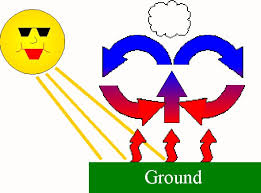
When two things are the same temperature:
They have the same number of molecules
Their molecules stop moving
Their molecules move at the same average speed
Heat transfer between the two things stops
Match the term with the correct definition.
this law states that, in any process, energy is neither created nor destroyed. It can only be converted from one form to another.
Law of Conservation of Energy
The transfer of thermal energy between two bodies which are at different temperatures.
Heat
The SI (metric) unit of energy or work.
Joule
Energy of motion
Kinetic Energy


What energy transformations occur when a flashlight is turned on?
Chemical energy to electrical energy to light energy
Electrical energy to chemical energy to light energy
Light energy to electrical energy to chemical energy
Electrical energy to light energy to chemical energy


How would you describe the relationship between the mass of a car and its kinetic energy?
As the mass of a car increases, its kinetic energy increases.
As the mass of a car increases, its kinetic energy decreases.
As the mass of a car decreases, its kinetic energy increases.
There is no clear relationship between mass and kinetic energy.
Select the items needed to have a complete circuit.
Energy source (battery)
Wires
Energy user (lightbulb)
Voltmeter
Switch

In the model, what do the arrows represent?
The flow of current
The flow of resistance
The flow of voltage
The flow of positrons

Based on this model, what change should be made in order to increase the current?
Close the switch
Add another battery
Add another lamp
Remove a wire

If a charger for a tablet offers a voltage of 120V and has 240Ω of resistance, what is the amperage?
0.5A
2A
14,400A
28,800A

Based on the model, which of the following would be true regarding the relationship between voltage, current, and resistance?
Current will reduce voltage.
Current will not pass through resistance.
Resistance will reduce current.
Voltage will reduce resistance.

