wayground logo

Free Printable Worksheets

NEW

Font size

S
M
L
XL
Worksheets

Astronomy test review

Total questions: 60

Worksheet time: 1hrs 12mins

Name
Class
Date
1.
Which of the following describes the sun?
a)
an object that is close to Earth
b)
an object that reflects light
c)
the body that orbits Earth
d)
the star at the center of our solar system
2.
About how long does it take for the moon to go from one new moon to the next new moon?
a)
About 15 days
b)
29 1/2 days
c)
24 hours
d)
365 days
3.
Which of the following lists the correct order of the four outer planets from the sun?
a)
Mercury, Venus, Earth, Mars
b)
Jupiter, Saturn, Uranus, Neptune

c)
Mars, Mercury, Earth, Venus
d)
Saturn, Uranus, Jupiter, Neptune
4.
What causes day and night on Earth?
a)
Earth rotates on its axis.  
b)
Earth moves around the sun.
c)
The moon moves around Earth.
d)
The sun rotates on its axis.
5.
Earth’s tilt on its axis and its revolution around the sun causes_____________________.
a)
day and night
b)
seasons            
c)
phases of the moon
d)
tides
6.
Which phase of the moon is shown in the picture?
a)
crescent moon
b)
full moon
c)
quarter moon
d)
new moon
7.
Which phase of the moon is shown in the picture?
a)
crescent moon
b)
full moon
c)
quarter moon
d)
new moon
8.
In winter, the Northern hemisphere gets
a)
direct light at noon
b)
less direct light than in summer
c)
more direct light than in summer
d)
no light
9.
What is the source of the moon's light?
a)
the moon
b)
Earth
c)
the sun
d)
the stars
10.
How long does it take Earth to spin on its axis?
a)
12 hours
b)
20 hours
c)
365 days
d)
24 hours
11.
What does Earth have that the moon does not have?
a)
an atmosphere
b)
a rocky surface
c)
mountains
12.
Which of these is the largest object in the solar system?
a)
Orion
b)
Earth
c)
the Sun
d)
Jupiter
13.
Revolve means:
a)
to spin
b)
to bounce 
c)
to orbit
14.

During a ___________________the Sun's rays are directed at the equator.

a)

Equinox

b)

Solstice

15.

During a __________________ the Sun's rays are directed on the Tropics.

a)

Equinox

b)

Solstice

16.

Earth rotates from...

a)

east to west

b)

north to south

c)

west to east

d)

None of the above

17.

Why do we have a leap year?

a)

Every year is 365 1/4 days.

b)

Every 4 years the 1/4 days add up to one full day.

c)

We gain a full day (February 29th).

d)

All of the above.

18.
Which celestial feature is largest in actual size?
a)
the Moon
b)
Jupiter
c)
the Sun
d)
the Milky Way
19.
What is represented by the diagram at the right?
a)
Changing phases of the Sun
b)
Changing phases of the Moon
c)
stages in an eclipse of the Sun
d)
stages in an eclipse of the Moon
20.
The red shift of light from distant galaxies provides evidence that the universe is 
a)
shrinking, only
b)
remaining the same size
c)
shrinking and expanding in a cyclic pattern
d)
expanding, only
21.
The diagram below represents a simple geocentric model. Which object is represented by the letter X? 
a)
Earth
b)
Sun
c)
Moon
d)
Polaris
22.
At which two positions of the Moon is an eclipse of the Sun or Moon possible?
a)
1 and 5
b)
2 and 6
c)
3 and 7
d)
4 and 8
23.
The Milky Way Galaxy is best described as _________.
a)
Elliptical
b)
Spiral
c)
Square
d)
Circular
24.
The distance light travels in a year.
a)
Light Year
b)
Kilometer
c)
Miles
d)
Light Minute
25.
If a star is 10 light years away that means it will take ___ years for light to reach us on Earth.
a)
1
b)
5
c)
10
d)
100
26.
A star's color tells you the relative ____________ of the star.
a)
temperature
b)
size
c)
location
d)
luminosity
27.
__________ ___________ are galaxies that contain very small amounts of gas and dust as well as relatively OLD stars.
a)
Spiral galaxies
b)
Elliptical galaxies
c)
Irregular galaxies
28.
_________ _________ are galaxies that have no pattern or easily defined shape but they do contain large amounts of gas and dust.
a)
Spiral galaxies
b)
Elliptical galaxies
c)
Irregular galaxies
29.
____ ______ is the evidence discovered by Edwin Hubble that is used to explain how distant galaxies are moving away from us.
a)
Red Shift
b)
Blue Shift
c)
Big Bang
d)
Red explosion
30.
This is the largest planet in the solar system.
a)
Saturn
b)
Jupiter
c)
Uranus
d)
Venus
31.
This is the smallest planet in the solar system
a)
Mercury
b)
Venus
c)
Earth
d)
Mars
32.
Only planet known to have life
a)
Earth
b)
Mars
c)
Venus
d)
Mercury
33.
This gas giant has a large storm in its atmosphere known as The Red Spot
a)
Jupiter
b)
Saturn
c)
Uranus
d)
Neptune
34.
Most likely due to a massive collision, this planet rotates from top to bottom.
a)
Saturn
b)
Venus
c)
Neptune
d)
Uranus
35.
The earth orbits around...
a)
the sun.
b)
the moon
c)
other planets
d)
the Milky Way
36.
What divides the inner planets from the outer planets?
a)
Kuiper Belt
b)
Oort Cloud
c)
Asteroid Belt
37.
Which planet is Mercury?
a)
1
b)
2
c)
3
d)
4
38.
The order of the planets is:
a)
Mars,Venus,Earth,
Mercury,Saturn
Jupiter, Uranus, Neptune
b)
Earth,Venus,Mars
Jupiter, Neptune,
Mercury,Saturn,
Uranus
c)
Mercury,Venus,Earth
Mars,Jupiter,
Saturn,Uranus
Neptune
39.
What force keeps the planets orbiting the sun?
a)
Gravity
b)
Magnetism
c)
Electricity
d)
Friction
40.

This model is showing us a...

a)

lunar eclipse

b)

solar eclipse

c)

phases of the moon

d)

earth eclipse

41.

This image is showing us a.....

a)

solar eclipse

b)

lunar eclipse

c)

phases of the moon

d)

earth eclipse

42.

When the moon passes between the earth and the sun, this results in a.....

a)

Waxing moon

b)

lunar eclipse

c)

solar eclipse

d)

sun rise

43.

When the earth is between the sun and the moon, this results in a...

a)

waxing moon

b)

solar eclipse

c)

lunar eclipse

d)

sun rise

44.

If you look up at the sky and see this, you are witnessing a....

a)

solar eclipse

b)

total eclipse

c)

lunar eclipse

d)

jupiter

45.

If you are looking up at the sky and see this, you are looking at a....

a)

solar eclipse

b)

total eclipse

c)

lunar eclipse

d)

jupiter

46.
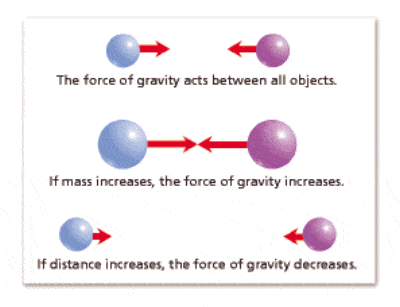
Any object with mass has gravity.
a)
True
b)
Sometimes
c)
False
d)
Never
47.
As distance between two objects increase the pull of gravity 
a)
Increases
b)
Decreases
c)
Stays the same
48.
As mass increases, what happens to gravitational force?
a)
increases
b)
decreases
c)
stays the same
d)
i don't know
49.
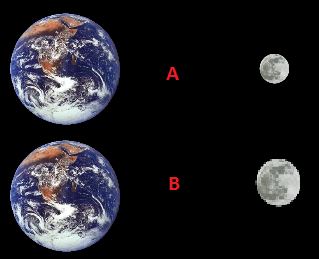
Which model has greater gravitational attraction (if any)
a)
Model A
b)
Model B
c)
Both Model A and Model B (same gravity)
50.
Which system has the greater gravitational attraction between the two objects (if any)?
a)
System A
b)
System B
c)
Same gravitational attraction fro System A and System B
51.
As mass increases, what happens to gravitational force?
a)
increases
b)
decreases
c)
stays the same
d)
i don't know
52.
Two factors effecting the magnitude of the force of gravity between 2 objects are...
a)
mass and distance 
b)
mass and matter
c)
distance and weight 
d)
weight and mass
53.
Any object with mass has gravity.
a)
True
b)
Sometimes
c)
False
d)
Never
54.
Differences in the moon's and sun's pull on different sides of the Earth cause _________.
a)
gravity
b)
lunar phases
c)
tides
d)
dabbing
55.
The bulge of water on the side of the Earth closest to the moon produces ___________.
a)
high tide
b)
low tide
c)
neap tide
d)
spring tide
56.
Tides are the cycle of rising and falling ocean water that repeats automatically every
a)
24 hours
b)
12.5 hours
c)
25 hours
d)
6.25 hours
57.
What is a difference between spring and neap tides?
a)
Spring tides occur when the earth and sun are IN LINE with the new or full moon. 
b)
Spring tides occur when moon in 3rd or 1st quarter phases
c)
Spring tides are LOWER than neap tides
d)
Spring tides occur in Spring and neap tides can occur in any season
58.
Which body has the greater effect on Earth's tides?
a)
Sun
b)
Saturn
c)
Moon 
d)
Venus
59.
What type of tide would this arrangement of earth-moon-sun create?
a)
full moon tide
b)
new moon tide
c)
neap tide
d)
spring tide
60.
How many times per month does a spring tide occur?
a)
Once
b)
twice
c)
three times
d)
it changes every month