wayground logo

Free Printable Worksheets

Font size

S
M
L
XL
Worksheets

UNIT 3 REVIEW

Total questions: 62

Worksheet time: 31mins

Name
Class
Date
1.
What causes tectonic plates to move along the Earth's surface?
a)
wind
b)
ocean currents
c)
convection in the mantle
d)
expansion of the Earth
2.
What type of boundary occurs when two plates move away from each other?
a)
transform
b)
subduction
c)
convergent
d)
divergent
3.
What forms at a divergent boundary between two oceanic plates?
a)
rift valley
b)
mountain
c)
mid-ocean ridge
d)
trench
4.
Which type of crust is more dense?
a)
oceanic
b)
continental
c)
divergent
d)
pizza
5.
What type of boundary occurs when two plates move toward each other?
a)
convergent
b)
divergent
c)
transform
d)
lateral
6.
What forms at a convergent boundary between a continental plate and an oceanic plate?
a)
volcanoes
b)
rift valleys
c)
faults
d)
mid-ocean ridges
7.
A rift valley occurs at a ____________ boundary.
a)
divergent
b)
convergent
c)
transform
d)
horizontal
8.
What is the process in which hot molten rock rises, then cools and sinks back to the core?
a)
plate tectonics
b)
continental drift
c)
convection
d)
divergence
9.
A trench forms at a _________ boundary.
a)
convergent
b)
divergent
c)
transform
d)
vertical
10.
What type of boundary occurs when two plates slide past each other?
a)
divergent
b)
transform
c)
lateral
d)
convergent
11.
A fault forms at a _________ boundary.
a)
transform
b)
divergent
c)
horizontal
d)
convergent
12.
What type of boundary is shown at A?
a)
transform
b)
convergent
c)
divergent
d)
subduction
13.
What is happening at point B?
a)
subduction
b)
a divergent boundary
c)
convection
d)
an earthquake
14.

A mid-ocean RIDGE is located at the boundary of two tectonic plates. Which diagram correctly models the relative plate motion on each side of a mid ocean ridge?

a)
b)
c)
d)
15.

The San Andreas fault is a transform fault. The map below shows a student's approximation of where the fault line crosses through the United States. Students were asked to make maps predicting which way land would most likely move over thousands of years.

a)
b)
c)
d)
16.

The diagram shows a model of the movement of two tectonic plates. When the plates collide, on plate often moves below the other plate. The rising magma that can result from this type of plate movement may produce-

a)

fossil layers

b)

volcanic islands

c)

deep-sea sediment

d)

seafloor spreading

17.
The map shows some of Earth’s plate tectonic boundaries. Based on the map, volcanic activity would most likely be found at —  
a)
Location W
b)
Location X
c)
Location Y
d)
Location Z
18.

The model below shows two continental plates. What type of plate boundary is this

a)

Transform boundary

b)

Divergent boundary

c)

Subduction boundary

d)

Convergent boundary

19.

What landform would most likely form at this plate boundary? Choose 2 correct answers.

a)

mountains

b)

volcanoes

c)

trenches

d)

mid-ocean ridges

20.
The area around the Pacific Ocean where lots of earthquakes and volcanoes happen is called the ____________.
a)
Ring of Earth
b)
Ring of Fire
c)
Ring of Stone
d)
Ring of Diamond
21.
Scientists hypothesize that a super continent existed 200 million years ago.  This continent is called
a)
America
b)
Super Earth
c)
Pangea
d)
Eurasia
22.

What does the theory of Continental Drift explain?

a)

Ocean currents move continents around the planet

b)

Convection works deep within the asthenosphere

c)

Mid-ocean ridges force tectonic plates to move

d)

Continents were once together and slowly drifted to where they are today

23.

Tectonic plates are made of?

a)

The mantle

b)

Continental and oceanic lithosphere

c)

The outer core

d)

The mesosphere

24.

Where are the youngest rocks on Earth found?

a)

Along mid-ocean ridges

b)

Along transform boundaries

c)

On the edges of the continents

d)

Near ocean trenches

25.

Who was the scientist who proposed the theory of continental drift?

a)

Alfred Powell

b)

Harry Hess

c)

Alfred Wegener

d)

Ernest Rutherford

26.

How far do tectonic plates move each year?

a)

Meters per year

b)

Centimeters per year

c)

Kilometers per year

d)

Feet per year

27.

Where does seafloor spreading take place?

a)

Convergent boundaries

b)

The continentals shelves

c)

Transform boundary

d)

Mid-ocean ridges

28.

What is the process of convection?

a)

The process of hot material rising and cooler material sinking in circular patterns

b)

The process of hot rock solidifying and forming new crust

c)

The process of explaining what goes up must come down

d)

Strong ocean currents moving tremendous amounts of material

29.

Earthquakes can happen along

a)

All boundaries

b)

Divergent and transform boundaries

c)

Convergent and divergent boundaries

d)

Transform and Convergent boundaries

30.
Which layer is contains the convection currents?
a)
Asthenosphere
b)
Lithosphere
c)
Mesosphere
31.
Which layer includes the crust and the upper mantle?
a)
Asthenosphere
b)
Lithosphere
c)
Mesosphere
32.
What takes place because of sea-floor spreading?
a)
Crust is recycled.
b)
Crust is created.
c)
The ocean is evaporated.
d)
The sea floor remains unchanged.
33.
The diagram shows layers of sedimentary rock and examples of the fossils each layer contains, Which layer contains the oldest fossils? 
a)
A. Layer 2
b)
B. Layer 4
c)
C. Layer 1
d)
D. Layer 3
34.
Which fossil layer is the youngest? 
a)
A. Layer A
b)
B. Layer B
c)
C. Layer C
d)
D. Layer D
35.

What does the Law of Superposition tell us?

a)

The most superior rock is the top layer of rock

b)

The oldest rock is the most top layer of rock

c)

The youngest rock is the most top layer of rock

d)

The strongest rock is the most top layer of rock

36.
Principle that states in a sequence of undisturbed rocks, the oldest rocks are on the bottom and the rocks become progressively younger toward the top 
a)
superposition 
b)
uniformitarianism
c)
half-life
37.
Gaps in rock records made when agents of erosion remove existing rock layers 
a)
fossils
b)
unconformities
c)
permineralized remains
38.
Time it takes for half of an isotopes atoms to decay 
a)
relative age 
b)
absolute age 
c)
half-life
39.
Method by which order of events or age of rocks is determined by examining the position of rocks in a layer 
a)
relative dating
b)
absolute dating
c)
radiometric dating
40.
Fossils of species that existed for  short periods and were widespread 
a)
trace fossils 
b)
index fossils 
c)
original remains 
41.
Correctly sequence the layers of rocks oldest to youngest 
a)
C,E,D,A,B
b)
C,E,D,A,B
c)
C,E, D,B,A
42.
What is the correct order of the rock layers from oldest to youngest?
a)
B, C, D, E, A
b)
A, B, C, D, E
c)
E, D, C, B, A
d)
B, C, D, A, E
43.
Which fossil makes the best index fossil?
a)
Fossil 1
b)
Fossil 2
c)
Fossil 3
d)
None follow all of the rules
44.
Does the picture represent relative or absolute dating?
a)
relative
b)
absolute
45.

What is the best reason that fossil #4 is NOT a good index fossil?

a)

It is not widespread

b)

it is not short-lived (in numerous layers)

c)

It is in half of the outcrops

46.

If you found an index fossil in a layer of rock in Montana and a similar fossil in a layer of rock in Texas, you would know that:

a)

the fossils and rock layers are the same age

b)

the fossils from Montana are older

c)

the fossils from England are older

d)

none of the above

47.
How does absolute age differ from relative age?
a)
only absolute dating indicates which rock is older than another
b)
only absolute dating finds the age in years
c)
only relative dating finds the age in years
48.
The amount of time it takes for 50% of the remaining radioactive material to decay into stable material is called:
a)
radiocarbon dating
b)
radioactive decay
c)
half-life
d)
successive decay time
49.
If the half-life of a radioactive group of atoms is 100 years, then how old is the rock if there have been two half-lives?
a)
25 years
b)
200 years
c)
400 years
d)
800 years
50.
The original element that undergoes radioactive decay is known as the...
a)
daughter element
b)
half-life
c)
parent element
d)
carbon-14
51.

The element that is the product of radioactive decay is known as the...

a)

daughter element

b)

half-life

c)

parent element

d)

carbon-14

52.

Wegener named this supercontinent

a)

Pangaea

b)

Panaga

c)

Gondwanaland

d)

Madagascar

53.

Name one major technology piece that helped Harry Hess' theory.

a)

Computers

b)

Lasers

c)

Sonar

d)

Submarines

54.

This is a model of sea floor spreading at a divergent boundary called a_________________________________

a)

Divergent boundary

b)

Transform boundary

c)

Mid Ocean Ridge

d)

Oceanic Crust

55.

What causes sea floor spreading?

a)

Convectional Currents

b)

Convection Currents

c)

Plates moving

d)

Divergent boundary and subduction

56.

Which of the following supports the theory of seafloor spreading? (Choose ONE)

a)

Correlation of rock layers

b)

Continents fitting together like puzzle pieces

c)

Magnetic Reversal recorded in the rocks on both sides of the mid-ocean ridge

d)

Continuous Mountain Chains

57.

When looking at mid-ocean ridges the oldest rocks are

a)

In the middle

b)

Found close to the rift zone

c)

Found far from the mid ocean ridges

d)

Found close to the mid-ocean ridges

58.

Two plates are far apart from each other but use to next to each other. Which diagram shows what would be found now?

a)

A

b)

B

c)

C

d)

D

59.

What can occur as two plates continuously push together?

a)

Continue mountain building & earthquakes

b)

Mountains crumble & volcanoes erupt

c)

Mid-ocean ridges form & volcanoes form

d)

Volcanic Arc islands form & earthquakes
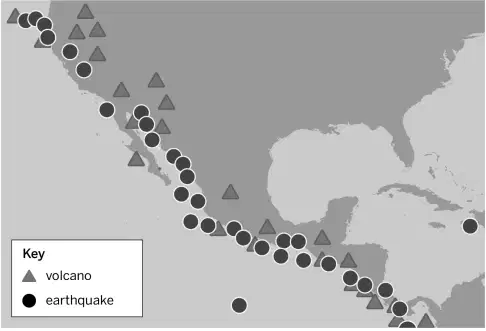
60.

Patterns on this map tell us that ________.

a)

Volcanic activity and earthquakes can cause damage to buildings.

b)

Volcanic activity and earthquakes happened in similar areas.

c)

Volcanic activity and earthquakes happened in random places.

d)

Volcanic activity and earthquakes happened at particular times each day.
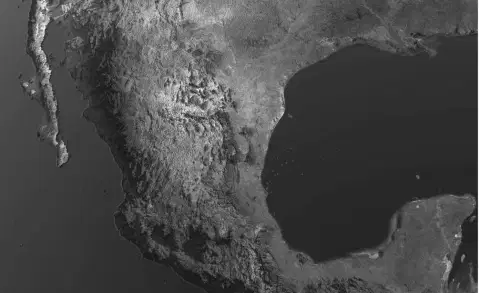
61.

Which statement best describes what Earth's outer layer is like underneath the surfaces?

a)

Underneath the soil, Earth's outer layer is made of water.

b)

Under the soil, Earth is hard, solid rock. Under the ocean, Earth is sand.

c)

Under both soil & water, the earth's outer layer is water and sand.

d)

Under both soil and the ocean, Earth is made of hard, solid rock.

62.

Choose 3 factors that contribute to continental drift?

a)

similar fossils, seafloor spreading, mountain ranges

b)

same crust, convection currents, seafloor spreading

c)

moving asthenosphere, convection currents, similar fossils

d)

seafloor spreading, convection currents, moving asthenosphere