
 Worksheets
Thermochemistry Quiz 2023
Total questions: 60
Worksheet time: 1hrs 2mins

Point A refers to
Freezing Point
Boiling Point
Point B refers to
Freezing Point
Boiling Point
Phase during point C is
solid
liquid
gas
solid + liquid
liquid + gas
Phase during point D is
solid
liquid
gas
solid + liquid
liquid + gas
Phase during point E is
solid
liquid
gas
solid + liquid
liquid + gas
Phase during point F is
solid
liquid
gas
solid + liquid
liquid + gas
What tool can you use to measure the average kinetic energy of a sample?
A Balance
A Bunsen Burner
A Thermometer
A Graduated Cylinder
In an exothermic reaction, energy is being ________________.
absorbed
released
Reactions where the energy of the reactants is greater than the energy of the products are called _____________.
Endothermic
Exothermic
Energy can not be created or destroyed, it can only be transferred refers to the ______________. This is also known as the First Law of Thermodynamics.
law of conservation of energy
law of conservation of mass
life facts
law of conservation of chemistry
Melting, boiling, evaporation, sublimation and cooking are:
a) EXO
b) ENDO
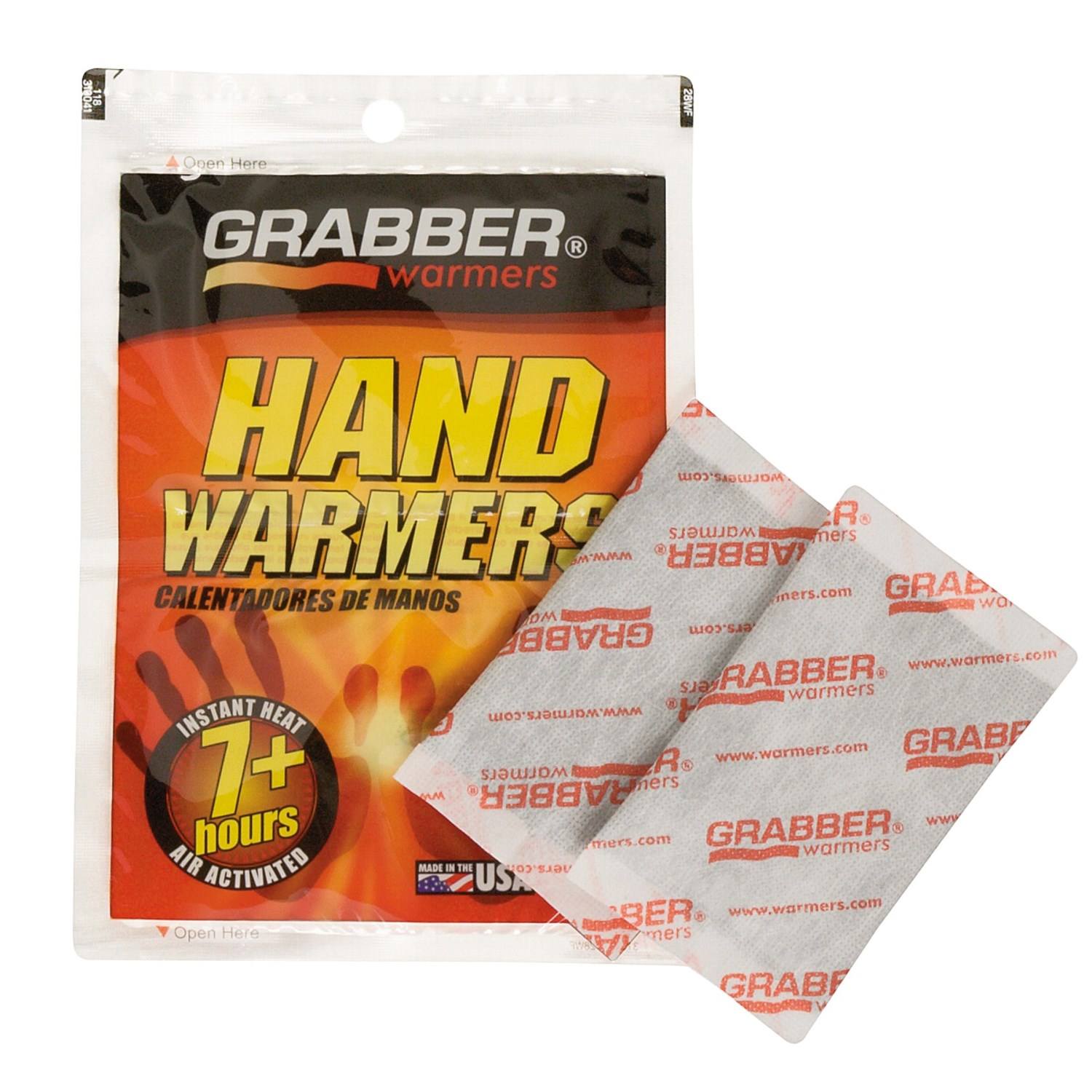
What type of reaction occurs in a hand warmer?
exothermic
endothermic
What term is given to a reaction which transfers heat energy to the surroundings?
Endothermic
Reversible
Exothermic
Explosion

An instant icepack is an example of what type of reaction?
Endothermic
Exothermic
Acid base
Neutralisation

In which region(s) does temperature increase?
Region C only
Regions B and D
Regions A, C, and E
Regions A and B
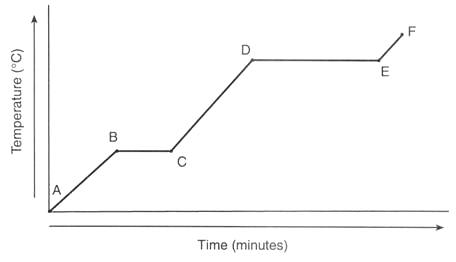
Between which points is the temperature of the substance remaining constant?
A-B only
A-B, C-D, and E-F
B-C only
B-C and D-E

The melting point of the sample is
-60 ºC
20 ºC
60 ºC
100 ºC

NaCl was heated starting at an initial temperature of 0°C. The heating curve is shown in the picture. What is the melting point of this substance?
0°C
801°C
1000°C
1465°C
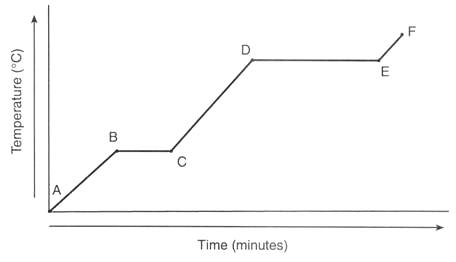
How many states of matter are present during line segment BC?
One
Two
Three
Depends on the temperature

In which region(s) of the heating curve would water be a liquid and a gas at the same time?
A
B
C
D
E

The diagram represents two solids and the temperature of each. What occurs when the two solids are placed in contact with each other?
Heat energy flows from solid A to solid B. Solid A decreases in temperature
Heat energy flows from solid A to solid B. Solid A increases in temperature
Heat energy flows from solid B to solid A. Solid B decreases in temperature.
Heat energy flows from solid B to solid A. Solid B increases in temperature.
If the temperature of a sample is decreased, the particles
slow down
have a lower kinetic energy
speed up
slow down and have a lower kinetic energy
A reaction that releases heat is
endothermic
exothermic
exotic
a combustion reaction


endothermic
SI unit of energy
Calorimeter
Calorie
Joule
Enthalpy
Specific heat
Device used to measure the heat absorbed or released during a chemical or physical process
Calorimeter
Calorie
Joule
Enthalpy
Specific heat

From point A to point F, the sample is going through an __________ process by __________.
exothermic, releasing heat to the surroundings
exothermic, absorbing heat from the surroundings
endothermic, releasing heat to the surroundings
endothermic, absorbing heat from the surroundings
What is the freezing point of the substance?
0oC
60oC
120oC
180oC
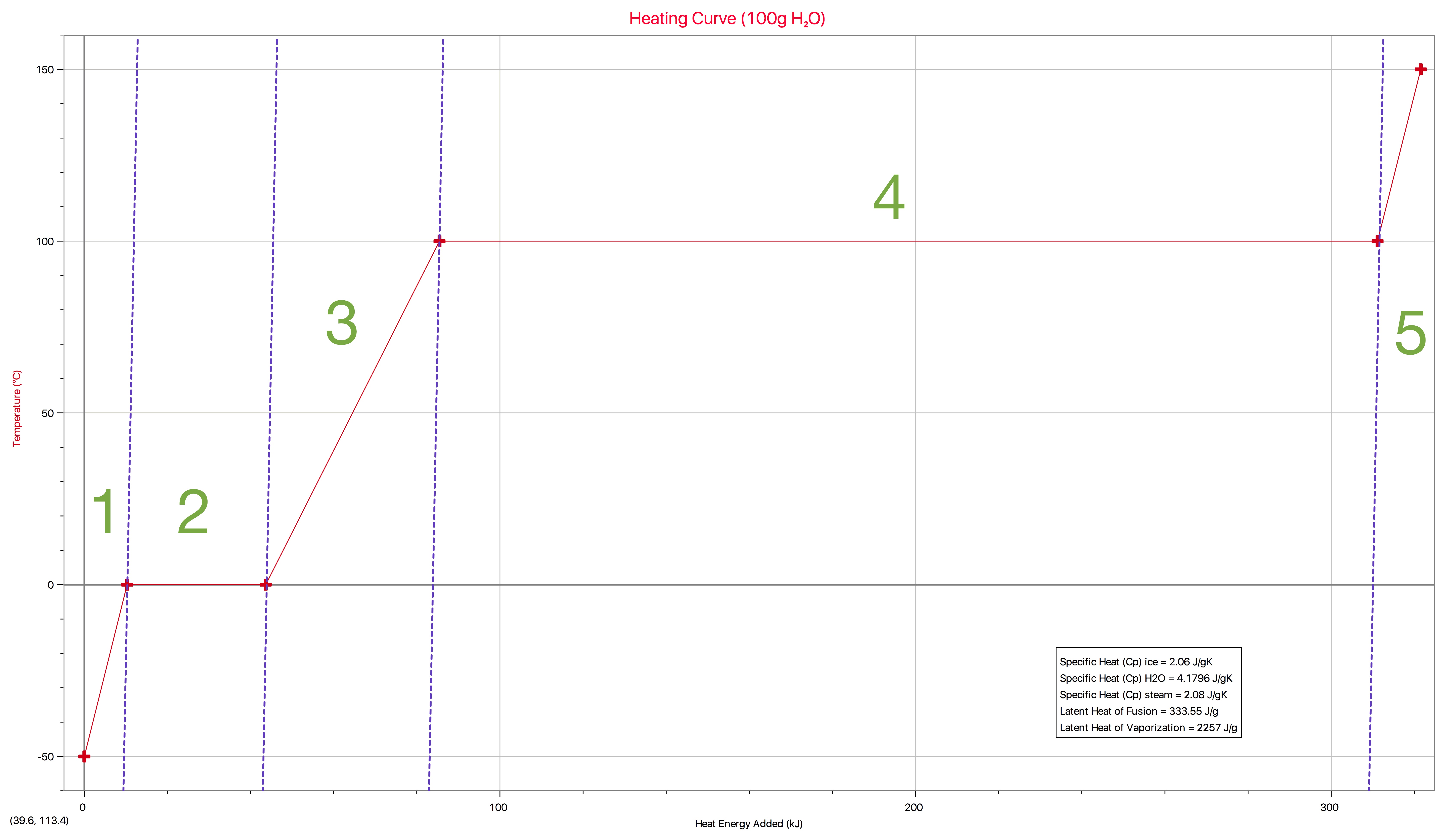

Given the heating curve of a solid being heated at a constant rate, what is the boiling point of this substance?
20°C
50°C
110°C
170°C
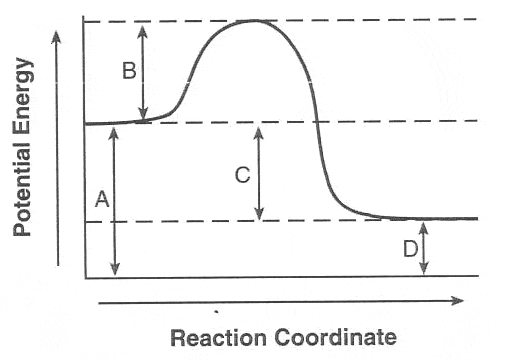
When heat flows from system to the surroundings that is an example of an ________________ process.
exothermic
endothermic
Kinetic energy is energy gained _______________
while at rest
during motion
What area of study in chemistry is concerned with the heat transfers that occur during chemical reactions?
stoichiometry
thermochemistry
inorganic chemistry
physical chemistry

The graph is showing an ____________ reaction.
exothermic
endothermic

The graph is showing an _________ reaction
endothermic
exothermic
___________________ is the capacity to do work or supply heat.
energy
heat changes
specific heat
thermochemistry
Point B refers to
Freezing Point
Boiling Point
Point A refers to
Freezing Point
Boiling Point
Phase during point C is
solid
liquid
gas
solid + liquid
liquid + gas
Phase during point D is
solid
liquid
gas
solid + liquid
liquid + gas
Phase during point E is
solid
liquid
gas
solid + liquid
liquid + gas
Phase during point F is
solid
liquid
gas
solid + liquid
liquid + gas
When a substance is changing from liquid to a gas, what do you have to do to change, and what is the process called?
Add heat
Remove heat
Condensation
Vaporization
When a substance is changing from liquid to solid, what do you have to do to change, and what is the process called?
Add heat
Remove heat
Melting
Freezing
When a substance is changing from gas to liquid, what do you have to do to change, and what is the process called?
Add heat
Remove heat
Condensation
Vaporization
When a substance is changing from solid to liquid, what do you have to do to change, and what is the process called?
Add heat
Remove heat
Melting
Freezing

