Wayground logo

Free Printable Worksheets

Font size

S
M
L
XL
Worksheets

Cover Lesson C10 Separation Techniques

Total questions: 63

Worksheet time: 58mins

Name
Class
Date
1.
Salt dissolved in water.  
What method would you use to separate this mixture so that you can get the salt AND the water?
a)
sorting by hand
b)
distillation
c)
chromatography
2.
A solution that contains a large amount of solute is best described as 
a)
unsaturated
b)
concentrated
c)
dilute
d)
weak
3.
A solution that contains a large amount of solute is best described as 
a)
unsaturated
b)
concentrated
c)
dilute
d)
weak
4.
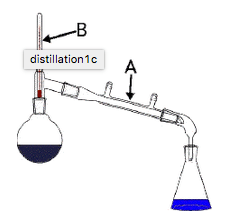
In the distillation apparatus shown, what are the parts labelled A and B?
a)
A = funnel, B = thermometer
b)
A = thermometer, B = funnel
c)
A = condenser, B = flask
d)
A = condenser, B = thermometer
5.
Which technique is shown the diagram below
a)
seiving
b)
filtration
c)
decanting
d)
crystallization
6.
Which one of the following is NOT an example of a separation technique?
a)
all of them
b)
fishing net
c)
surgical mask
d)
 tea strainer
7.
Sand and gravel may be separated from each other through using
a)
a filter funnel
b)
leibig condenser
c)
an evaporating basin
d)
sieve
8.
Dyes in water soluble markers may be separated by means of
a)
Distillation
b)
Decanting
c)
Chromatography
d)
Centrifuge
9.
Which one of the following methods would NOT be used to separate an insoluble solid and a liquid?
a)
evaporation
b)
decanting
c)
distillation
d)
chromatography
10.
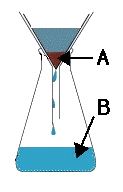
The diagram shows the apparatus for separating soil and water. What are the labelled parts?
a)
A = distillate, B = filtrate
b)
A = filtrate, B = residue
c)
A = residue, B = filtrate
d)
A = residue, B = distillate
11.
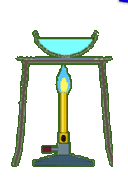
Which one of the following is the name for separation technique in the picture below
a)
distillation
b)
dissolving
c)
evaporation
d)
decanting
12.
Which one of the following is a disadvantage of evaporation?
a)
It always requires heat
b)
It cannot be used for insoluble solids
c)
All of the solute is recovered
d)
The solvent (liquid part) is not recovered
13.
If you shake up the sand and water, the sand spreads through the water forming a cloudy ______.
a)
substance
b)
suspension
c)
sediment
d)
solution
14.
No matter what you do, sand will not dissolve in water, sand is _________ ?
a)
dissolved
b)
soluble
c)
insoluble
d)
aqueous
15.
Evaporation is a process that removes a...
a)
solvent (liquid part of solution)
b)
solute (material that dissolves in the solvent)
c)
distillate (liquid collected after a solution is distilled)
d)
impurity
16.
Adding more solvent to a solution will make it more
a)
concentrated
b)
diluted
c)
coloured
d)
wet
17.
Which separation technique could you use to recover fresh drinking water from salty sea water?
a)
Filtration
b)
Decantation
c)
Distillation
d)
Evaporation
18.
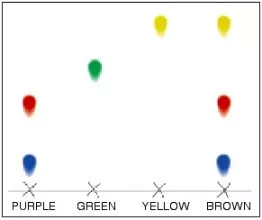
The diagram shows the chromatogram for three colouring dyes and that for a brown marker. What dye(s) are contained in the brown marker's ink?
a)
purple and green
b)
purple and yellow
c)
purple only
d)
green and yellow
19.
The diagram shows the chromatogram for four colouring dyes.  The pens that contain only single substances are
a)
purple and green
b)
purple and yellow
c)
purple only
d)
green and yellow
20.
Filtration can be used to separate...
a)
an insoluble solid from a solution
b)
a soluble solid from a solution
c)
a dissolved solid from a solution
21.
An example of a mixture is 
a)
Water and oil
b)
Cereal and Milk 
c)
Sand and water 
d)
All of the above
22.
Dyes in water soluble markers may be separated by means of..
a)
crystallization
b)
sublimation
c)
chromatography
d)
sedimentation
23.
Look at the apparatus setup. It cannot be used to separate which of the following mixtures? 
a)
Marble chips from oil 
b)
Alcohol and water
c)
Chalk from sugar solution
d)
Sand and sea water
24.
The drops of water that appear on the outside of a glass of cold water on a warm day are an example of?
a)
sublimation
b)
condensation
c)
evaporation
25.
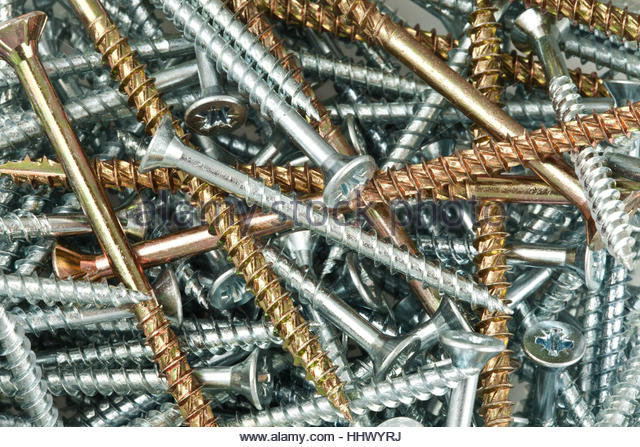
Iron and copper screws could be separated using a magnet because
a)
iron is magnetic, copper is not
b)
copper is magnetic, iron is not
c)
neither metal is magnetic
d)
copper screws are heavier than iron and fall off the magnet
26.
Name the separation method that causes wet clothes on a clothes line to dry
a)
Chromatography
b)
Filtration
c)
Distillation
d)
Evaporation
27.
What is the boiling point of water?
a)
0oC
b)
100oC
c)
80oC
d)
95oC
28.

How can we separate an insoluble solid from a liquid?

a)

chromatography

b)

evaporation

c)

filtration

d)

condensation

29.
The clear liquid which passes through the filter paper is called
a)
filt
b)
filter
c)
filtrate
d)
filtration
30.
Water and alcohol are easily separated by distillation because of their
a)
different densities
b)
different boiling points
c)
different colours
d)
different melting points
31.

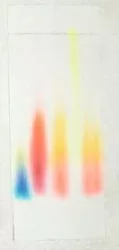
Which one of the following is the name for separation technique in the picture below

a)

distillation

b)

filtration

c)

evaporation

d)

chromatography

32.
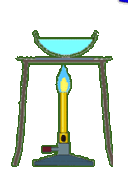
In the process of evaporation, which one of the following pieces of laboratory apparatus would NOT be used?
a)
evaporating basin
b)
filter funnel
c)
bunsen burner
d)
Wire gauze
33.
Which one of the following would you use to separate sand from iron filings?
a)
a bar magnet
b)
 filter paper
c)
distillation apparatus
d)
chromatography paper
34.

Which separation technique is shown below

a)

Evaporation

b)

Simple Distillation

c)

Decantation

d)

Fractional Distilation

35.

Which separation technique is shown below

a)

using a magnet

b)

separating funnel

c)

Centrifuging

d)

Chromatography

36.

Which separation technique is shown below

a)

filtration

b)

crystallization

c)

sublimation

d)

evaporation

37.

Which of the following is a disadvantage of evaporation?

a)

It always requires heat

b)

It cannot be used for insoluble solids

c)

All of the solute is recovered

d)

The solvent (water) is not recovered

38.
Name the separation method that causes wet clothes on a clothes line to dry
a)
Chromatography
b)
Filtration
c)
Distillation
d)
Evaporation
39.
What is the boiling point of water?
a)
0oC
b)
100oC
c)
80oC
d)
95oC
40.

How can we separate an insoluble solid from a liquid?

a)

chromatography

b)

evaporation

c)

filtration

d)

condensation

41.

Name the separation method that causes wet clothes on a laundry line to dry

a)

Chromatography

b)

Filtration

c)

Distillation

d)

Evaporation

42.

In the process of evaporation, which one of the following pieces of laboratory apparatus would NOT be used?

a)

evaporating dish

b)

filter funnel

c)

bunsen burner

d)

wire gauze

43.

Which separation technique is shown below

a)

filtration

b)

evaporation

c)

distillation

d)

chromatography

44.

Ink can be separated by a method of -----------------------------------------------

a)

distillation

b)

filtration

c)

chromatography

d)

sedimentation

45.

Chromatography separates the mixture of dyes on the basis of their ...........................

a)

density

b)

solubility

c)

gravity

d)

boiling point

46.

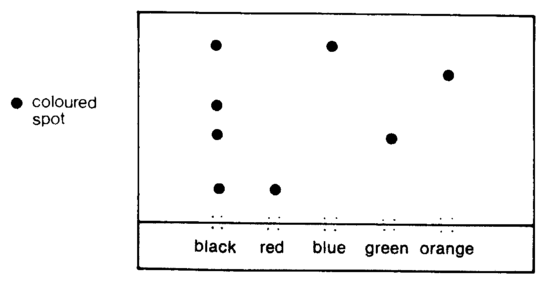
On the chromatogram given .................. is a mixture.

a)

red

b)

orange

c)

green

d)

black

47.

A pure substance shows .......... spot on chromatogram

a)

0

b)

1

c)

2

d)

3

48.

On this chromatogram, which coloured spot/spots are NOT mixtures?

a)

red

b)

orange

c)

green

d)

black

e)

blue

49.

Red, blue, green and orange dyes are pure because

a)

they only produced one spot on the chromatogram

b)

they produced spots at different heights

50.

How many spots will be produced by a pure substance?

a)

0

b)

1

c)

2

d)

3

51.

How many inks are pure?

a)

0

b)

1

c)

4

d)

3

52.

____________________ is the process of separating solids from liquids by passing a mixture through a filter.

a)

Filtration

b)

Distillation

c)

Evaporation

d)

Chromatography

53.

How many inks are PURE?

a)

1

b)

2

c)

3

d)

4

54.

How many inks are MIXTURES?

a)

1

b)

2

c)

3

d)

4

55.

Which picture is a mixture?

a)

A

b)

B

c)

C

d)

D

56.

Which picture shows a pure substance?

a)

A

b)

B

c)

C

d)

A, C, D

57.

Filtration is used to ___________________________________________.

a)

separate magnetic materials from non-magnetic materials.

b)

separate an insoluble solid from the liquid

c)

separate dissolved solids from a solution

d)

separate oil from water

58.

Name a application of magnetic attraction as a separation technique.

a)

Salvaging of iron and steel

b)

Removing tea leaves from tea

c)

Production of salt from seawater

d)

Making excellent coffee

59.

After filtration is finished, the solid remaining on the filter paper is called the ___________.

a)

filtrate

b)

dirt

c)

residue

d)

salt

60.

Which separation technique is used in the treatment of sewage water?

a)

Magnetic Attraction

b)

Filtration

c)

Evaporation

d)

Distillation

61.

Which separation method is used in food processing?

a)

Magnetic Attraction

b)

Filtration

c)

Evaporation

d)

Distillation

62.

When a mixture is filtered, the filter paper trapped the __________ particles, while allowing the _________ particles to pass through.

a)

larger, smaller

b)

smaller, larger

c)

brighter, darker

d)

lighter, heavier

63.

Which of the following is an example of filtration technique found in our bodies?

a)

Eyelids that helps us to close our eyes.

b)

Nose hair that helps to separate dust and solid particles from the air we breath.

c)

Teeth that helps to chew food for easy swallowing.

d)

Heart that helps to pump blood through our body.