
 Worksheets
Matter in Our Surroundings_4
Total questions: 36
Worksheet time: 18mins
The amount of heat which is used to change the state of matter not for increase the temperature is called
Latent heat
Specific heat
Heat capacity
None of the above.
Latent heat of fusion is amount of
heat energy required to change 1 kg solid into liquid completely at its melting point.
heat energy required to convert 1 kg solid into liquid at room temperature
heat energy required to change 1 g of solid into liquid completely
heat energy required to change 1 kg of solid into liquid at any temperature.
Specific latent heat is the amount of energy required to change the state of 1 kg of a substance without changing its (a) .
Select the state changes that latent heat of fusion applies to.
melting
evaporating
freezing
condensing
sublimation
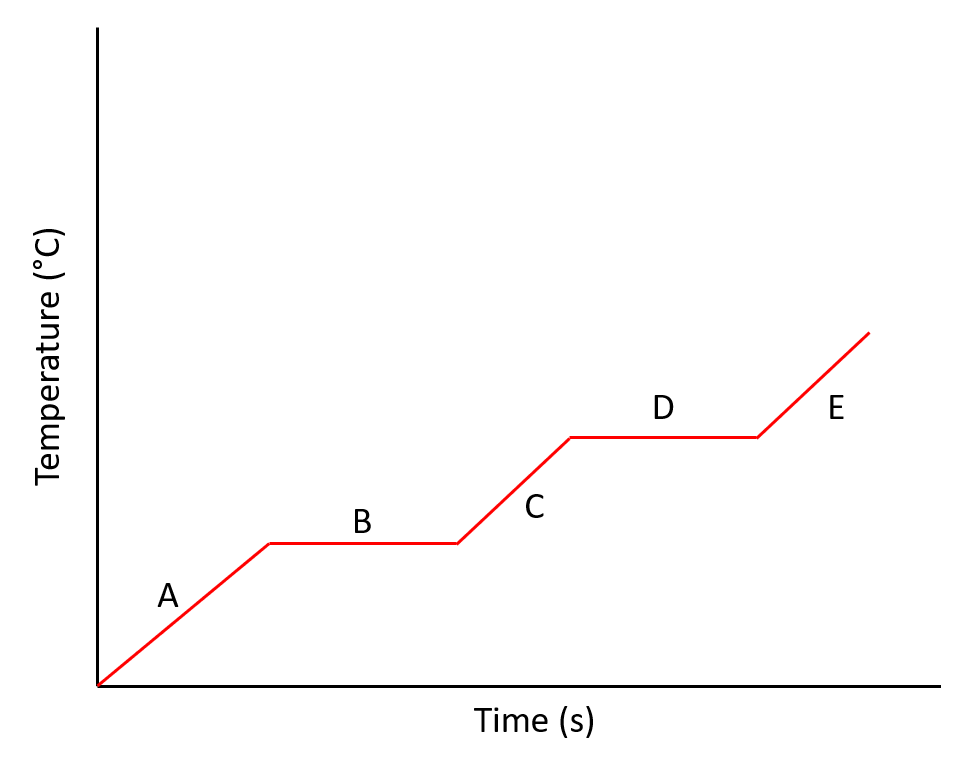
Why are lines B and D flat?
The ice is melting
The ice is freezing
All of the thermal energy is used to break the bonds
They stopped the stopwatch
They stopped heating the ice.
The heat absorbed by melting a solid is known as
latent heat of fusion
latent heat of solid
latent heat of liquid
latent heat of vaporisation
specific latent heat of vaporisation is
the amount of heat required to change 1 kg of the substance from the solid to liquid phase without change in temperature
the amount of heat required to change 1 kg of the substance from the liquid to gaseous phase without change in temperature
the amount of heat required to change the temperature 1 kg of the substance by 1 degree Celcius
What are the two types of latent heat
Latent heat of vaporization
Latent Heat Of Fusion
Latent Heat Of formation
Latent Heat Of reaction
How much is the latent heat of fusion of ice?
Latent heat of fusion of ice is 0.333 kJ
The latent heat of fusion of ice is 33600 J/K.
The latent heat of fusion of ice 0 °C
The heat of fusion for ice is 100 °C
Give one word or term for the following descriptions:
Changes from a vapour to a liquid.
(a)
Give one word or term for the following descriptions: The process during which ammonium chloride changes from a solid to a gas when it is heated.
(a)
Give one word or term for the following descriptions: A measure of the average kinetic energy of particles.
(a)
Give one word or term for the following descriptions: The temperature at which a liquid changes into vapor at the atmospheric pressure.
(a)
. Give one word or term for the following descriptions: The amount of heat required to change 1 kg of a solid into a liquid state.
(a)
Condensation occurs when water vapour....
loses heat
gains heat
Condensation involves a change of state from ___ to ___
Liquid to Solid
Liquid to Gaseous
Solid to Liquid
Gaseous to Liquid
Give reason: Evaporation cools a liquid. What is the first statement of the video clip?
Evaporation is the process by which a liquid changes into vapours at a temperature below the boiling point of the liquid
Evaporation results in cooling as the liquid absorbs heat from its surroundings.
Take a wooden block and sprinkle some water over it.
Now, place a copper calorimeter over it.
Take some ether in the calorimeter and dip a hollow tube into it as shown
Give reason: Evaporation cools a liquid. What is the second statement of the video clip?
Blow air through the tubes so that the ether gets converted into its vapors.
Evaporation results in cooling as the liquid absorbs heat from its surroundings.
Take a wooden block and sprinkle some water over it.
Now, place a copper calorimeter over it.
Take some ether in the calorimeter and dip a hollow tube into it as shown
Give reason: Evaporation cools a liquid. What is the third statement of the video clip?
Blow air through the tubes so that the ether gets converted into its vapors.
Remove the calorimeter, what do you observe?
Take a wooden block and sprinkle some water over it.
Now, place a copper calorimeter over it.
Take some ether in the calorimeter and dip a hollow tube into it as shown
Give reason: Evaporation cools a liquid. What is the fourth statement of the video clip?
Blow air through the tubes so that the ether gets converted into its vapors.
Remove the calorimeter, what do you observe?
We observe that the water below the calorimeter freezes to form ice.
Now, place a copper calorimeter over it.
Take some ether in the calorimeter and dip a hollow tube into it as shown
Give reason: Evaporation cools a liquid. What is the fifth statement of the video clip?
Blow air through the tubes so that the ether gets converted into its vapors.
Remove the calorimeter, what do you observe?
We observe that the water below the calorimeter freezes to form ice.
This shows that ether has absorbed heat from water and also from its surroundings resulting in decrease in temperature of
the surroundings
Take some ether in the calorimeter and dip a hollow tube into it as shown
Give reason: Evaporation cools a liquid. What is the sixth statement of the video clip?
Blow air through the tubes so that the ether gets converted into its vapors.
Remove the calorimeter, what do you observe?
We observe that the water below the calorimeter freezes to form ice.
This shows that ether has absorbed heat from the water and also from its surroundings resulting in a decrease in the temperature of
the surroundings
Take some ether in the calorimeter and dip a hollow tube into it as shown
Give reason: Evaporation cools a liquid. What is the seventh statement of the video clip?
Blow air through the tubes so that the ether gets converted into its vapors.
Remove the calorimeter, what do you observe?
We observe that the water below the calorimeter freezes to form ice.
This shows that ether has absorbed heat from the water and also from its surroundings resulting in a decrease in the temperature of
the surroundings
Take some ether in the calorimeter and dip a hollow tube into it as shown
Give reason: Evaporation cools a liquid. What is the eighth statement of the video clip?
Blow air through the tubes so that the ether gets converted into its vapors.
Remove the calorimeter, what do you observe?
We observe that the water below the calorimeter freezes to form ice.
This shows that ether has absorbed heat from the water and also from its surroundings resulting in a decrease in the temperature of
the surroundings
Take some ether in the calorimeter and dip a hollow tube into it as shown
Give reason: Evaporation cools a liquid. What is the ninth statement of the video clip?
Blow air through the tubes so that the ether gets converted into its vapors.
Remove the calorimeter, what do you observe?
We observe that the water below the calorimeter freezes to form ice.
This shows that ether has absorbed heat from the water and also from its surroundings resulting in a decrease in the temperature of the surroundings
Take some ether in the calorimeter and dip a hollow tube into it as shown
A desert cooler cools better on a hot dry day. What is the first sentence of the video clip?
We know that evaporation causes cooling.
We know that rate of evaporation is high when humidity in the
air is low.
We also know that rate of evaporation is high when the temperature of the surroundings is high.
so we can answer this question as
A desert cooler works because of evaporation
A desert cooler cools better on a hot dry day. What is the second sentence of the video clip?
Evaporation causes cooling
We know that rate of evaporation is high when humidity in the
air is low.
We also know that rate of evaporation is high when the temperature of the surroundings is high.
so we can answer this question as
A desert cooler works because of evaporation
A desert cooler cools better on a hot dry day. What is the third sentence of the video clip?
Evaporation causes cooling
Evaporation is increased at lower humidity in air.
We also know that rate of evaporation is high when the temperature of the surroundings is high.
so we can answer this question as
A desert cooler works because of evaporation
A desert cooler cools better on a hot dry day. What is the fourth sentence of the video clip?
Evaporation causes cooling
Evaporation is increased at lower humidity in air.
and high temperature of the surroundings
so we can answer this question as
A desert cooler works because of evaporation
A desert cooler cools better on a hot dry day. What is the fifth sentence of the video clip?
Evaporation causes cooling
Evaporation is increased at lower humidity in air.
and high temperature of the surroundings
On a hot dry day both a low humidity in air and high temperature of the surroundings are present
A desert cooler works because of evaporation
A desert cooler cools better on a hot dry day. What is the sixth sentence of the video clip?
Evaporation causes cooling
Evaporation is increased at lower humidity in air.
and high temperature of the surroundings
On a hot dry day, both a low humidity in the air and high temperature of the surrounding are present
So on a hot dry day a desert cooler works or you can say
cools better.
A desert cooler cools better on a hot dry day. What is the seventh sentence of the video clip?
Evaporation causes cooling
Evaporation is increased at lower humidity in the air.
and high temperature of the surroundings
On a hot dry day, both a low humidity in the air and high temperature of the surrounding is present
So on a hot dry day a desert cooler works or you can say
cools better.
A desert cooler cools better on a hot dry day. What is the seventh sentence of the video clip?
Evaporation causes cooling
Evaporation is increased at lower humidity in the air.
and high temperature of the surroundings
On a hot dry day, both a low humidity in the air and high temperature of the surrounding is present
So on a hot dry day a desert cooler works or you can say
cools better.
A desert cooler cools better on a hot dry day. What is the eighth sentence of the video clip?
Evaporation causes cooling
Evaporation is increased at lower humidity in the air.
and high temperature of the surroundings
On a hot dry day, both a low humidity in the air and high temperature of the surrounding is present
So on a hot dry day a desert cooler works or you can say
cools better.
A desert cooler cools better on a hot dry day. What is the ninth sentence of the video clip?
Evaporation causes cooling
Evaporation is increased at lower humidity in the air.
and high temperature of the surroundings
On a hot dry day, both a low humidity in the air and high temperature of the surrounding is present
So on a hot dry day a desert cooler works or you can say
cools better.
A desert cooler cools better on a hot dry day. What is the tenth sentence of the video clip?
Evaporation causes cooling
Evaporation is increased at lower humidity in the air.
and high temperature of the surroundings
On a hot dry day, both a low humidity in the air and high temperature of the surrounding is present
So on a hot dry day a desert cooler works or you can say
cools better.

