wayground logo

Free Printable Worksheets

NEW

Font size

S
M
L
XL
Worksheets

20-21 IPC Electricity& Magnetism Quizizz

Total questions: 70

Worksheet time: 1hrs 9mins
Name
Class
Date
1.
How many Volts would it take to push 1 Amp through a resistance of 1 Ohm
a)
10 volts
b)
1 volt
c)
48 volts
d)
5 volts
2.
What would the circuit resistance be if a 7.5 Amp draw was present with the engine running and the charging system producing 15 Volts
a)
15 Ohms
b)
4 Ohms
c)
0.3333 Ohms
d)
2 Ohms
3.
A Charging system producing 14.5 Volts with a current flow of 43.5 Amps, what is the circuit resistance
a)
58 Amps
b)
0.33 Amps
c)
13 Amps
d)
1 Amp
4.
If the current through a circuit is 2 A and the resistance of a light bulb in the circuit is 10 Ohms, what is the voltage difference across the light bulb?
a)
5 V
b)
12 V
c)
0.2 V
d)
20 V
5.
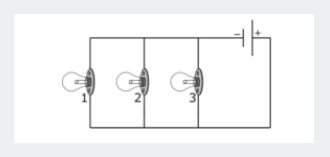
If bulb 1 burns out, what will occur?
a)
bulbs 2 and 3 will go out
b)
bulbs 2 and 3 receive more volts
c)
bulbs 2 and 3 will stay lit
d)
nothing will happen
6.
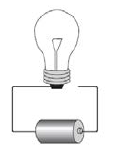
Will the light bulb in this circuit light and why/why not?
a)
yes, because it has two batteries
b)
no, because the switch is open
c)
yes, because it is in a circuit
d)
no, because the bulb is burned out
7.
This image represents what type of circuit?
a)
open
b)
closed
c)
series
d)
parallel
8.
Which of these substances conducts electricity the best?
a)
wood
b)
brick
c)
copper
d)
plastic
9.
Which of these best completes the circuit?
a)
rubber band
b)
metal nail
c)
leather shoelace
d)
wooden toothpick
10.
The difference in electrical potential energy between two places is called
a)
resistance
b)
friction
c)
induction
d)
voltage
11.

Voltage divided by Current

(V / I)

a)

Current

b)

Power

c)

Resistance

d)

Watts

12.

Voltage divided by Resistance

(V / R)

a)

Current

b)

Power

c)

Ohms

d)

Watts

13.
Current times Resistance equals
 (I X R)
a)
Power
b)
Voltage
c)
Amperage
d)
Ohm
14.
The mathematical relationship among Voltage, Current, and Resistance
a)
Faraday's Law
b)
Tesla's Law
c)
Edison's Law
d)
Ohm's Law
15.
Electricity that flows in a closed path is called a
a)
path
b)
current
c)
circuit
d)
light
16.
What is Resistance?
a)
The flow of electrons
b)
Electric potential difference
c)
A battery
d)
The ability to reduce the flow of electrons
17.
What is resistance measured in?
a)
Ω (Ohms)
b)
V (Volts)
c)
A (Amps)
d)
W (Watts)
18.
What is current measured in?
a)
Ω (Ohms)
b)
V (Volts)
c)
A (Amps)
d)
W (Watts)
19.
Electricity is the flow of ______.
a)
electrons
b)
protons
c)
neutrons
d)
atoms
20.
measure of power
a)
watt
b)
ohm
c)
volt
d)
amp
21.
measure of resistance
a)
watt
b)
ohm
c)
volt
d)
amp
22.
measure of electric current
a)
watt
b)
ohm
c)
volt
d)
amp
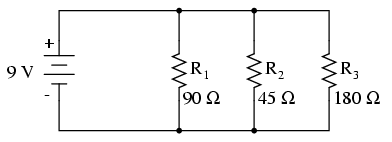
23.
What kind of circuit is this?
a)
series
b)
parallel
24.
An example of a parallel circuit is
a)
the wiring in a house
b)
a flashlight
c)
a single circular path
25.
To complete a circuit the switch must be
a)
unattached
b)
open
c)
closed
26.
____________ stops the flow of electricity.
a)
A conductor
b)
An insulator
c)
A magnet
27.
____________ allows electricity to flow.
a)
A conductor
b)
An insulator
c)
A magnet
28.
Magnetism is generated by moving
a)
protons.
b)
electrons.
c)
neutrons.
d)
elements.
29.
What do the lines around this magnet represent?
a)
North Pole
b)
South Pole
c)
Magnetic Declination
d)
Magnetic Field
30.

What is responsible for the Magnetic Field around Earth?

a)

The Earth's crust

b)

The Earth's molten iron core

c)

The Earth's mantel

d)

The Sun

31.
What kind of magnet can be turned on and off?
a)
refridgerator magnet
b)
electromagnet
c)
magnetite
d)
iron
32.
The strongest part of a magnet is...
a)
the bars.
b)
the force field.
c)
the poles. 
d)
the middle.
33.
If you cut a magnet in half, what happens to the poles?
a)
One half gets the North Pole, the other half gets the South Pole
b)
Both halves get only a North Pole
c)
Both halves get only a South Pole
d)
Both halves get a North pole and a South Pole
34.

How can a wire become magnetic?

a)

point it north

b)

add a resistor

c)

heat it up

d)

run a current through it

35.
Magnetism is a type of ____________
a)
force
b)
book
c)
plant
d)
animal
36.
When two magnets attract, they ______________
a)
push apart
b)
change color
c)
get colder
d)
pull together
37.
When two magnets repel, they ________________
a)
change color
b)
pull together
c)
push apart
d)
get colder
38.
Magnets have a north and a south ___________
a)
shape
b)
color
c)
pole
d)
region
39.
Surrounding every magnet is a __________  __________.
a)
magnetic field
b)
electrical current
c)
another magnet
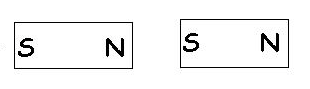
40.
Magnets that are arranged like this will _______. 
a)
move away from each other (repel)
b)
move towards each other (attract)
41.
These magnets will _______.
a)
move away from each other (repel)
b)
move toward each other (attract)
42.
What happens if you cut a bar magnet in half?
a)
You get two North pole magnets
b)
You get two South pole magnets
c)
You get a North pole magnet and a South pole magnet
d)
You get two smaller magnets, each with a North and South pole
43.

Moving electricity generates a

a)

Magnetic field

b)

Resistance

c)

Electric field

44.

Moving magnetic fields generates

a)

a magnetic field

b)

a large resistance

c)

an electric current

45.
Lightning is an example of _________.
a)
static electricity
b)
current electricity
c)
watts
d)
voltage
46.
Identify the conductor below.
a)
cloth rag
b)
plastic bottle
c)
gold ring
47.
Identify the insulator below.
a)
aluminum foil
b)
paperclip
c)
rubber eraser
48.
Electrons have ___ charge. 
a)
no
b)
negative
c)
positive
49.
Protons have ___ charge.
a)
no
b)
positive
c)
negative
50.
Two things with opposite charges will
a)
attract one another.
b)
repel one another.
51.
Two like charges:
a)
 neutralize each other.
b)
repel each other. 
c)
must be neutrons. 
d)
attract each other.
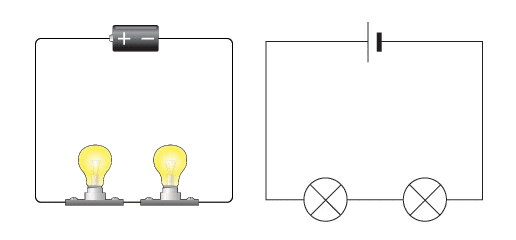
52.

In a series circuit like this, devices ___.

a)

are either ALL ON or ALL OFF

b)

can be turned on or off individually

53.

If the top bulb goes out,

a)

All the bulbs go out

b)

The other bulbs get dimmer

c)

There is no effect on the other bulbs

d)

The other bulbs get brighter

54.

What kind of circuit has only one path?

a)

current circuit

b)

series circuit

c)

parallel circuit

d)

short circuit

55.

What kind of circuit has more than one path?

a)

current circuit

b)

series circuit

c)

parallel circuit

d)

short circuit

56.
what is this symbol for?
a)
light bulb
b)
switch
c)
battery
d)
resistor
57.

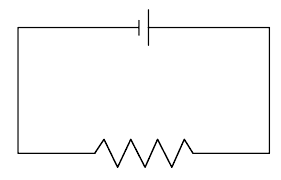
Where is the resistor located on this diagram?

a)

A

b)

C

c)

D

d)

B

58.
This is an example of a _______ circuit
a)
open
b)
series
c)
parallel
d)
square
59.
This is an example of a ______ circuit
a)
Series
b)
Parallel
c)
Open
d)
Dihexihedral
60.
What kind of circuit is this?
a)
Series
b)
Consecutive
c)
Parallel
d)
Training
61.
What kind of circuit is this?
a)
Series
b)
Consecutive
c)
Parallel
d)
Training
62.
What is current measured in?
a)
Ω (Ohms)
b)
V (Volts)
c)
A (Amps)
d)
W (Watts)
63.
What is resistance measured in?
a)
Ω (Ohms)
b)
V (Volts)
c)
A (Amps)
d)
W (Watts)
64.
What is Resistance?
a)
The flow of electrons
b)
Electric potential difference
c)
A battery
d)
The ability to reduce the flow of electrons
65.
What size resistor would produce a 3 Amp current flow with a 12 Volt battery
a)
1 Ohm
b)
3 Ohms
c)
4 Ohms
d)
12 Ohms
66.
How many Volts would it take to push 1 Amp through a resistance of 1 Ohm
a)
10 volts
b)
1 volt
c)
48 volts
d)
5 volts
67.
This circuit has a 24 volt battery and the resistor is 8 ohms. How many amps are running through the circuit?
a)
3 Amps
b)
192 Amps
c)
2 Amps
d)
4 Amps
68.
What is this symbol?
a)
resistor
b)
switch
c)
battery
d)
bulb
69.

A material through which electrons do NOT flow easily is a(n) ______.

a)

insulator

b)

conductor

c)

fuse

d)

circuit breaker

70.
Lightning is an example of _________.
a)
static electricity
b)
current electricity
c)
watts
d)
voltage