wayground logo

Free Printable Worksheets

Font size

S
M
L
XL
Worksheets

Chemistry Spring Final Review

Total questions: 67

Worksheet time: 1hrs 7mins

Name
Class
Date
1.
A mole of Neon contains
6.02 x 10²³ _____.
a)
atoms
b)
formula units
c)
ions
d)
molecules
2.
What can be determined from a balanced chemical equation?
a)
Mole ratio of any two substances in the reaction
b)
Energy released in the reaction.
c)
Electron configuration of all elements in the reaction. 
d)
Mechanism involved in the reaction. 
3.
Where do you look to calculate the molar mass?
a)
avogadros number
b)
periodic table 
4.
What is the molar mass of Carbon Dioxide (CO2)?
a)
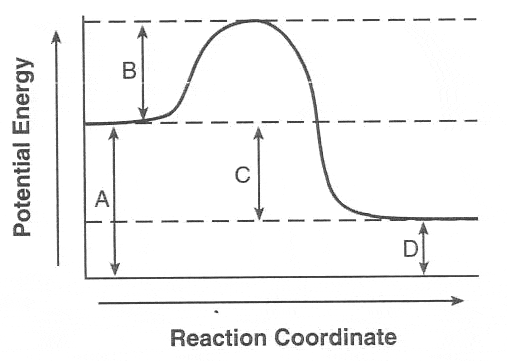
12 amu
b)
12 g
c)
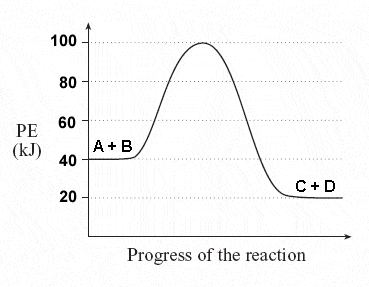
44 g
d)
44 amu
5.
Which is Chemical Equation is Balanced?
a)
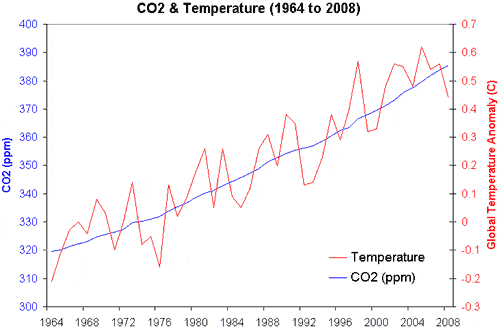
CH₄+O₂------CO₂+2H₂O
b)
H₂+O₂-----2H₂O₄
c)
4Al+3O₂-----2Al₂O₃
6.
When balancing equations a ____ can be placed to the left of a formula of a substance to make the equations balanced
a)
charge
b)
subscript
c)
random number
d)
coefficient
7.
N2 +  3H2 → 2NH3 
How many moles of hydrogen are needed to react with 2 moles of nitrogen?
a)
6
b)
2
c)
3
d)
1
8.
2 NaClO3 (s) --> 2NaCl (s) +3 O2 (g)  
12.00 moles of NaClO3 will produce how many grams of O2?
a)
256 g of O2
b)
576 g of O2
c)
288 g O2
9.
Balance the following reaction :
 
CaC₂(s)   +   H₂O(l)   -->   C₂H₂(g)   +   Ca(OH)₂(aq)
a)
1,2,2,2
b)
1,2,1,1
c)
2,1,1,1
d)
2,1,2,1
10.
For the Balanced Reaction: 3 Mg + 1 Fe2O3 → 3 MgO + 2 Fe; What is the Ratio of moles of Mg to moles Fe?
a)
3mol Mg / 2 mol Fe
b)
2 mol Mg/ 3 mol Fe
c)
1 mol Fe/ 2 mol Fe
d)
3 mol MgO / 2 mol Fe
11.
Convert 15 g of sodium chloride into moles.
a)
0.257 moles
b)
877 moles
c)
58.443 moles
12.
What is the molar mass of C6H12O6?
a)
180.18
b)
180.12
c)
180.24
d)
180.06
13.

Which has the greater electronegativity (EN):

N or C?

a)

C

b)

N

14.

Electronegativity is...

a)

how good an atom is at attracting (stealing) electrons

b)

the ability of an atom to lose electrons

c)

the energy required to remove an electron from a specific atom

d)

how easy it is to make friends.

15.

Electronegativity __________ from left to right within a period and __________ from top to bottom within a group.

a)

decreases, increases

b)

increases, increases

c)

increases, decreases

d)

stays the same, increases

16.

What is the correct formula of magnesium sulfide?

a)

MgSO4

b)

MgS

c)

MgSO3

d)

Mg2S2

17.

What is the correct formula of sodium bicarbonate?

a)

NaHCO3

b)

Na3HCO

c)

NaCO3

d)

Na2CO3

18.

Which of the following names and formulas are correctly paired together?

a)

sodium oxide - NaO

b)

calcium sulfite - Ca2(SO3)2

c)

barium bromate - Ba(BrO2)2

d)

lithium chromate - Li2CrO4

e)

potassium phosphide - KP3

19.
Which of the following is an ionic compound:
a)
CH4
b)
I2
c)
LiBr2
d)
CO
20.
Which of the following combinations would need roman numerals in the name?
a)
potassium + fluorine
b)
beryllium + oxygen
c)
boron + iodine
d)
silver + oxygen
21.
Which of these combinations is an ionic compound made of?
a)
Metal and Metal
b)
Nonmetal and Nonmetal
c)
Metal and Nonmetal
d)
Cation and Cation
22.
An atom that gains or loses electrons is called a _______.
a)
atom
b)
ion
c)
oxidation
d)
metal
23.
Covalent compounds
a)
Share electrons
b)
transfer electrons
c)
contain a sea of electrons
d)
conduct electricity
24.
What is the prefix for 3?
a)
tre
b)
drei
c)
tetra
d)
tri
25.
BrO3
a)
bromine oxide
b)
monobromine trioxide
c)
bromine trioxide
d)
bromine (III) oxide
26.
The number of atoms you begin with in a chemical reaction ...
a)
must be the same as the number of  atoms you end with
b)
must be an even number
c)
can be different to the number you finish with
d)
changes depending on how much energy is formed
27.

What is the Law of Conservation of Mass?

a)

It states that matter cannot be created or destroyed.

b)

It states that energy cannot be created or destroyed.

c)

It states that matter can be created or destroyed.

d)

It states that sound can be created or destroyed.

28.

How many Hydrogen atoms are in 4H2O?

a)

6

b)

8

c)

2

d)

4

29.
What explains the very high melting and boiling point of water
a)
Strong dipole-dipole bonds between water molecules
b)
Strong hydrogen bonds between water molecules
c)
Dispersion forces which are present in all molecules
d)
Asymmetrical shape of the polar bonds.
30.
Which is the second strongest intermolecular force, after hydrogen bonding?
a)
dipole-dipole attraction
b)
London forces
31.
All molecules have London forces between them, but dipole-dipole and hydrogen bonding are so much stronger that when they are present we can ignore London forces.  Which of these has ONLY London forces?
a)
I2
b)
NH3
c)
OCl2
d)
SH2
32.

Which substance would have the weakest intermolecular forces of attraction?

a)

CH4

b)

NaCl

c)

H2O

d)

MgF2

33.
What is the basis of a metallic bond?
a)
the attraction of neutral metal atoms.
b)
the attraction between protons and neutrons.
c)
the attraction between positive metal ions and interlocking electrons.
d)
the attraction between positive metal ions and free floating electrons.
34.
Ionic Bonding involves...
a)
The transfer of protons
b)
The transfer of nuetrons 
c)
The transfer of electrons
d)
None Of the above
35.
Intermolecular forces are the forces
a)
within molecules
b)
between molecules
36.

Which substance has the weakest intermolecular forces?

a)

Substance A, boiling point of 75 °C

b)

Substance B, boiling point of 105 °C

c)

Substance C, boiling point of 25 °C

d)

Substance d, boiling point of 45 °C

37.

______ molecules are found in nature as pairs of two atoms of the same type covalently bonded together.

a)

Diatomic

b)

Monatomic

c)

Polyatomic

d)

Network

38.
Write a Balanced Equation for this reaction:
C2H4 + 2 O2 -->
a)
C2O2 + H4
b)
CO2 + HOH
c)
CO + H
d)
2 CO2 + 2H2O
39.

Which of the following substances not required for combustion?

a)

(a) Oxygen

b)

(b) Carbon Dioxide

c)

(c) Fuel

d)

(d) Heat

40.

At the end of this reaction, has energy been released or absorbed?

a)

Absorbed

b)

Released

c)

There is not enough information to tell.

d)

There is not change in the amount of energy in the system.

41.
Grinding a seltzer tablet into powder increases the rate of reaction due to increased
a)
concentration
b)
surface area
c)
temperature
d)
reactants
42.

Adding a catalyst ___________ the activation energy.

a)

Raises

b)

Lowers

c)

Doesn't affect

d)

Inreases

43.
What makes an effective collision?
a)
When molecules collide.
b)
When molecules collide with the proper orientation.
c)
When molecules collide with proper orientation and enough kinetic energy.
d)
High Temperature.
44.
What type of reaction is this?
a)
Endothermic
b)
Exothermic
45.

The energy needed to start a reaction is called the

a)

activation energy

b)

starting energy

c)

promoting energy

d)

reacting energy

46.

Which letter shows the activation energy?

a)

A

b)

B

c)

C

d)

D

e)

E

47.

Which letter shows the heat change?

a)

A

b)

B

c)

C

d)

D

e)

E

48.

What is the change of the heat of the reaction (ΔH)?

a)

-40 kJ

b)

-20 kJ

c)

100 kJ

d)

60 kJ

49.

For the reaction...

heat + N2 (g) + O2 (g) <==> 2NO (g)

If O2(g) is removed, the concentration of N2 will _______.

a)

increase

b)

decrease

c)

remain the same

d)

double

50.

Select all factors that would cause the equilibrium for this reaction to shift to the left:

2SO2 + O2 <==> 2SO3 + heat

a)

Increase in temperature

b)

Removal of heat

c)

Decrease in Sulfur Dioxide

d)

Decrease in pressure

e)

Increase in Oxygen gas

51.

Select all factors that would cause the equilibrium for this reaction to shift to the left:

heat + N2 + O2 <==> 2NO

a)

Increase temperature

b)

Decrease temperature

c)

Add Nitrogen monoxide

d)

Increase the pressure

e)

Remove Nitrogen gas

52.
Which 2 greenhouse gases contribute the MOST to global warming of Earth?
a)
N2O and H2O
b)
O3 and H2O
c)
CO2 and CH4
53.
Which layer of the atmosphere contains ozone (O3) that protects us from radiation?
a)
Troposphere
b)
Thermosphere
c)
Exosphere
d)
Stratosphere
54.

The graph below shows CO2 emissions and temperatures from 1984 to 2009. What conclusion is best supported by the graph?

a)

There is no relationship between carbon dioxide concentrations and temperatures

b)

As carbon dioxide concentrations increase, temperatures increase

c)

As carbon dioxide concentrations increase, temperatures decrease

55.

What happens to most of the sunlight that hits a dark colored area of the Earth's surface?

a)

It is reflected and scattered as potential energy.

b)

It is absorbed and reflected as light.

c)

It is absorbed and re-released as heat

56.

a gases that contributes to the greenhouse effect by absorbing infrared radiation, e.g., carbon dioxide and chlorofluorocarbons

a)

Climate

b)

Scattering

c)

Methane

d)

Greenhouse gases

57.

Heat from a lamp is an example of _____________.

a)

convection

b)

conduction

c)

radiation

d)

reaction

58.

Cooking pancakes on a skillet is as example of _____________.

a)

radiation

b)

convection

c)

conduction

d)

conduit

59.

Which trait (characteristic) is common in gases that contribute (give) to Earth’s greenhouse effect?

a)

the ability to trap heat

b)

a tendency to lose electrons

c)

a tendency to exist as diatomic molecules

d)

the ability to bond with multiple other elements

60.
What would be the effect on the particles if more heat is supplied to the system?
a)
They would slow down
b)
They would stop moving
c)
They would speed up
d)
There would be no effect
61.
There are four cups of hot cocoa. The cup sizes are shown. The temperature of the cocoa in each cup is 25 degrees celsius. Which cup has the MOST thermal energy?
a)
Large cup (Trenta)
b)
Small cup (Tall)
c)
Venti
d)
All three are the same temperature so they have same thermal energy
62.
A high specific heat means...
a)
It heats up quickly with energy added
b)
It requires more energy to change temperature
63.

This is a diagram of ice. Ahmad measures the temperature of ice. After some time, he notices the ice melts.


Choose the best statement related to the melting ice.

a)

The temperature is not the same as the ice.

b)

the temperature remains constant even though heat is being supplied continually.

c)

Heat that is absorbed during melting is the specific latent heat

64.

Solid starts to melt at

a)

P

b)

Q

c)

R

d)

S

65.
As you move down a group, atomic radius increases because - 
a)
you add more and more neutrons
b)
you add more and more protons
c)
you add more and more shells (energy levels)
d)
you add more atomic mass
66.
As you move across the periodic table from left to right, the atomic radius decreases.  This is because - 
a)
the number of protons increases, so attraction to electrons increases
b)
the number of energy levels increases
c)
the number of electrons increases
d)
the atomic mass increases
67.
The energy required to remove electrons is the definition of: 
a)
Electronegativity
b)
Atomic Number
c)
Atomic Radius
d)
Ionization