
NEW
Font size
 Worksheets
Chemistry Heat Test Review
Total questions: 30
Worksheet time: 35mins
Which layer of Earth do scientists believe is most likely made of solid metal, mostly iron?
Crust
Mantle
Outer Core
Inner Core
Which layer of the Earth is the thinnest?
Crust
Mantle
Outer core
Inner core

What statement describes the heat that results from the radioactive decay of elements deep in Earth's interior?
It originally came from our sun
It is the reason the inner core is solid
It drives the convection currents in the mantle
It heats the atmosphere and makes life possible.
The ________ is a measure of the average kinetic energy of a substance.
heat
thermal energy
temperature
conductor

In an exothermic reaction, energy is ________the surroundings making the temperature of the surroundings ________. To your hands it feels _______.
absorbed from, decrease, cold
released to, increase, warm
released to, decrease, cold
absorbed from, increase, warm
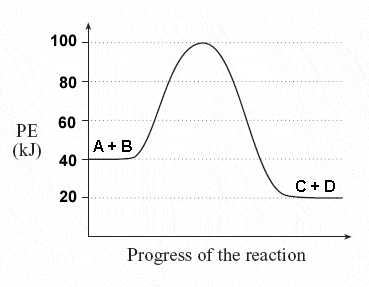
How much energy is being absorbed to break the reactants apart?
40 kJ
60 kJ
20 kJ
- 20 kJ
How much energy is released when the products form?
-80 kJ
60 kJ
20 kJ
- 20 kJ
What is ΔH for the reaction?
-80 kJ
60 kJ
20 kJ
- 20 kJ
Is this reaction endothermic or exothermic?
endothermic
exothermic
What happens to the particles in matter when they cool down?
particles remain in place
particles speed up
particles slow down
particles disappear
__________is heat transfer or movement by direct contact, usually through solids.
Conduction
Convection
Radiation
Heat that is transferred or moved in circle currents through liquids or gases is __________________.
radiation
convection
conduction
During convection, particles rise because they are
cold and more dense
warm and less dense


Which phase change process is happening at D-E?
freezing
vaporization
sublimation
melting
In an endothermic reaction energy is released to the surrounding.
Where are tectonic plates located?
inner core
outer core
mantle
crust
What is the definition of specific heat?
The amount of heat needed change 1 g of substance by 1 K
The amount of energy needed to cool a substances
__________is the form of energy that is transferred between objects that are different temperatures.
Heat or Temperature
Heat
Temperature
Is this reaction exothermic or endothermic?
H2 + Cl2 --> 2 HCl + heat
Exothermic Reaction
Endothermic Reaction
How do you find the heat required to raise the temperature of 10.0 g of copper from 10.0°C to 55.0°C? specific heat of copper is 0.385 J/(g∙°C).
(10.0)(0.385)45
(10.0)(45)0.385
(10.0)(0.385)(45)
(10.0)(0.385)(-45)
How do you find the specific heat capacity of a 15.75-g piece of metal if it absorbs 1087 joules of heat energy, and its temperature changes from 25°C to 175°C?
(15.75)(150)1087
(15.75)(−150)1087
(1087)(15.75)(150)
1087(15.75)(150)
When a piece of aluminum foil is taken out of the oven and cools from 100° to 50°, what is the change in temperature?
-50o
How do you find the temperature change(∆t) when 100 Joules of heat is absorbed by 20.0 g of Cu? specific heat = 0.385 J/Kg
(20.0)(0.385)100
(100)(20.0)(0.385)
100(20.0)(0.385)

Using the bond energies given, how would you find the energy needed to break the reactants apart?
2(413) + 839 + 299
413 + 839 + 299
2(413) + 3(348) + 2(299)
2(413) + 839 + 2(299)
Using the bond energies given, how would you find the energy released when products form?
4(413) + 2(240) + 348
4(413) + 240 + 348
413 + 240 + 348
2(413) + 240 + 4(348)
Find ΔH for the reaction if the bond energies for reactants add up to 2263 kJ and the bond energies for products add up to 2480 kJ.
-4743 kJ
-217 kJ
217 kJ
4743 kJ
When you drop something hot into something cold, the temperature of the hot object _____ and the cold object ______ until the temperatures are ______.
decreases, increases, different
decreases, decreases, the same
decreases, increases, the same
increases, decreases, the same
To turn 50. g of water at 30°C to steam at 115°C what would have to happen?
The water would heat from 30°C to 100°C , boil, then heat from 100°C to 115°C .
The water would heat from 30°C to 115°C , then boil.
The water would heat from 30°C to 115°C
The water would boil, then heat from 30°C to 115°C .

