Wayground logo

Free Printable Worksheets

Font size

S
M
L
XL
Worksheets

Magnets and electromagnets

Total questions: 38

Worksheet time: 43mins

Name
Class
Date
1.

Where on a magnet is the magnetic field the strongest?

a)

Both magnetic poles

b)

Center of the magnet

c)

Magnetic north pole

2.

Which statement is true?

a)

Two north poles attract each other.

b)

Two south poles attract each other.

c)

A north pole and a south pole will repel each other.

d)

A north pole and a south pole will attract each other.

3.

Which materials are magnetic?

a)

Wood

b)

Zinc

c)

Iron

d)

Aluminium

e)

All the Above

4.

The magnetic field is strongest at the poles, where the field lines are most concentrated?

a)

True

b)

False

5.

If you bring two north poles together, or two south poles together, they attract and the magnets stick together?

a)

True

b)

False

6.

What are the differences between an Electromagnet and a Permanent Magnet?

a)

A permanent magnet stays a magnet forever and a Electromagnet doesn't.

b)

An Electromagnet needs electricity and a permanent magnet doesn't

c)

Electromagnets are less useful.

d)

You can turn an electromagnet on and off but not a permanent magnet.

e)

You can change the power of the permanent magnet but not an electromagnet.
7.
Surrounding every magnet is a __________  __________.
a)
magnetic field
b)
electrical current
c)
another magnet
d)
an enemy
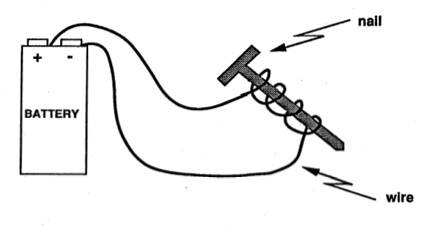
8.
What is most likely to happen when the switch is closed?
a)
A magnetic field should be produced
b)
The nail will rust
c)
The battery will explode
d)
The wire will catch on fire
9.
This is a picture of a simple electromagnet. How can the electromagnet be made stronger?
a)
Add more coils of wire to the nail.
b)
Use a smaller battery.
c)
Reverse the poles of the magnet.
d)
Remove all the coils and the nail.
10.
Like poles on a magnet
a)
attract
b)
repel
11.
Magnets can interact without touching.
a)
True
b)
False
12.

Dylan puts two magnetic toy trains very close to each other on a track. What will happen next, and why?

a)

The trains will not move because the magnets are not touching.

b)

The trains will move closer to each other because the magnetic force will pull the trains together.

c)

The trains will move away from each other because the magnetic force will push the trains apart.

d)

The trains will move away from each other because the magnets are not touching.
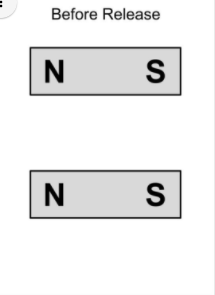
13.
Which way will the magnets move after they are released?
a)
Towards each other
b)
Away from each other
c)
Not enough information
14.
How can magnets cause objects to have kinetic energy?
a)
A magnetic force can convert kinetic energy stored in a magnetic field to potential energy.
b)
Kinetic energy can convert potential energy stored in a gravitational field.
c)
A magnetic energy can convert potential energy stored in a gravitational field to kinetic energy.
d)
A magnetic force can convert potential energy stored in a magnetic field to kinetic energy.
15.
The energy something has because it is moving
a)
kinetic energy
b)
potential energy
c)
magnetic energy
d)
force
16.
Which picture has the most potential energy?
a)
Picture A
b)
Picture B
17.
The energy that is stored in an object or system
a)
kinetic energy
b)
potential energy
c)
magnetic energy
d)
force
18.
Which type of energy will be present in the scenario shown below?
a)
Potential
b)
Kinetic
c)
Neither
19.
How is energy being transferred in the scenario shown below?
a)
Potential --> Kinetic
b)
Kinetic --> Potential
c)
Kinetic --> Kinetic
d)
Neither
20.

How do you put potential energy into a system of magnets?

a)
The energy used to move a magnet with (same direction as) a magnetic force.
b)
The energy used to move a magnet against (opposite direction as) a magnetic force.
c)
Magnets get their potential energy from kinetic energy.
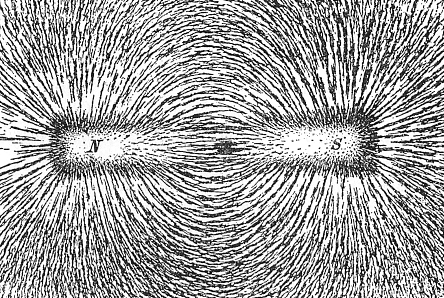
21.

Looking at the field lines in this picture, these two magnets are ________

a)

Attracting

b)

Repelling

c)

Attracting and Repelling

d)

Doing nothing

22.
Magnetic force between two magnets gets weaker the more ________________ between them.
a)
distance
b)
attraction
c)
metal
d)
lightsabers
23.

How does mass of an object relate to kinetic energy?

a)

More mass, more kinetic energy.

b)

Less mass, more kinetic energy.

c)

There is no relation.

24.

How does mass of an object relate to kinetic energy?

a)

More mass, more kinetic energy.

b)

Less mass, more kinetic energy.

c)

There is no relation.

25.

What has more kinetic energy moving 30 m/s?

a)

Bicycle

b)

Semi-truck

c)

Car

26.

Which person would have the least kinetic energy while running?

a)

Man

b)

Teen

c)

Baby

27.

If the same baseball player swung two bats at the same speed, which bat would have more kinetic energy?

a)

Both would be the same

b)

A heavier material bat

c)

A lighter material bat

28.

If all objects are moving as the exact same speed, which would have the greatest kinetic energy?

a)

tennis ball

b)

football

c)

notebook

d)

box of 20 textbooks

29.
At which point is potential energy greatest?
a)
W
b)
X
c)
Y
d)
Z
30.
The faster an object moves, the ________ kinetic energy it has. 
a)
more
b)
less
c)
none of the above
d)
all of the above 
31.

The more mass an object has the _____________ kinetic energy it has

a)

more

b)

less

32.

energy cannot be created or destroyed, only transferred

a)

Law of conservation of matter

b)

Law of conservation of energy

c)

Law of energy transfer

d)

Law of the universe

33.
What type of energy is in this picture?
a)
Kinetic
b)
Potential
c)
Chemical
d)
Sound
34.
On a roller coaster, where is maximum kinetic energy?
a)
At the bottom of a big hill
b)
When going around a corner
c)
When going upside down
d)
At the top of a big hill
35.
At which point is potential energy greatest?
a)
W
b)
X
c)
Y
d)
Z
36.
What happens when two north poles of a magnet are placed together?
a)
they repel
b)
they attract
c)
they cancel each other out
d)
the strength of the magnet is doubled
37.
Magnetic force between two magnets gets weaker the more ________________ between them.
a)
distance
b)
attraction
c)
metal
d)
lightsabers
38.

When two strong magnets are released, the __________ energy will decrease and the ___________ energy will increase.

a)

Potential, Kinetic

b)

Kinetic, Attract

c)

Attract, Repel

d)

Repel, Refute