Wayground logo

Free Printable Worksheets

Font size

S
M
L
XL
Worksheets

Final review Physical Science 2021

Total questions: 79

Worksheet time: 1hrs 5mins

Name
Class
Date
1.

What is the SI unit for mass?

a)

Kg

b)

m

c)

m/s

d)

N

e)

J

2.
Iron + oxygen = rust is an example of a ___________.
a)
physical property/change
b)
chemical property/change
c)
mass
d)
volume
3.
Physical or Chemical?  Water is nonflammable
a)
Physical
b)
Chemical
c)
Neither
4.
Which physical property is measured in liters?
a)
color
b)
length
c)
mass
d)
volume
5.
A positively charged particle found in the nucleus of the atom
a)
Proton
b)
Electron
c)
Neutron
6.
The area of the atom where protons and neutrons are found
a)
Electron Cloud
b)
Nucleus
c)
Energy Level
7.
This number is represented by the number of protons in the atom
a)
Atomic Mass
b)
Atomic Number
c)
Mass Number
8.
This unit is represented by the combined number of protons and neutrons
a)
Atomic Mass
b)
Atomic Number
c)
Mass Number
9.
The electrons that are on the outer most region of the atom
a)
Shell Electrons
b)
Violent Electrons
c)
Valence Electrons
10.
The horizontal rows of the periodic table
a)
Groups
b)
Periods
c)
Families
11.
The vertical rows of the periodic table, also called families
a)
Groups
b)
Periods
c)
Rows
12.
What element does the Bohr Model represent?
a)
Nitrogen
b)
Potassium
c)
Sodium
13.
What line segment represents only the solid state?
a)
A-B
b)
B-C
c)
C-D
d)
D-E
14.
In which segment is the kinetic energy remaining constant?
a)
A-B
b)
B-C
c)
C-D
d)
E-F
15.
Which process takes the longest to occur?
a)
melting
b)
boiling
c)
freezing
d)
heating the solid
16.
This type of graph is called a:
a)
Phase diagram
b)
Heating curve
c)
State of matter
d)
Temperature chart
17.
Which is an example of a solute?
a)
Egg whites
b)
Sugar
c)
Water
d)
Acetone
18.
Which is an example of a solvent?
a)
Salt
b)
Egg whites
c)
Water
d)
Sugar
19.
At approximately what temperature does the solubility of sodium chloride, NaCl, match the solubility of potassium dichromate, K2Cr2O7?
a)
60 ºC
b)
30 ºC
c)
50 ºC
d)
83 ºC
20.
How many grams of K2Cr2O7, are soluble in 100 g of water at 95 ºC?
a)
83 grams
b)
75 grams
c)
40 grams
d)
12 grams
21.
Which substance is MOST soluble at 0 ºC?
a)
KI
b)
NaNO3
c)
NaCl
d)
Ce2(SO4)3
22.

Which of the following refers to substances that do not mix together and look different throughout?

a)

homogeneous mixture

b)

solution

c)

heterogeneous mixture

d)

solubility curve

23.

Sugar dissolved in water is an example of a

a)

Homogeneous Mixture

b)

Heterogeneous Mixture

24.
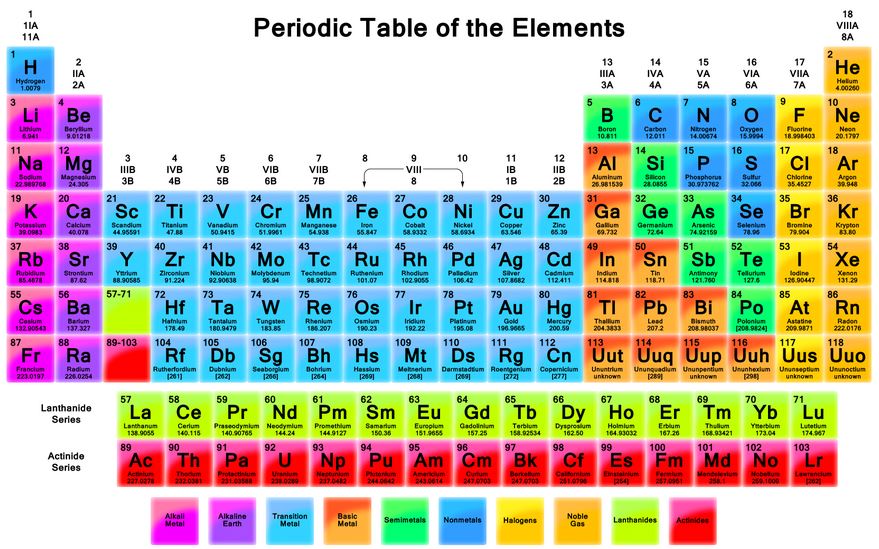
All elements found on the left side of the Periodic Table of the Elements have what properties in common?
a)
They conduct heat and electricity 
b)
They are all gases 
c)
They are brittle and dull
d)
They are radioactive
25.
Based on their locations in the periodic table, which element has chemical properties most similar to those of calcium, Ca?
a)
beryllium, Be
b)
potassium, K
c)
titanium, Ti
d)
yttrium, Y
26.
The number of valence electrons in an element affects the reactivity of that element. Which element listed has the fewest valence electrons?
a)
beryllium (Be)
b)
sodium (Na) 
c)
oxygen (O) 
d)
neon (Ne)
27.
What is the family name of this group of elements? 
a)
Alkali metals 
b)
Halogens 
c)
Noble Gases 
d)
Alkali Earth Metals 
28.
Which element has 2 valence electrons? 
a)
cesium (Cs) 
b)
magnesium (Mg)
c)
boron (B)
d)
argon (Ar) 
29.
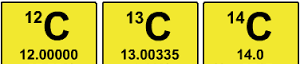
What do these isotopes of carbon all have in common?
a)
neutrons & mass number
b)
atomic number and neutrons
c)
atomic number and electrons
d)
protons, atomic number, and mass number
30.
How many neutrons does the isotope of lithium have?
a)
8
b)
3
c)
4
d)
5
31.
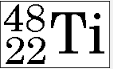
How many protons does this isotope of titanium have?
a)
48
b)
22
c)
26
d)
70
32.
Which process involves the joining of small nuclei?
a)
Beta decay
b)
Alpha decay
c)
Nuclear fission
d)
Nuclear fusion
33.
Which process involves the splitting of large nuclei?
a)
Beta decay
b)
Alpha decay
c)
Nuclear fission
d)
Nuclear fusion
34.
The time taken for half of an amount of radioactive atoms to decay.
a)
Nuclear fusion
b)
Full-life
c)
Dead time
d)
Half-life
35.
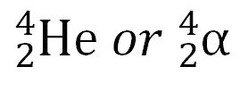
What do these symbols represent?
a)
alpha particle
b)
beta particle
c)
neutron
d)
gamma ray
36.
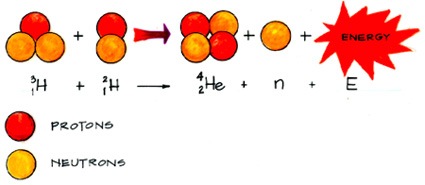
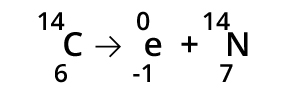
What type of nuclear equation is this?
a)
fusion
b)
fission
c)
alpha
d)
beta
37.
Which type of radiation has the greatest penetrating power?
a)
Alpha
b)
Beta
c)
Gamma 
d)
Microwaves
38.
Elements on the LEFT side of the periodic table will most likely form:
a)
Positive ions
b)
Negative ions
c)
Neutral Ions
d)
None of these
39.
An ionic bond forms when atoms ___________ electrons.
a)
gain
b)
share
c)
increase
d)
transfer
40.
Chemical bonds form when atoms
a)
combined nuclei
b)
give up neutrons
c)
gain protons
d)
share or transfer electrons
41.
If an atom loses two electrons what charge will it have?
a)
+ 2
b)
 - 2
c)
+1
d)
-1
42.
How many valence electrons in this structure?
a)
6
b)
5
c)
4
d)
7
43.
A bond that forms when electrons are transferred is called a/an
a)
ionic bond
b)
covalent bond
c)
hydrogen bond
44.
Name the compound S2F8
a)
sulfur (II) fluoride
b)
disulfur octafluoride
c)
sulfur fluorine
d)
sulfur octafluoride
45.
What is the name for SrO?
a)
strontium monoxide
b)
strontium oxide
c)
strontium (II) oxide
d)
strontium oxygen (II)
46.
Which of the following is a covalent compound?
a)
CH4
b)
NaCl
c)
K3PO4
d)
Zn(OH)
47.
 Ionic compounds must have...
a)
a metal and a polyatomic ion
b)
a metal and a nonmetal
c)
only nonmetals
d)
only metals
48.

What is any motion that repeats itself?

a)

variable

b)

cycle

c)

pendulum

d)

circle

49.

Complete- The shorter the string, the _____________ the swings.

a)

greater

b)

less

50.

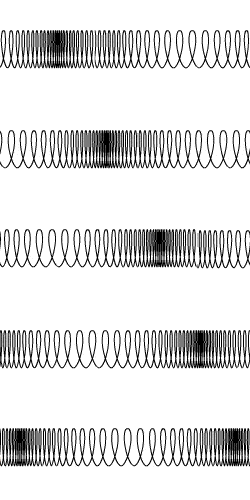
Which transverse wave has the highest frequency?

a)

1

b)

2

c)

3

d)

4

51.
The matter (solid, liquid, or gas) through which waves can travel
a)
Medium
b)
Object
c)
Transverse Wave
d)
Wavelength
52.

The highest point on a transverse wave is the

a)

compression

b)

crest

c)

rest position

d)

trough

53.

The lowest point on a transverse wave is the

a)

compression

b)

crest

c)

rest position

d)

trough

54.

A wave that can travel through matter and empty space is a:

a)

electromagnetic wave

b)

longitudinal wavy

c)

transverse wave

d)

mechanical

55.

What type of wave is this?

a)

Longitudinal

b)

Transverse

c)

Electromagnetic

d)

x ray

56.

This is the distance between two peaks. What is this called?

a)

amplitude

b)

wavelength

c)

longitude

d)

trough

57.

A wave with a large wavelength will have a ______ frequency and _____ energy

a)

high, low

b)

high, high

c)

low, high

d)

low, low

58.

What is the speed of light?

a)

3.0x10⁸ ms

b)

3.0x10⁸ m/s

c)

6.626x10⁻³⁴ Js

d)

6.626x10⁻³⁴ J/s

59.
The part of a longitudinal wave where the particles of the medium are close together.
a)
rarefaction
b)
compression
c)
crest
d)
trough
60.
A part in a longitudinal wave where the particles are spread apart
a)
compression
b)
rarefaction
c)
crest
d)
trough
61.
You and your father inspect an empty house with the hopes of buying it. You walk through the rooms talking to one another, and you notice that your voices and footsteps are echoing in the big, empty house. What causes the echo?
a)
sound waves reflecting off smooth, flat surfaces throughout the house
b)
sound waves moving around the large rooms
c)
sound waves moving slowly through air
d)
sound waves refracting around corners in the empty rooms
62.
As the fire truck approached Mary, the pitch of the siren got higher. Once the fire truck passed and moved away, the siren's pitch got lower. This change in pitch is because of a change in the sound wave's
a)
concussion. 
b)
amplitude. 
c)
reflection.
d)
frequency. 
63.

The faster an object moves, the ________ kinetic energy it has.

a)

more

b)

less

64.
__________ is stored energy. 
a)
Potential
b)
Kinetic
65.
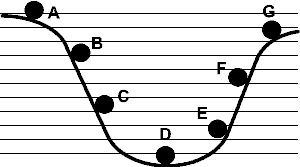
At which point is potential energy greatest?
a)
W
b)
X
c)
Y
d)
Z
66.

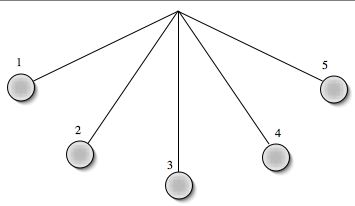
When a pendulum swings, where is potential energy the greatest?

a)

1 and 5

b)

2 and 4

c)

3

d)

apple sauce

67.

What type of energy is greatest when the cannonball is at point C?

a)

kinetic energy

b)

potential energy

c)

elastic energy

d)

awesome sauce

68.

Which point has the most potential energy?

a)

G

b)

F

c)

B

d)

A

69.

Which of these is a property of acidic solutions?

a)

they taste sour

b)

they feel slippery

c)

they are in many cleaning products

d)

they taste bitter

70.

An acid has a pH

a)

higher than 7

b)

lower than 7

c)

7

d)

greater than 14

71.

Scale that measures how acidic or basic something is.

a)

aH

b)

bH

c)

pH

d)

Hp

72.

Which is NOT a property of acids?

a)

slippery

b)

pH below 7

c)

dissociate in water

d)

contain H1+ ions

73.

Which is NOT a property of bases?

a)

caustic

b)

corrosive

c)

pH below 7

d)

bitter

74.
Which pH is considered neutral?
a)
1
b)
3
c)
7
d)
14
75.

_____ reactions usually feel hot!

a)

endothermic

b)

exothermic

76.

In an endothermic reaction, energy is _________.

a)

absorbed

b)

released

77.

Solid --> liquid --> gas is what type of reaction?

a)

endothermic

b)

exothermic

c)

catalytic

d)

inhibited

78.

Endo means in or _______.

a)

absorbed

b)

released

79.

Exo means out or ________.

a)

absorbed

b)

released