wayground logo

Free Printable Worksheets

Font size

S
M
L
XL
Worksheets

Big Bang Unit 1

Total questions: 93

Worksheet time: 2hrs 9mins

Name
Class
Date
1.

Which statement is true?

a)

The galaxies are moving toward us.

b)

The galaxies are moving away from us.

c)

The universe remains static or unchanged in motion.

d)

None of the above

2.

Light emitted from a star or galaxy can be separated into a band of colors, called a ________.

a)

Red Shift

b)

Wave Length

c)

Spectrum

d)

Microwave

3.

Which elements are most

abundant in the visible

universe?

a)

Hydrogen and Carbon

b)

Carbon and Helium

c)

Hydrogen and Oxygen

d)

Hydrogen and Helium

4.

How does Cosmic Microwave Background Radiation support the Big BangTheory?

a)

Microwaves are found everywhere in the universe.

b)

Microwaves occurred at the time of the Big Bang

c)

Microwaves are useful in our everyday lives

d)

Only A & B

5.
The universe is expanding!  This means that:
a)
all of the galaxies are spreading out.
b)
the universe must have started from a single point.
c)
the universe is cooling down.
d)
all of the above.
6.
Light waves that are stretched out by objects moving apart:
a)
have a shorter wavelength.
b)
travel faster than the speed of light.
c)
are invisible.
d)
appear more red.
7.
If a star is being observed from Earth and it's light has shifted towards the blue side of the electromagnetic spectrum it would be...
a)
Moving towards the Earth
b)
Moving away from the Earth
c)
This is a trick question that cannot be answered
d)
It isn't a star, it is a very large blueberry.
8.

What charge does a proton have?

a)

positive

b)

negative

c)

neutral

9.

What charge does a neutron have?

a)

positive

b)

negative

c)

neutral

10.

What charge does an electron have?

a)

positive

b)

negative

c)

neutral

11.

There are equal numbers of ___ and ___ in an atom (if it's neutral)

a)

protons and neutrons

b)

protons and electrons

c)

neutrons and electrons

12.

What two particles are in the nucleus of an atom?

a)

protons and electrons

b)

electrons and neutrons

c)

protons and neutrons

13.
Which subatomic particles contribute the most to the mass of an atom?
a)
Protons, Neutrons, Electrons
b)
Protons only
c)
Protons and Electrons
d)
Protons and Neutrons
14.
an atom with atomic number 6 would have how many protons 
a)
6
b)
12
c)
3
d)
cannot be determined 
15.
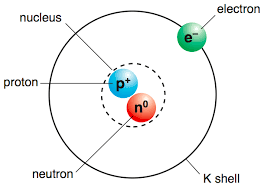
What part of the atom is the arrow pointing to?
a)
nucleus
b)
proton
c)
electron shell
d)
electron
16.
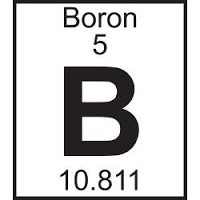
Which number here is my atomic number?
a)
5
b)
10.811
17.
How many protons does this atom have?
a)
2.5
b)
6
c)
5
d)
10.811
18.
In order for me to find the number of neutrons, I must round the atomic mass and then do what?
a)
atomic number-atomic mass
b)
atomic number x atomic mass
c)
atomic mass + atomic number
d)
atomic mass - atomic number
19.
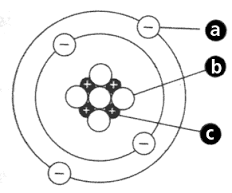
B and C are found in the ______ of an atom.
a)
Energy levels
b)
Space
c)
Nucleus
d)
Outside
20.
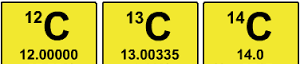
What do these isotopes of carbon all have in common?
a)
neutrons & mass number
b)
atomic number and neutrons
c)
atomic number and electrons
d)
protons, atomic number, and mass number
21.
How many neutrons does the isotope of lithium have?
a)
8
b)
3
c)
4
d)
5
22.
What quantities vary between isotopes of an element?
a)
protons, electrons, and atomic mass
b)
protons, electrons, and atomic number
c)
neutrons and electrons
d)
neutrons and atomic mass
23.
How many neutrons in C-14?
a)
6
b)
7
c)
14
d)
8
24.
Isotopes are atoms of the same element with different #’s of __________ & therefore different __________.
a)
n0 ;  atomic #’s
b)
p+ ; atomic #’s
c)
e- ; atomic masses
d)
n0 ; atomic masses
25.

76 protons and 114 neutrons

a)

Osmium-114

b)

Osmium-76

c)

Osmium-190

d)

Osmium-190.23

26.

Each element produces its own pattern of emission spectra lines because each element has its own distinct

a)

Speed of light

b)

Electron configuration

c)

Number of neutrons

d)

None of these

27.

The color of emitted light with the LONGEST wavelength is

a)

violet

b)

green

c)

red

d)

indigo

28.

The color of emitted light with the SHORTEST wavelength is

a)

violet

b)

green

c)

red

d)

indigo

29.

The color of emitted light with the HIGHEST frequency is

a)

violet

b)

green

c)

red

d)

indigo

30.

The unknown emissions spectra belongs to the element

a)

Hydrogen

b)

Mercury

c)

Neon

d)

Sodium

31.

The unknown emissions spectra belongs to the element

a)

Hydrogen

b)

Mercury

c)

Neon

d)

Sodium

32.

The unknown emissions spectra belongs to the element

a)

Hydrogen

b)

Mercury

c)

Neon

d)

Helium

33.
Is the process in which an unstable atomic nucleus emits charged particles and energy 
a)
radioactivity 
b)
radioisotope
c)
beta decay
d)
background radiation 
34.

True or False:  During nuclear decay atoms of one element can change into atoms of a different element altogether.  This is know as Transmutation.

a)
True
b)
False
35.
Charged particles and energy that are emitted from the nuclei of radioisotopes.
a)
nuclear radiation
b)
nuclear decay
c)
beta particles
d)
alpha particles
36.
What would two different isotopes of an atom have in common?
a)
Number of neutrons 
b)
Number of protons
c)
Atomic weight 
d)
Atomic mass
37.
An isotope of an element has the same number of _________, but a different number of _________.
a)
Protons, electrons
b)
Protons, neutrons
c)
Electrons, neutrons
38.
Which process involves the splitting of large nuclei?
a)
alpha decay
b)
nuclear fusion
c)
beta decay
d)
nuclear fission
39.
What type of nuclear reaction occurs in the Sun?
a)
Nuclear fission
b)
beta decay
c)
alpha decay
d)
Nuclear fusion
40.
Both a fusion reaction and a fission reaction produce 
a)
heat (energy)
b)
light
c)
sound
d)
magnetism
41.
What makes something radioactive?
a)
elements with an atomic number above 81
b)
an unstable nucleus
c)
contaminated sewage
d)
It decays over time
42.

Which of these particles are the nucleus of a helium atom

a)

alpha particles

b)

beta particles

c)

gamma rays

d)

alpha decay

43.

The weakest radioactive emission is

a)

alpha

b)

beta

c)

gamma

44.

Which particles are negatively charged

a)

alpha

b)

beta

c)

gamma

45.

Which radiation carries no charge

a)

alpha

b)

beta

c)

gamma

46.

A rock was analyzed using Potassium-40. The half life of P-40 is 2.5 billion years. If the rock had only 25% of the P-40 that would be found in a similar rock, find the age of the rock.

a)

4 billion years

b)

5 billion years

c)

6 billion years

d)

7 billion years

47.

Ash was found to have 12.5% as much carbon-14 as found in similar ash. How long ago was the ash formed? The half-life of C-14 is 5730 years

a)

14080 years

b)

11460 years

c)

17190 years

d)

2865 years

48.

Nitrogen-13 has a half-life of 15 minutes. How much of a 320 gram sample of N-13 would remain after decaying 45 minutes?

a)

20g

b)

40g

c)

60g

d)

80g

49.

Alpha particles are nuclei are

a)

Helium

b)

Iron

c)

Carbon

d)

Uranium

50.

The amount of time it takes for half of the nuclei in a sample to undergo radioactive decay is

a)

nuclear stability

b)

nuclear instability

c)

beta decay

d)

half life

51.

A nuclear chain reaction occurs when

a)

Three neutrons are absorbed by other uranium-235 nuclei and continue the reaction repeatedly.

b)

Three neutrons are released from protons of radioactive elements and the reaction continues repeatedly.

c)

An atomic bomb releases enough energy to start a hydrogen bomb.

d)

Nuclei of smaller atoms join together to form larger nuclei

52.

In the equation, 146C --> 147N + 0-1B, the _______ decay of radioactive carbon-14 results in the creation of a new nitrogen-14 atom.

a)

Gamma

b)

Beta

c)

Alpha

53.
Uranium-238  decays into  Thorium-234  by emitting .........
a)
an alpha particle
b)
a beta particle
c)
gamma rays
d)
visible light
54.
If we start off with element 24X50 after an alpha decay we get another element Y that looks like
a)
22Y50
b)
22Y46
c)
20Y48
d)
26Y54
55.
Solve this equation for alpha decay.
85209At = ___ + 24He
a)
83205Bi
b)
86209Rn
c)
81207Tl
d)
85208At
56.

Gamma rays have

a)

no mass

b)

a huge mass

c)

a small mass

d)

an average mass

57.
The diagram shows the path of radioactive rays, S and T. Which of the following shows the type of ray S and ray T?
a)
ray S= alpha.  ray T=beta
b)
ray S= alpha   ray T=gamma
c)
ray S= beta.    ray T=gamma
d)
ray S= gamma.  ray T= beta
58.

An isotope that undergoes B- decay has

a)

too few protons

b)

too many protons

c)

too few neutrons

d)

Too many neutrons

59.

An ion is an atom that has an electrical charge.

a)

true

b)

false

60.

Atoms have a total charge of zero if the number of protons and the number of electrons are equal.

a)

true

b)

false

61.

If the atom as more electrons, it is left with a negative charge.

a)

true

b)

false

62.

We use the sign "+" next to the atom's symbol to show that the ion has a positive charge.

a)

true

b)

false

63.

An anion is an ion with a negative charge.

a)

true

b)

false

64.
What is the charge of an atom that has lost one electron?
a)
-1
b)
-2
c)
+1
d)
+2
65.

This rock was another type of rock that was heated and compressed over time. What type of rock is this?

a)

Sedimentary

b)

Igneous

c)

Metamorphic

66.

The process when rocks break into smaller pieces due to exposure to natural elements is called

a)

erosion

b)

weathering

c)

sediments

67.

The process by which metamorphic rocks are formed...

a)

heat and pressure

b)

erosion and deposition

c)

melting and cooling

68.

What causes igneous rocks to form

a)

compaction of sediment

b)

animal and plant remains aka fossils

c)

cementation or hardening of minerals

d)

cooling magma, lava, and pressure

e)

sediment

69.

What do we call the material that comes from rocks that have been broken down into smaller pieces. This usually results from weathering.

a)

texture

b)

weathering

c)

sediment

d)

erosion

70.
As lava cools and crystallizes, what type of rock will form?
a)
Sedimentary
b)
Metamorphic
c)
Extrusive Igneous
d)
Intrusive Igneous
71.
When you watch a volcano erupt molten rock, you are seeing _____
a)
Lava
b)
Magma
c)
Mineral Crystals
d)
Igneous Rocks
72.

Obsidian forms when lava cools rapidly. What type of rock is this?

a)

Igneous

b)

Sedimentary

c)

Metamorphic

73.

Granite forms from the slow crystallization of magma below Earth's surface.

a)

Igneous

b)

Metamorphic

c)

Sedimentary

74.
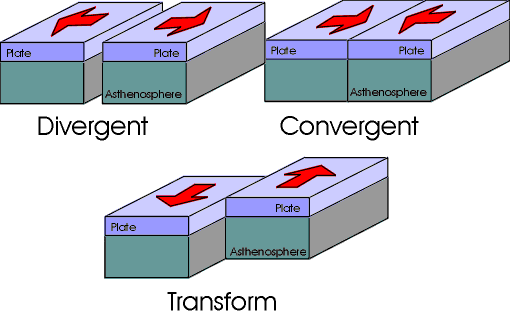
The San Andrea's Fault in California is which type of boundary?
a)
Convergent
b)
Divergent
c)
Subductive Zone
d)
Transform
75.
At which type of boundary are mountains formed?
a)
Convergent
b)
Divergent
c)
Subductive Zone
d)
Transform
76.
What type of boundary is formed when plates separate?
a)
convergent
b)
horizontal
c)
divergent
d)
transform
77.
According to the continental drift theory, a single, huge continent once existed called
a)
Pangaea.
b)
Wegener.
c)
Panthalassa.
d)
Euraisa.
78.
The process that takes place at mid-ocean ridges is called
a)
sea-floor spreading.
b)
uplift. 
c)
continental drift.
d)
subduction.
79.
Most volcanoes and earthquakes occur...
a)
along the coast
b)
along tectonic plate boundaries
c)
in the Arctic
d)
in the ocean
80.
Which of these events can ONLY happen on a DIVERGENT BOUNDARY?
a)
Rift Valley
b)
Mountain
c)
A peninsula
d)
An Insanely complex, long answer that you will click out of instinct. 
81.
This colorless, odorless gas can be deadly if breathed in. It is produced by incomplete combustion (not enough oxygen).
a)
SO2
b)
CO
c)
NO
d)
NO2
82.
The general term for air pollution that reduces visibility, especially in cities. 
a)
atmospheric transport
b)
pollution 
c)
smog
d)
wet scrubber
83.
Greenhouses gases
a)
Absorb and radiate heat
b)
Destroy the ozone layer
c)
Cause respiratory problems
d)
Create smog
84.
Which of the following are greenhouse gases?
a)
Carbon dioxide
b)
Methane
c)
Water vapor
d)
All answers are correct
85.

The 3 main anthropogenic sources of gaseous air pollutants in the US are

a)

soil erosion, volcanoes, and forest fires

b)

transportation, soil erosion, and energy production

c)

industry, transportation, and energy production

d)

industry, transportation and agriculture

86.

Which below is a source of particulate matter?

a)

burning wood

b)

dust from gravel roads

c)

volcanoes

d)

forest fires

e)

all of these are sources of particulate matter

87.

Volcanic eruptions can be sources of air pollution

a)

True

b)

False

88.
An air pollution prevention mechanism found in vehicles. 
a)
combustion chamber
b)
electrostatic precipitator
c)
scrubber
d)
catalytic converter
89.

Which one is not a cause of noise pollution?

a)
b)
c)
d)
90.
Hydrocarbons such as gasoline, solvents, paints, finger nail polish & thinners that vaporize easily.
a)
Sulfur Oxides
b)
Nitrogen Oxides
c)
VOC's
d)
Mercury
91.

Concentration of nitrogen in the atmosphere

a)

21%

b)

55%

c)

78%

d)

95%

92.

Colorless, odorless gas that is a naturally occurring decay product of uranium

a)

asbestos

b)

radon

c)

lead

d)

carbon monoxide

e)

formaldehyde

93.

What size of particulate matter (PM) pollution is the most harmful to humans

a)

2.5 micrometers

b)

5 micrometers

c)

10 micrometers

d)

100 micrometers