wayground logo

Free Printable Worksheets

Font size

S
M
L
XL
Worksheets

Topic Review

Total questions: 20

Worksheet time: 25mins

Name
Class
Date
1.
Ionization energy is the...
a)
energy needed to remove the outermost electron.
b)
ability of an atom to attract electrons from another atom.
2.
Electronegativity is the...
a)
energy needed to remove the outermost electron.
b)
ability of an atom to attract electrons from another atom.
3.
Which element has the smaller atomic radius: potassium (K) or bromine (Br)?
a)
potassium (K)
b)
bromine (Br)
4.
Which element has the greatest ionization energy: Aluminum (Al)    or    Chlorine (Cl)?
a)
Aluminum (Al)
b)
Chlorine (Cl)
5.
Which element has the greatest electronegativity: Nitrogen (N) or Arsenic (As)?
a)
Nitrogen (N)
b)
Arsenic (As)
6.
As you move down a group, atomic radius increases because - 
a)
you add more and more neutrons
b)
you add more and more protons
c)
you add more and more shells (energy levels)
d)
you add more atomic mass
7.
As you move across the periodic table from left to right, the atomic radius decreases.  This is because - 
a)
the number of protons increases, so attraction to electrons increases
b)
the number of energy levels increases
c)
the number of electrons increases
d)
the atomic mass increases
8.
What is the name of family I
a)
Alkaline Earth Metals
b)
Boron Family
c)
Alkali Metals
d)
Halogen Family
9.
Families all have similar 
a)
Names
b)
atomic numbers
c)
atomic masses
d)
properties
10.
The reactants are on the left side of the chemical equation.
a)
True
b)
False
11.

What are products?

a)

The chemicals that start the reaction.

b)

The chemicals that the reaction produced.

c)

The chemicals that are on the left side of the arrow.
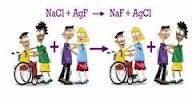
12.

What is the type of reaction shown above?

a)

Synthesis

b)

Decomposition

c)

Single Replacement

d)

Double Replacement

13.
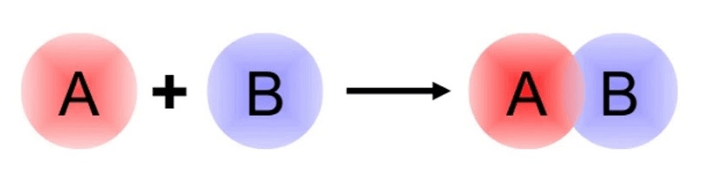
This pictures simulates what type of reaction?
a)
Synthesis
b)
Decomposition
c)
Single Replacement
d)
Double Replacement
14.

Identify the reaction type:

C2H6 + O2 --> CO2 + H2O

a)

Double replacement

b)

Synthesis

c)

Acid base

d)

Combustion

15.

Identify the reaction type for the following equation:

K + F2 --> KF

a)

Double replacement

b)

Single Replacement

c)

Synthesis

d)

Decomposition

16.

Identify the type of reaction:

ZnCl2 + Mg --> Zn + MgCl2

a)

Precipitate

b)

Single Replacement

c)

Double Replacement

d)

Decomposition

17.

Identify the reaction type:

NaCl + KOH --> KCl + NaOH

a)

Double replacement

b)

Combustion

c)

Synthesis

d)

Decomposition

18.

Identify the reaction type:

H2O2 --> H2O + O2

a)

Decomposition

b)

Synthesis

c)

Combustion

d)

Acid Base

19.

Which of the following is an acid-base reaction?

a)

2Na + Cl2 → 2NaCl

b)

CH4 + 2O2 → CO2 + 2H2O

c)

HCl + KOH → KCl + H2O

d)

CaCO3 → CO2 + CaO

20.

In a ___________change, a substance changes into a different substance.

a)

Physical

b)

Chemical