wayground logo

Free Printable Worksheets

Font size

S
M
L
XL
Worksheets

Electricity

Total questions: 65

Worksheet time: 2hrs 28mins

Name
Class
Date
1.

Which of these materials is a good insulator?

a)

gold

b)

copper

c)

silver

d)

plastic

2.

In a series circuit, what will happen if the path for the electrical current is broken by a burned out bulb?

a)

The electrical current will stop fllowing and none of the bulbs will light up.

b)

The electrical current will continue flowing and the other bulbs will light up.

c)

The energy source will continue to move the electric charge through the circuit.

3.

An electric tooth brush is an example of transforming

a)

electricity into heat

b)

electricity into sound energy

c)

electricity into motion energy

d)

electricity into light

4.

Which of the following can transform electrical energy into heat?

a)

a hair dryer

b)

a warm sweater

c)

a barbeque grill

d)

the sun

5.

Which of the following is a good conductor?

a)

copper

b)

rubber

c)

dry wood

d)

glass

6.

Which type of circuit has more than one path for the electrical current?

a)

The series circuit

b)

The parallel circuit

c)

They both have more than one path

d)

Neither circuit has more than one path for the electrical current
7.
Electricity that flows in a closed path is called a
a)
path
b)
current
c)
circuit
8.
The flow of electricity in a circuit-
a)
current
b)
flow
c)
circuit
9.
____________ stops the flow of electricity.
a)
A conductor
b)
An insulator
c)
A magnet
10.
Two types of circuits are
a)
parallel and magnetic
b)
electromagnetic and series
c)
series and parallel
11.
The unit for current is the 
a)
Volt
b)
Ohm
c)
Electron
d)
Amp
12.
In a ________ circuit there are multiple paths for the current to take.
a)
Series
b)
Parallel
13.
In a _________ circuit, if one bulb goes out then the entire circuit doesn't work.
a)
Series
b)
Parallel
14.
The continuous flow of electric charges through a material is called...
a)
Electric Field
b)
Electric Force
c)
Electric Current
d)
Electric Circuit
15.
Identify the conductor below.
a)
cloth rag
b)
plastic bottle
c)
gold ring
16.
What is the unit for resistance?
a)
Volts
b)
Amperes
c)
Ohms
17.
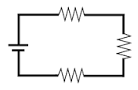
What type of circuit is pictured?
a)
series
b)
parallel
18.
What kind of circuit is this?
a)
Series
b)
Consecutive
c)
Parallel
d)
Training
19.
If the battery produced 12.6 Volts and what would be the current flow be for a 6 Ohm resistor
a)
2.1 Amps
b)
2.4 Amps
c)
1.71 Amps
d)
15 Amps
20.
What voltage is needed to cause a 2A current flow through a 10Ω resistor?
a)
5V
b)
0.2V
c)
20V
d)
200V
21.
What resistance is needed to cause a 20A current flow because of a 100V battery?
a)
0.2Ώ
b)
2000Ώ
c)
120Ώ
d)
22.

What voltage is needed to cause a 50A current flow through a 10Ω resistor?

a)

15V

b)

500V

c)

500 kV

d)

0.2V

23.
If the battery produced 12.6 Volts and what would be the current flow be for a 6 Ohm resistor
a)
2.1 Amps
b)
2.4 Amps
c)
1.71 Amps
d)
15 Amps
24.
What would the circuit resistance be if a 7.5 Amp draw was present with the engine running and the charging system producing 15 Volts
a)
15 Ohms
b)
4 Ohms
c)
0.3333 Ohms
d)
2 Ohms
25.

Electric current flows from

a)

detect electric current

b)

negative terminal to positive terminal

c)

positive terminal to negative terminal

d)

the flow rate of electric charges through a conductor

26.

Electrons flows from

a)

detect electric current

b)

negative terminal to positive terminal

c)

positive terminal to negative terminal

d)

the flow rate of electric charges through a conductor

27.
What is voltage measured in?
a)
Ω (Ohms)
b)
V (Volts)
c)
A (Amps)
d)
W (Watts)
28.
What is current measured in?
a)
Ω (Ohms)
b)
V (Volts)
c)
A (Amps)
d)
W (Watts)
29.
What is resistance measured in?
a)
Ω (Ohms)
b)
V (Volts)
c)
A (Amps)
d)
W (Watts)
30.
How do you calculate voltage?
a)
Current X Resistance
b)
Resistance ÷ Current
c)
Current ÷ Resistance
d)
Measure it with a ruler
31.
How do you calculate current
a)
Resistance X Voltage
b)
Voltage X Resistance
c)
Resistance ÷ Voltage
d)
Voltage ÷ Resistance
32.
How do you calculate resistance?
a)
Voltage X Current
b)
Current ÷ Voltage
c)
Voltage ÷ Current
d)
Current X Amps
33.
What voltage is needed to cause a 2A current flow through a 10Ω resistor?
a)
5V
b)
0.2V
c)
20V
d)
200V
34.
What voltage is needed to cause a 5A current flow through a 2Ω resistor?
a)
10V
b)
2.5V
c)
7V
d)
0.4V
35.
What resistance is needed to cause a 50A current flow because of a 500V battery?
a)
10Ώ
b)
c)
2500Ώ
d)
550Ώ
36.
What resistance is needed to cause a 20A current flow because of a 100V battery?
a)
0.2Ώ
b)
2000Ώ
c)
120Ώ
d)
37.

Which of the following is an insulator?

a)

an eraser

b)

a wire

c)

a penny

d)

a metal spoon

38.

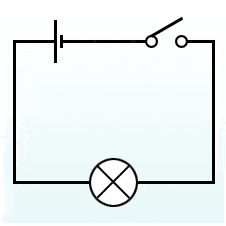
This picture shows a circuit that is

a)

closed

b)

open

c)

an insulator

d)

static electricity

39.

What kind of electricity is natural (example: lightning)?

a)

current electricity

b)

static electricity

c)

power source

d)

insulator

40.

What is the purpose of a fuse?

a)

to break the circuit and turn the power off if there is too much power being run

b)

to add more power to the circuit

c)

to be a conductor

d)

to be an insulator

41.

A parallel circuit has more than one path for electricity to flow

a)

true

b)

false

42.

If the light bulb turns ON in a circuit, that means the circuit is


a)

open

b)

closed

43.
this is the symbol for a _____?
a)
switch
b)
light 
c)
battery
d)
wires
44.
what is this symbol for?
a)
light bulb
b)
cell
c)
battery
d)
resistor
45.
This is the symbol for a ...
a)
Bulb
b)
Battery
c)
Horn
d)
Fuse
46.
This is the symbol for a ...
a)
Wire
b)
Battery
c)
Buzzer
d)
Fuse
47.
This is the circuit symbol for ...
a)
an AC current source
b)
a DC current source
c)
an ammeter
d)
a voltmeter
48.
This is the circuit symbol for ...
a)
an AC current source
b)
a DC current source
c)
an ammeter
d)
a voltmeter
49.
This is the circuit symbol for ...
a)
an AC current source
b)
a DC current source
c)
a battery
d)
a single cell
50.
This is the symbol for a _____?
a)
Lamp
b)
Water wheel
c)
Loudspeaker
d)
Motor
51.
a)
Closed switch
b)
Push switch
c)
Trap door
d)
AC Power supply
52.

What is the following symbol represent?

a)

Wire

b)

Resistor

c)

Battery

d)

Switch

53.
This circuit is _________.
a)
open
b)
parallel
c)
closed
d)
The cutest little circuit evah!
54.
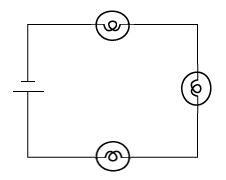
The picture shows an electrical circuit.  This circuit is a series circuit because: 
a)
it has 3 light bulbs.
b)
the same current flows through all three light bulbs.
c)
it uses a single battery.
d)
the electrical current has more than one path to flow through
55.
This picture is an example of what kind of circuit?
a)
Series
b)
Complete
c)
Broken
d)
Parallel
56.
Which of the following answer choices correctly describes the image? 
a)
Series circuit - Bulbs are lit
b)
Series circuit - Bulbs are off
c)
Parallel circuit - Bulbs are lit
d)
Parallel circuit - Bulbs are off
57.
this is the symbol for a _____?
a)
switch
b)
light 
c)
battery
d)
wires
58.
What voltage is needed to cause a 50A current flow through a 10Ω resistor?
a)
15V
b)
500V
c)
500 kV
d)
0.2V
59.
What word means how fast the electrons flow.
a)
Current
b)
Voltage
c)
Resistance
d)
Power
60.
If two charges repel each other, the two charges must be
a)
Positive and neutra
b)
Positive and negative
c)
positive and neutral
d)
negative and negative
61.
If you rub a glass rod with a piece of silk, the rod becomes positively charged. This means that
a)
friction destroyed electrons in the rod.
b)
the silk has become negatively charged.
c)
protons have moved to the rod.
d)
glass attracts more protons.
62.

Ms Pippin rubbed two balloons with a piece of wool. What will happen when the balloons are brought near each other?

a)

The balloons will repel each other.

b)

The balloons will attract each other.

c)

The balloons will become positively (+) charged.

d)

The balloons will pop.

63.
Electrical charge built up on the surface of an object is called _________________.
a)
static electricity
b)
current electricity
c)
lightning
d)
electrons
64.

the positively charged particle in an atom, never leaves the nucleus, determines the element

a)

proton

b)

neutron

c)

electron

65.
What types of charges attract?
a)
Positive and Positive
b)
Positive and Neutral
c)
Negative and Neutral
d)
Positive and Negative