Worksheets
Reproduction in Flowering Plants 2
Total questions: 40
Worksheet time: 21mins
A bee buzzes inside a flower to drink some nectar. While there it touches the stamen. Later the bee goes to another flower and comes into contact with the flower's pistil. Which process of reproduction is this helping with?
pollination and fertilization
plant growth and fertilization
germination and pollination
seed dispersal and germination

The petals job is not only to protect the reproductive parts of the plant, but also to
keep wind away from the stamen
attract pollinators with their colors
absorb sunlight
fall off and become food for bugs
Seed structure that grows become roots
radicle
plumule
cotyledon
endosperm
Seed structure that protects seed
radicle
plumule
endosperm
seed coat(testa)
[Multi-answer] Plants scatter their seeds to reduce overcrowding. This reduces the competition for _______________.
sunlight
space
water
air
The _________ travels to the __________ during fertilization to form a seed.
anther travels to the ovule
pollen travels to the ovule
anther travels to thestigma
pollen travels to the stigma
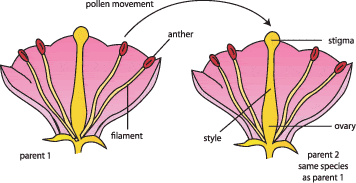
The ___________ of one flower receives pollen grains from another flower.
anther
ovary
style
stigma
[Multi-answer] Plants scatter their seeds to reduce overcrowding. This reduces the competition for _______________.
sunlight
space
water
air
The ______ supports the stigma and keeps it high above the plant to receive pollen grains easily.
style
filament
stalk
stem
Pollination is the process of transferring pollen from the anther of one flower to the ______________ of another flower.
filament
style
stigma
ovary
ovule
After a pollen grain has reached the stigma, it travels through the __________ to reach the ovary.
style
stalk
stigma
stem
After fertilization, each _______forms a seed, while each _________forms a fruit.
ovary ... ovule
ovule ... ovary
egg ... ovary
pollen ... ovary
ovary ... pollen
Fruit X is fleshy and bright-red in colour. The likely dispersal method for its seeds is by ____________.
animal
wind
water
splitting
[Multi-Answer] Which of the following features suit a wind-dispersed fruit/seed?
wing-like structures
light
colourful
can float on water
The process of the pollen fusing with the ovule is called ________________.
pollination
fertilisation
germination
reproduction
After fertilisation, the seeds are formed inside the _________.
ovule
ovary
flower
stalk
Germination is _________________________________.
when a seed starts to grow
when an egg and pollen join together
when pollen moves stamen to stigma
when a plant makes its own food.
A seed needs __________, __________ and a __________ to germinate.
soil, water, air
suitable temperature, water, sunlight
air, water, suitable temperature
water, air, sunlight

What do you call to the process where plants make their own food?
Germinate
Nutrients
Photosynthesis
Plant Life
Where does the seed get its energy from?
Food stored in the roots.
Energy from the sun.
Root coat and seed coat.
Food stored in its seed leaves.
Which part of the plant should come out before it can make it's own food?
seed leaf
seed coat
tiny shoot
first leaves

What makes an avocado a fruit?
An avocado is green.
An avocado grows on a tree.
An avocado contains a seed.
An avocado is edible.
After fertilisation, the ovary develpos into a
seed
fruit
embyro
zygote
What is the function of cotyledon?
proctect the seed
small holes that enable water and air to enter the seed
stores food
embryo that develops into root
What word is used to describe a seed that is inactive?
Sleeping
Dormant
Metabolism
Radicle
Which condition is NOT needed for germination?
Water
Oxygen
Light
Suitable temperature

Which of the following statement is true about the picture above.
Process A and C is demonstrating self pollination
Process B and C is demonstrating self pollination
Process A and C is demonstrating cross pollination
Process A and B is demonstrating self pollination

The flower above is most likely pollinated by
The wind because it has brightly coloured petals
Insects because it has brightly coloured petals
The wind because its anthers and stigmas are located inside
Insects because it has no stamen and pistils

The flower above is
Complete flower
Incomplete Flower
Wind pollinated flower
All of the above