wayground logo

Free Printable Worksheets

Font size

S
M
L
XL
Worksheets

Final Review Anatomy

Total questions: 205

Worksheet time: 17hrs 5mins

Name
Class
Date
1.
One difference between bone and cartilage is...
a)
bone can't regenerate
b)
cartilage is avascular (lacks blood vessels)
c)
cartilage isn't supportive
d)
cartilage isn't a connective tissue
2.
Your ears and nose are made of _________.
a)
hydro cartilage
b)
elastic cartilage
c)
fibro cartilage
d)
hyaline cartilage
3.
The study of structure is called ___________.
a)
homeostasis
b)
anatomy
c)
physiology
d)
interrelation
4.
Which is NOT a shape of epithelial cells?
a)
cuboidal
b)
columnar
c)
squamous
d)
circular
5.
which tissue is this?
a)
Pseudostratified columnar
b)
Stratified Squamous
c)
Simple Columnar
d)
Transitional
6.
Type of epithelial tissue likely to be found forming glands
a)
Simple Cuboidal
b)
Stratified Squamous
c)
Stratified Columnar
d)
Transitional
7.
a)
Dense regular connective
b)
Stratified squamous epithelium
c)
Pseudostratified ciliated epithelium
d)
Fibrocartilage
8.
Epithelium is
a)
Bone, cartilage,dense connective tissue, loose connective tissue, and blood
b)
Highly specialized tissue that contracts or shortens to produce movement
c)
Lining, covering, and glandular tissue of the body
9.
This type of connective tissue forms strong rope like structures such as tendons and ligaments.
a)
Loose connective
b)
Dense connective
c)
Cartilage 
d)
Bone
10.
Mature cartilage cell
a)
chondrocyte
b)
fibroblast
c)
neuron
d)
erythrocyte
11.
Which glands are ductless and secrete hormones directly into the bloodstream?
a)
goblet
b)
endocrine
c)
exocrine
d)
holocrine
12.
Name this tissue
a)
Bone
b)
Hyaline cartilage
c)
Fibrocartilage
d)
Adipose
13.
Name this tissue
a)
Bone
b)
Hyaline cartilage
c)
Fibrocartilage
d)
Elastic cartilage
14.
Chondrocytes are found in cavities called ___.
a)
lacunae
b)
lamellae
c)
canaliculi
15.
a)
Blood
b)
Simple columnar epithelium
c)
Nervous tissue
d)
Bone
16.
the thick filament in muscle cells
a)
actin
b)
myosin
c)
hemoglobin
d)
myofibril
17.
a bundle of muscle fibers
a)
actin
b)
mysoin
c)
fascicle
d)
sarcomere
18.
What is the central nervous system (CNS) made of?
a)
brain and spinal cord
b)
brain and cranial nerves
c)
spinal cord and spinal nerves
d)
cranial nerves and spinal nerves
19.
What is this?
a)
Cerebrum
b)
Cerebellum
c)
Brain Stem
d)
Diencephalon
20.
Label the Neuron-What does the letter "D" represent?
a)
Dendrite
b)
Axon
c)
Myelin Sheath
d)
Node of Ranvier
21.
Processes visual information
a)
Frontal Lobe
b)
Temporal Lobe
c)
Occipital Lobe
d)
Parietal Lobe
22.
The major part of the brain that controls higher mental activities such as learning and making decisions
a)
cerebellum
b)
cerebrum
c)
thalamus
d)
midbrain
23.
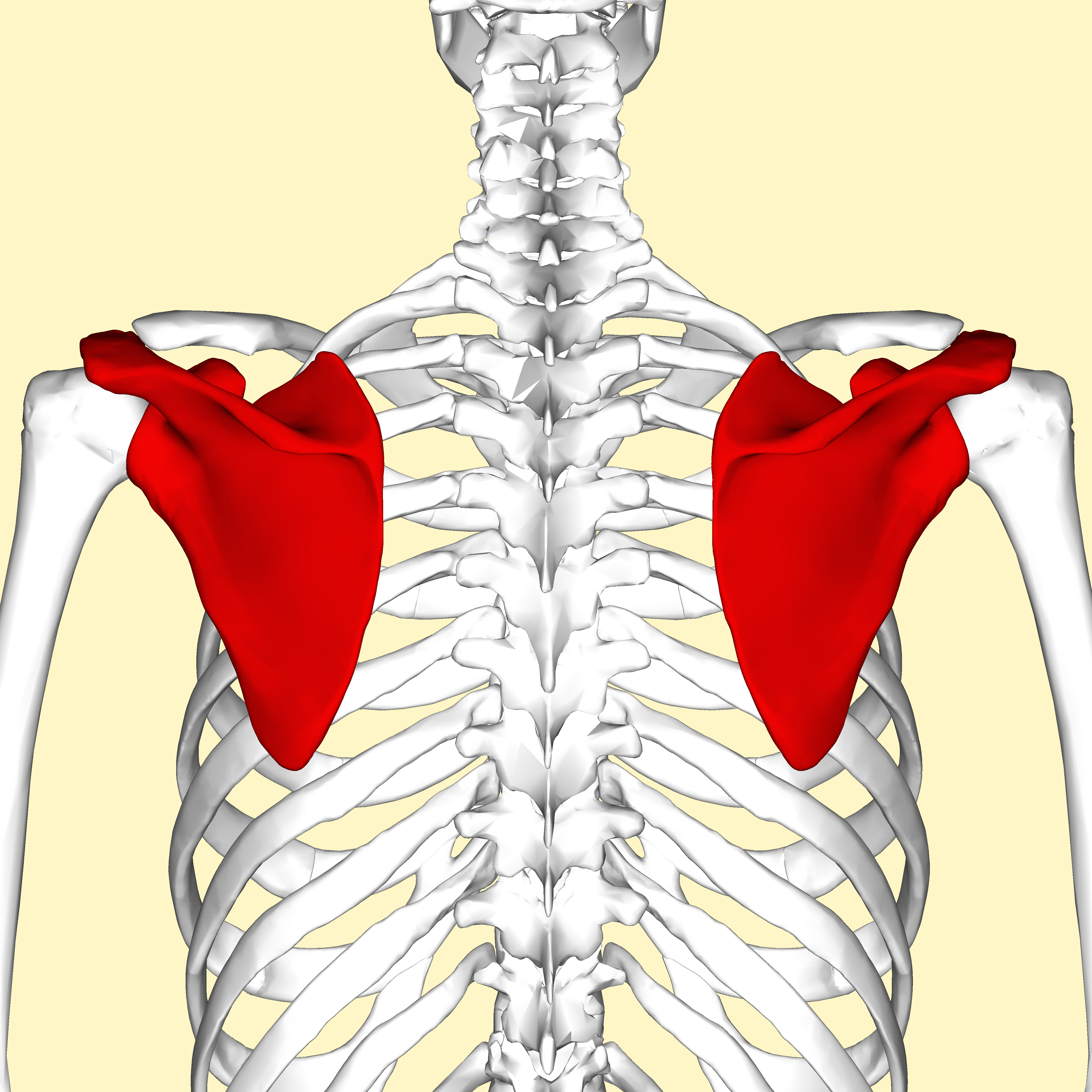
What bones is represented in the  picture?
a)
Clavicle
b)
Scapula
c)
Sternum
d)
Carpals
24.
This bone is located on the thumb side of the forearm
a)
ulna
b)
radius
c)
humerus
d)
patella
25.
This bone is on the pinky side of your forearm
a)
Ulna
b)
Radius
c)
Humerus
d)
Pelvis
26.
This is the smaller bone behind the Tibia
a)
Tibia
b)
Femur
c)
Fibula
d)
Pelvis
27.
a)
metacarpals
b)
metatarsals
c)
carpals
d)
tarsals
28.
The frontal bone is part of the _____________ skeletal system.
a)
appendicular
b)
axial
c)
central 
d)
peripheral
29.
                                            What                                           muscle
                                          is this?
a)
Gastrocnemius
b)
Tibialis Anterior
c)
Extensor Digitorum Longus
d)
Plantaris
30.
What muscle is this?
a)
Trapizius
b)
External Obliques
c)
Latissmus dorsi
d)
Rectus abdominus
31.
What muscle is this?
a)
Trapezius
b)
Erector spinae
c)
External obliques
d)
Internal obliques
32.
a)
Elevation
b)
Depression
c)
Flexion
d)
Extension
33.
a)
Elevation
b)
Depression
c)
Flexion
d)
Extension
34.
What region is this? (HEEL)
a)
Carpal
b)
Calcaneal
c)
Cervical
d)
Plantar
35.
What region is this?
a)
Scapular
b)
Vertebral
c)
Sural
d)
Plantar
36.
My elbow is ______________ to my fingers
a)
proximal
b)
distal
37.
To be on your back
a)
flexion
b)
extension
c)
prone
d)
supine
38.
What is the name of cavity 2?
a)
Cranial
b)
Dorsal
c)
Vertebral
d)
Thoracic
39.
What is the name of cavity 3?
a)
Cranial
b)
Dorsal
c)
Vertebral
d)
Thoracic
40.
What is the name of cavity 4?
a)
Cranial
b)
Dorsal
c)
Vertebral
d)
Thoracic
41.
What is the name of cavity 7?
a)
Diaphragm
b)
Abdominal
c)
Pelvic
d)
Abdominopelvic
42.
What is the name of cavity 7?
a)
Diaphragm
b)
Abdominal
c)
Pelvic
d)
Abdominopelvic
43.
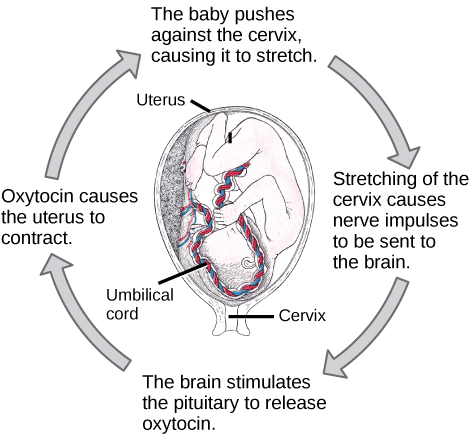
What type of feedback loop is shown?
a)
negative
b)
neutral 
c)
positive
44.
The finger-like projections of the papillary dermis region are called:
a)
Friction ridges
b)
Dermal papillae
c)
Meissner's corpuscles
d)
Dermal peaks
45.
Goosebumps are caused by contractions of the ______ muscle
a)
Sartorius
b)
Latissimus dorsi
c)
Arrector pili
d)
Sebaceous
46.

Which of the following produces Sebum?

a)

Eccrine glands

b)

Apocrine glands

c)

Sebaceous glands

d)

Thyroid glands

47.
Osmosis is the movement of _____ across a membrane.
a)
food
b)
energy
c)
oxygen
d)
water
48.

Anatomical landmark describing the Elbow:

a)

Occipital

b)

Umbilical

c)

Patellar

d)

Olecranon

49.
What a cell needs to transport particles by active transport?
a)
Sun
b)
Wind
c)
Energy
d)
Channels
50.

Anatomical landmark describing the upper Arm:

a)

Antebrachial

b)

Brachial

c)

Mental

d)

Frontal

51.

Anatomical landmark describing the shoulder:

a)

Acromial

b)

Crural

c)

Scapular

d)

Axillary

52.

Pores embedded in the cell membrane that allow cells to communicate described which type of junction?

a)

Tight Junctions

b)

Desmosomes

c)

Gap Junctions

d)

Plasmodesmata

53.

Lying on one's back is "Supine" and lying on one's stomach is called:

a)

Dorsal

b)

Anterior

c)

Lithe

d)

Prone

54.
The movement of molecules against a concentration gradient
a)
simple diffusion
b)
facilitated diffusion
c)
active transport
d)
osmosis
55.
What is diffusion?
a)
when molecules move 
b)
when molecules move from a high concentration to a low.
c)
no movement 
d)
molecules move everywhere
56.

Which organelle is responsible for ATP production?

a)

Golgi body

b)

Mitochondria

c)

Nucleus

d)

Ribosome

57.

Which type of cell junction forms a water-tight seal so that nothing can escape?

a)

TIght junction

b)

Gap junction

c)

Desmosome

d)

Plasmodesmata

58.

Which layer of the skin contains the blood vessels and nerves?

a)

Epidermis

b)

Dermis

c)

Hypodermis

d)

Stratum corneum

59.

What is the largest organ in the human body?

a)

Liver

b)

Brain

c)

Skin

d)

Stomach

60.
Which type of cell junction strongly anchors cells in place but is not waterproof?
a)
Desmosomes
b)
Tight Junctions
c)
Gap Junctions
d)
Plasmodesmata
61.
This tissue type in this photo is:
a)
Stratified cuboidal
b)
Pseudo stratified ciliated 
c)
Simple columnar
d)
Stratified squamous
62.
What is the function of Simple Cuboidal epithlium?
a)
Secretion/Absorption
b)
Filtration/Diffusion
c)
Move particles down a tube
d)
Accommodate distention
63.
Which cartilage type makes up the inter-vertebral discs?
a)
Hyaline
b)
Fibrocartiliage
c)
Elastic
d)
Hyaline & Elastic
64.
Which muscle tissue type contains Intercalated Discs?
a)
Cardiac
b)
Smooth
c)
Skeletal & Cardiac
d)
Skeletal
65.
Which part of the neuron conducts the impulse?
a)
Dendrite
b)
Connexon
c)
Neuroglia
d)
Axon
66.

This photo shows which tissue type?

a)

Fibrocartiliage

b)

Stratified cuboidal

c)

Stratified squamous

d)

Blood

67.

Adipose tissue can also be called:

a)

Lymph

b)

Fat

c)

Plasma

d)

Marrow

68.
Which muscle type is found in your stomach, bladder, and intestines?
a)
Skeletal
b)
Smooth
c)
Cardiac
d)
Straight
69.
Which muscles are involuntary?
a)
skeletal
b)
cardiac
c)
smooth
d)
smooth and cardiac
70.
Which of the following best describes why, when compared to other cells, muscle cells contain a large number of mitochondria?
a)
The muscle cells require a lot of ATP for muscle contraction.
b)
The mitochondria are needed to remove carbon dioxide from the cells
c)
Muscle fibers are strongly associated with mitochondria.
d)
The mitochondria produce myoglobin.
71.

The contractile unit of muscle, which runs from Z-disc to Z-disc is called a:

a)

Synergist

b)

Sarcomere

c)

Myofilament

d)

Myoblast

72.

The neurotransmitter for muscle contraction (binds to receptors) is:

a)

Chondroitin

b)

Acetylcholine

c)

Calcium

d)

Sebum

73.

Which of the following best illustrates a Concentric contraction?

a)

Curling a dumbell toward chest

b)

Lowering a dumbell away from chest

c)

Holding dumbell straight above head

d)

All of the above

74.
What type of joint is the thumb?
a)
gliding
b)
condyloid
c)
saddle
d)
ball and socket
75.
What type of joint is the elbow?
a)
hinge
b)
ball and socket
c)
condyloid
d)
gliding
76.
Ligaments connect:
a)
Bone to bone
b)
Muscle to bone
c)
Joint to joint
d)
Bone to joint
77.
The shaft of the bone
a)
diaphysis
b)
epiphysis
c)
medullary cavity
d)
matrix
78.
Which type of joint give you the largest range of motion?
a)
pivot
b)
ball-and-socket
c)
hinge
d)
gliding
79.

What bone is highlighted?

a)

Skull (Mandible)

b)

Clavicle

c)

Mandible

d)

Scapula

80.

The Tibia is what type of bone?

a)

Short

b)

Flat

c)

Long

d)

Irregular

81.

The Atlas vertebrae is what type of bone?

a)

Short

b)

Flat

c)

Long

d)

Irregular

82.

The exaggerated lateral bending of the spine called:

a)

Lordosis

b)

Kyphosis

c)

Scoliosis

d)

Mardosis

83.

What type of fracture is shown in the photo?

a)

Oblique

b)

Spiral

c)

Comminuted

d)

Transverse

84.

Which of the following is NOT part of the Appendicular skeleton?

a)

Femur

b)

Ulna

c)

Mandible

d)

Pelvis

85.

Which of the following stores energy in bone?

a)

Red marrow

b)

Osteoblasts

c)

Collagen

d)

Yellow marrow

86.

Synarthroses describes which of the following?

a)

Immovable joints

b)

Slightly movable joints

c)

Freely movable joints

d)

Synovial joints

87.

Diarthroses describes which of the following?

a)

Immovable joints

b)

Slightly movable joints

c)

Freely movable/Synovial joints

d)

None of the above

88.

List the layers of the skin from outer to inner.

a)

Epidermis, Subcutaneous layer, Dermis

b)

Epidermis, Dermis, Subcutaneious layer

c)

Subcutaneous layer, Dermis, Epidermis

d)

Dermis, Subcutaneous layer, Epidermis

89.

Which of the following accurately describes what happens first when conducting a nerve impulse?

a)

Sodium rushes into the neuron to create a positive charge.

b)

Potassium is pumped out to repolarize the neuron.

c)

The sodium-potassium pump moves potassium into the neuron and sodium out.

90.

Check off the two answers that apply. In the spinal cord ...

a)

White matter is found in the middle

b)

Gray matter is found in the middle

c)

White matter contains interneurons for reflexes

d)

Gray matter contains interneurons for reflexes

91.

Listen the structures in order of signaling for a reflex arc.

a)

Sensor, Sensory Nerve, Interneuron, Motor Neuron, Effector

b)

Effector, Motor Neuron, Interneuron, Sensory Nerve, Sensory

c)

Sensor, Motor Neuron, Interneuron, Sensory neuron, Effector

d)

Interneuron, Motor Neuron, Sensory neuron, Effector

92.

The root oste- means:

a)

Brain

b)

Belly

c)

Bone

d)

Head

93.

The root pulm- means:

a)

Lungs

b)

Skin

c)

Heart

d)

Egg

94.

Armpit area

a)

Acrominal

b)

Axillary

c)

Deltoid

d)

Nasal

95.

Cheek area

a)

Axillary

b)

Buccal

c)

Cephalic

d)

Nasal

96.

Neck area

a)

Thoracic

b)

Cubital

c)

Cervical

d)

Vertebral

97.

Naval area

a)

Coxal

b)

Abdominal

c)

Umbilical

d)

Pelvic

98.

Nails are ____________ to the skin.

a)

Lateral

b)

Proximal

c)

Superficial

d)

Deep

99.

The abdomen region is ___________ to the cervical region.

a)

Superior

b)

Posterior

c)

Inferior

d)

Anterior

100.

In the ________ phase of mitosis, the chromosomes condense & become visible.

a)

Telophase

b)

Anaphase

c)

Metaphase

d)

Prophase

101.

_____________ is an epidermal (skin) pigment

a)

Keratin

b)

Sebum

c)

Melanin

d)

Stratum

102.

This part of the brain is responsible for communicating between the right and left hemispheres of the brain.

a)

Hypothalamus

b)

Thalamus

c)

Amygdala

d)

Corpus callosum

103.

The ______________ is part of the brain that regulates balance & coordination.

a)

Frontal Lobe

b)

Cerebellum

c)

Brain Stem

d)

Occipital Lobe

104.

The ___________ are stored in __________ before crossing the synapse.

a)

vacuoles; axon terminals

b)

neurotransmitters; vacuoles

c)

neurotransmitters; vesicles

d)

neurons; axon terminals

105.

The __________ nervous system is responsible for “resting and digesting."

a)

Autonomic

b)

Parasympathetic

c)

Somatic

d)

Sympathetic

106.
a)

Muscle

b)

Epithelial

c)

Nervous

d)

Connective

107.

The ribs are an example of __________ bones.

a)

Long

b)

Short

c)

Irregular

d)

Flat

108.

The term for the shaft of a long bone, which has the medullary cavity inside is called the:

a)

Diaphysis

b)

Epiphyses

c)

Periosteum

d)

Articular Cartilage

109.

You have ___ cervical vertebrae, ___ thoracic vertebrae, & ___ lumbar vertebrae.

a)

5, 7, 12

b)

12, 7, 5

c)

7, 12, 5

d)

7, 5, 1

110.

The most superior vertebrae, which supports the head is called the:

a)

Atlas

b)

Axis

c)

Sacrum

d)

Coccyx

111.

The zygomatic bones are __________ to the nasal bones.

a)

Proximal

b)

Distal

c)

Lateral

d)

Medial

112.

This is a bone fracture that is common in children because of their soft, bendable bones. The bone breaks and splinters on one side, but not the other.

a)

Open

b)

Displaced

c)

Greenstick

d)

Compression

113.

The theory on a muscle contraction when the actin and myosin bind heads and move past

one another to contract the sarcomere unit is called the __________ filament theory.

a)

Moving

b)

All-or-none

c)

Neuromuscular

d)

Sliding

114.

If you are touching the lateral side of your shoulder, you are touching your ________ muscle.

a)

Trapezius

b)

Deltoid

c)

Latissimus dorsi

d)

Rectus abdominus

115.

The term for the production of RBCs is called:

a)

Homeostasis

b)

Hemostasis

c)

Hypertension

d)

Hematopoiesis

116.

The _____ is/are responsible for filtering blood as well as producing bile to break down fats in the digestive system

a)

Heart

b)

Lungs

c)

Kidneys

d)

Liver

117.

_______ is the study of the structure of body parts, while ________ is the study

of the function of body parts.

a)

Anatomy / Physiology

b)

Physiology / Anatomy

118.
The positive particles of an atom are 
a)
electrons 
b)
positrons 
c)
neutrons 
d)
protons 
119.
an atom with atomic number 6 would have how many protons 
a)
6
b)
12
c)
3
d)
cannot be determined 
120.
Particles in an atom that are neutral and have no charge are 
a)
negatrons 
b)
electrons 
c)
neutrons 
d)
protons 
121.
Carbon is considered an element while carbon dioxide is considered a compound. This is because carbon dioxide is –
a)
a gas at room temperature.
b)
made of two different elements.
c)
given off by green plants.
d)
useful to human beings.
122.
How many protons does this atom have?
a)
2.5
b)
6
c)
5
d)
10.811
123.
If the number of protons equal the number of _____, the atom will have no charge
a)
protons
b)
neutrons
c)
electrons
d)
nucleus
124.
What subatomic particle(s) would be found orbiting the nucleus?
a)
Neutrons only
b)
Electrons only
c)
Protons and Neutrons
d)
Protons and Electrons
125.
Nucleic acids are one of the four major macromolecules.  The main functions of nucleic acids are to
a)
store and transport energy and structural components in the cell.
b)
act as enzymes, cell signals, and structural support for the cell.
c)
carry genetic material and create structures inside the cell.
d)
aid in development, the immune system, and blood clotting.
126.
Protein molecules are composed of long chains of __________ .
a)
ribosomes
b)
RNA
c)
amino acids
d)
DNA
127.
The major macromolecules of life are:
a)
lipids, proteins, carbohydrates, nucleic acids
b)
nucleic acid and water
c)
lipids and fats
d)
DNA
128.
Which has a pH below 7?
a)
Acid
b)
Base
129.
What is the pH of water?
a)
0
b)
4
c)
7
d)
14
130.
What is the pH range of a base?
a)
0-6.9
b)
7.1-14
c)
0-14
d)
7
131.

What is the main biological function of carbohydrates?

a)

main source of energy

b)

Contain genetic information

c)

Make up enzymes

d)

long term storage

132.

Building blocks of carbohydrates

a)

monosaccharides

b)

glycerol and fatty acids

c)

neucleotides

d)

amino acids

133.

Building blocks of DNA or RNA

a)

monosaccharides

b)

glycerol and fatty acids

c)

neucleotides

d)

amino acids

134.
Which food is the most acidic?
a)
bananas
b)
lemon juice
c)
orange juice
135.

Which of the following statements best describes a covalent bond?

a)

A bond where nitrogen is bonded to everything.

b)

A bond where electrons are shared.

c)

A bond where electrons are donated from one atom to another.

136.

Which of the following statements is true about diffusion and facilitated diffusion?

a)

A carrier protein is needed for facilitated diffusion to work, while diffusion doesn’t need a carrier protein.

b)

A carrier protein is needed for diffusion to work, facilitated diffusion doesn’t need a carrier protein

c)

Molecules are moved from areas of low concentration to high concentration in both

d)

Energy is needed in order for both to work

137.

What structure is contains and helps transport substances around the cell?

a)

Cell Membrane

b)

Golgi Apparatus

c)

Vesicle

d)

Mitochondria

138.

What structure synthesizes proteins?

a)

Cell Membrane

b)

Golgi apparatus

c)

Mitochondria

d)

Ribosome

139.

Ninety-six percent of the human body is composed of the following elements

a)

carbon, calcium, sodium, and oxygen

b)

sodium, potassium, hydrogen, and sulfur

c)

calcium, magnesium, potassium, and iron

d)

carbon, oxygen, iron, and potassium

e)

carbon, oxygen, hydrogen, and nitrogen

140.

Which of the following is a principle of the fluid mosaic model of the cell membrane structure?

a)

Phospholipids form a bilayer that is largely impermeable to water soluble molecules

b)

Phospholipids consist of a polar head and nonpolar tail made of three fatty acid chains

c)

The lipid bilayer is a solid at body temperature, thus protecting the cell

d)

All proteins associated wit the cell membrane are contained in a fluid layer on the outside of the cell.

141.

Ionic bonds form between two atoms when __________.

a)

The two atoms share electrons

b)

Protons are exchange

c)

One atom donates an electron to the other atom

d)

Neutrons are exchanged

142.
Which of the following is organic?
a)
H2O (water)
b)
O2 (oxygen gas inhaled)
c)
C6H12O6 (glucose)
d)
CO2 (carbon dioxide)
143.
Which of the following is true regarding lipids?
a)
2nd energy source
b)
padding & protection
c)
keeps you warm
d)
all of the above
144.
A type of bond, unequal sharing of electrons; otherwise, assymetrical.
a)
covalent
b)
ionic
c)
polar covalent
d)
single covalent
145.

Which direction term refers to the back of a human body?

a)

posterior

b)

anterior

c)

cepahilc

d)

media

146.
This section is
a)
frontal
b)
transverse
c)
coronial 
d)
sagittal
147.
This section is 
a)
transverse
b)
frontal
c)
sagittal
148.
This section is 
a)
frontal
b)
transverse
c)
sagittal
149.

What is A?

a)

upper right quadrant

b)

lower right quadrant

c)

upper left quadrant

d)

lower left quadrant

150.

What is D?

a)

upper right quadrant

b)

lower right quadrant

c)

upper left quadrant

d)

lower left quadrant

151.

What is 3?

a)

right hypocondriac

b)

left hypochondriac

c)

right lumbar

d)

left lumbar

e)

left iliac

152.

What is 7?

a)

right iliac

b)

left hypochondriac

c)

right lumbar

d)

left lumbar

e)

left iliac

153.

What is 2?

a)

epigastric

b)

hypogastric

c)

umbilical

154.

What is 8?

a)

epigastric

b)

hypogastric

c)

umbilical

155.

What is the only connective tissue membrane in the body?

a)

synovial membrane

b)

cartilaginous membrane

c)

dermal membrane

d)

serous membrane

156.
What part of the cutaneous membrane is made up of keratinized stratified squamous epithelium?
a)
dermis
b)
epidermis
c)
ectodermis
d)
endodermis
157.

Which body membrane occurs in pairs?

a)

synovial

b)

serous

c)

cutaneous

d)

mucous

158.
Mucous membrane:
a)
forms the pleurae.
b)
forms the peritoneal membranes.
c)
lines the respiratory tract.
d)
is a type of connective tissue membrane.
159.

Which body membrane will you find surrounding the entire body?

a)

Serous

b)

Mucous

c)

Synovial

d)

Cutaneous

160.

Serous membrane covering the outer surface of the heart.

a)

visceral pleura

b)

parietal pleura

c)

visceral pericardium

d)

parietal pericardium

161.

If the black area represents the space with fluid, what is the arrow pointing to?

a)

Visceral pleura

b)

Parietal pleura

c)

Visceral peritoneum

d)

Visceral pericardium

e)

Parietal pericardium

162.
This person is the Chief Executive at the NATIONAL Level
a)
Governor
b)
Attorney General
c)
President
d)
Cabinet
163.

What process involves the division of cell cytoplasm?

a)

Meiosis I

b)

Meiosis II

c)

Cytokinesis

d)

Karyokinesis

164.

Which of the following animal cells has already undergone meiotic cell division?

a)

Sperm cell

b)

Muscle cell

c)

Nerve cell

d)

Red blood cell

165.

When meiosis is complete, how does DNA in the daughter cells compare to the DNA from the original parent cell?

a)

half as much and genetically the same

b)

twice as much and genetically the same

c)

half as much and genetically different

d)

twice as much and genetically different

166.
This picture shows which process? 
a)
mitosis
b)
meiosis
c)
the cell cycle
167.
This diagram depicts which phase of mitosis? 
a)
prophase
b)
metaphase
c)
anaphase
d)
telophase
168.
In DNA, Adenine pairs with ___________. 
a)
Guanine
b)
Cytosine
c)
Thymine
d)
Uracil
169.
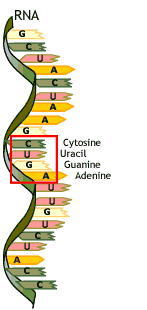
In RNA, Uracil pairs with ______. 
a)
cytosine
b)
adenine
c)
guanine
d)
thymine
170.
The mRNA leaves the ________ to find the ribosome to make proteins.
a)
cell
b)
nucleotide
c)
nucleus
171.
The main function of tRNA is to...
a)
carry a message that, when translated, forms proteins
b)
form a portion of ribosomes
c)
string together complementary RNA and DNA strands
d)
bring amino acids from the cytoplasm to the ribosomes
172.
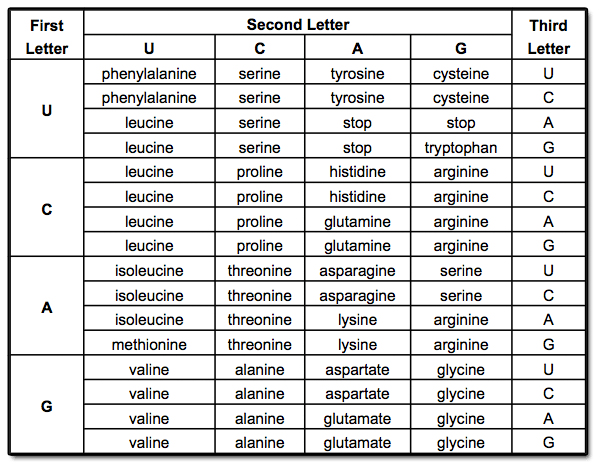
What amino acid is represented by the codon UUA?
a)
Phenylalanine
b)
Tyrosine
c)
Leucine
d)
Stop codon
173.
DNA travels outside of the nucleus.
a)
true
b)
false
174.

Which organelle is the location where protein is made?

a)

Ribosome

b)

Nucleus

c)

Cytoplasm

d)

Nucleotide

175.

During transcription, this type of ribonucleic acid is responsible for copying the DNA and brining it out of the nucleus.

a)

tRNA

b)

mRNA

c)

rRNA

d)

dRNA

176.
This egg has shrunk, what type of solution was it placed in?
a)
hypotonic solution
b)
hypertonic solution
c)
isotonic solution
d)
active transport
177.
You put a cell into a solution, the cell grows. Is the solution hypotonic or hypertonic to the cell? 
a)
hypertonic
b)
hypotonic
c)
isotonic
d)
not enough information
178.
An ISOTONIC solution has a(n) ______________ concentration of solute (dissolved stuff) than inside the cell.
a)
lower
b)
equal
c)
higher
179.
What type of solution is this cell in?
a)
Isotonic
b)
Hypertonic
c)
Hypotonic
d)
diffused
180.
 If a cell containing 5% salt is placed into a glass of water with 20% salt, the water is _______ compared to the cell.
a)
hypertonic-
b)
hypotonic
c)
isotonic
181.
Ideally, your cells should be in a(n) _______ solution
a)
Hypertonic
b)
Hypotonic
c)
Isotonic
d)
Cola
182.
If you looked at red blood cells under a microscope and saw the blood cells exploded, what would you say happened?
a)
The cells were placed in a hypotonic solution.
b)
the solution was isotonic.
c)
The solution was hypertonic.
183.
Name this tissue
a)
Bone
b)
Cartilage
c)
Blood
d)
Adipose
184.
What tissue is this
a)
Bone
b)
Cartilage
c)
Blood
d)
Adipose
185.
What tissue is this
a)
Transitional epithelium
b)
Cartilage
c)
Dense Fibrous
d)
Areolar
186.
This type of cartilage is highly resistant to wear and found at the ends of bones?
a)
Hyaline
b)
Fibrocartilage
c)
Elastic 
d)
Adipose
187.

The entire muscle is encased by connective tissue called the

a)

sacromere

b)

sarcoplasm

c)

myosin

d)

epimysium

188.

The _______________ covers bundles of cells (fascicles) within the muscle.

a)

endomysium

b)

perimysium

c)

sarcoplasm

d)

tendon

189.

Structure B is known as the thin filaments of the sarcomere, what is another name for the thin filaments?

a)

myosin

b)

actin

c)

fascia

d)

myofibril

190.

A muscle primarily responsible fro the action (movement) is called the

a)

prime mover

b)

antagonist

c)

synergist

d)

fixator

191.

Organize the parts below from most basic to most complex according to the levels of organization in a multicellular organism.

a)

neurons > nerve tissue > brain > central nervous system > human being

b)

human being > central nervous system > brain > nerve tissue > neurons

c)

nerve tissue > central nervous system > neurons > brain > human being

d)

neurons > brain > nerve tissue > central nervous system > human being

192.
Which type of epithelial tissue stretches and is found in the bladder and other urinary organs?
a)
Transitional
b)
Simple Cuboidal
c)
Stratified Squamous
d)
Stratified Columnar
193.
The whole cell dies with its secretions in this type of exocrine gland.
a)
Holocrine
b)
Merocrine
c)
Apocrine
d)
Pituitary 
194.
The apical surface pinches off with its secretions in this type of exocrine gland. 
a)
Merocrine
b)
Thymus 
c)
Apocrine
d)
Holocrine 
195.
Sweat is produced by the...
a)
sebaceous gland
b)
hypothalamus gland
c)
apocrine gland
d)
thyroid gland
196.

Name the type of secretion

a)

merocrine

b)

apocrine

c)

holocrine

d)

berocrine

197.
What is the normal resting potential of a neuron cell membrane?
a)
+40mV
b)
-30mV
c)
+55mV
d)
-70mV
198.
Which ions are involved in an action potential?
a)
Na; Cl
b)
Na; K
c)
K; Cl
d)
Na; Ca
199.
At which point on the diagram does depolarisation of the axon occur? 
a)
A
b)
B
c)
C
d)
D
200.
In resting potential, neurons have more _________ on the outside of the cell membrane.
a)
K+
b)
NaCl
c)
Na+
d)
Cl-
201.

What number(s) on the graph represents the THRESHOLD level of stimulus?

a)

1 and 5

b)

2

c)

3

d)

6

202.
What number on the graph represents the Hyperpolarization phase?
a)
1
b)
2
c)
3
d)
4
203.

When is the potassium channel open?

a)

during rest only

b)

during repolarization only

c)

during depolarization only

d)

all the time

204.

Action potentials run along the ______ from ______ to ________.

a)

axon, dendrites, axon terminals

b)

axon, axon terminals, dendrites

c)

dendrites, axon, axon terminals

d)

axon terminals, axon, dendrites

205.
If cartilage remains in this "specific" area, then growth is still occurring; it is located at the end of long bone
a)
Epipyseal plate
b)
 Medulary Cavity 
c)
Diaphysis 
d)
Endosteum