wayground logo

Free Printable Worksheets

Font size

S
M
L
XL
Worksheets

Biology Sem 2 Final Study

Total questions: 200

Worksheet time: 2hrs 13mins

Name
Class
Date
1.
Which sequence of DNA bases would pair with this partial strand
ATG TGA CAG
a)
ATG TGA CAG
b)
TAC ACT GTC
c)
GTA AGT GAC
d)
CAT TCA CTG
2.
Which of the following best describes a DNA molecule?
a)
double helix
b)
contains ribose
c)
made of amino acids
d)
contains Uracil
3.
Which of the following units are repeatedly joined together to form a strand of DNA?
a)
amino acids
b)
nucleotides
c)
fatty acids
d)
polysaccharides
4.
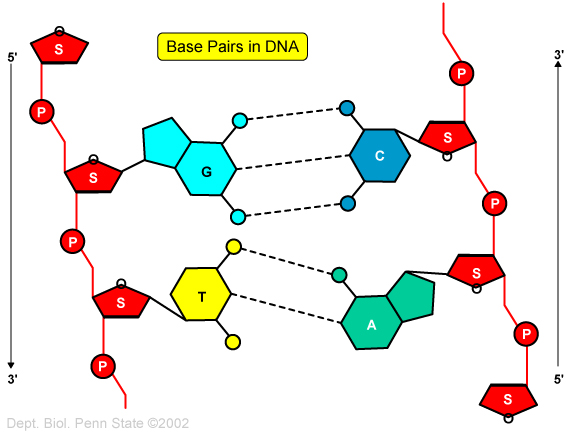
In a molecule of double-stranded DNA, the amount of Adenine present is always equal to the amount of
a)
cytosine
b)
guanine
c)
thymine
d)
uracil
5.
Adenine bonds with ______________.
a)
Guanine
b)
Thymine
c)
Cytosine
d)
Adenine
6.
Guanine bonds with ______________.
a)
Adenine
b)
Guanine
c)
Cytosine
d)
Thymine
7.
Why is DNA important?
a)
it is very small and very complicated
b)
it's in everything
c)
it serves as the blueprint for traits of all living things
d)
because we eat it every day for energy
8.
What determines the code, or information, of a DNA molecule?
a)
the shape (structure) of the nitrogen bases
b)
the order (sequence) of the nitrogen bases
c)
the color of the nitrogen bases
d)
the frequency (number) of nitrogen bases
9.
Which 2 molecules form the sides (backbone) of the DNA ladder?
a)
deoxyribose sugar and adenine
b)
deoxyribose sugar and a hydrogen bond
c)
deoxyribose sugar and the nucleus
d)
deoxyribose sugar and phosphate
10.
Which organelle is DNA usually found in?
a)
cell membrane
b)
vacuole
c)
chloroplast
d)
nucleus
11.
Nitrogenous bases are joined by which type of bond?
a)
polar bonds
b)
ionic bonds
c)
covalent bonds
d)
hydrogen bonds
12.
Replicate the following strand of DNA: 
AATCATGGA
a)
AATCATGGA
b)
TTAGTACCT
c)
UUAGUACCU
d)
GGATAUCUA
13.
The enzyme that unzips the DNA to prepare for replication
a)
helicase
b)
replicase
c)
polymerase
d)
synthase
14.
DNA replication results in two DNA molecules,
a)
each one with two original strands
b)
each one with two new strands
c)
each one with one new strand and one original strand
d)
one with two new strands and the other with two original strands
15.
order of replication
a)
3, 2, 1, 4
b)
2, 1, 4, 3
c)
2, 3, 1, 4
d)
3, 4, 1, 2
16.
A process in which DNA has the unique ability to make an exact copy of itself.
a)
Replication
b)
Translation
c)
Transcription
17.
What is the correct complimentary strand for the following DNA?ATCGAG
a)
TACGAG
b)
ATCGAG
c)
TAGCTG
d)
TAGCTC
18.
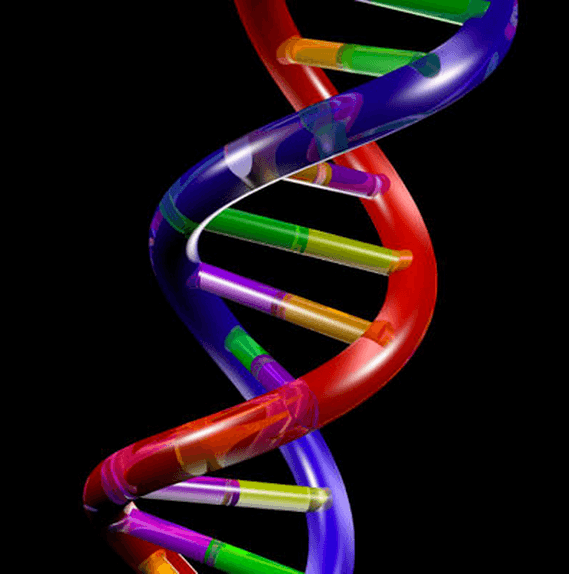
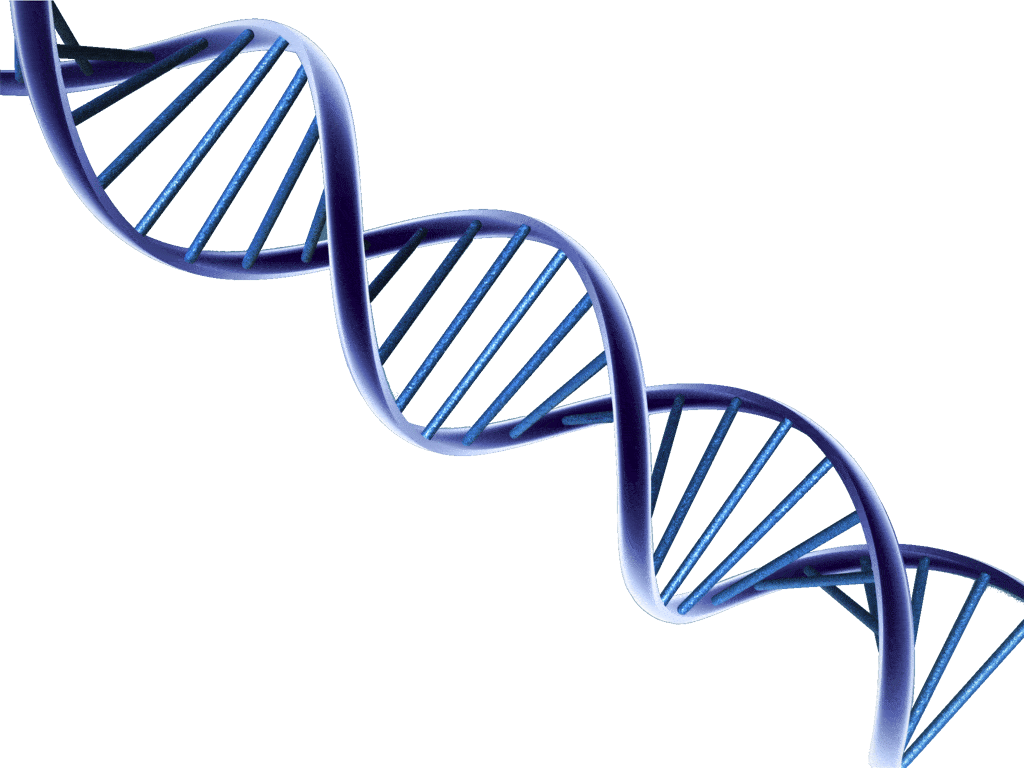
The drawing shows the structure of what molecule?
a)
A DNA molecule
b)
A lipid molecule
c)
A carbohydrate molecule
d)
A protein molecule
19.
In what phase of the cell cycle does DNA replication take place?
a)
G1
b)
S
c)
G2
d)
M
20.

What is the role of mRNA in protein synthesis?

a)

it makes the bases that makes up DNA

b)

it copies a section of DNA and uses the information to create the appropriate protein

c)

it helps DNA perform replication

d)

it makes the amino acids used in protein synthesis

21.

Where is mRNA made?

a)

in the nucleus

b)

in the ribosome

c)

in the mitochondria

d)

in the vacuole

22.

How is mRNA made?

a)

it forms when chromosomes are cut into sections or genes

b)

it forms when the DNA molecule is separated into its single DNA strands

c)

it "reads" the code (base sequences) in the DNA and forms a string of nucleotides with bases complementary to those in the DNA molecule

d)

it randomly gathers nitrogen bases in the nucleus and joins them via peptide bonds

23.

Does DNA have to replicated before mRNA can be made?

a)

No, DNA replication and mRNA synthesis are totally independent processes

b)

No, DNA is already replicated before mRNA is made

c)

Yes, DNA needs to be replicated before the mRNA molecule can be formed

d)

Yes, these two processes are dependent upon each other

24.

Structure "a" in the diagram is...

a)

tRNA

b)

mRNA

c)

an anticodon

d)

an amino acid

25.

Structure "b" in the diagram is...

a)

an anticodon

b)

the large subunit of the ribosome

c)

the small subunit of the ribosome

d)

tRNA

26.

Transfer RNA is indicated by which structure in the diagram?

a)

a

b)

d

c)

e

d)

f

27.

If structure "d" is an amino acid, what is the purple string of shapes to the left of it?

a)

a sugar

b)

a protein

c)

a nitrogen base

d)

phosphate group

28.

The bottom of the tRNA molecule joins with the mRNA molecule because it has the _____________ to the mRNA's codon.

a)

ribosomes

b)

anticodon

c)

nitrogen bases

d)

sugars

29.

The job of structure "e" is to

a)

copy the genetic code from DNA

b)

bring amino acids to the ribosome so they can be made into a protein

c)

bring the code from DNA in the nucleus to the ribosome in the cytoplasm

d)

synthesize amino acids

30.

Ribosomal RNA is a form of RNA that

a)

makes up a ribosome and catalyzes protein synthesis

b)

carries amino acids to the ribosome

c)

transfers the genetic code to the nucleus

d)

copies the genetic code from DNA

31.

Which nitrogen base is not a part of RNA molecules?

a)

thymine

b)

uracil

c)

adenine

d)

cytosine

e)

guanine

32.

In order for protein synthesis to occur, mRNA must leave the nucleus and travel to

a)

a ribosome in the cytoplasm

b)

a mitochondria in the cytoplasm

c)

a vacuole in the cytoplasm

d)

a chloroplast in the cytoplasm

33.
Which project is most likely to interest a scientist working at a biotechnology company?
a)
Study and reconstruction of fossilized bones.
b)
Conservation of key species within ecosystems.
c)
Development of genetically modified corn plants
d)
Prevention of sewage leaking into water supplies
34.
Strawberries have been genetically modified to resist frost. How does this benefit farmers?
a)
A longer growing season.
b)
A pest-resistant berry.
c)
A larger berry.
d)
Easier harvesting.
35.
Which of these is a concern about the use of biotechnology?
a)
increased crop yield
b)
development of new vaccines
c)
increased job opportunities 
d)
creation of new pathogens.
36.
Which is a product of biotechnology?
a)
video surveillance camera
b)
soil-eating bacteria
c)
electronic communications devices
d)
Global Positioning System (GPS)
37.
How can biotechnology help farmers overcome sudden changes in the environment?
a)
by developing crops which are resistant to winter weather
b)
by changing the types of soil where the crops are planted
c)
by rotating the crop within the same field by using simple machines 
d)
to grow crops in the laboratory
38.
How are scientists able to produce a type of corn that will repel insects?
a)
by not spraying the corn plants
b)
by soaking corn seeds in insect spray
c)
by changing the genetics of the corn plants
d)
by altering the temperature of soil so the insects will die
39.
Which of these careers would a student studying biotechnology most likely pursue?
a)
electrical engineering
b)
astronomy
c)
agricultural research 
d)
geology
40.
Which is a way the agricultural industry could have a positive impact on the environment?
a)
by increasing the use of wind farms to produce electricity
b)
by making robots to produce large farm machines
c)
by reducing the need for countries to import food
41.
The process of changing the genetic material of a living organism 
a)
Genetic Modification
b)
Taxonomy
c)
Adapting
d)
Bioremediation
42.
Which area of biotechnology would create ethical issues within human society?
a)
insulin produced by bacteria
b)
organ cloning for use in transplants
c)
genetic engineering to improve agricultural yields
d)
DNA and forensic testing of crime scene evidence
43.
Which career field is most related to biotechnology?
a)
journalism
b)
medicine
c)
meterology
d)
political science
44.
Which is a benefit of genetically-modified foods?
a)
The cost of research is included in the cost to the consumer
b)
The cost of food decreases and the quality of food increases
c)
genetically modified foods won't need to be studied
d)
"gmo's" are completely resistant to disease and drought
45.
Which term is not related to the word "agriculture"?
a)
farming
b)
crops
c)
cultivation
d)
physics
46.
Which of these is not a way in which biotechnology can benefit agriculture?
a)
increasing crop yield
b)
reducing the loss of crops to insects
c)
producing better-tasting fruits
d)
improving farm machinery
47.
Which process uses a body cell to crete a new organism?
a)
crossbreeding
b)
cloning
c)
genetic modification
d)
gene splicing
48.
A DNA fingerprint is
a)
 unique sequence of repeating units in a section of DNA
b)
a gene inserted into a bcteril chromosome
c)
the complete sequence of an organism's DNA
d)
a copy of a chromosome
49.
The blood stain most likely belongs to 
a)
Bob
b)
Sue
c)
John
d)
Lisa
50.
Which of the following is a term for a group of similar organisms that can reproduce fertile offspring?
a)
individual
b)
population
c)
species
d)
fossil
51.
If an organism has a vestigial structure, that structure likely once had a function in a(n)
a)
close relative
b)
early ancestor
c)
unrelated organism
d)
embryological stage
52.
Mutations are important because they bring about
a)
death of the organism in which they develop
b)
genetic variation needed for a population to evolve
c)
benefits for the individual, not for the population
d)
Hardey-Weinberg equilibrium within a population
53.
Finches on the Galapagos Islands had different beaks in order to help them do what?
a)
Build nests
b)
Fight off predators
c)
Collect food sources
d)
Compete with rivals
54.
This scientist came up with the idea of natural selection.
a)
Jean Baptiste Lamarck
b)
Gregor Mendel
c)
Charles Darwin
d)
Thomas Malthus
55.
A remnant or trace of an organism from the past is called a _______.
a)
Ancestor
b)
Skeleton
c)
Fossil
d)
Imprints
56.
Inherited trait that helps an organism survive is a(n) __________.
a)
Fossil
b)
Adaptation
c)
Ancestor
d)
Natural selection
57.
Survival of the fittest or when favorable adaptations reproduce faster is called what?
a)
Evolution
b)
Adaptation
c)
Natural selection
d)
Fossilization
58.
This occurs when no more of a species is living.
a)
Fossilization
b)
Adaptation
c)
Extinction
d)
Natural selection
59.
Magda is a tall, 11 year old drummer. She has a scar on her right cheek. She is good at swimming. Which of her traits did Magda most likely inherit?
a)
height
b)
the scar
c)
ability to swim
d)
ability to play drums
60.
According to the diagram, which organism is older?
a)
ammonite
b)
coral
c)
gastropod
d)
trilobite
61.
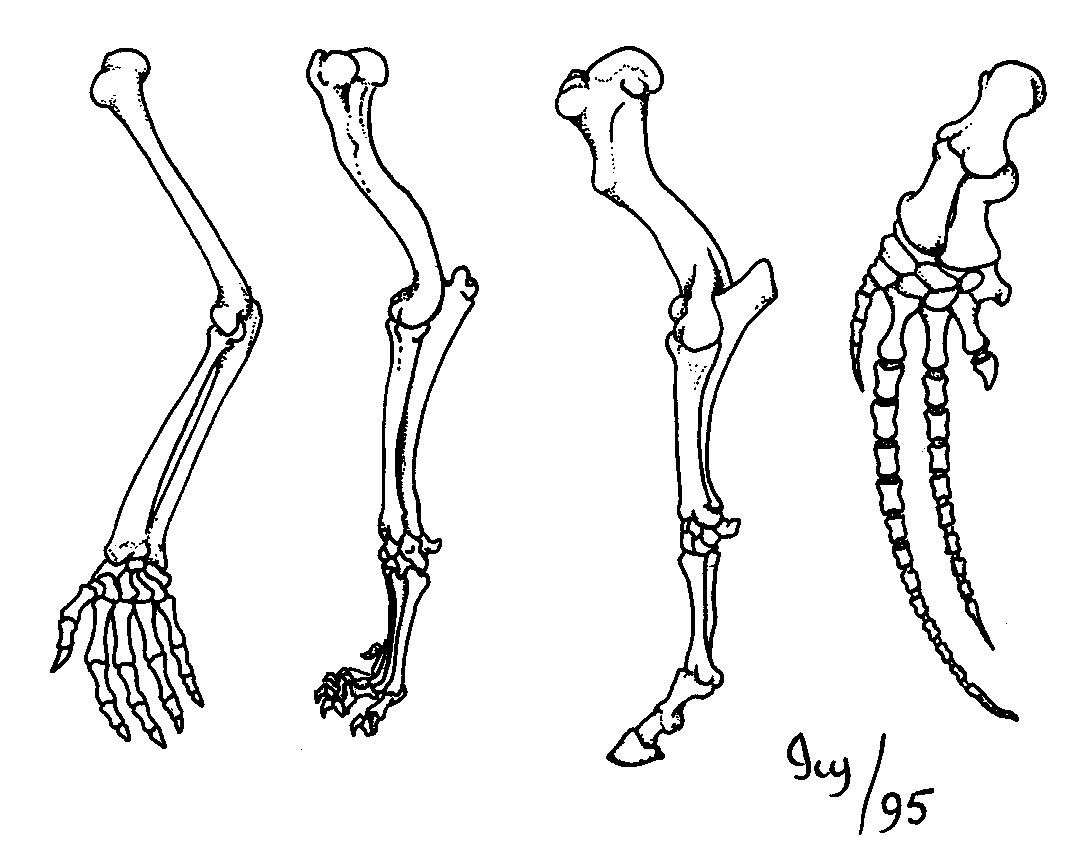
Structures with the same parts have different functions; suggests that organisms share a common ancestry
a)
vestigial structures
b)
homologous structures
c)
adaptive radiation
d)
fossil
62.
If species A and B have very similar genes and proteins, what is probably TRUE?
a)
species A and B share a relatively recent common ancestor
b)
species A evolved independently of species B for a long period
c)
species A is younger than species B
d)
species A is older than species B
63.
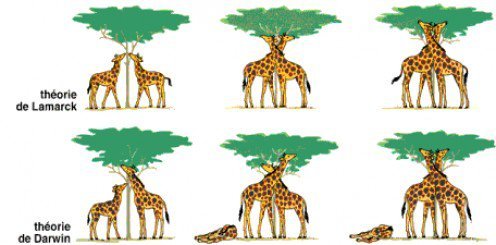
What would happen if the Giraffes never evolve?
a)
they would survive
b)
They would thrive
c)
They would become extinct
d)
They will find another source of food
64.
The ability of an organism to survive and reproduce in its specific environment 
a)
diversity.
b)
evolution
c)
adaptation
d)
 fitness
65.
Why are advantageous traits more likely to be passed onto offspring?
a)
Because they are more likely to survive and reproduce.
b)
Because they come from dominant alleles.
c)
Because they come from recessive alleles.
d)
Because the trait is an acquired phenotype.
66.
Farmers breed cows to produce high amounts of milk. This is an example of...
a)
Natural Selection 
b)
Variations in a species 
c)
Selective Breeding 
d)
inbreeding
67.
Which species’ DNA is most similar to the DNA of the toothed whale? 
a)
Hippopotamus 
b)
Baleen Whale
c)
Grazing Mammals
d)
Camels
68.
The similarities of organisms in which two areas numbered in the picture provide the best evidence for common ancestry?
a)
1 and 2
b)
3 and 4
c)
5 and 6
d)
7 and 8
69.

Some organisms that share a common ancestor have features that have different functions, but similar structures. These are known as

a)

vestigial structures

b)

analogous structures

c)

homologous structures

d)

embryology

70.

What is this an example of?

a)

Homologous structure

b)

Analogous structure

c)

Vestigial organs

d)

Functional adaption

71.
Which word is defined as a reduced form of a functional structure in 1 organism that shows up as fully functional in another?
a)
homologous structures
b)
vestigial structures
c)
analogous structure
d)
DNA
72.
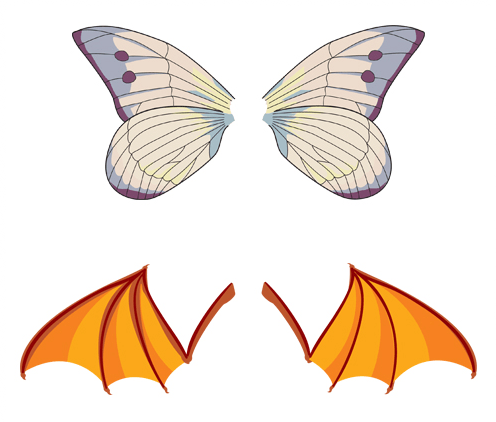
Structures that are very different in structure or anatomy but have similar functions such as the wings of a bird and a butterfly.
a)
Vestigial Structures
b)
Homologous Structures
c)
Analogous Structures
d)
Cladogram
73.

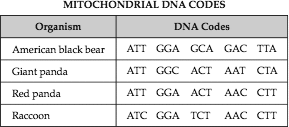
What conclusions can be made based on this table shown?

a)

the American black bear and the giant panda are most closely related

b)

the giant panda and the red panda are most closely related

c)

the red panda and the racoon are the most closely related

d)

the giant panda and the racoon are most closely related

74.
The picture shows the members of the Camelidae family. The physical features and the geographical origin of these animals provide evidence that - 
a)
they live in the same type of environment.
b)
have slowly evolved to become herbivores.
c)
have a common ancestor.
d)
exchanged DNA in the past.
75.
States that organisms appeared due to random chance beginning with a Big Bang that started the universe.
a)
Micro-evolution
b)
Macro-evolution
c)
Intelligent design
d)
Creationism
76.
States that organisms change over time to be better suited to their environment.
a)
Micro-evolution
b)
Macro-evolution
c)
Intelligent design
d)
Creationism
77.
Inherited characteristics that increase the fitness of an organism
a)
Fitness
b)
Adaptation
c)
Natural selection
d)
Artificial selection
78.
Survival of the fittest
a)
Fitness
b)
Adaptation
c)
Natural selection
d)
Artificial selection
79.
Nature provides the genetic variations and Man selects the variations he finds useful.
a)
Fitness
b)
Adaptation
c)
Natural selection
d)
Artificial selection
80.
A force that changes the gene pool and leads to evolutionary change.
a)
Gene pool
b)
Speciation
c)
Genetic drift
d)
Gene flow
81.
All genes present in a population.
a)
Gene pool
b)
Speciation
c)
Genetic drift
d)
Gene flow
82.
Addition of new genes to a population.
a)
Gene pool
b)
Speciation
c)
Genetic drift
d)
Gene flow
83.

What animals did Charles Darwin Study?

a)

Cats.

b)

Cows.

c)

Dogs.

d)

Finches.

84.

What is variation?

a)

Things that vary.

b)

Different in traits.

c)

Animals that are the same.

d)

Species that change.

85.

why is variation important?

a)

It helps the animals vary

b)

It makes animals the same so they all can survive

c)

It helps so they can't get sick

d)

It is an advantages for animals that can help in natural selection

86.
How does embryology support the Theory of Evolution?
a)
It shows that they have a common ancestor because of their similarities.
b)
         I'm not sure.
c)
Animals change over time. 
87.
The most recent ancestral form or species from which two different species evolved is known as ________________________.
a)
a common ancestor.
b)
an embryonic stage.
c)
development.
d)
evolution.
88.
In stage one (top row) of these embryos, most of the embryos________
a)
look very similar.
b)
have very different features.
c)
show different stages of development.
d)
have only a tail if they are non-human.
89.

The scientist who created this picture

a)

Purposefully distorted the truth to promote his ideas.

b)

Showed truthful evidence for the evolution of man.

c)

Removed his biased opinions as all scientists do.

d)

Was trying to illustrate what really happens in embryonic growth.

90.

Which scientist visited the Galapagos Islands and came up with the theory of natural selection?

a)

Theodor Schwann

b)

Gregor Mendel

c)

Charles Darwin

d)

Rudolf Virchow

91.

What type of evidence is shown in the image above?

a)

Fossils

b)

Vestigial structures

c)

Homologous Structures

d)

DNA

92.

What type of evidence are shown in the picture above?

a)

Fossils

b)

Embryology

c)

Homologous Structures

d)

Vestigial Structures

93.
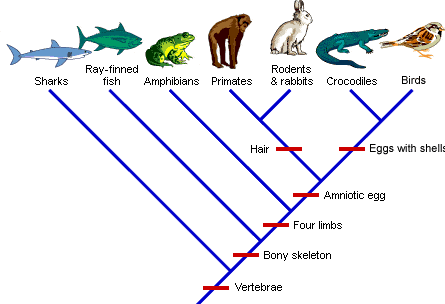
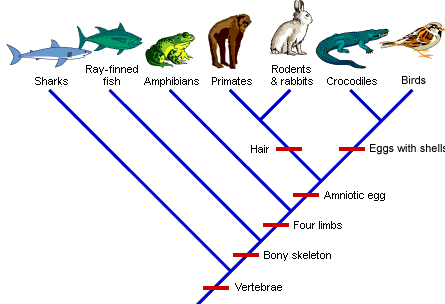
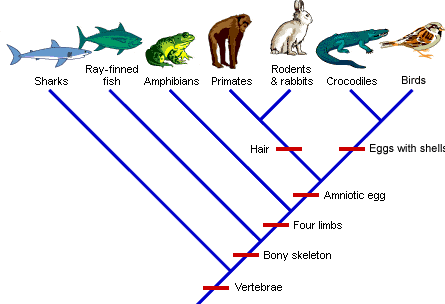
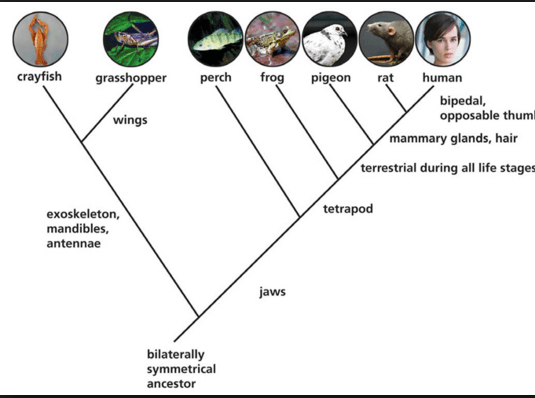
According to this cladogram, sharks are MOST closely related to which organism? 
a)
Amphibians
b)
Ray finned fish
c)
Crocodiles
d)
Birds
94.
Which two orgainsms have hair? 
a)
Sharks & Ray Finned Fish
b)
Primates & Rodents
c)
Birds & Crocodiles
d)
Rabbits & Birds
95.
According to this cladogram, birds are LEAST related to: 
a)
Amphibians
b)
Sharks
c)
Ray Finned Fish
d)
Crocodiles
96.
According to the cladogram, which organism is most distantly related to the human?
a)
crayfish
b)
grasshopper
c)
perch
d)
frog
97.

A species is defined as:

a)

a group of organisms that are extremely different.

b)

a group of organisms that have similar characteristics and always live in the same place.

c)

a group of organisms with similar characteristics and can reproduce to make fertile offspring.

d)

any two organisms to make a hybrid.

98.

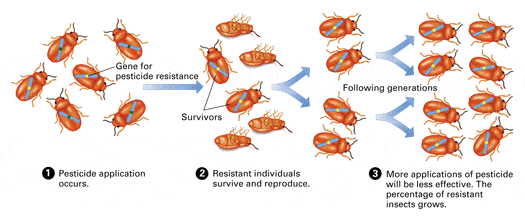
What statement is true regarding why natural selection can be easily seen in insects and bacteria?

a)

Natural selection only occurs in prokaryotic cells

b)

Insects and bacteria can reproduce faster than more complex organisms and pass on selected traits quicker

c)

Insects were the first multi-cellular organism to live on land

d)

Bacteria have directly evolved from insect traits.

99.

What is the cell cycle?

a)

A regular sequence of growth and division that eukaryotic cells undergo.

b)

The time a cell spends actively dividing.

c)

The process of duplication of genetic material (DNA).

d)

Repeating process of DNA synthesis.

100.

A human body cell has 46 chromosomes. After mitosis, how many chromosomes will the new cells have?

a)

46

b)

23

c)

92

d)

12

101.

The final stage of the cell cycle in which the membrane-enclosed cytoplasm of the cell divides to form two daughter cells is called:

a)

prophase

b)

metaphase

c)

G1

d)

cytokinesis

102.

Which phase of cell division does this picture show?

a)

prophase

b)

metaphase

c)

anaphase

d)

telophase

103.

Which phase of cell division does this picture show?

a)

prophase

b)

metaphase

c)

anaphase

d)

telophase

104.

Which type of cell division results in 4 genetically unique haploid (1/2 the number of chromosomes) cells?

a)

mitosis

b)

G1

c)

meiosis

d)

S

105.

A form of reproduction in which their is one parent with identical offspring is called:

a)

sexual reproduction

b)

asexual reproduction

c)

mitosis

d)

meiosis

106.

Offspring that are produced through sexual reproduction are usually similar, but never identical, to their parents. This is because:

a)

genes mutate during every occurrence of sexual reproduction

b)

all of the offspring's genes only come from one parent or the other

c)

genes are not transferred between parents and offspring during sexual reproduction

d)

half of the offspring's genes come from one parent while the other half comes from the other parent

107.

Which of the following is an advantage of asexual reproduction?

a)

increases genetic variation

b)

often produces less offspring

c)

less time since no mate is required

d)

often takes longer for offspring to develop

108.

In which stage of the cell cycle does DNA make a copy of itself?

a)

G1

b)

S

c)

G2

d)

mitosis/meiosis

109.

Which phase of cell division does this picture show?

a)

prophase

b)

metaphase

c)

anaphase

d)

telophase

110.

Which phase of cell division does this picture show?

a)

prophase

b)

metaphase

c)

anaphase

d)

telophase

111.

Crossing over occurs in:

a)

asexual reproduction

b)

mitosis

c)

meiosis

d)

interphase

112.

A human has 46 chromosomes. How many chromosomes will their gametes have?

a)

23

b)

46

c)

92

d)

2

113.

All of the following are forms of asexual reproduction except:

a)

budding

b)

binary fission

c)

fragmentation

d)

pollination

114.

Letter A can be described as:

a)

centriole

b)

centromere

c)

sister chromatids

d)

centrosome

115.

A cell spends most of its life growing and carrying out normal cell activities during which phase:

a)

interphase

b)

mitosis

c)

meiosis

d)

asexual reproduction

116.

The part of the cell cycle when the cell goes through a final checklist before dividing:

a)

G1

b)

S

c)

G2

d)

mitosis/meiosis

117.

Which of the following cells would form a cell plate during the cell cycle?

a)

a skin cell

b)

a plant cell

c)

a muscle cell

d)

all of the above

118.

Which process is used for cell growth and repair?

a)

interphase

b)

mitosis

c)

meiosis

d)

glycolysis

119.

Which process produces gametes?

a)

the cell cycle

b)

mitosis

c)

meiosis

d)

photosynthesis

120.
Binary fission is a kind of sexual reproduction 
a)
True
b)
False 
121.
Asexual reproduction takes place in the body cells 
a)
True
b)
False 
122.

This type of reproduction makes cells with the haploid number of chromosomes

a)

Asexual

b)

Sexual

c)

Both

d)

Neither

123.
Budding is a kind of ____________ reproduction 
a)
Sexual
b)
asexual
124.

1 parent

a)

Asexual

b)

Sexual

c)

Both

d)

Neither

125.

2 parents

a)

Asexual

b)

Sexual

c)

Both

d)

Neither

126.

Starfish can asexually reproduce by producing offspring from a broken piece of the parent organism. This is an example of...

a)

budding

b)

sporulation

c)

fragmentation

d)

binary fission

127.

DNA wraps tightly around a protein called a ______.

a)

histone.

b)

haploid

c)

karyotype

d)

prototype

128.

A haploid sex cell is also known as a ________.

a)

gamete

b)

autosome

c)

chromatid

d)

centromere

129.

Males have

a)

2 X Chromosomes

b)

1 X Chromsome

c)

1 X and 1 Y Chromosome

d)

2 Y Chromosomes

130.

When DNA is loosely coiled it is called ____________.

a)

chromatin

b)

karyotype

c)

chromosome

d)

centromere

131.

Structure A refers to the _____.

a)

chromatid

b)

chromosome

c)

centromere

d)

centriole

132.
When cells divide they make two ____ cells.
a)
daughter
b)
son
c)
Mom
d)
Dad
133.
Put the following stages of the cell cycle in order: G2, S, G1, M. 
a)
G1, S, G2, M
b)
S, G1, G2, M
c)
G1, M, G2, S
d)
M, G1, S, G2
134.
What is it called when a sperm and egg meet?
a)
meiosis
b)
fertilization
c)
cell division
d)
mitosis
135.
What causes genetic variation in meiosis?
a)
chromosomes lining up
b)
crossing over of chromosomes
c)
separation of chromosomes
d)
chromosomes pulling apart
136.
Unlike mitosis, meiosis in male mammals results in the formation of
a)
one haploid gamete
b)
three diploid gametes
c)
four diploid gametes
d)
four haploid gametes
137.
If the Diploid number of Carrots is 18, the haploid number is
a)
18
b)
9
c)
27
d)
36
138.
Goes through P.M.A.T two rounds 
a)
Mitosis
b)
Meiosis
c)
Osmosis
d)
Transcription
139.
The process of crossing over occurs in what phase of meiosis?
a)
anaphase 1
b)
prophase 1
c)
prophase 2
d)
telophase 1
140.
The chromosomes that pair up during meiosis, are called __________ chromosomes.  
a)
homozygous 
b)
asexual
c)
homologous
d)
genes
141.
What is another reason we need meiosis?
a)
So the offspring has genes from both parents
b)
So the offspring has genes from one parent
c)
So the offspring has genes from neither parents
d)
So the offspring makes its own genes
142.

Letter D is pointing at which of the following?

a)

Homologous Chromosomes

b)

Chromosome

c)

Sister Chromatid

d)

Centromere

143.

What do we call duplicate halves of ONE chromosome? Letter C in this image.

a)

Homologous Chromosomes

b)

Sister Chromatid

c)

Centromeres

d)

Genes

144.
What percentage of chromosomes are handed down by a sperm cell?
a)
75%
b)
25%
c)
50%
d)
100%
145.

Identify the best order for sexual reproduction.

a)

zygote-->meiosis-->fertilization-->gametes

b)

fertilization-->gametes-->meiosis-->zygote

c)

meiosis-->gametes-->fertilization-->zygote

d)

mitosis-->gametes-->meiosis-->fertilization

146.

The male sex cell.

a)

Egg

b)

Sperm

c)

Zygote

d)

Embryo

147.

The female sex cell.

a)

Sperm

b)

Egg

c)

Zygote

d)

Fetus

148.

An egg that has been fertilized by a sperm cell

a)

Zygote

b)

Emrbyo

c)

Fetus

d)

Baby

149.

A small grouping of cells formed after 36 hours after fertilization.

a)

Sperm

b)

Egg

c)

Zygote

d)

Embryo

150.

A fetus is

a)

fertilized cell with 100 cells

b)

a developed human organism from 2 weeks after fertilization through the second month

c)

called a fetus after birth

d)

becomes fetus after 9 weeks, until birth

151.

Which of the following sequences represents the correct order of events in the formation of a human fetus?

a)

Zygote → Blastocyst → Embryo → Fertilization

b)

Fertilization → Zygote → Blastocyst → Embryo

c)

Blastocyst → Embryo → Differentiation → Zygote

d)

Fertilization → Growth → Differentiation → Zygote

152.
An individual belonging to a specific species
a)
Biotic
b)
Community
c)
Organism
d)
Reptile
153.
All of the living and nonliving things in an area that interact with each other are called a/an ______.
a)
community
b)
habitat
c)
population
d)
ecosystem
154.
The living part of an ecosystem
a)
Biotic
b)
Abiotic
c)
Mother Earth
d)
Flowers
155.
The non-living part of an ecosystem
a)
Ocean
b)
Lava Flow
c)
Birds
d)
Abiotic
156.
The study of how living things interact with one another and with their environment.
a)
Biology
b)
Lithology
c)
Ecology
d)
Farmacology
157.
Organisms that look similar and can produce fertile offspring
a)
Species
b)
Fish
c)
Community
d)
Trees
158.
Two or more members of a particular species living and interacting in the same area
a)
Community
b)
Population
c)
Organisms
d)
Biosphere
159.
Different populations living and interacting with each other in the same area
a)
Biome
b)
Ecosystem
c)
Community
d)
Niche
160.

Homozygous recessive genotype

a)

Aa

b)

aa

c)

AA

161.

Homozygous dominant genotype

a)

Aa

b)

aa

c)

AA

162.

In pea plants, yellow peas are dominant to green. What is the phenotype for a heterozygous pea plant?

a)

Yellow

b)

Green

163.

Hybrid genotype is also known as...

a)

Homozygous

b)

Heterozygous

164.

A recessive allele will always be "hidden" by a dominant allele.

a)

Mendel's Law of Dominance

b)

Mendel's Law of Independent Assortment

c)

Mendel's Law of Segregation

165.

Allele pairs separate from one another during gamete formation.

a)

Mendel's Law of Dominance

b)

Mendel's Law of Independent Assortment

c)

Mendel's Law of Segregation

166.

Any of the alternative forms of a gene that

occurs at a specific place on a chromosome.

a)

Loci

b)

Chromatid

c)

Gene

d)

Allele

167.

In peas, tall plants are dominant to short plants. What is the probability of having a short plant if you cross two heterozygous parents?

a)

100%

b)

75%

c)

50%

d)

25%

168.

Cross, or mating, between organisms involving

two pairs of contrasting traits.

a)

Monohybrid cross

b)

Fertilization

c)

Dihybrid cross

d)

Codominance

169.

Cross, or mating, between organisms involving

one pair of contrasting traits.

a)

Monohybrid cross

b)

Fertilization

c)

Dihybrid cross

d)

Codominance

170.

Chromosome that contains genes for characteristics

NOT directly related to the sex of the organism.

a)

Sex chromosome

b)

Loci

c)

Gene

d)

Autosome

171.

Chromosome that directly controls the development of sexual characteristics.

a)

Autosomes

b)

Genes

c)

Sex chromosomes

d)

Loci

172.

Why are men more likely to inherit sex-linked traits?

a)

Woman have only one of each sex chromosome.

b)

Men have only one of each sex chromosome.

c)

Men have two copies of each sex chromosome.

d)

Woman have two copies of each sex chromosome.

173.

Eye color, hair color, and skin color are polygenic traits. Polygenic traits result from...

a)

recessive genes.

b)

many genes.

c)

codominant genes.

d)

epistatic genes.

174.

In snapdragons purebreeding dominant flowers are red, purebreeding recessive flowers are white, and hybrids are pink. What type of inheritance is this?

a)

Polygenic

b)

Sex-linked

c)

Codominance

d)

Incomplete dominance

175.

In cows and horses fur color is controlled by two dominant alleles, red and white. A hybrid animal will be roan (red and white spots). What type of inheritance is this?

a)

Polygenic

b)

Sex-linked

c)

Codominance

d)

Incomplete dominance

176.

Which type of inheritance is shown in this photo?

a)

Sex-linked

b)

Dominant

c)

Recessive

d)

Incomplete

177.

Which type of inheritance is shown in this photo?

a)

Sex-linked

b)

Dominant

c)

Recessive

d)

Incomplete

178.

Which type of inheritance is shown in this photo?

a)

Sex-linked

b)

Dominant

c)

Recessive

d)

Incomplete

179.

Hemophilia is a sex-linked recessive disorder. A normal man marries a carrier woman. What is the likelihood of having a son with hemophilia?

a)

100%

b)

75%

c)

50%

d)

25%

180.

For certain types of flowers, color is trait that demonstrates codominance. If a red flower (RR) is bred with a flower that shows red and white stripes (RW), what percentage of the offspring will have completely red flowers?

a)

50%

b)

25%

c)

100%

d)

0%

181.

A sex-linked trait (such as hemophilia or color-blindness) is carried on what type of chromosome?

a)

X

b)

Y

c)

Z

d)

Dominant

182.

A blue-eyed daughter (bb) is born to parents both have brown (B) eyes. What is the genotype of each parent for eye color?

a)

Bb X Bb

b)

BB X bb

c)

BB X BB

d)

bb X bb

183.

Why is meiosis called a "reduction" division?

a)

Because it reduces the number of cells in the body

b)

Because it reduces the number of chromosomes from diploid to haploid

c)

Because it reduces the chances of sexual reproduction

d)

Because it reduces the chances of survival

184.

What is the diploid number of total chromosomes in human cells?

a)

46

b)

23

c)

22

d)

92

185.

Which of these is NOT a major difference between mitosis and meiosis?

a)

Mitosis has one round of division, but meiosis has two rounds

b)

Mitosis produces diploid daughter cells, but meiosis produces haploid daughter cells

c)

Mitosis produces 4 daughter cells, but meiosis produces 6 daughter cells

d)

Mitosis can produce many types of cells, but meiosis only produces gametes

186.

Which of these is NOT considered to be a gamete?

a)

Egg Cells

b)

Sperm Cells

c)

Pollen from a Plant

d)

Skin Cells

187.

An allele that can be masked by a more dominant form of the same gene is called...

a)

Dominant

b)

Recessive

c)

Homozygous

d)

Hybrid

188.

A male with blood type A marries a female with blood type B, and their first child is blood type O. This demonstrates that blood type is a...

a)

Pleiotropic Trait

b)

Polygenic Trait

c)

Multiple Allele Trait

d)

Codominant Trait

189.

Which of these is one of Gregor Mendel's two famous laws of genetics?

a)

The Law of Inheritance

b)

The Law of Segregation

c)

The Law of Gravity

d)

The Law of Genetics

190.

Gregor Mendel was a...

a)

Buddhist Engineer

b)

Protestant Lawyer

c)

Jewish Philosopher

d)

Catholic Monk

191.

If a homozygous dominant (AA) individual is cross-bred with a homozygous recessive (aa) individual, what will be the genotype of the resulting offspring?

a)

Aa

b)

AA

c)

aa

d)

AAaa

192.
Why does meiosis produce haploid cells?
a)
So that when male and female gametes join, the resulting cell has the normal number of chromosomes for that species
b)
Some cells require half the genetic information because they do not have to carry out all cellular functions.
193.
Every living thing that reproduces sexually must go through Meiosis
a)
TRUE
b)
FALSE
194.
Egg cells and Sperm cells are also called:
a)
Gametes
b)
Somatic cells
c)
Zygotes
195.
A zygote is a fertilized egg.
a)
TRUE
b)
FALSE
196.
All males received the Y chromosome only from their mothers.
a)
TRUE
b)
FALSE
197.
Most genes are recipies for making specific 
a)
Proteins
b)
Gametes
c)
Zygotes
d)
Monohybrid cross
198.
A gene is located on the 
a)
DNA
b)
RNA
c)
Protein
d)
Trait
199.
This type of inheritance pattern shows BOTH traits in possible offspring
a)
complete dominance
b)
incomplete dominance
c)
co-dominance
d)
dominant pattern
200.
This type of inheritance pattern is a MIXTURE of both traits.
a)
incomplete dominance
b)
co-dominance
c)
complete dominance
d)
recessive pattern