wayground logo

Free Printable Worksheets

Font size

S
M
L
XL
Worksheets

2nd Semester Final Exam

Total questions: 195

Worksheet time: 3hrs 48mins

Name
Class
Date
1.
Which of the following best describes a DNA molecule?
a)
double helix
b)
contains ribose
c)
made of amino acids
d)
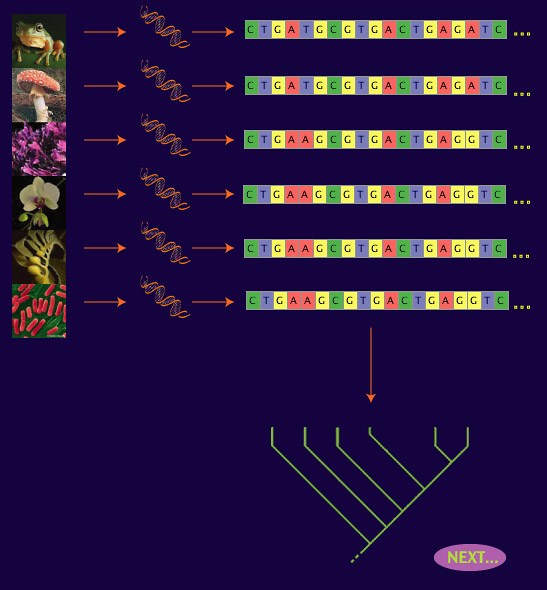
contains Uracil
2.
Which of the following units are repeatedly joined together to form a strand of DNA? (This is the MONOMER of DNA.) 
a)
amino acids
b)
nucleotides
c)
fatty acids
d)
polysaccharides
3.
Who was the naturalist that traveled the world to study plants and animals?
a)
Albert Einstein
b)
Charles Darwin
c)
Charles Barkley
d)
Isaac Newton
4.
The gradual change in species over time is...
a)
Evolution
b)
Nucleotide 
c)
Adaptation
d)
Natural Selection
5.
To adjust to a changing environment
a)
Mutation
b)
Adapt
6.
Darwin wrote that organisms with traits that are best suited to the environment will ________________
a)
increase in number
b)
become extinct
7.
What characteristic did Darwin observe about the finches on the Galapagos Islands?
a)
Their feathers 
b)
Genotypes 
c)
Their beaks
d)
Their body sizes
8.
Another word for adapt is ____________.
a)
change
b)
create
9.
Which term refers to the process by which individuals that are better suited to the environment survive and reproduce therefore passing down their genes to their offspring? 
a)
Evolution 
b)
Variation 
c)
Adaptation
d)
Natural Selection 
10.
When an organism completely dies out, it is called.....
a)
Adaption
b)
Extinction
c)
Fossilization
d)
Mutation
11.
Which term refers to the process by which individuals that are better suited to the environment survive and reproduce therefore passing down their genes to their offspring? 
a)
Evolution 
b)
Variation 
c)
Adaptation
d)
Natural Selection 
12.
The white feathers of a snowy owl allow it to blend in with its environment during the winter months (snow). This is an example of ________________
a)
Species
b)
Environmental Change
c)
Adaptation
d)
Variation
13.
Darwin referred to this as survival of the fittest. Over time, it results in changes in the inherited characteristics of a population because organisms with adaptations that make them fit for their environment will survive and reproduce better than those without favorable traits.
a)
Natural Selection
b)
Genetic Variation
c)
Survival of the Fittest
14.
Genetic differences between organisms of the same species
a)
Variation
b)
Adaptation
c)
Behavior
d)
Environment
15.
What is the advantage of having different shaped beaks?
a)
To look different from other species.
b)
To be able to eat the food readily available in the environment.
c)
To protect itself against predators.
d)
To protect itself against prey.
16.
The struggle for existence against other members of an organisms species is
a)
Competition
b)
Natural Selection
c)
gene flow
d)
genetic drift
17.
Remains of ancient organisms are called
a)
Extinctions
b)
Fossils
c)
Mutations
d)
Variations
18.
Which of the following is NOT a factor that affects the process of natural selection?
a)
Overpopulation
b)
Fossils
c)
Competition
d)
Variations
19.
A group of similar organisms that can mate with each other and produce fertile offspring is called a species.  
a)
True  
b)
False
20.
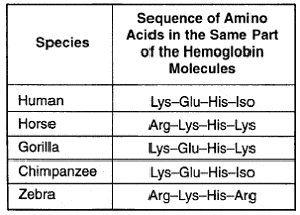
You look at two species and see very similar amino acid sequences. What does this likely tell you?
a)
These are the same animal.
b)
These animals have a common ancestor.
c)
These animals are not likely related.
d)
These animals are likely becoming one species.
21.
What is the study of organisms at the early stages of development?
a)
DNA studies
b)
embryology 
c)
extinction
d)
fossil record
22.
Which layer is the oldest?
a)
1
b)
2
c)
3
d)
4
23.
Two organisms that are closely related would have
a)
very similar DNA sequence
b)
exactly the same DNA sequences
c)
no proteins in common
d)
completely different DNA sequence
24.

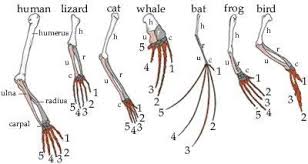
Which evidence for evolution is shown below?

a)

Comparative embryology

b)

Homologous structures

c)

Biochemical evidence

d)

Vestigial structures

25.

Which statement provides the best evidence that Ambulocetus natans is an ancestor of Basilosaurus isis?

a)

Homologous structures occur in each fossil

b)

Similar nitrogenous bases are found in the DNA of each fossil

c)

The fossils were found in different locations

d)

The youngest fossils is larger than the older fossils
26.
Which of the following is NOT an example of natural selection? 
a)
People selectively breeding hamsters.
b)
Insect populations developing resistance to certain pesticides.
c)
Bacteria becoming resistant to antibiotics.
d)
Male birds of certain species developing colorful feathers to attract female mates.
27.
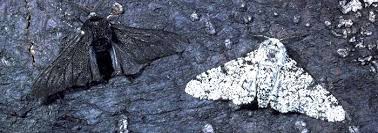
The environment around Manchester, England, changed during the Industrial Revolution.  How did this change affect peppered moths living in the area?
a)
Natural selection favored moths with dark wings because predators could not see them on the soot-colored trees.
b)
Natural selection favored moths with white wings that were easy for predators to see.
c)
Natural selection favored moths with white wings because predators could not see them on the soot-colored trees.
d)
Natural selection caused moths with white wings to become extinct.
28.
The separation of a group of individuals from the rest of the population is referred to as 
a)
genetic drift
b)
natural selection
c)
geographic isolation
d)
survival of the fittest
29.
What is an organism that has similar characteristics and can reproduce?
a)
species
b)
organism
c)
embryology
d)
vestigial 
30.
What is this an example of?
a)
vestigial structures
b)
embryology
c)
homologous structures
d)
fossil record
31.
Predict which moth would increase in population
a)
light 
b)
dark
32.
When the DNA of an organism is altered it is referred to as…
a)
Mutation
b)
Gene Flow
c)
Genetic Drift
d)
Sexual Selection
33.
When individuals choose traits possessed by the opposite sex it is called…
a)
Mutation
b)
Gene Flow
c)
Genetic Drift
d)
Sexual Selection
34.
The cause of artificial selection is…
a)
The environment
b)
Humans
c)
Mutation
d)
Gene Flow
35.
Why are advantageous traits more likely to be passed onto offspring?
a)
Because they are more likely to survive and reproduce.
b)
Because they come from dominant alleles.
c)
Because they come from recessive alleles.
d)
Because the trait is an acquired phenotype.
36.
Favors the middle of the population.
a)
Disruptive selection
b)
Stabilizing selection
c)
Directional selection
37.
What type of selection is depicted in the picture? 
a)
stabilizing 
b)
directional 
c)
disruptive 
d)
the answer is not here
38.
What type of selection?
a)
Directional 
b)
Stabilizing
c)
Disruptive
39.
Robins typically lay fours eggs. If more then four eggs are produced then the baby chicks are malnourished while smaller egg numbers result in no viable (able to live) baby chicks. This is an example of
a)
stabalizing
b)
disruptive
c)
direction
d)
none of the above
40.
Only populations can evolve.
Individuals can not evolve.
a)
True
b)
False
41.
If finches with large beaks and finches with small beaks increase in a population while finches with average sized beaks decreases, which pattern of natural selection has occurred?
a)
Directional selection
b)
Disruptive selection 
c)
Stabilizing selection
42.

A fire has wiped out the vegetation that produces medium sized seeds. As a result, the finches left can feed on seed that are available in two sizes: small and large. What type of selection is likely to take place in this population?

a)

directional selection

b)

disruptive selection

c)

stabilizing selection

d)

artificial selection

43.

In Canada, the people have overfished the salmon in a particular river. They catch the larger salmon and throw the smaller salmon back into the river. Over time, what type of selection is likely to take place?

a)

directional selection

b)

disruptive selection

c)

stabilizing selection

d)

artificial selection

44.
Animals are able to pick and choose their adaptations.
a)
True
b)
False
45.
Animals are born with their adaptations due to genes.
a)
True
b)
False
46.
The theory of ________ proposes that species evolve slowly but steadily
a)
gradualism
b)
puncuated equilibrium
c)
evolution
d)
adaptation
47.
In natural selection, the selective agent is the
a)
humans
b)
mutations
c)
breeders
d)
environment
48.
All rabbits living in a particular area would be an example of a(n)
a)
population
b)
species
c)
fossil
d)
individual organism
49.

Which of the following describes natural selection?

a)

it acts on genetic material directly

b)

it acts on existing physical traits

c)

it forms new traits

d)

it forms new genetic material

50.
Genetic variation can arise from a random change in the DNA of a gene.  The change is called a(n)
a)
mutation
b)
gene flow
c)
gene pool
d)
allele
51.

The more genetic variation a population has,

the more likely it is for some individuals to

a)

evolve

b)

migrate

c)

survive

d)

mutate

52.
What increases genetic variation when animals move  from one population to another
a)
genetic drift
b)
sexual selection
c)
bottleneck effect
d)
gene flow
53.

The five-factors for evolution are gene flow, genetic drift, mutation, natural selection and ....

a)

non-random mating

b)

controlled mating

c)

emigration

d)

immigration

54.
Mutations are important because they bring about
a)
death of the organism in which they develop
b)
genetic variation needed for a population to evolve
c)
benefits for the individual, not for the population
d)
Hardey-Weinberg equilibrium within a population
55.
What is speciation?
a)
combining of tow species to form one with different traits
b)
isolation that affects mating behaviors
c)
timing of mating that prevents normal sexual selection
d)
divergence of two or more species from an existing one
56.
An earthquake causes an ocean channel top open and separate an island into two.  the species on each section are now in
a)
geographic isoliation
b)
behavioral isolation
c)
disruptive selection
d)
temporal isolation
57.

The combined alleles of all individuals in a population is called the population's

a)

phenothype

b)

gene pool

c)

mutation rate

d)

allele frequency

58.
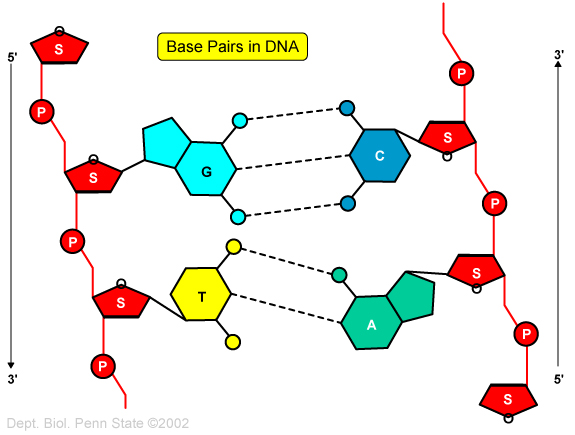
Guanine bonds with ______________.
a)
Adenine
b)
Guanine
c)
Cytosine
d)
Thymine
59.
Why is DNA important?
a)
it is very small and very complicated
b)
it's in everything
c)
it serves as the blueprint for traits of all living things
d)
because we eat it every day for energy
60.
What are the 4 nitrogen bases?
a)
adenine, thymine, cytoplasm, and guanine
b)
adenine, thymine cytosine, and guanine
c)
adenine, thymine, cytosine, and gylcerol
d)
adenine, thymine, cytosine, and glucose
61.
Which 2 molecules forms the sides (backbone) of the DNA ladder?
a)
deoxyribose and adenine
b)
deoxyribose and a hydrogen bond
c)
sugar and the nucleus
d)
deoxyribose (sugar) and phosphate
62.
Which enzyme is responsible for adding nucleotides?
a)
Topoisomerase
b)
DNA Polymerase
c)
Ligase
d)
Primase
63.
Which sequence of DNA bases would pair with this partial strand
ATG TGA CAG
a)
ATG TGA CAG
b)
TAC ACT GTC
c)
GTA AGT GAC
d)
CAT TCA CTG
64.
A process in which DNA has the unique ability to make an exact copy of itself.
a)
Replication
b)
Translation
c)
Transcription
65.
Which organelle is DNA usually found in?
a)
cell membrane
b)
vacuole
c)
chloroplast
d)
nucleus
66.
Nitrogenous bases are joined by which type of bond?
a)
polar bonds
b)
ionic bonds
c)
covalent bonds
d)
hydrogen bonds
67.
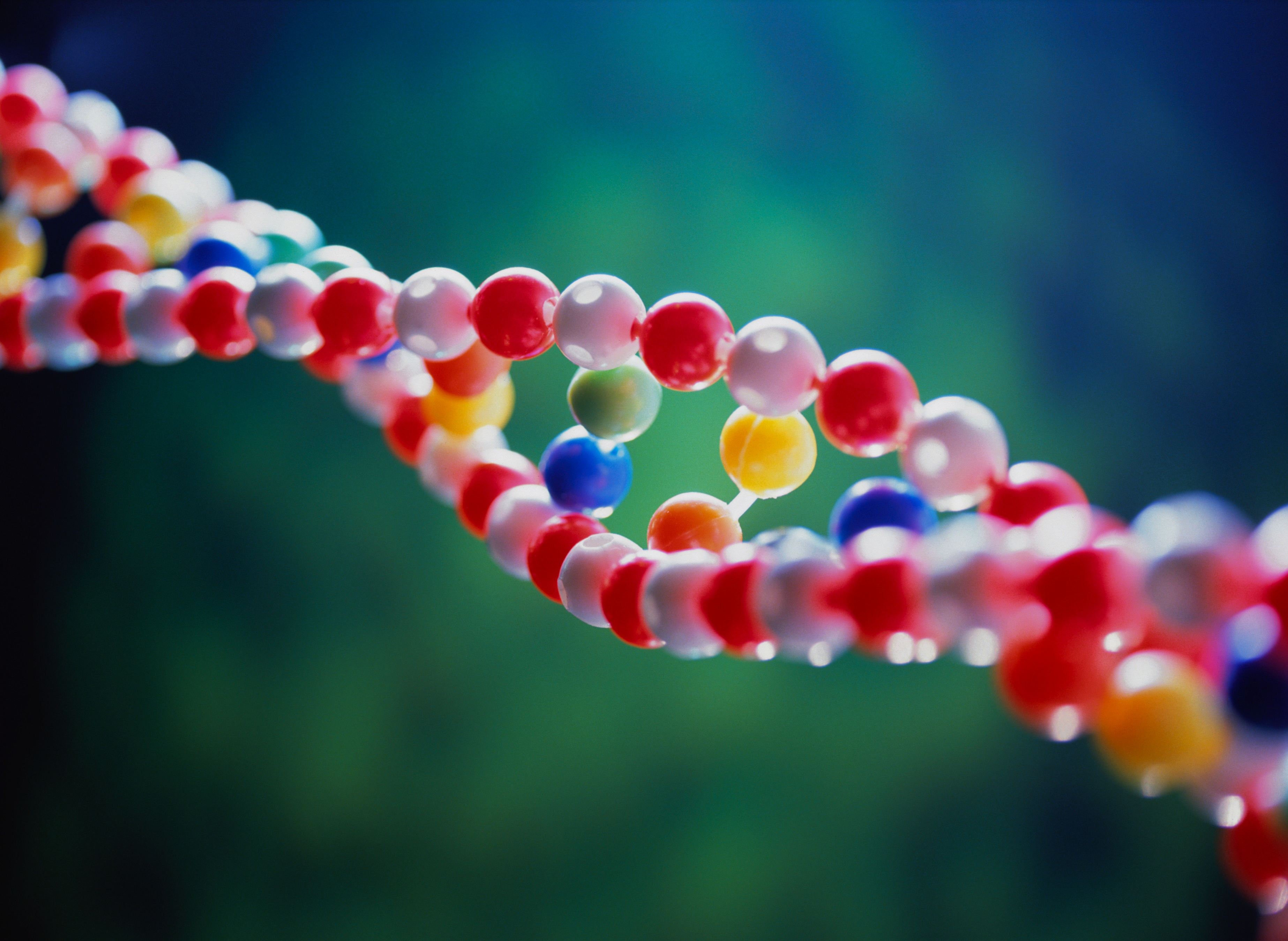
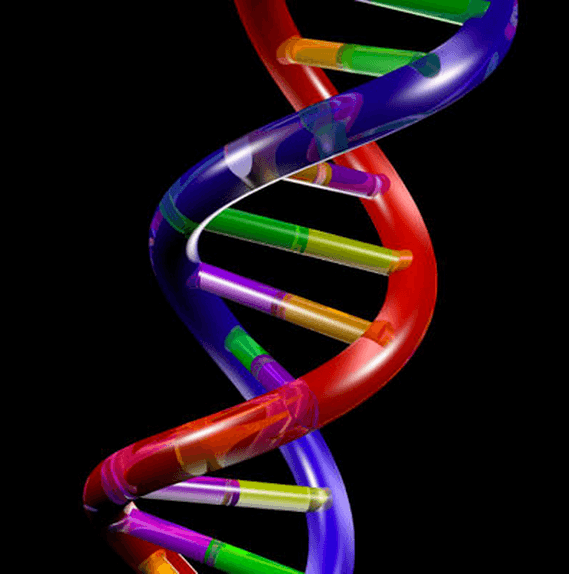
The drawing shows the structure of what molecule?
a)
A DNA molecule
b)
A lipid molecule
c)
A carbohydrate molecule
d)
A protein molecule
68.
In a molecule of double-stranded DNA, the amount of Adenine present is always equal to the amount of
a)
cytosine
b)
guanine
c)
thymine
d)
uracil
69.
What determines the code, or information, of a DNA molecule?
a)
the shape (structure) of the nitrogen bases
b)
the order (sequence) of the nitrogen bases
c)
the color of the nitrogen bases
d)
the frequency (number) of nitrogen bases
70.
The enzyme that unzips the DNA to prepare for replication
a)
helicase
b)
replicase
c)
polymerase
d)
synthase
71.
DNA replication results in two DNA molecules,
a)
each one with two original strands
b)
each one with two new strands
c)
each one with one new strand and one original strand
d)
one with two new strands and the other with two original strands
72.
order of replication
a)
3, 2, 1, 4
b)
2, 1, 4, 3
c)
2, 3, 1, 4
d)
3, 4, 1, 2
73.
What are the three components of a nucleotide?
a)
sugar, hydrogen, nitrogen base
b)
sugar, oxygen, nitrogen base
c)
sugar, phosphate, nitrogen base
d)
sugar, phosphate, protein
74.
What sugar is in DNA?
a)
deoxyribose
b)
ribose
c)
oxyribose
d)
deoxyose
75.
Which enzyme proofreads the DNA after replication to catch any mistakes?
a)
primase
b)
proof-read-ase
c)
DNA polymerase
d)
helicase
76.

A gene gives the instructions for protein synthesis. Which type of molecule is responsible for "reading"the instructions and then creating the protein?

a)

rRNA

b)

mRNA

c)

tRNA

d)

ATP

77.
In RNA, Uracil pairs with ______. 
a)
cytosine
b)
adenine
c)
guanine
d)
thymine
78.
The process to go from DNA to mRNA is _______
a)
translation
b)
transcription
c)
replication
79.
The process to go from mRNA to a protein is called ____
a)
transcription
b)
rRNA
c)
replication
d)
translation
80.
DNA holds the code for
a)
lipids
b)
carbohydrates
c)
protein
d)
sugar
81.
Choose the nucleotide sequence of the RNA strand that would be complementary to the following strand: 
GTAGTCA
a)
UATUAGA
b)
ACGACTG
c)
CAUCAGU
d)
CATCAGT
82.
The main function of tRNA is to...
a)
carry a message that, when translated, forms proteins
b)
form a portion of ribosomes
c)
string together complementary RNA and DNA strands
d)
bring amino acids from the cytoplasm to the ribosomes
83.
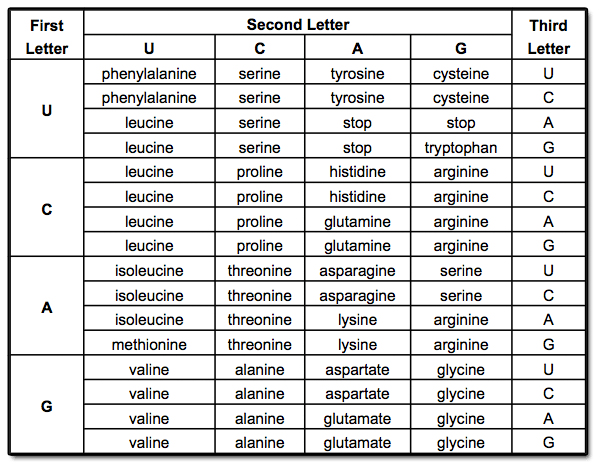
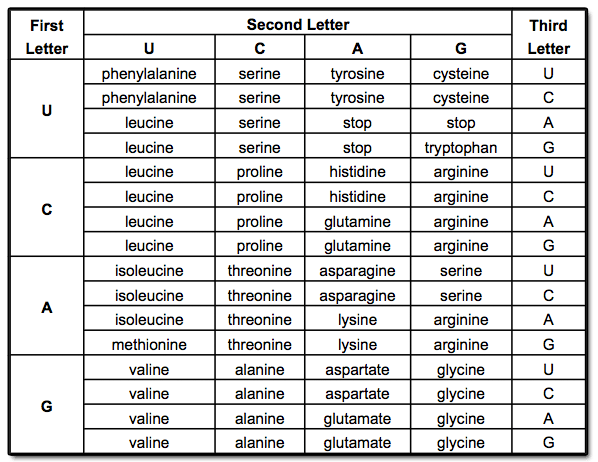
What amino acid is represented by the codon UUA?
a)
Phenylalanine
b)
Tyrosine
c)
Leucine
d)
Stop codon
84.
Which component of DNA determines the traits of an organism? 
a)
Nitrogen Bases
b)
Sugar-Phosphate Backbone
c)
Hydrogen bonds
85.

What is the location in the cell for translation?

a)

ribosome in the nucleus

b)

mitochondria in the cytoplasm

c)

ribosome in the cytoplasm

d)

chloroplast nucleus

86.
How many amino acids are coded for by this sequence of nucleotides:
ATG GGA ACT CCA
a)
4
b)
2
c)
6
d)
12
87.
What is the correct amino acid sequence for the mRNA code AUGCCAGUAUGA
a)
Met-Pro-Ala-Val
b)
Met-Pro-Val
c)
Tyr-Gly-His
d)
Tyr-Gly-Arg-His
88.
Which is the mRNA molecule that would be transcribed from this DNA template:
TGGCAAGTACGT
a)
ACCGTTCATGCA
b)
UGGCAAGUACGU
c)
UCCGUUCUUGCU
d)
ACCGUUCAUGCA
89.
What is the start codon?
a)
AUG
b)
STOP
c)
GUA
d)
UUU
90.
What are small segments of a chromosome that help code for a trait?
a)
Genes
b)
Nucleotides
c)
Proteins
d)
Carbohydrates
91.
The process represented in the diagram produces a molecule that is complementary to the template strand of DNA. What type of molecule is produced?
a)
New DNA
b)
Polypeptide
c)
Messenger RNA
d)
Carbohydrate
92.
what does mRNA do?
a)
carry info from genes to ribosomes
b)
carry amino acids to ribosomes
c)
help with RNA splicing
d)
make up ribosomes
93.
True or false:  RNA is double-stranded.
a)
true
b)
false
c)
it depends on the type
94.

What is the building block of proteins?

a)

Monosacchrides

b)

Polysaccharides

c)

amino acids

d)

Triglycerides

95.
Does the order of amino acids in a protein matter?
a)
YES!
b)
NO!
96.
How many different amino acids are there?
a)
15
b)
20
c)
40
d)
100
97.

Brings the amino acids to the ribosome, using the anticodon

a)

mRNA

b)

tRNA

c)

rRNA

d)

DNA

98.
What would be the tRNA anticodon for the mRNA codon CAG?
a)
GTC
b)
GUC
c)
CUG
d)
CAG
99.
What is the term for a three-nucleotide sequence that codes for an amino acid?
a)
base
b)
codon
c)
amine
d)
serine
100.
What type of bonds are forming during translation?
a)
Peptide bonds
b)
Hydrogen bonds
c)
Acid bonds
101.
Which phase of which process does this picture show?
a)
Transcription
b)
Translation
c)
Replication
102.

What is transcription

a)

RNA to DNA

b)

DNA to RNA

c)

RNA to RNA

d)

DNA to DNA

103.

What is the correct order to make a protein?

a)

Protein, DNA, RNA

b)

RNA, DNA, Protein

c)

DNA, RNA, Protein

d)

Protein, RNA, DNA

104.

RNA contains which sugar?

a)

deoxyribose

b)

Ribose

c)

glucose

d)

fructose

105.

What enzyme does transcription use?

a)

DNA polymerase

b)

ligase

c)

RNA polymerase

d)

helicase

106.

Which RNA carries the message?

a)

mRNA

b)

rRNA

c)

tRNA

107.
When does DNA replication happen?
a)
Before Mitosis begins
b)
During prophase
c)
During metaphase
d)
During anaphase
108.

The DNA Helicase has created a ......

a)

Replication fork

b)

Replication exchange

c)

Replication carry code

d)

Replication spoon

109.
A triplet of mRNA is called a
a)
codon
b)
anticodon
c)
amino acid
d)
peptide bond
110.
What is this a picture of?
a)
mRNA
b)
tRNA
c)
rRNA
d)
pRNA
111.
What is the relationship between a protein, the cell, and DNA?
a)
DNA is produced by protein which is produced in the cell
b)
Protein is composed of DNA which is produced in the cell
c)
DNA makes RNA which produces protein in the cell
d)
A cell is composed of DNA and protein
112.
Which structure reads the mRNA codons?
a)
Nucleus
b)
Ribosome
c)
Golgi Body
d)
Enzyme
113.

What is the correct sequence of protein synthesis?

A. tRNA brings amino acids to the ribosome

B. DNA molecules serve as the templates for mRNA.

C. mRNA molecules move to ribosomes.

D. Polypeptides are formed on ribosomes.

a)

A-B-C-D

b)

B-C-A-D

c)

C-B-A-D

d)

D-B-A-C

114.
The mRNA leaves the ________ to find the ribosome to make proteins.
a)
cell
b)
nucleotide
c)
nucleus
115.
How many codons are needed to specify for five amino acids?
a)
3
b)
5
c)
15
d)
30
116.

Set of triplicate nitrogen bases found on tRNA that are complementary to one codon

a)

peptide bond

b)

polypeptide

c)

anti-codon

d)

amino acid

117.
Discovered that A=T and C=G
a)
Griffith
b)
Chargraff
c)
Hershey & Chase
d)
Watson & Crick
118.

How was Rosalind Franklin's photo 51 use in the discovery of DNA?

a)

It was used to determine the physical structure of DNA

b)

It was used to identify the four bases that make up DNA

c)

It was used to determine the theory of independent assortment

d)

It was used to show DNA was the molecule of inheritance

119.

Which scientist(s) were the first to create a physical model of DNA?

a)

Chargraff

b)

Hershey and Chase

c)

Rosalind Franklin

d)

Watson and Crick

120.

ATTATTATTCGCGTA Complimentary strand?

a)

TAATAATAAGCGCAT

b)

TAATATTTAACGCGC

c)

CAACAACAATCTCCTA

d)

TAATAATAAGCCGTA

121.

If a genetic sequence has 20% Adenine, how much thymine?

a)

40%

b)

20%

c)

10%

d)

30$

122.

If a genetic sequence has 20% Adenine, how much Guanine?

a)

20%

b)

30%

c)

60%

d)

40%

123.

DNA: ATCGCGTTTATAATT, mRNA: UAGCGCAAAUAUUAA, tRNA: AUCGCGUUUAUAAUU. Using the necessary code, identify the correct amino acid sequence.

a)

Met-Pro-Ala-Val-Iso

b)

Tyr-Arg-Lys-Tyr-Stop

c)

Iso-ala-Phe-Iso-Iso

d)

Tyr-Gly-Arg-His-Stop

124.

A dog gives birth to 5 puppies. What percentage of the chromosomes does each puppy share with the mother?

a)

25%

b)

50%

c)

75%

d)

100%

e)

33.3%

125.

What does heterozygous mean?

a)

An organism that has the same genes for a trait (AA or aa)

b)

An organism that has different genes for a trait (Aa)

c)

When neither gene is fully dominant; offspring is a mixture of both

d)

the different forms of a trait (hair color--> brown, blonde, red

126.

The dominant trait is

a)

yellow pea seeds

b)

green pea seeds

c)

there is no dominant seed

d)

Jolly green giant

127.
What are the possible genotypes for this cross?
a)
TT = 25% Tt= 50% tt=25%
b)
all tall
c)
TT= 75% tt = 25%
d)
Tt = 100%
128.
___________________________ is the study of how traits are passed on, or inherited.
a)
dominant traits
b)
ratio
c)
phenotype
d)
genetics
129.
True or False:  Recessive traits are ALWAYS present 
a)
True
b)
False
130.

_____________________ is the appearance of an organism, or how it looks

a)

phenotype

b)

genotype

c)

karyotype

d)

personality type

e)

tintype

131.

What would the genotypes be?

a)

TT, Tt

b)

TT, Tt, tt

c)

Tt, tt

d)

None of the above

132.

Which of the following is a hybrid?

a)

IBIB

b)

ii

c)

IAi

d)

IAIA

133.

Looking at this pedigree, how many female family members are carriers?

a)

1

b)

3

c)

10

d)

7

134.
How many PAIRS of chromosomes do humans have?
a)
23
b)
46
c)
1
d)
2
135.
Hemophilia is a recessive x-linked disorder.
Which genotype represents a male with hemophilia?
a)
XHXh
b)
XhXh
c)
XHY
d)
XhY
136.
A calico cat shows both the traits for orange fur and black fur. What kind of allele expression is this?
a)
Incomplete Dominance
b)
Co dominance
c)
Independent assortment
d)
Recessive inheritance
137.
Snap dragon color is a incomplete dominant trait.  A red flower (RR) is crossed with white flower (WW)? What color are flowers that are RW?
a)
Red
b)
Red and White
c)
White
d)
Pink
138.
A segment of DNA that codes for a particular protein.
a)
Chromosome
b)
Nucleotide
c)
Allele
d)
Gene
139.
Alternate forms of the same gene.
a)
Chromosomes
b)
Nucleotides
c)
Alleles
d)
Nucleosomes
140.
Genes that are found on the X or Y chromosome.
a)
Autosomal
b)
Sex-linked
141.

A sperm contains

a)

Both an X and a Y chromosome

b)

Two X chromosomes

c)

An X or a Y chromosome

d)

only a Y chromosome

142.

"Normal" human males have

a)

1 X chromosome and 1 Y chromosome

b)

2 X chromosomes

c)

2 Y chromosomes

143.

"Normal" human females have

a)

1 X chromosome and 1 Y chromosome

b)

2 X chromosomes

c)

2 Y chromosomes

144.
The gender of this karyotype is...
a)
Male
b)
Female
145.

Spontaneous changes in genetic material are called:

a)

genetics

b)

mutations

c)

hereditary

d)

crossing over

146.

A person who is heterozygous for a recessive disorder is called a(n)

a)

carrier

b)

homozygous donor

c)

autosomal dominant

d)

hybrid

147.

The failure of replicated chromosomes to separate is called

a)

point mutation

b)

non disjunction

c)

frameshift mutation

d)

germ cell mutation

148.

Method for determining the unknown genotype of an individual with a dominant genotype

a)

test cross

b)

crossing over

c)

monohybrid cross

d)

dihybrid cross

149.

Pairs of genes separate independently of one another during gamete formation (Meiosis I).

a)

Law of Segragation

b)

Law of Independent Assortment

c)

Law of Heredity

d)

Law of Dominance

150.

Two alleles for a trait segregate (separate) when gametes are formed.

a)

Law of Segragation

b)

Law of Independent Assortment

c)

Law of Dominance

d)

Law of Heredity

151.

A cross that involves two pairs of traits. Example (seed color and shape)

a)

Monohybrid Cross

b)

Test Cross

c)

Dihybrid Cross

152.

The sex of a human offspring is determined by the:

a)

father

b)

mother

c)

offspring

d)

both mother and father

153.

When you study a pedigree, you notice a disease that is found equally in males and females of all generations. the gene coding for this disease is probably

a)

sex-linked recessive

b)

sex-linked dominant

c)

autosomal recessive

d)

autosomal dominant

154.

A family record that indicates the occurrence of a trait is a

a)

pedigree

b)

punnett square

c)

karyotype

d)

sonogram

155.

Produce offspring each of which can have only one form of a trait

a)

heterozygous

b)

true-breeding

c)

dihybrid

d)

hybrid

156.

The passing of traits from parents to offspring is called

a)

maturation

b)

development

c)

genetics

d)

heredity

157.

Which is a homozygous recessive genotype?

a)

BB

b)

aa

c)

Dd

d)

ab

158.

Which is a heterozygous genotype?

a)

AB

b)

Aa

c)

AA

d)

aa

159.

What is the expected phenotypic ratio of a monohybrid cross with 2 heterozygous parents

a)

1:2:1

b)

1:1

c)

3:1

d)

1:3:1

160.

In a heterozygous x heterozygous dihybrid cross, what is the expected phenotypic ratio?

a)

3:1

b)

9:3:3:1

c)

1:1:1:1

d)

2:3:3:1

161.

Which is an example of multiple alleles?

a)

colorblindness

b)

blood type

c)

sickle cell anemia

d)

hemophilia

162.

The difference between a monohybrid and a dihybrid cross is that

a)

monohybrid crosses involve traits for which only one allele exists, while dihybrid traits involve two alleles

b)

dihybrid crosses require two Punnett squares; monohybrid crosses need only one

c)

monohybrid crosses involve one trait; dihybrid crosses involve two traits

d)

monohybrid crosses involve self-pollination, while dihybrid crosses involve cross-pollination

163.
Examples of a producer
a)
frog
b)
algae
c)
worm
d)
mouse
164.
Example of a decomposer
a)
fungus
b)
mouse
c)
plants
d)
frogs
165.
A tree is a ....
a)
composer
b)
decomposer
c)
producer
166.
What is a producer?
a)
an organism that gets energy from eating other organisms
b)
an organisms that uses sunlight to make its own food
c)
an organism that gets energy from eating dead organisms, non-living material or waste
d)
an organism that uses chemical energy to make its own food
167.
What is a herbivore?
a)
an animal that gets energy from eating other animals
b)
an organism that gets energy from eating only plants
c)
an animal that gets energy by eating both plants and other animals
d)
an animal that eats only herbs
168.
What is a carnivore?
a)
an animal that gets energy by eating other animals
b)
An animal that gets energy by eating only plants
c)
an animal that gets energy by eating both plants and animals
d)
an animal that makes its own energy through photosynthesis
169.
An animal that gets energy from eating both plants and animals is a 
a)
herbivore
b)
carnivore
c)
omnivore
d)
autotroph
170.
The shrew provides energy for the _______?
a)
cricket
b)
grasshopper
c)
frog
d)
snake
171.
Which of the following is a herbivore?
a)
cricket
b)
frog
c)
hawk
d)
shrew
172.
Where do all life forms get their energy?
a)
Earth's Core
b)
Water
c)
Plants
d)
The Sun
173.
What is this called?
a)
Food Web
b)
Food Chain
c)
Abiotic Factors
174.
What is this called?
a)
Food Web
b)
Food Chain
c)
Abiotic Factors
175.
A producer is a (n) ______________.
a)
heterotroph
b)
omnitroph
c)
autotroph
d)
oscartroph
176.
All food chains begin with a ____________.
a)
primary consumer
b)
secondary consumer
c)
producers
d)
scavengers
177.
Which best describes what a food chain shows you?
a)
Energy flow through an ecosystem
b)
Food flowing through an ecosystem
c)
Consumers going into other consumers
d)
Who eats who
178.
An organism that produces its own food supply from inorganic compounds is called a(an)
a)
heterotroph
b)
consumer
c)
detritivore
d)
autotroph
179.
What is an ecological model of the relationships that form a network of complex interactions among organisms in a community from producers to decomposers?
a)
food web
b)
an ecosystem
c)
food chain
d)
a population
180.
What is the term for each step in the transfer of energy and matter within a biological community?
a)
energy path
b)
food web
c)
trophic level
d)
food pyramid
181.
The energy at each trophic level in the pryamid of energy decreases by a factor of ____.
a)
10
b)
1
c)
100
d)
2
182.
diagram that shows the energy available to each trophic level in an ecosystem; 10% is passed on to upper levels, the rest is lost as heat
a)
succession 
b)
cellular respiration
c)
energy pyramid
d)
biochemical cycle
183.
Study of interactions between organisms and their environment 
a)
niche
b)
community 
c)
ecology
d)
ecosystem
184.
Members of a species in a defined area
a)
Ecosystem
b)
community
c)
biodiversity
d)
population
185.
Non-living factor that affects an ecosystem
a)
biotic factor
b)
abiotic factor
c)
food chain 
d)
biome
186.
Organisms that relies on other organisms for food; consumer
a)
herbivore
b)
decomposer
c)
heterotroph
d)
species
187.
All the organisms in a particular location, including their nonliving environment
a)
ecosystem
b)
carnivore
c)
niche
d)
population
188.
What does fungi do to dead plants and animals?
a)
Leave them there
b)
Decompose them
c)
Wait for other animals to eat them
d)
Move away
189.
What may happen if the snowshoe hare was removed from the food web pictured?
a)
The insects in the habitat would increase.
b)
The shrew population would decrease due to being only hawk food source.
c)
The willow tree population would decrease.
d)
Foxes would dies due to no food source. 
190.
In the energy pyramid here, how much of the energy in the producers gets passed to the herbivores?
a)
10%
b)
20%
c)
80%
d)
90%
191.
Which of the following leads to a decrease in biodiversity?
a)
protection of ecosystems
b)
pollution control
c)
selective cutting
d)
introduction of exotic or invasive species
192.
In the food web shown, the snail would be considered...
a)
primary consumer
b)
secondary consumer
c)
tertiary consumer
d)
producer
193.
Overpopulation occurs when a population exceeds its carrying capacity.  White-tailed deer are considered to be an overpopulated species in the central United States.  What is one consequence of white-tailed deer exceeding their carrying capacity?
a)
People don't see deer as often in urban areas.
b)
The deer are less healthy and more prone to disease.
c)
There are more predators to eat the deer.
d)
The deer have stopped breeding.
194.
What two factors have been the GREATEST contributors to the exponential growth of the human population during the last two centuries?
a)
plentiful food and a mild climate
b)
the industrial revolution and peace
c)
agricultural developments and peace
d)
good sanitation and medical advances
195.
A collection of organisms that belong to different populations but all live in the same area and interact with one another.
a)
Population
b)
Ecosystem
c)
Community
d)
Ecosphere