
 Worksheets
BIOLOGY REVISION F4 CHAPTER 7-13
Total questions: 190
Worksheet time: 3hrs 10mins

A
B
C
D

A
B
C
D

A
B
C
D

A
B
C
D

A
B
C
D

A
B
C
D

A
B
C
D

A
B
C
D

A
B
C
D

A
B
C
D

A
B
C
D

A
B
C
D

A
B
C
D

A
B
C
D

A
B
C
D

A
B
C
D

A
B
C
D

A
B
C
D

A
B
C
D

A
B
C
D
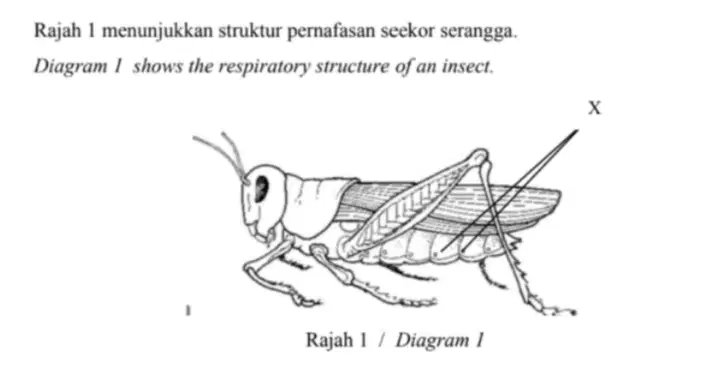
Based on the diagram, what is the function of structure X that ensure the insects receive adequate amount of oxygen?
Filter the air that flows into the trachea
Select the air that flows into the trachea
Allows the air to flow into the trachea
Inhibit the air to flow into the trachea
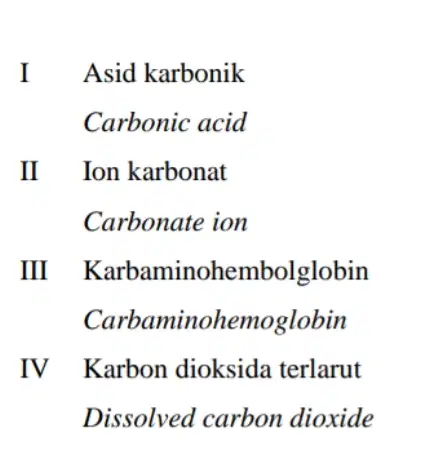
In what forms are the carbon dioxide being transported in the blood?
I and III
I and IV
II and III
III and IV
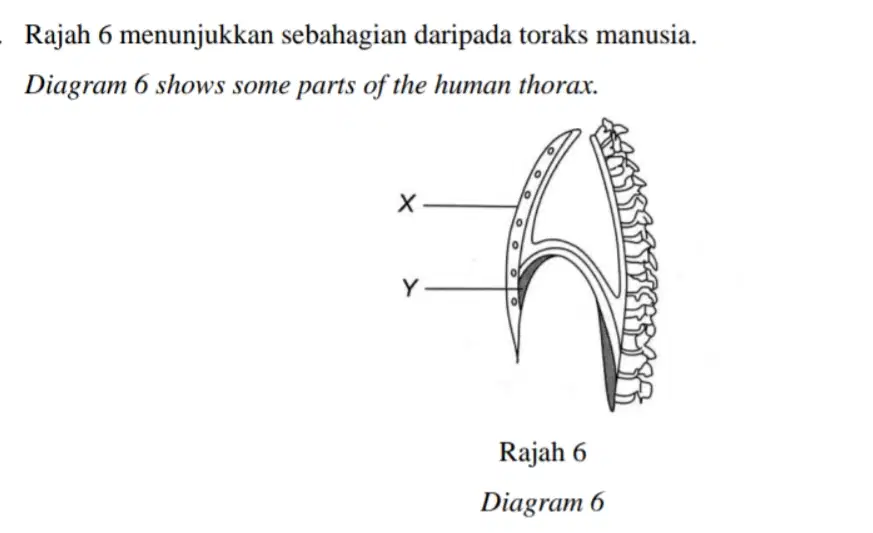
What happen to structure X and Y during inhalation?
X : Moves downwards and inwards Y : Contracts
X : Moves upwards and outwards Y: Contracts
X : Moves downwards and inwards Y : Relaxes
X : Moves upwards and outwards Y : Relaxes
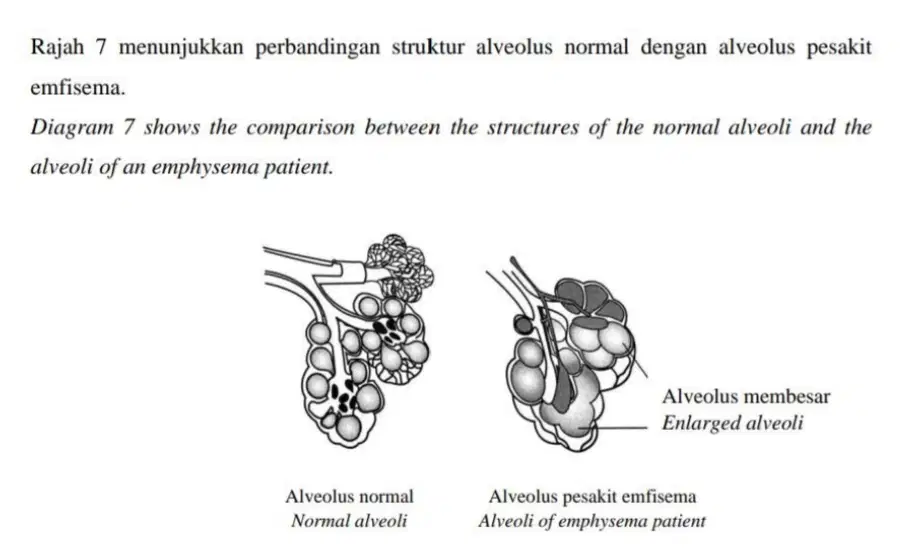
Why does the gaseous exchange become less efficient for an emphysema patient?
Excessive amount of mucus is produced inside the alveoli
The surface area pf the alveoli is reduced
The walls of the alveoli are less moist
The walls of the alveoli become swollen and thick
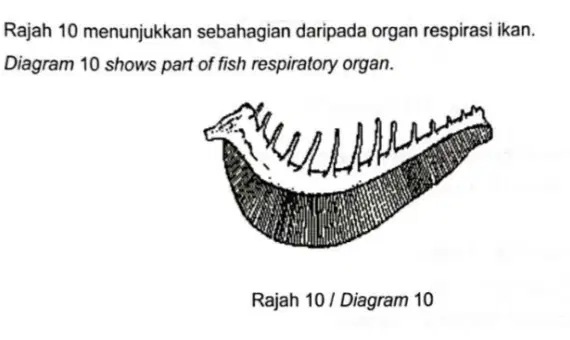
Which of the following characteristics refers to the respiratory structure?
The lining surface is thin
The surface is always moist
Rich with blood capillaries
Numerous numbers of structure so that the total surface area is also large
Which of the following statements is correct about the human respiratory structure and its adaptations?
Large number of trachioles to provide a large amount of surface area for absorption of respiratory gases
Extensive blood capillary network to accelerate the transportation of respiratory gases
The walls of the respiratory structure are thick to facilitate gas diffusion
What would happen to our breathing if the alveoli were damaged and poorly functioning?
Sneeze often
Gasping
Persistent cough
Difficult to swallow
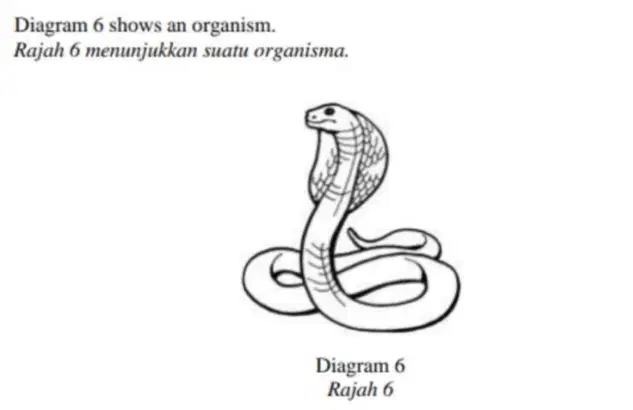
What is the respiratory surface for the organism shown in diagram 6?
Trachiole
Skin
Alveolus
Filament
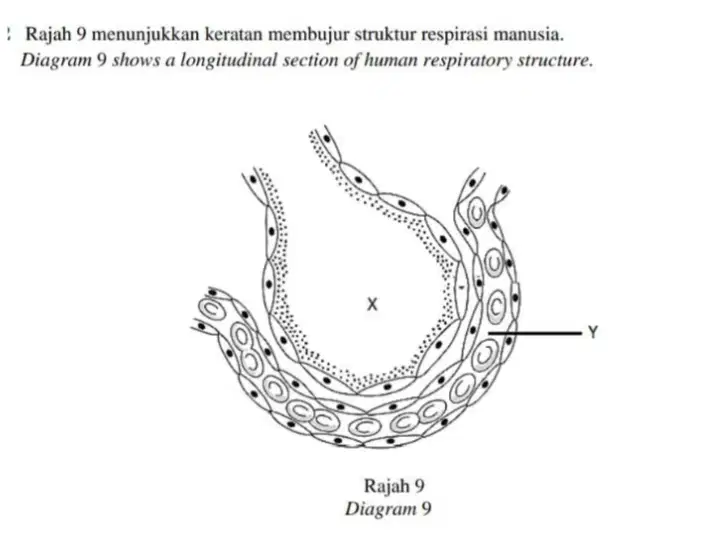
WHich of the following situation causes maximum diffusion of oxygen from X to Y?
X : High partial pressure of oxygen Y : Low partial pressure of carbon dioxide
X : Low partial pressure of carbon dioxide Y : High partial pressure of oxygen
X : High partial pressure of oxygen Y : High partial pressure of carbon dioxide
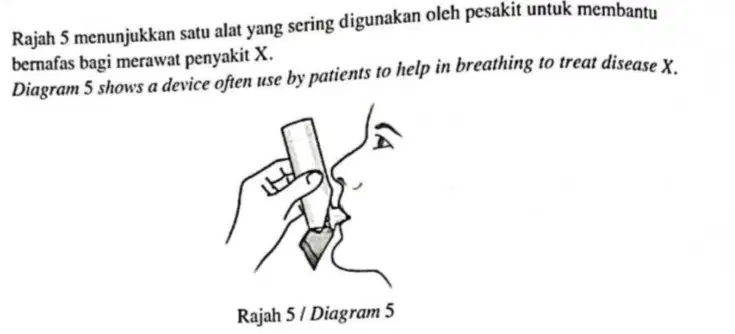
How does this device help to treat disease X?
This device can reduce inflammation and widen the path in bronchiole tube and ease the air flow
This device increase total surface area of alveolus to increase the gaseous exchange
This device reduces mucus production and prevent infection

The diagram above shows the respiratory system of an insect. What is K?
Tracheole
Muscle
Spiracle
Trachea
Which of the following is true about the structural adaptation of the tracheoles in insects for gaseous exchange?
I. The large number of tracheoles provide large surface area
II. The tracheoles are close to ecah body cell
III. The tracheoles have thin permeable wall
IV. Gaseous exchange takes place directly from the tracheoles into the cell
I and II only
III and IV only
I, III, and IV only
I, II, III and IV
Which of the following are adaptations of a fish gill filaments for respiration?
I. The gill filaments has thin membrane to filter the bacteria in the water.
II. The gill filaments are supplied with numerous blood capillaries.
III. The gill filaments have many folds to increase the respiratory surface.
IV. The direction of blood flow in gill filament is opposite of the direction of water flow.
I and II only
III and IV only
II, III and IV only
I, II, III and IV only
Which of the following structure is involved in breathing in a frog?
Mouth cavity
Diaphragm
Intercostal muscles
Rib cage
Which of the following is the adaptation of skin of frogs for gaseous exchange?
Moist and cold
Slippery and slimy
Thin and folded
Moist and rich in blood capillaries

The diagram shows the condition of the rib cage and diaphragm during breathing. What happens to muscle X and Y during this process?
Muscle X contracts while Muscle Y relaxes
Muscle X relaxes while Muscle Y contracts
Muscle X and Muscle Y relaxes
Muscle X and Muscle Y contracts
When climbing a mountain, the atmospheric pressure decreases. The partial pressure of oxygen decreases and this causes the oxygen level in the blood to drop. How does the body return the oxygen level to the normal level.
I. Respiratory muscles contract and relax faster
II. Intercostal muscles contract and relax slower
III. Breathing and ventilation rate increases
IV. pH of blood decreases
I and II
I and III
II and IV
III and IV
Which of the following is not the way carbon dioxide transports in the body?
70% is transported in the form of bicarbonate ions (HCO3-)
7% dissolved carbon dioxide is transported as carbonic acid (H2CO3)
7% dissolved carbon dioxide is transported in the form of carbonic anhydrase enzymes in erythrocytes.
23% of carbon dioxide combines with haemoglobin to form carbaminohaemoglobin
What are the causes of emphysema?
Blockage of bronchioles
Airway inflammation
Damage to the alveoli walls
Excessive production of mucus
A man involved in a car accident. His rib is fractured and punctured his lungs. What will happen to the man?
He will have difficulties in swallowing food
He will experience short of breath
He cannot sneeze
He cannot speak

The diagram below shows the tracheal system in a grasshopper. What is the name of the structure in the grasshopper's tracheal system that is filled with air to speed up the delivery of respiratory gas during active movement?
Trachea
Spiracles
Tracheole
Air sacs
What are the characteristics of the respiratory structure of fish that enable the rapid exchange of respiratory gases?
A large number of filaments and lamellae
Lamella membrane is thin and supplied with many blood capillaries.
Moist skin
The skin is thin and highly permeable.
Which of the following is the respiratory structure of a frog?
Trachea
Alveolus
Gills
Lungs
What is the adaptation of the lungs of the frog for gaseous exchange?
Folded surface & moist
Thin & flat
Smooth surface & dry
Thick & moist

What is the adaptation of the human alveoli for gaseous exchange?
Large number of alveoli that are rich with blood capillaries
Surface of the alveoli is folded and thin
Surface of the alveoli is smooth & dry
Wall of the alveoli is thick and moist
Which of the following is the correct sequence of the pathway of oxygen entering the tracheal system?
Trachea > spiracles > tracheole > body cells
Spiracles > trachea > tracheole > body cells
Tracheole > trachea > spiracles > body cells
Body cells > trachea > tracheole > spiracle
Which of the following structures involved in the breathing mechanism of a frog?
Ribcage
Intercostal muscle
Diaphragm
Buccopharyngeal cavity
Which of the following occurs during exhalation in a fish?


What is the correct sequence of oxygen movement from the alveolus to the blood capillaries in humans?
J, K, M, L
K, L, J, M
K, M, L, J
L, K,M, J
Asthma is one of the diseases related to the human respiratory system.
What is the cause of asthma?
Bronchiole tube become smaller.
ALveolus loses its elasticity.
Bronchiole tube is blocked.
Alveolus wall is damaged.

A
B
C
D

A
B
C
D

A
B
C
D

A
B
C
D

A
B
C
D

A
B
C
D

A
B
C
D

A
B
C
D

A
B
C
D

A
B
C
D

A
B
C
D

A
B
C
D

A
B
C
D

A
B
C
D

A
B
C
D

A
B
C
D

A
B
C
D

A
B
C
D

A
B
C
D

A
B
C
D

A
B
C
D

A
B
C
D

A
B
C
D

A
B
C
D

A
B
C
D

A
B
C
D

A
B
C
D

A
B
C
D

A
B
C
D

A
B
C
D
Which of the following vessels has thin muscle wall and a large lumen?
Vein
Artery
Capillary
Aorta

What type of blood vessel is shown in figure number 2?
vein
artery
capilary
aorta
Filtration is involved in the formation of tissue fluid because
the wall of blood capillary is selectively permeable and acts as a filter.
The hydrostatic pressure of the blood is lower than the tissue fluid.
blood cells and plasma proteins block the pores on the wall of blood capillary.
oxygen and nutrients can diffuse across the wall of blood capillary.
Arteries, except for the pulmonary artery, carry
*2015 Q30
deoxygenated blood away from the heart under high pressure
deoxygenated blood away from the heart under low pressure
oxygenated blood away from the heart under high pressure
oxygenated blood away from the heart under low pressure

The diagram shows the front view of a human heart.
Letters P, Q, R and S indicate the different chambers of the heart.
Which of the following shows the sequence in which a blood cell returning from other parts of the body passes through the four chambers of the heart?
R-S-P-Q
Q-S-R-P
P-R-Q-S
S-R-P-Q

The bar chart shows the concentration of oxygen in blood sampled at four places in the circulatory system of a human.
Which blood sample was taken from the pulmonary vein?
A
B
C
D

The graph below shows the changes in blood oxygen content and blood pressure along blood vessels (1), (2) and (3).
Which of the following best represents the identities of blood vessels (1), (2) and (3)?
blood vessel 1: aorta
blood vessel 2: capillary
blood vessel 3: pulmonary vein
blood vessel 1: pulmonary artery
blood vessel 2: capillary
blood vessel 3: pulmonary vein
blood vessel 1: pulmonary vein
blood vessel 2: pulmonary artery
blood vessel 3: capillary
blood vessel 1: pulmonary vein
blood vessel 2: aorta
blood vessel 3: capillary

The figure shows pressure changes in the aorta, left atrium, left ventricle during one complete heartbeat.
What causes the increase in pressure in point X?
contraction in left atrium
contraction in left ventricle
relaxation in left atrium
relaxation in left ventricle

The diagram shows three types of blood vessels, 1, 2 and 3.
Which option describes features of each vessel?
A
B
C
D

The diagram shows the longitudinal section of a blood vessel.
Which of the following combinations of the structures concerned enables blood to flow
from W to Z?
A
B
C
D

The table below shows changes in heart rate and in the volume of blood pumped per beat of an adult man while resting and during vigorous exercise.
Comparing resting with exercise, the volume of blood passing through the heart per minute was increased by
1.5 times
4 times
6 times
12 times
Coronary heart disease can be caused by all of the following factors except
fatty deposits on the inner surface of the heart
formation of blood clot in an artery
a diet rich in saturated fats
a stressful lifestyle
What causes the sounds of a heartbeat?
The backflow of blood hitting the heart muscles.
The closure of the semi-lunar valves, bicuspid valve and tricuspid valve.
The flow of blood into the left and right atria.
The return of blood into the heart from the vena cava and pulmonary vein.

Figure below shows the components of blood. What is letter Z represent?
plasma
white blood cell
red blood cell
platelets
Which of the following is/are involved in the return of tissue fluid?
osmosis
phagocytosis
diffusion
active transport

Identify the blood vessel labelled B.
Aorta
Pulmonary artery
Pulmonary vein
Vena cava

What is the function of the blood vessel labelled D?
To transport blood from the heart to the lungs
To transport blood from the heart to the rest of the body.
To transport blood from the rest of the body to the heart.
To transport blood from the lungs to the heart.
Which of these following is the function of white blood cell?
Transport oxygen
Producing antibody
Blood clotting
Transport hormone

Structure of the red blood cell is special, it lack of nucleus. this condition provide ... .
more space for hemoglobin
more space for cytoplasm
less space for hemoglobin
less space for cytoplasm

A
B
C
D

A
B
C
D

A
B
C
D

A
B
C
D

A
B
C
D

A
B
C
D

A
B
C
D

A
B
C
D

A
B
C
D

A
B
C
D

A
B
C
D

A
B
C
D

A
B
C
D

A
B
C
D

A
B
C
D

A
B
C
D

A
B
C
D

A
B
C
D

A
B
C
D

A
B
C
D

A
B
C
D

A
B
C
D

A
B
C
D

A
B
C
D

A
B
C
D

A
B
C
D

A
B
C
D

A
B
C
D

A
B
C
D

A
B
C
D

A
B
C
D

A
B
C
D

A
B
C
D

A
B
C
D

A
B
C
D

A
B
C
D

A
B
C
D

A
B
C
D

A
B
C
D

A
B
C
D
Organisms have the ability of detecting ............. and giving apropriate ...........
stimuli.....response
response.....stimuli
response....effector
impulse.....stimuli
A stimulus is detected by sensory .......
Response
Receptors
Impulse
Effectors
Choose the external stimuli
Sound
Smell
Body temperatures
Light
Choose the internal stimuli
Temperature
Blood osmotic pressure
Blood sugar level
Blood pH
What is stimulus detect by photoreceptor
Light
Pain
Chemical substances
Temperature
Thermoreceptor can detect
Change in temperature
Touch
Chemical substances
Light
Chemoreceptor detect stimulus
Pain
Chemical substances
Change in pressure
Touch and pressure
What stimulus for baroreceptor
Pain
Chemical substances
Change in pressure
Change in temperature
What is sensory receptor that can detect touch and pain
Thermoreceptor
Baroreceptor
Mechanoreceptor
Nociceptor
What the name od sensory receptor that can detect pain
Photoreceptor
Chemoreceptor
Baroreceptor
Nociceptor
Why do organisms have to respond to stimuli?
To disable the organisms to adapt to the environmental change
To protect the organisms from danger
To ensure the survival of organism
To regulate the internal environment through homeostasis

A
B
C
D

A
B
C
D

A
B
C
D

A
B
C
D

A
B
C
D

A
B
C
D

A
B
C
D

A
B
C
D

A
B
C
D

A
B
C
D

A
B
C
D

A
B
C
D

A
B
C
D

A
B
C
D

A
B
C
D

A
B
C
D

A
B
C
D

A
B
C
D

A
B
C
D

A
B
C
D

What is P?
Cortex
Medulla
Pelvis
Renal Artery

A
B
C
D

What happens if structure X is shaved?
Erector muscle cannot contract.
Sweat gland becomes more active.
More heat is lost to the environment.
More blood is supplied to skin surface.

A
B
C
D

A
B
C
D

A
B
C
D

A
B
C
D

A
B
C
D

A
B
C
D
Homeostasis refers to
the maintenance of a constant heart beat.
the dynamic processes occurring in the kidney.
the static unchanging environment factors.
the constancy of the internal environment of an organism.

The figure above shows a part of the nephron.Which of the following is true about the processes that happen to blood in X, glucose in Y and water in Z?
X: Diffusion , Y: Active transport , Z: Osmosis
X: Osmosis, Y: Re-absorption, Z:Diffusion
X: Active transport, Y: Diffusion, Z:Reabsorption
X: Ultra filtration, Y: Assisted diffusion, Z: Osmosis
About 85% of water is reabsorbed from the filtrate at
Bowman's capsule.
Proximal uriniferous tubule.
Collecting duct.
Henle's loop.
The substance present in blood passes through the glomerulus and the Bowman's capsule by a process called
diffusion.
ultra filtration.
active transport.
osmosis.
Which one of the following substances can pass into the Bowman's capsule?
Serum albumin.
Serum globulin.
Ascorbic acid.
Fibrinogen.
Which one of the following is totally reabsorbed?
Water.
Urea.
Glucose.
Sodium.
Reabsorption of useful substances from the filtrate begins at the
Proximal tubule.
Henle's loop.
Collecting duct.
Bowman's capsule.
The mechanism which maintains the
physical and chemical characteristics of the body in a balanced and stable
state is called
growth.
homeostasis.
development.
excretion.
The process whereby the kidney maintains the concentration of water, salt and ions at an optimum level is called
osmoregulation.
metabolism.
homeostasis.
excretion.
Components of human blood plasma which enter the Bowman's capsule and form the glomerular filtrate are
urea, mineral salts, water glucose, fibrinogen.
urea, mineral salts, water, glucose, amino acid.
albumen. urea, mineral salts, water, glocose, amino acid.
urea, mineral salts, water, vitamin, amino acid, globulin.

