wayground logo

Free Printable Worksheets

Font size

S
M
L
XL
Worksheets

Honors Biology Module 4 Study Guide

Total questions: 196

Worksheet time: 49hrs 0mins

Name
Class
Date
1.

Daughter cells are identical to parent cell

a)

Mitosis

b)

Meiosis Both

c)

MItosis and Meiosis

2.

Results with same # of chromosomes as parent cell

a)

Mitosis

b)

Meiosis

c)

Both MItosis and Meiosis

3.

Crossing over occurs

a)

Mitosis

b)

Meiosis

c)

Both MItosis and Meiosis

4.

One division

a)

Mitosis

b)

Meiosis

c)

Both MItosis and Meiosis

5.

Daughter cells are not identical to parent cell

a)

Mitosis

b)

Meiosis

c)

Both MItosis and Meiosis

6.

Results in haploid cells (n)

a)

Mitosis

b)

Meiosis

c)

Both MItosis and Meiosis

7.

Creates reproductive cells

a)

Mitosis

b)

Meiosis

c)

Both MItosis and Meiosis

8.

Results with half the # of chromosomes as parent cell

a)

Mitosis

b)

Meiosis

c)

Both MItosis and Meiosis

9.

Two divisions

a)

Mitosis

b)

Meiosis

c)

Both MItosis and Meiosis

10.

Results in diploid cells (2n)

a)

Mitosis

b)

Meiosis

c)

Both MItosis and Meiosis

11.

2 daughter cells produced

a)

Mitosis

b)

Meiosis

c)

Both MItosis and Meiosis

12.

Creates body cells

a)

Mitosis

b)

Meiosis

c)

Both MItosis and Meiosis

13.

Purpose: growth and repair

a)

Mitosis

b)

Meiosis

c)

Both MItosis and Meiosis

14.

Starts with one parent cell

a)

Mitosis

b)

Meiosis

c)

Both MItosis and Meiosis

15.

Associated with sexual reproduction

a)

Mitosis

b)

Meiosis

c)

Both MItosis and Meiosis

16.

Undergoes DNA replication

a)

Mitosis

b)

Meiosis

c)

Both MItosis and Meiosis

17.

4 daughter cells produced

a)

Mitosis

b)

Meiosis

c)

Both MItosis and Meiosis

18.
The cells produced via meiosis are called:
a)
sex cells
b)
somatic cells
c)
body cells
d)
skin cells
19.
A human usually has xx amount of chromosomes.
a)
6
b)
22
c)
4
d)
46
20.
What is it called when a sperm and egg meet?
a)
meiosis
b)
fertilization
c)
cell division
d)
mitosis
21.
Meiosis makes sperm and egg cells. In humans, sperm and egg cells each have _____ chromosomes. Therefore a fertilized human egg cell (sperm and egg cell combined) would create a cell with _____ chromosomes.
a)
23, 46
b)
46, 23
c)
2, 4
d)
50, 100
22.
Unlike mitosis, meiosis in male mammals results in the formation of
a)
one haploid gamete
b)
three diploid gametes
c)
four diploid gametes
d)
four haploid gametes
23.
What kind of cells are made in MEIOSIS?
a)
Haploid Gametes
b)
Diploid Somatic Cells
c)
Skin Cells
d)
Liver Cells
24.
Goes through P.M.A.T two rounds 
a)
Mitosis
b)
Meiosis
c)
Osmosis
d)
Transcription
25.
Which process and type of resulting cells are represented?
a)
mitosis, gametes
b)
mitosis, body cells
c)
meiosis, gametes
d)
meiosis, body cells
26.
If a somatic cell in a butterfly contains 24 chromosomes, a butterfly egg would contain
a)
3
b)
6
c)
12
d)
24
27.
The process of crossing over occurs in what phase of meiosis?
a)
anaphase 1
b)
prophase 1
c)
prophase 2
d)
telophase 1
28.
Which of these cells would be produced through meiosis?
a)
skin cells
b)
liver cells
c)
brain cells
d)
sperm cells
29.
The chromosomes that pair up during meiosis, are called __________ chromosomes.  
a)
homozygous 
b)
asexual
c)
homologous
d)
genes
30.
Crossing over helps promote 
a)
male genotype
b)
genetic variation
c)
DNA replication
d)
mitosis
31.
A male shark has 40 chromosomes in each of its sex cells. How many would be present in its body cells?
a)
20
b)
40
c)
80
d)
160
32.
What is another reason we need meiosis?
a)
So the offspring has genes from both parents
b)
So the offspring has genes from one parent
c)
So the offspring has genes from neither parents
d)
So the offspring makes its own genes
33.
Chromosomes exchange genetic material during 
a)
crossing over
b)
replication
c)
synthesis
d)
translation
34.
A human zygote should have _____ chromosomes inside.
a)
46
b)
23
c)
92
d)
64
35.
Unlike mitosis, meiosis in male mammals results in the formation of
a)
one haploid gamete
b)
three diploid gametes
c)
four diploid gametes
d)
four haploid gametes
36.
Human eggs and sperm are _____, and each has ____ chromosomes.
a)
diploid, 23
b)
diploid, 46
c)
haploid, 23
d)
haploid, 46
37.
A dog has 78 chromosomes in its body cells.  What is the diploid number?
a)
78
b)
39
c)
1
d)
100
38.
A Goat has 60 chromosomes in its body cells.  What is the haploid number?
a)
60
b)
30
c)
100
d)
120
39.
A human has 46 chromosomes in their body cells.  What is the haploid number?
a)
46
b)
92
c)
23
d)
12
40.
Mitosis produces cells with haploid or diploid number of chromosomes?
a)
Haploid
b)
Diploid
41.
Meiosis produces cells with a haploid or diploid number of chromosomes?
a)
Haploid
b)
Diploid
42.
Body cells have diploid or haploid number of chromosomes?
a)
Haploid
b)
Diploid
43.
Gametes have haploid or diploid number of chromosomes?
a)
Haploid
b)
Diploid
44.
How many cells are produced in Mitosis?
a)
1
b)
2
c)
3
d)
4
45.
Are the cells in Mitosis identical or unique?
a)
Identical 
b)
Unique
c)
It's random
46.
In which phase do chromosomes move away to opposite sides of the cell?
a)
Prophase
b)
Metaphase
c)
Anaphase
d)
Telophase
47.
What occurs during interphase?
a)
Two cells are formed
b)
The nucleus disappears
c)
Chromosomes line up in the middle of the cell
d)
DNA synthesized and cell grows
48.
What type of cells are produced in meiosis?
a)
Body Cells
b)
Gametes
c)
Hair cells
d)
Liver cells
49.
How many cells are produced in meiosis?
a)
1
b)
2
c)
3
d)
4
50.
Are the cells produced in meiosis identical or unique?
a)
Identical
b)
Unique
c)
It's random
51.
What happens in Meiosis that causes the cells produced to be unique?
a)
Metaphase 2
b)
Interphase
c)
Splitting of Cytoplasm
d)
Crossing Over
52.

Differences in genes within the population is known as--

a)

Genetic variation

b)

Gene flow

c)

Homologous chromosomes

d)

Monohybrid cross

53.

Which of the following statements is true about gametes?

a)

Gametes are body cells such as blood, skin, heart, fat

b)

Gametes are made in the bones

c)

Human gametes are sex cells that contain 46 chromosomes

d)

Human gametes are sex cells that contain 23 chromsomes

54.

Which of the following is an example of being heterozygous?

a)

AA

b)

GG

c)

ff

d)

Nn

55.

Which of the following is an example of being homozygous?

a)

AA

b)

Gg

c)

Ff

d)

Nn

56.

How many daughter cells are produced during MITOSIS?

a)

1

b)

2

c)

3

d)

4

57.

How many chromosomes are in the daughter cells of MEIOSIS for humans?

a)

23

b)

36

c)

46

d)

92

58.

Which of the following is NOT a somatic cell?

a)

Blood cell

b)

Skin cell

c)

Egg cell

d)

Platelet

59.

Which of the following is a gamete?

a)

Sperm

b)

Penis

c)

Fat cell

d)

Bone cell

60.
The model in this picture increases genetic variation in the population during meiosis. What process is being shown?
a)
Photosynthesis
b)
Homozygous
c)
Crossing Over
d)
Translation
61.
Which diagram represents Meiosis?
a)
1
b)
2
62.
How many chromosomes are in a human muscle cell?
a)
46
b)
23
63.
How many chromosomes are in a human sperm?
a)
46
b)
23
64.

A dominant trait...

a)

Will never show in the organism

b)

Will always show in the organism

c)

Will only show if the organism is homozygous

d)

Will only show if the organism is heterozygous

65.

Somatic means...

a)

Body cell

b)

Sex cell

c)

Sperm cell

d)

Egg cell

66.

Gametes means

a)

Body cell

b)

Sex cell

c)

Muscle cell

d)

Skin cell

67.

Sexual reproduction results in

a)

Genetically unique offspring

b)

Genetically identical offspring

68.

Sexual reproduction results in

a)

No variation

b)

Large amounts of variation

69.

Which of the following is the female animal gamete?

a)

Sperm

b)

Egg

c)

Pollen

d)

Teste

70.

Which of the following describes the main advantages of sexual reproduction?

a)

requires lots of time/energy

b)

no new gene combos can arise

c)

genetic diversity

d)

looks identical to the parent

71.
The cells produced via meiosis are called:
a)
sex cells
b)
somatic cells
c)
body cells
d)
skin cells
72.
Unlike mitosis, meiosis in male mammals results in the formation of
a)
one haploid gamete
b)
three diploid gametes
c)
four diploid gametes
d)
four haploid gametes
73.
If the Diploid number of Carrots is 18, the haploid number is
a)
18
b)
9
c)
27
d)
36
74.
A human zygote should have _____ chromosomes inside.
a)
46
b)
23
c)
92
d)
64
75.
When an area of a chromatid is exchanged with the matching area on a chromatid of its homologous chromosome, _________________ occurs
a)
crossing over
b)
mutagenesis
c)
hybridization
d)
fertilization
76.
Human eggs and sperm are _____, and each has ____ chromosomes.
a)
diploid, 23
b)
diploid, 46
c)
haploid, 23
d)
haploid, 46
77.
How are your chromosomes inherited?
a)
most of your chromosomes from your mother
b)
most of your chromosomes from your father
c)
a random number of chromosomes from each parent
d)
half your chromosomes from your mother and half from your father.
78.

Crossing-over is an efficient way to produce _________ ____________which increases genetic diversity

a)

genetic variation

b)

genetic recombination

c)

genetic elements

79.

What process creates reproductive cells used in sexual production?

a)

meiosis

b)

mitosis

c)

cellular respiration

d)

photosynthesis

80.

A zygote is formed by ___________ of a male and female gamete.

a)

fertilization

b)

division

c)

reduction

d)

addition

81.

Which describes a zygote cell?

a)

diploid

b)

haploid

c)

monoploid

d)

triploid

82.
Each body cell in an erthworm contains 36 chromosomes.  HOw many chromosomes are in each of its gametes?
a)
54
b)
36
c)
72
d)
18
83.

The diagram below represents a change that occurred in a pair of chromosomes during the formation of an egg cell. The alteration that occurred will most likely be passed on to every cell that develops from the egg cell. Why would this type of alteration result in offspring with combinations of traits that differ from those found in either parent?

a)

It converts sex cells into body cells.

b)

It results in the formation of diploid gametes.

c)

. It results in new combinations of genes on each chromosome.

d)

It changes the chromosome number of the body cells that develop from the egg cell.

84.

The diagram shows the process of crossing over. Which claim about crossing over in chromosomes is best supported by the diagram?

a)

Crossing over increases genetic diversity through deletion.

b)

Crossing over decreases genetic diversity through mutation.

c)

Crossing over increases genetic diversity by creating new combinations of genes.

d)

Crossing over decreases genetic diversity by inserting nucleotides into gene sequences.

85.

The process of "crossing over" occurs in what phase of meiosis?

a)

anaphase 1

b)

prophase 1

c)

prophase 2

d)

telophase 2

86.

The diagram shows homologous chromosomes during prophase I of meiosis. Which of the following correctly describes the process being illustrated?

a)

Segregation of sister chromatids

b)

Mutation in which the DNA content of the gene is altered

c)

Crossing over in which alleles are exchanged

d)

Condensation and segregation of alleles

87.
New combination of genetic information in a gamete as a result of crossing over during prophase I of meiosis
a)
fertilization
b)
sex chromosome
c)
genetic recombination
d)
benign tumor
88.
One of a matching pair of chromosomes, one inherited from each parent
a)
malignant tumor
b)
sex chromosome
c)
homologous chromosome
d)
benign tumor
89.

Law of independent assortment states:

a)

the two alleles for each trait separate during meiosis

b)

the two alleles for each trait separate during mitosis

c)

a random distribution of alleles occur during gamete formation

d)

a ordered distribution of alleles occur during gamete formation

90.

Independent assortment happens:

a)

during metaphase I of meiosis I

b)

during metaphase II of meiosis II

c)

during metaphase of mitosis

91.

New combinations of chromosomes are produced through:

a)

crossing over

b)

independent assortment

c)

random fertilization

92.

New combinations of genes are produced by:

a)

crossing over

b)

independent assortment

c)

random fertilization

93.

Chromosomes that are organized in pairs, are the same size, and have the same genes are called _______ chromosomes.

a)

homeostasis

b)

homologous

c)

matching

d)

sister

94.

Chromosomes that have the same sequence of genes and the same structure are ___________.

a)

homologous chromosomes

b)

alleles

c)

phenotypes

d)

genotypes

95.
Which of the following statements about homologous chromosomes is correct?
a)
Each gene is at the same locus on both chromosomes.
b)
They are two identical copies of a parent chromosome which are attached to one another at the centromere.
c)
They come from the same parent.
d)
They are chromosomes that have identical genes and alleles.
96.

Mutation that occur in _________ cells are passed from parents to offspring.

a)

Somatic

b)

Germ

c)

Brain

d)

Genotypic

97.

a photograph or picture of chromosomes grouped in ordered pairs is a ______________

a)

pedigree

b)

Punnett Square

c)

Venn Diagram

d)

Karyotype

98.
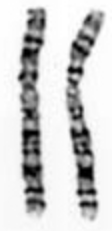
What is the gender of the individual whose karyotype is seen in the image?
a)
Male
b)
Female
99.
The results of the karyotype indicate that an individual has 3 chromosome #21. Which of the following genetic disorders do they have?
a)
Edwards Syndrome
b)
Patau's Syndrome
c)
Down's Syndrome
d)
Klinefelter's Syndrome
100.

Based on the karyotype, what is the sex of this baby?

a)

Male

b)

Female

101.
A pair of identical chromosomes shown in a karyotype, one inherited from mom, and one inherited from dad are called
a)
sister chromotids
b)
centromeres
c)
homologous chromosomes
d)
autosomes
102.
Which would be considered a somatic cell?
a)
Sperm cell
b)
Egg Cell
c)
Skin Cell
d)
All of these
103.
Which of the following would be considered a Gamete cell?
a)
Egg Cell
b)
Sperm Cell
c)
Both of these
d)
None of these
104.
Nondisjunction can result in 
a)
trisomy conditions
b)
monosomy conditions
c)
additional sex chromosomes
d)
all of these
105.
When chromosomes fail to separate correctly during anaphase of meiosis, what can occur?
a)
extra chromosomes are found in the sex cell
b)
chromosomes of the sex cell are doubled
c)
chromosomes of the sex cell are halved
d)
meiosis never completes
106.

What would you call the failure of one or more pairs of homologous chromosomes or sister chromatids to separate normally during meiosis?

a)

nondisjunction

b)

anaphase I

c)

nondiploidy

d)

karyotype

107.

A karyotype is:

a)

A tool scientists use to analyze chromosomes

b)

A tool scientists use to predict the potential genotypes / phenotypes of offspring

c)

A tool scientist use to identify genes in the human genome

d)

A tool scientists use to identify criminals & find relatives

108.

Monosomy:

a)

Missing 1 chromosome

b)

3 chromosomes (instead of a pair)

c)

Chromosomes are normal

109.

Trisomy:

a)

Missing 1 chromosome

b)

3 chromosomes (instead of a pair)

c)

Chromosomes are normal

110.
Chromosome pairs 1-22 are referred to as
a)
sex chromosomes
b)
sister chromatids
c)
a karyotype
d)
autsomes
111.
What makes this individual's karyotype not normal?
a)
An extra sex chromosome
b)
An extra autosome
c)
A missing sex chromosome
d)
A missing autosome
112.

SELECT ALL THAT APPLY: Autosomes:

a)

Pair #23

b)

Determine whether you're male / female

c)

Pairs #1-22

d)

Every chromosome except sex chromosomes

113.
The physical appearance of an organism based on traits
a)
Genotype
b)
Phenotype
c)
Meiosis
d)
Genetics
114.
Hair colour is an example of
a)
genotype
b)
phenotype
115.
Having the genes for baldness is an example of
a)
genotype
b)
phenotype
116.
How tall you are is an example of
a)
genotype
b)
phenotype
117.
Being a carrier of a genetic disorder is an example of
a)
genotype
b)
phenotype
118.
Having blue eyes is an example of
a)
genotype
b)
phenotype
119.
Having the genes for blue eyes is an example of
a)
genotype
b)
phenotype
120.
Having genes that make you more likely to be good at sprinting is an aspect of
a)
genotype
b)
phenotype
121.
Usain Bolt trains daily to improve his muscular explosiveness. Muscle size is an example of
a)
genotype
b)
phenotype
122.
Usain Bolt's genes affect his height. Being 1.95m tall is an example of
a)
genotype
b)
phenotype
123.
The genotype of:  bb   will have the PHENOTYPE of...
a)
black fur
b)
white fur
c)
course hair
d)
fine hair
124.
The genotype of:  Bbll  will have the PHENOTYPE of...
a)
black fur/short tail
b)
black fur/long tail
c)
white fur/short tail
d)
white fur/long tail
125.
Homozygous Course Hair / Heterozygous Black hair
a)
HHBb
b)
hhBb
c)
HhBb
d)
Hhbb
126.

Physical characteristics, or visible traits of an organism

a)

phenotype

b)

genotype

c)

trait

127.

Two identical alleles for the same trait.

a)

Heterozygous

b)

Homozygous

c)

Dominant

128.

Two different alleles for the same trait.

a)

Heterozygous

b)

Homonzygous

c)

Dominant

129.

The Alleles bb are

a)

Heterozygous

b)

Homozygous Dominant

c)

Homozygous Recessive

130.

The allelles BB are

a)

Heterozygous

b)

Homozygous Recessive

c)

Homozygous Dominant

131.

The Alleles Bb are

a)

Homozygous

b)

Heterozygous

c)

Homozygous Dominant

132.
R = tongue rolling, r = no tongue rolling. An individual who is Rr can roll their tongue.  What type of inheritance pattern does this follow?
a)
Complete Dominance
b)
Incomplete Dominance
c)
Co-Dominance
d)
Sex-linked
133.
If you cross a heterozygous tongue roller and a non-tongue roller, what are the chances of having children who can roll their tongue?
a)
100%
b)
75%
c)
50%
d)
25%
134.
What type of inheritance pattern is shown here?
a)
Complete Dominance
b)
Incomplete Dominance
c)
Co-Dominance
d)
Sex-linked
135.
If a man with straight hair marries a woman with curly hair, all of their children have wavy hair.  What type of inheritance pattern does this follow?
a)
Complete Dominance
b)
Incomplete Dominance
c)
Co-Dominance
d)
Sex-linked
136.
If you cross a red snapdragon with a white snapdragon, only pink snapdragons will be produced.  What type of inheritance pattern does this follow?
a)
Complete Dominance
b)
Incomplete Dominance
c)
Co-Dominance
d)
Sex-linked
137.
Which type of inheritance pattern causes a heterozygote to have an intermediate trait?
a)
Complete Dominance
b)
Incomplete Dominance
c)
Co-Dominance
d)
Sex-linked
138.
Which type of inheritance causes both traits to be expressed equally in the heterozygote?
a)
Complete Dominance
b)
Incomplete Dominance
c)
Co-Dominance
d)
Sex-linked
139.

A man with type O blood is accused of being the father of a type B baby. The mother is type A. Could this man be the father?

a)

Yes

b)

No

c)

Maybe

140.

What is the definition of Phenotype?

a)

The diagram that shows all the chromosomes of an individual

b)

The combination of alleles that control that an individual has for a particular trait

c)

How many genes on one chromosome

d)

How a trait is expressed (what it looks like or what it does)

141.

Which of the following statements are TRUE? (3)

a)

An allele is a form of a gene

b)

Dominant alleles are represented by uppercase letters

c)

You need two recessive alleles to have a recessive trait

d)

Homozygous is when two chromosomes with similar traits line up side by side on the spindle during Metaphase II

e)

You can inherit two forms a gene from your mom, and two forms of the same gene from your dad

142.
B = brown fur  b = white fur
In the punnett square, what is the probability for white fur? 
a)
0%
b)
25%
c)
50%
d)
75%
143.
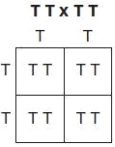
In the punnett square shown, what must the genotype of the missing parent be?
a)
BB
b)
Bb
c)
bb
d)
Tt
144.
In the punnett square shown, what is the genotypes of the two parents?
a)
RW and RR
b)
RW and WW
c)
RR and WW
d)
RW and RR
145.
This image shows a...
a)
Punnett Square
b)
Phenotype
c)
Genotype
d)
Dominant allele
146.
Which of the following genotypes is heterozygous?
a)
Bb
b)
BB
c)
bb
d)
B
147.
What is the probability of a purple-horned unicorn if a heterozygous pink-horned unicorn is crossed with a heterozygous pink-horned unicorn?
a)
0%
b)
25%
c)
50%
d)
75%
148.
What ratio of the offspring from the cross shown will be homozygous recessive for the  trait of tallness? 
a)
0 in 4
b)
1 in 4
c)
2 in 4
d)
4 in 4
149.
In the punnett square shown, what must the genotype of the missing parent be?
a)
BB
b)
Bb
c)
bb
d)
Tt
150.
In the punnett square shown, what are the genotypes of the two parents?
a)
RW and RR
b)
RW and WW
c)
RR and WW
d)
RW and RR
151.

A male is blood type B (his mom was type O) marries a woman that is type AB. What are the possible genotypes from this cross?

a)

BB, AB, Bo, Ao

b)

Bo, Ao

c)

BB, AB, Ao

152.

Punnett Square: Type AB father and type O mother. What are the percentages of each offspring?

a)

Type A: 50%, Type B 0%, Type AB 50%, Type 0 0%

b)

Type A: 50%, Type B 50%, Type AB 0%, Type 0 0%

c)

Type A: 25%, Type B 25%, Type AB 25%, Type 0 25%

d)

Type A: 0%, Type B 0%, Type AB 50%, Type 0 50%

153.

Mrs. Canal is type A and Mr. Canal is type O. They have three children named Greg, Rosalind and Biff. Greg is type 0, Rosalind is type A and Biff is type AB...

What is Mr. Canal's Genotype?

a)

IᴬIᴬ

b)

IᴮIᴮ

c)

IᴬIᴮ

d)

ii

154.

Mrs. Canal is type A and Mr. Canal is type O. They have three children named Greg, Rosalind and Biff. Greg is type 0, Rosalind is type A and Biff is type AB...

What is Mrs. Canal's genotype? How do you know?

a)

IᴬIᴬ , because Rosalind is A

b)

Iᴮi because Biff is AB

c)

Iᴬi because Greg is type O

d)

ii because it is a universal donor

155.

Mrs. Canal is type A and Mr. Canal is type O. They have three children named Greg, Rosalind and Biff. Greg is type 0, Rosalind is type A and Biff is type AB...

Can BIFF be there son? Explain

a)

Yes because he has a portion of A in his blood like his mom

b)

Yes because his dad is type O and that is a universal donor

c)

No because his sister is type A blood

d)

No because neither parent has the B allele

156.

Two parents think their baby was switched at the hospital. The mother has blood type O, the father has blood type AB and the baby has blood type B.

Complete a punnett square and then answer the question. Was the baby switched at birth? (Do they have a baby that is not theirs? )

a)

No, the baby is type B which is possible when Dad is AB

b)

No, the baby is theirs - it has type B just like the mom

c)

Yes - neither parent is type B so it must have been switched

157.
What is NOT a possible genotype for someone with type B blood?
a)
IBIB
b)
IAIB
c)
IB i
158.

In the image above, what is the percentage of the offspring has the possibility of inheriting blood type O?

a)

0%

b)

25%

c)

50%

d)

100%

159.

Biological sex is determined by the

a)

father

b)

mother

160.
Autosomes are
a)
chromosomes found in autotrophs, only
b)
chromosomes that automatically correct all errors in the DNA
c)
chromosomes that determine traits other than sex
d)
chromosomes that determine the sex of the individual
161.
The structure that holds two chromosomes together until they separate for cell division is the
a)
chromatid
b)
chromatin
c)
centromere
d)
cytoplasm
162.

Determine the sex of an individual and are represented by XX or XY

a)

sex chromosomes

b)

autosomes

c)

somatic cells

d)

diploid cells

163.

An organism's reproductive cells, sperm and egg cells, are called _____.

a)

bacteria

b)

prokaryotes

c)

gametes

d)

pathogens

164.

The 2 female sex chromosomes are ___.

a)

XY

b)

XX

165.

The 2 male sex chromsomes are _____.

a)

XY

b)

XX

166.
Albinism is a recessive genetic disorder.  An individual who has two recessive alleles will be albino; while an individual with one dominant allele will not. What is the definition of a recessive genetic disorder? 
a)
One copy of an abnormal gene must be present for the disease or trait to develop. 
b)
 Two copies of an abnormal gene must be present in order for the disease or trait to develop?
167.
If a recessive genetic disorder mean that you need 2 abnormal alleles to express the disorder.  What dose a dominant genetic disorder mean?
a)
An individual only needs 1 abnormal allele to express the disorder. 
b)
An individual needs 2 abnormal alleles to express the disorder. 
c)
An individual will never express the disorder.
d)
An individual needs 3 abnormal alleles to express the disorder. 
168.
What is a carrier? 
a)
An individual is heterozygous for a dominant recessive genetic disorder.
b)
An individual is homozygous for a recessive genetic disorder. 
c)
An individual is heterozygous for a recessive genetic disorder. 
d)
An individual is homozygous for a dominant genetic disorder. 
169.
Can an individual be a carrier for a dominant  genetic disorder. 
a)
Yes 
b)
No
170.

Colorblindness is more common in males than in females because......

a)

fathers pass the allele for colorblindness to their sons only

b)

the allele for colorblindness is located on the Y chromosome

c)

the allele for colorblindness is recessive and located on the X chromosome

d)

males who are colorblind have two copies of the allele for colorblindness

171.

Males are more likely to suffer from a sex-linked disease or disorder because...

a)

males are the weaker sex

b)

males have less DNA

c)

males have 1 X chromosome, so the disorder is more likely to be expressed

d)

females are the stronger sex

172.
What kind of trait is colorblindness if females can be carriers without having the disease?
a)
Regular trait
b)
Sex-linked trait
c)
Co-dominant
d)
Incomplete dominant
173.
Which gender can be carriers of colorblindness and not have it?
a)
Just males
b)
Just females
c)
Both genders
d)
Neither gender is a carrier
174.
The sex of a child is determined by
a)
whether the father's sperm contains an x or y chromosome
b)
whether the mother's egg contains an x or y chromosome
c)
the age of the parents
175.
An individual's sex is determined by 
a)
1 of 23 chromosomes
b)
2 of 46 chromosomes
c)
4 of 92 chromosomes
176.
Why is the gene for a disease or disorder more likely to be found on the X chromosome than Y?
a)
The X chromosome has many more genes
b)
The Y chromosome has many more genes
177.
When we say that a woman is a carrier for a genetic disease or disorder it means that
a)
she has 1 gene, but not the disorder
b)
she has 2 genes for the disorder
c)
she can pass the gene only to male children
d)
she can pass the gene only to female children
178.
Why are men 16 times more likely to be color-blind than women?
a)
to be color-blind, you must have a Y chromosome
b)
to be color-blind, all of your X chromosomes must have the gene
c)
color-blindness is caused by testosterone
d)
color-blindness is caused by the same gene as baldness
179.
If a gene is found only on the X chromosome and not the Y chromosome, it is said to be 
a)
sex-linked trait
b)
polygenic trait
c)
codominant trait
d)
incomplete dominance trait
180.

Males can be heterozygous for sex-linked traits.

a)

True

b)

False

181.
What does a filled in square represent?
a)
Not affected Female
b)
Not affected Male
c)
Affected Male
d)
Affected Female
182.
How many generations are shown in this pedigree?
a)
1
b)
2
c)
3
d)
4
183.
How many kids did the mother and father from the first generation have?
a)
2
b)
4
c)
5
d)
6
184.
This pedigree represents the inheritance of hemophilia in this family. How many of the females have the hemophilia trait?
a)
8
b)
5
c)
2
d)
3
185.
What do half colored symbols represent?
a)
The individual is a carrier (heterozygous).
b)
The individual expresses the trait.
c)
The individual has both recessive alleles.
d)
The individual has both dominant alleles.
186.
What does an open circle represent?
a)
Not Affected Male
b)
Not Affected Female
c)
Affected Male
d)
Affected Female
187.
Is this trait (the shaded individuals) dominant or recessive?
a)
dominant
b)
recessive
188.
In the second generation-how many people are carriers of the trait?
a)
2
b)
3
c)
5
d)
6
189.
How many people in this whole pedigree have the trait/disease?
a)
2
b)
3
c)
4
d)
6
190.
How many females are in this pedigree?
a)
3
b)
4
c)
6
d)
7
191.
What is this?
a)
Pedigree
b)
Karyotype
c)
Venn diagram
d)
Punnett Square
192.

In this pedigree, which gender can be carriers of colorblindness and not have it?

a)

Just males

b)

Just females

c)

Both genders

193.
If a trait SKIPS a generation, it is an indication that the trait is....
a)
dominant
b)
recessive
c)
incompletely dominant
d)
co-dominant
194.
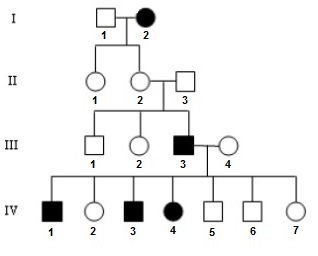
If this pedigree shows an autosomal recessive disorder, what MUST the genotype of individual II-3 be?
a)
HH
b)
Hh
c)
hh
d)
None of the above
195.

Individuals that are shaded in have premature hair whitening. Is this trait dominant or recessive? How do you know?

a)

Dominant because it skips generations

b)

Dominant because it is present in every generation

c)

Recessive because it skips generations

d)

Recessive because it is present in every generation.

196.

In this pedigree, the shading represents people in the family with dark hair while the unshaded represents blondes. Is dark hair controlled by a dominant or recessive allele?

a)

Dominant

b)

Recessive