wayground logo

Free Printable Worksheets

Font size

S
M
L
XL
Worksheets

Energy Review

Total questions: 42

Worksheet time: 1hrs 4mins

Name
Class
Date
1.
Which situation is work not done?
a)
lifting a 20 pound box off the floor
b)
holding a 20 pound box above the floor
c)
sliding a 20 pound box across the floor
d)
sliding a 20 pound box up an inclined plane
2.
If you push a cart with a force of 60 N for 2 m, how much work have you done?
a)
120 J
b)
30 J
c)
120 N 
d)
30 N
3.
Both work and energy are measured in 
a)
joules
b)
newtons
c)
meters
d)
seconds
4.
What is work?
a)
Force x Distance
b)
Force / Distance
c)
Distance / Force
d)
Force + Distance
5.
The net work done by a net force acting on an object is equal to the change in the kinetic energy of the object.
a)
Force-Work Theorem
b)
Work-Kinetic Energy Theorem
c)
Force-Kinetic Energy Theorem
d)
Work-Force Theorem
6.

What is the ΔKE of a baseball hit with a force of 6000 N that travels 120 m across the field?

a)

6000J

b)

43560000J

c)

720000J

d)

50J

7.

A 10.0 kg box is accelerated from 2.0 m/s to 4.0 m/s. What is the amount of work needed to accelerate the box?

a)

50 J

b)

60 J

c)

20 J

d)

45 J

8.

A 12 kg book is pushed from rest to a final velocity of 10 m/s. The book travels 6 m. How much force was the book pushed with?

a)

600 N

b)

100 N

c)

200 N

d)

1200 N

9.
Which of these is a measurement of power?
a)
100 joules
b)
100 watts
c)
100 meters per second
d)
100 hertz
10.
When is positive work done?
a)
When an object moves in the same direction as its force.
b)
When an object moves in the opposite direction as its force.
c)
When a force causes the object to move more quickly.
d)
When an object stops moving.
11.
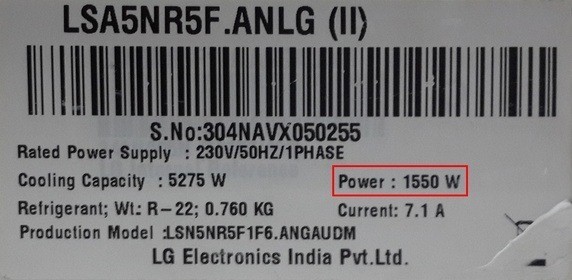
A microwave has a power rating of 1550 W. How much energy does it transfer per second?
a)
1.550 Joules
b)
15.50 Joules
c)
155.0 Joules
d)
1550 Joules
12.
A kettle transfers 1000J of energy every 2 seconds. Calculate its power.
a)
2000 Watts
b)
1000 Watts
c)
500 Watts
d)
cannot be determined
13.

What is potential energy?

a)

moving energy

b)

stored energy

c)

renewable energy

d)

non renewable energy

14.

What is kinetic energy?

a)

moving energy

b)

potential energy

c)

stored energy

d)

renewable energy

15.
What is energy transformation?
a)
a change of energy from one form to another
b)
when energy gets more energy added to it
c)
when energy gets destroyed
d)
a change in intensity
16.

What type of energy does a rock have when it is sitting at the edge of a cliff.

a)

Potential

b)

Kinetic

17.
As a pendulum swings from its highest to lowest position, what happens to its kinetic and potential energy? 
a)
Both the potential energy and kinetic energy decrease
b)
The potential energy decreases while the kinetic energy increases 
c)
The kinetic energy decreases while the potential energy increases 
d)
Bothe the potential energy and kinetic energy increase 
18.

At which point of the roller coaster is potential energy the greatest?

a)

W

b)

X

c)

Y

d)

Z

19.
Which point has the greatest kinetic energy?
a)
W
b)
X
c)
Y
d)
Z
20.
What is happening to the energy of the girl from point A to point B
a)
kinetic changes to potential
b)
potential changes to kinetic
c)
energy is lost
d)
energy is gained
21.
Why won't the roller coaster reach over the second hill?
a)
because it is going slow
b)
because energy cannot be created
c)
because it is going fast
d)
because energy cannot be destroyed
22.
Which point has greatest kinetic energy?
a)
A
b)
B
c)
C
d)
none
23.
When a pendulum swings, at which point is kinetic energy highest?
a)
1
b)
2
c)
3
d)
4
24.
When a pendulum swings, at which point is potential energy at its greatest? (assume there is no friction)
a)
1 and 5
b)
2 and 4
c)
d)
4 and 5
25.
What is the mass of a moving object that has 100 Joules of KE and moves at a velocity of 2 m/s?
a)
50 kg
b)
200 kg
c)
25 kg
d)
100 kg
26.
How much KE does a moving 6 kilogram object have if it moves with a velocity of 3 m/s?
a)
27 J
b)
18 J
c)
9 J
d)
2 J
27.

How could you increase the gravitational potential energy of an object without changing its mass and gravity?

a)

Make the object larger

b)

Lower the object towards the ground

c)

Raise the object farther off the ground

d)

Allow the object to roll on the ground

28.

Which would have the LEAST gravitational potential energy (GPE)?

a)

A ball sitting on the ground

b)

Moon viewed from the Earth

c)

An airplane flying 30,000 feet above the ground

d)

A rock sitting on top of Mt. Everest

29.

What is the gravitational potential energy of an 85 kg mountain climber at the summit of a 6267 m volcano?

Let g = 9.8N/kg

a)

5,220,411 J

b)

532,695 J

c)

73.7 J

d)

54,356.6 J

30.

What is the gravitational potential energy of a 26 kg eagle, flying at an altitude of 65 m at a speed of 19 m/s?

Let g = 9.8N/kg

a)

32,110 J

b)

1690 J

c)

172.4 J

d)

16,562 J

31.

An Olympic high jumper, with a mass of 82 kg, has a maximum gravitational potential energy of 1970 J. How high was the jump?

Let g = 9.8N/kg

a)

24 m

b)

161,540 m

c)

2.5 m

d)

201 m

32.
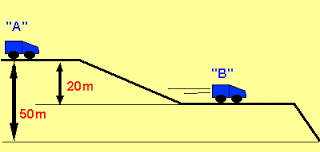
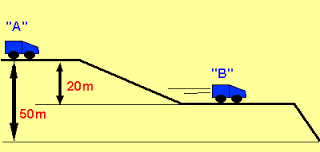
In diagram 2, if the mass of the car is 600 kg, what is the change in potential energy from point A to point B?
a)
411,600 J
b)
294,000
c)
176,400 J
d)
117,600 J
33.
In diagram 2, if the 600 kg cart is initially at rest, what is its velocity at point B?
a)
19.8 m/s
b)
15.0 m/s
c)
10.3 m/s
d)
3.8 m/s
34.

1. A ball has a 17 J of kinetic energy and its mechanical energy is 25 J. If the ball has a mass of 3.2 kg, what is its height above the ground?

a)

0.26 m

b)

0.52 m

c)

5.2 m

d)

25 m

35.
A 40 kg crate is picked up by a crane to a height of 50m. The crate falls. What is the velocity of the crate just before it hits the ground?
a)
2000 Joules
b)
19,600 Joules
c)
19,600 m/s
d)
31.3 m/s
36.
A 2.5 kg ball moving at 4.2 m/s collides with a 2.5 kg stationary ball. If the first ball is at rest after the collision, what is the velocity of the second ball? 
a)
2.1 m/s
b)
2.5 m/s
c)
4.2 m/s
d)
8.4 m/s
37.
When is momentum conserved in a collision?
a)
When the collision is inelastic.
b)
When the collision is elastic.
c)
When the collision is inelastic OR elastic but never an explosion.
d)
All collisions.
38.

What is an inelastic collision?

a)

When two objects collide, becoming stuck together and internal kinetic energy is lost (but not really lost, it transfers to different forms of energy)

b)

When two objects collide, becoming stuck together and internal kinetic energy is lost

c)

When two objects don't collide, becoming stuck together and internal kinetic energy is lost (but not really lost, it transfers to different forms of energy)

39.

2 balls collide and bounce off of each other. During the collision total momentum remained constant and total kinetic energy remained constant. What type of collision is this?

a)

Inelastic Collision

b)

Elastic Collision

c)

Perfectly Inelastic Collision

d)

No collision occurred

40.

A BMW rear ends a car at the stop light. Neither car sticks together. The momentum was conserved in the collision but the kinetic energy was not conserved. What type of collision is this?

a)

Elastic Collision

b)

Inelastic Collision

c)

Perfectly inelastic Collision

d)

No Collision

41.

A piece of silly putty is dropped onto a skateboard as it rolls by. The putty sticks to the skateboard and moves the direction the board is moving. What type of collision is this?

a)

Inelastic collision

b)

Elastic Collision

c)

Perfectly Inelastic collision

d)

No collision

42.

Joe is trying to tackle Carson while Carson is standing still. Joe is running at 15 m/s and has a mass of 32 kg. Carson has a mass of 64 kg. What is their final velocity, assuming this is a perfectly inelastic collision? (do not write units)

(a)